


The Department of Home Affairs requires certified translations so case officers can reliably verify identity, qualifications, and legal facts without needing to independently re-check every translator’s work. If any document in your visa application is not in English, you must attach an accepted certified translation before you lodge. No exceptions, no workarounds.
Here is what that means in practice:
- Every non-English document must be accompanied by an English translation when lodged with the Department of Home Affairs.
- In Australia, that translation must come from a NAATI-credentialled translator (NAATI stands for the National Accreditation Authority for Translators and Interpreters).
- Submitting uncertified or self-translated documents is one of the most common causes of processing delays and, in some cases, visa refusal.
- Certitranslate provides NAATI-credentialled certified translations for immigration, legal, and personal documents across more than 120 languages.
The rest of this guide explains the policy rationale, the document types affected, what a valid certified translation looks like, and how to avoid the mistakes that stall applications.
Table of Contents
- Which documents need certified translation for an Australian visa?
- Who can provide an accepted certified translation in Australia?
- What makes a translation ‘certified’ for Home Affairs?
- What happens if you submit uncertified or incorrect translations?
- How does the Department of Home Affairs verify certified translations?
- How to avoid translation problems before you submit
- Typical costs and turnaround for certified translations in Australia
- How to get a DHA-acceptable certified translation, step by step
- Key takeaways
- The thing most applicants get wrong about certified translations
- Certitranslate: NAATI-credentialled translations for your visa application
- Useful sources and further reading
Which documents need certified translation for an Australian visa?
Most applicants are surprised by how many documents fall into this category. The rule is straightforward: if it is not in English and it supports your application, it needs a certified translation.
| Document type | Notes |
|---|---|
| Birth certificate | Full document; translate all fields including issuing authority stamps |
| Marriage or divorce certificate | Full document; include any court seals or annotations |
| Police clearance / criminal record check | Full document; translate issuing authority header and any stamps |
| Passport biographical page | Usually sufficient; full passport required when entry/exit stamps are relevant |
| Academic transcripts and qualifications | Full document; translate institution name, grading scale, and any seals |
| Financial statements or bank records | Full document; translate column headers, institution name, and any official stamps |
| Legal documents (contracts, court orders, powers of attorney) | Full document; every clause, annotation, and seal must be translated |
| Medical records | Full document; translate diagnoses, medications, and issuing practitioner details |
For multi-page documents, upload both the original and the translation together into ImmiAccount. Uploading the translation without the original is a common mistake that prompts case officer queries. When passport entry and exit stamps are relevant to your visa subclass, translate those pages too, not just the biographical page.
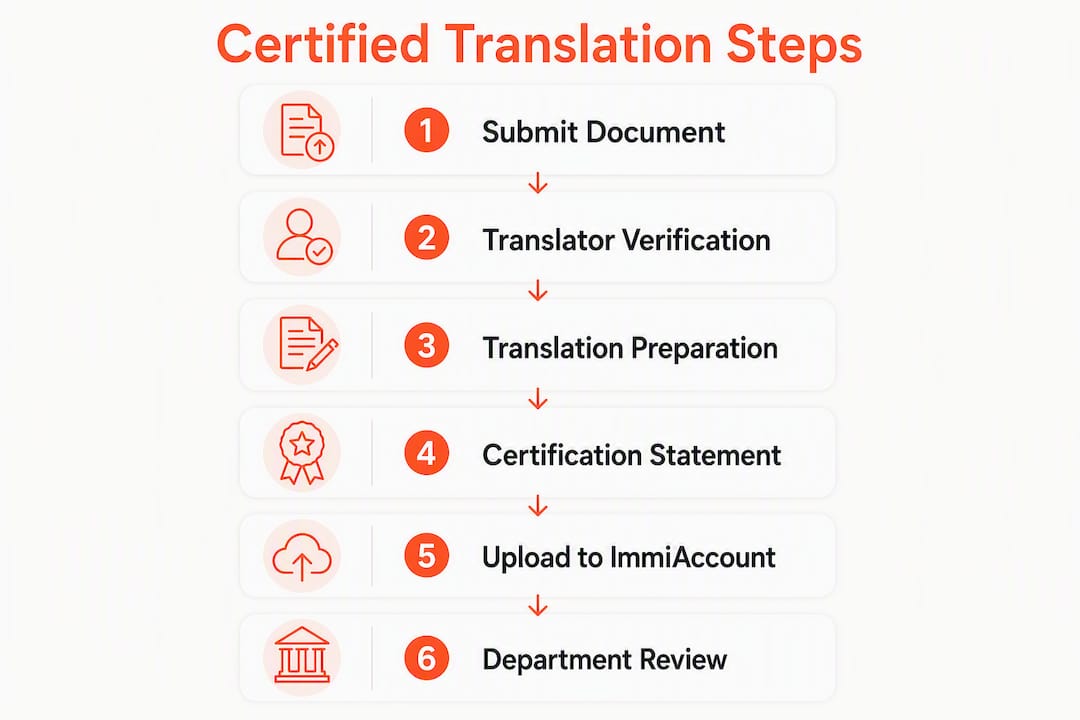
DHA sometimes asks for certified copies of originals rather than the originals themselves. When in doubt, submit the original document alongside the translation and let the case officer confirm what they need.
Who can provide an accepted certified translation in Australia?
Onshore translations: NAATI credentials required
For translations completed in Australia, the translator must hold a current NAATI credential. NAATI is the national standards body for translators and interpreters; its credentialling process tests linguistic competence, professional ethics, and intercultural knowledge. A translation signed by someone without a current NAATI credential is not considered certified for DHA purposes, regardless of how qualified that person may otherwise be.

You can confirm a translator’s current status through the NAATI Online Directory, which is publicly searchable by name or practitioner number.
Offshore translations: verifiable details required
If you are applying from outside Australia, a translation completed overseas can still be acceptable, provided the translator supplies full, verifiable details in English, including their name, qualifications, contact information, and the languages they work in. The safest approach, even from offshore, is to use an Australia-based NAATI practitioner when possible.
What is not accepted
- Self-translations, even if you are fluent in both languages
- Translations by an uncertified freelancer without verifiable credentials
- Translations signed by a practitioner whose NAATI credential has expired
- Machine translations, with or without a human signature attached
Pro Tip: Before you order, search the NAATI Online Directory for your translator’s practitioner number and confirm the language direction listed matches the language pair in your document. A mismatch between the listed direction and the document’s language is enough to trigger a query.
| Translator type | Accepted for DHA? | Condition |
|---|---|---|
| NAATI-credentialled translator (Australia) | Yes | Current credential, matching language direction |
| Offshore translator with full verifiable details | Conditionally | Must supply name, qualifications, and contact info in English |
| Self-translation | No | Never accepted |
| Uncertified freelancer | No | No verifiable credentials |
| Expired NAATI credential | No | Credential must be current at time of translation |
What makes a translation ‘certified’ for Home Affairs?
A certified translation is not just a translated document. It is a translated document accompanied by a formal declaration from the translator. Without that declaration, the translation carries no verifiable authority.
A valid translator declaration for DHA purposes must include:
- Translator’s full name as it appears on their NAATI credential
- NAATI practitioner number (for Australia-based translators)
- Language direction (e.g. “from Vietnamese into English”)
- Date the translation was completed
- A certification statement confirming the translation is accurate and complete to the best of the translator’s knowledge and ability
- Translator’s signature
- Contact details (phone or email, so a case officer can follow up if needed)
Layout fidelity matters too. A well-prepared certified translation mirrors the structure of the original: headings appear where headings appeared, tables where tables appeared. Stamps, seals, and handwritten annotations must be described in English rather than left as blank spaces or marked “illegible.” A missing or incomplete declaration is one of the most frequent reasons case officers raise queries.
A typical certification statement reads something like: “I, [full name], NAATI Practitioner Number XXXXXXX, certify that I am competent to translate from [language] into English and that the above translation is a true and accurate translation of the original document.”
That statement, signed and dated, is what transforms a translated document into a certified one.
What happens if you submit uncertified or incorrect translations?
The consequences range from inconvenient to serious, depending on the visa subclass and the stage of processing.
- Request for further information (RFI): The most common outcome. A case officer puts the file on hold and asks you to resubmit with a compliant translation. This adds weeks to processing time.
- Processing delay: Even a minor query can push your application to the back of the queue, particularly for high-volume visa subclasses where officers process files in strict date order.
- Identity verification problems: Inconsistent name spellings across translated documents, for example “Nguyen Van An” in one translation and “Van An Nguyen” in another, create doubt about whether the documents belong to the same person. This is a surprisingly common trigger for RFIs.
- Visa refusal: In cases where the translation deficiency is significant or the applicant has already been given an opportunity to correct it, refusal is possible.
Submitting uncertified or self-translated documents is a documented cause of processing delays and refusals. Stamps and seals left untranslated are another frequent problem. Case officers cannot simply assume a stamp is a standard issuing authority mark; they need the English description to make that determination.
The cost of fixing a rejected translation, including reordering, resubmitting, and potentially paying a new application fee, almost always exceeds the cost of getting it right the first time.

How does the Department of Home Affairs verify certified translations?
The policy rationale sits in the Australian Government Language Services Guidelines, which direct government agencies to engage NAATI-credentialled practitioners to ensure accurate communication and equitable access to services. The guidelines also note that NAATI credentialling includes ethical and intercultural competence assessment, which supports agencies’ obligation to provide accessible services and mitigate risk.
In practical terms, a case officer verifying a translation does not need to speak the source language. They check the declaration for the translator’s name, NAATI practitioner number, and language direction, then confirm those details against the NAATI Online Directory. If the number is valid, the language direction matches, and the declaration is complete, the translation clears that checkpoint.
| Verification step | What the case officer checks |
|---|---|
| Declaration completeness | Name, NAATI number, language direction, date, statement, signature, contact |
| NAATI directory lookup | Practitioner number is current and matches the stated language direction |
| Layout and annotation fidelity | Stamps, seals, and handwritten notes are described in English |
| Name consistency | Applicant’s name is spelled consistently across all translated documents |
This system works because NAATI credentials carry a built-in code of ethics and a renewal requirement. A practitioner who produces inaccurate translations risks losing their credential. That accountability is what allows DHA to trust the credential rather than independently verify every word of every translation.
How to avoid translation problems before you submit
Work through this checklist before you lodge your application.
- Identify every non-English document early. Go through your document list before you order anything. Missing one document and having to reorder mid-processing is a common delay.
- Keep name spellings consistent. Decide on one romanisation of your name and give it to every translator in writing. Inconsistencies across documents are a leading cause of identity queries.
- Upload originals with translations. Always upload the original foreign-language document alongside the English translation in ImmiAccount. Never upload the translation alone.
- Confirm current NAATI status. Check the NAATI Online Directory before you order, not after you receive the translation.
- Translate stamps, seals, and annotations. Do not leave these blank. Every official mark on the original must have an English description in the translation.
- Avoid extract translations. Unless a case officer has specifically asked for a summary, submit a full translation of the document. Partial translations of legally significant documents frequently trigger queries.
File and submission tips
Combine the original and translation into a single PDF per document where ImmiAccount allows it. Use clear filenames such as “BirthCertificate_Original_Translation.pdf” rather than “scan001.pdf.” Scan in colour at a resolution high enough to read handwriting and stamps clearly; blurry scans of stamps are a known trigger for requests.
Pro Tip: Keep the translator’s contact details and the translation cover page saved separately. If a case officer contacts you about a translation months after lodgement, having that information ready means you can respond in hours rather than days.
Typical costs and turnaround for certified translations in Australia
Pricing and turnaround vary considerably. The main factors are language rarity, document length, layout complexity, and whether you need a rush service.
| Factor | Effect on cost and time |
|---|---|
| Common language pairs (e.g. Mandarin, Arabic, Spanish to English) | Lower cost, faster turnaround; more practitioners available |
| Rare language pairs (e.g. Tigrinya, Dzongkha) | Higher cost, longer lead time; fewer credentialled practitioners |
| Document length and complexity | Longer or technically complex documents cost more and take longer |
| Stamps, seals, and annotations | Add time; each element must be described accurately in English |
| Rush or same-day service | Available from some providers at a premium |
For applicants who qualify, TIS National’s Free Translating Service allows some new permanent residents and eligible visa holders to have some eligible documents translated within a limited period after their visa grant. This is worth checking before you pay for translations if you have recently been granted permanent residency.
Order translations as early as possible in your application preparation. Waiting until the day before lodgement and discovering a rare language pair has a two-week lead time is a preventable problem. For most common languages, standard turnaround from a provider like Certitranslate is one to three business days; rare languages or complex documents may take longer.
How to get a DHA-acceptable certified translation, step by step
- Gather your original documents. Collect every non-English document your visa subclass requires. Check the DHA website for the specific document list for your visa type.
- Scan in colour at high resolution. Every page, including the back if it contains information, stamps, or seals. Blurry or cropped scans delay the translator and can result in incomplete translations.
- Brief the translator clearly. Tell them the language, the country of issue, which sections are required (usually the full document), and your preferred name romanisation. If you have previous translations, send those too so name spellings stay consistent.
- Confirm NAATI credentials before ordering. Check the NAATI Online Directory for the practitioner number and language direction.
- Review the finished translation. When you receive the translation, check that the declaration includes the translator’s full name, NAATI practitioner number, language direction, date, certification statement, signature, and contact details. Confirm your name is spelled the same way across all translations.
- Check that stamps and seals are described. Every official mark on the original should have a corresponding English description in the translation.
- Combine and upload. Merge the original and translation into one PDF per document where possible. Upload to ImmiAccount using clear, descriptive filenames.
For a detailed walkthrough of the immigration document translation process, including what to include in your translator brief and how to package files for ImmiAccount, Certitranslate’s guide covers each step.
- Send the translator the full original scan, not a photo taken on a phone at an angle.
- Include any context that affects terminology (e.g. “this is a police clearance from Vietnam, not a court order”).
- Ask for the NAATI practitioner number in writing before you pay.
Key takeaways
Every non-English document in an Australian visa application must be accompanied by a certified English translation from a NAATI-credentialled translator, uploaded alongside the original in ImmiAccount.
| Point | Details |
|---|---|
| All non-English documents need translation | Every supporting document not in English must have a certified English translation before lodgement. |
| NAATI credentials are mandatory in Australia | Only use a translator with a current, verifiable NAATI credential for onshore translations. |
| Upload originals with translations | Always attach the original foreign-language document alongside the translation in ImmiAccount. |
| Stamps and seals must be translated | Every official mark on the original needs an English description; blank spaces trigger case officer queries. |
| Certitranslate for immigration files | Certitranslate provides NAATI-credentialled certified translations across 120+ languages with immigration-focused checks. |
The thing most applicants get wrong about certified translations
There is a widespread assumption that “certified translation” is mainly about language accuracy. Get the words right, and you are fine. In practice, the declaration is at least as important as the translation itself.
A case officer reviewing a file is not a linguist in every language pair they encounter. What they can assess is whether the declaration is complete, whether the NAATI number checks out, and whether the name spellings are consistent across documents. A beautifully accurate translation with a missing practitioner number or an unsigned declaration will still generate a query. Conversely, a translation with a complete, verifiable declaration from a credentialled practitioner carries institutional trust that no amount of informal accuracy can replicate.
The other thing applicants consistently underestimate is the stamps and seals issue. Leaving a stamp blank or writing “official stamp” without describing what it says is not a neutral act. It creates a gap in the evidentiary record that a case officer has to flag. Describing a stamp as “Issued by the People’s Committee of Hanoi, Department of Justice, 14 March 2019” takes thirty seconds and closes that gap permanently.
The NAATI framework exists precisely because DHA cannot employ linguists in every language pair. The credential is a proxy for trust, and understanding that changes how you approach the whole process. It is not bureaucratic box-ticking. It is the mechanism by which a case officer in Canberra can make a reliable decision about a document issued in Addis Ababa.
Certitranslate: NAATI-credentialled translations for your visa application
Getting your translations right the first time is the single most controllable factor in how quickly your visa application moves. Certitranslate works with NAATI-credentialled translators across more than 120 languages, with a specific focus on immigration files: consistent name registers across documents, full translation of stamps and seals, and files packaged for ImmiAccount upload.
Every translation comes with a compliant translator declaration, including the practitioner’s NAATI number, language direction, certification statement, and contact details. Turnaround for most common language pairs is one to three business days, with rush options available. Files are delivered in PDF format, ready to upload alongside your originals.
Note: Certitranslate’s translations are prepared to meet DHA acceptance criteria. The Department of Home Affairs retains final authority on all visa decisions.
Get a quote for your certified translation or visit Certitranslate’s immigration translation guide to see exactly what to prepare before you order.
Useful sources and further reading
- Department of Home Affairs — settling in Australia overview
- Australian Government Language Services Guidelines (PDF)
- TIS National Free Translating Service — eligibility and how to apply
- Department of Home Affairs — visa processing times
- NAATI Online Directory — verify a practitioner’s current credential
- Certitranslate — NAATI-credentialled translators for immigration
- Certitranslate — immigration document translation process
- Certitranslate — languages most translated for Australian visas
Recommended
- Why police clearance needs certified translation: 2026 guide – CertiTranslate – Translations by NAATI Certified Translators
- How visa document translation is verified in Australia – CertiTranslate – Translations by NAATI Certified Translators
- Immigration document translation process: a complete guide – CertiTranslate – Translations by NAATI Certified Translators
- Translate documents for Australian immigration: 2026 guide – CertiTranslate – Translations by NAATI Certified Translators