


Certified translation is a translation accompanied by a signed statement from a qualified translator confirming the work is complete, accurate, and produced by a competent professional. This formal attestation is what separates a certified translation from an ordinary one. Authorities including the Australian Department of Home Affairs, USCIS in the United States, and universities across Australia require certified translations before they will accept foreign language documents. Whether you are applying for a visa, enrolling in a degree programme, or submitting a legal agreement, understanding what certified translation means is the first step to getting your documents accepted without delay.
What is a certified translation statement?
A certified translation statement is the written declaration attached to a translated document that makes the translation officially acceptable. Without it, a translation is simply a language exercise with no formal accountability attached.
The statement must do three things clearly:
- Confirm completeness. The translation covers every element of the source document, including tables, marginal notes, stamps, seals, and signatures.
- Confirm accuracy. The translated content faithfully reflects the original text without omissions or additions.
- Confirm competence. The translator identifies themselves, states their qualifications, and signs and dates the statement.
A certificate of accuracy must explicitly link the translator to the specific document being translated. A generic statement that does not name the document or the translator fails this test. Missing or incomplete certification content is a leading cause of translation rejection by authorities such as USCIS.
Pro Tip: Before submitting any certified translation, read the certification statement yourself. Check that it names the document, states completeness and accuracy, identifies the translator, and includes a signature and date. If any of these elements are absent, request a corrected version before lodging your application.
The practical consequence of a weak certification statement is real. An immigration application can be delayed by weeks if the receiving authority requests a replacement translation. A university admissions office may reject an academic transcript outright. The statement is not a formality. It is the legal backbone of the entire document.
How does certified translation differ from regular translation?
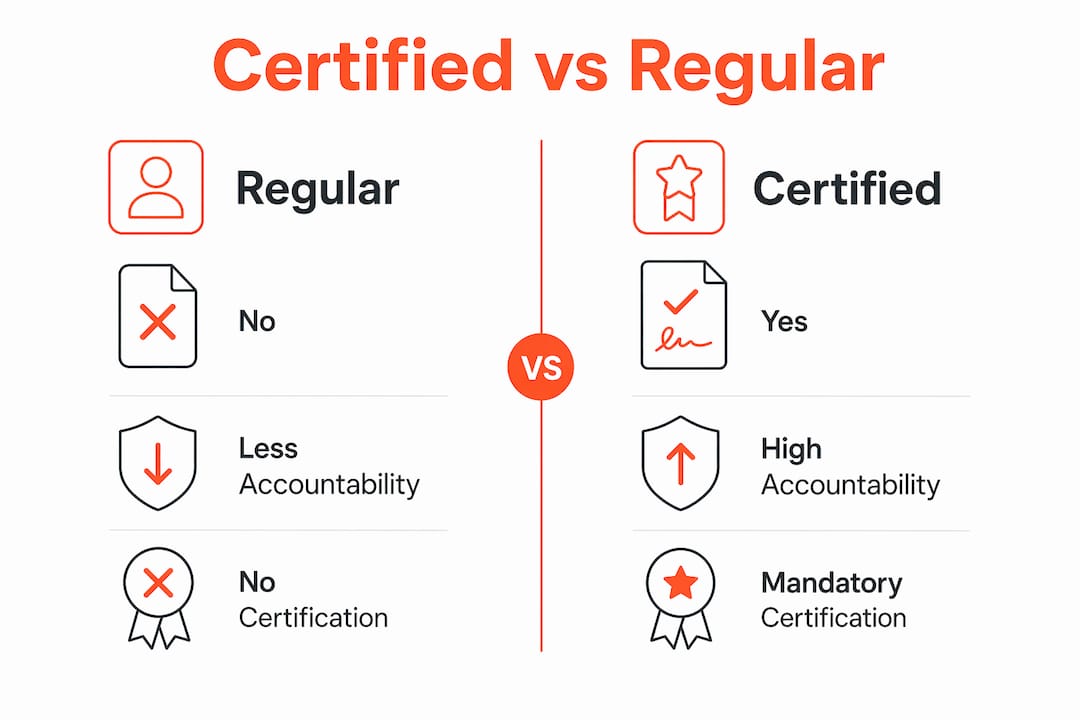
Certified translation differs from regular translation in one critical way: accountability. A regular translation carries no formal guarantee. A certified translation carries a signed, legally meaningful statement that a qualified professional stands behind the work.

| Feature | Regular translation | Certified translation |
|---|---|---|
| Signed statement | No | Yes, required |
| Translator identified | Optional | Mandatory |
| Accepted by authorities | Rarely | Yes, when requirements are met |
| Completeness guarantee | No | Yes, all elements included |
| Notarisation required | No | Only when authority specifies |
Notarisation is a separate process that is frequently confused with certification. Certification confirms accuracy; notarisation witnesses the signing of a document but does not verify the translation’s accuracy at all. A notary public confirms that a signature is genuine. They make no judgement about whether the translation is correct.
Some authorities do require both certification and notarisation. A court filing in certain jurisdictions may need the translator’s signature notarised as an additional layer of authentication. However, USCIS explicitly does not require notarisation. What USCIS requires under 8 CFR 103.2(b)(3) is a full English translation and a certification statement confirming completeness, accuracy, and translator competence.
Pro Tip: Always check the specific requirements of the receiving authority before ordering a translation. Ask whether they need certification, notarisation, or both. Getting this wrong means paying for a second translation.
The confusion between notarised and certified translations is common enough that clarifying the recipient authority’s actual requirements is critical to avoid document rejection. When in doubt, contact the authority directly and ask for their written requirements.
What are the certification standards in Australia and internationally?
NAATI certification in Australia
NAATI is Australia’s national authority for translator and interpreter credentialling. Many Australian government agencies mandate NAATI-certified translations where foreign language documents are involved. NAATI-certified translators hold a credential that confirms they have met a national standard of professional competence.
NAATI has introduced digital stamps with multi-factor authentication and unique 32-bit encryption QR codes to verify certified translations and combat fraud. Each digital stamp is unique to the translator and the document, making forgery significantly harder than with traditional paper stamps.
However, some organisations remain hesitant to accept NAATI digital stamps despite their advanced security. NAATI advises translators and clients to provide official fact sheets to receiving organisations that are unfamiliar with the digital format. If an authority refuses to accept a digital stamp, contacting NAATI directly with supporting documentation is the recommended path forward.
USCIS requirements in the United States
For documents submitted in US immigration case files, the requirements are set out in regulation 8 CFR 103.2(b)(3). The rule mandates a full English translation accompanied by a certification statement guaranteeing completeness, accuracy, and translator competence. USCIS does not require the translator to hold a specific credential or belong to a particular organisation. The focus is entirely on the content of the certification statement, not on decorative seals or notarised signatures.
This distinction matters for Australians applying for US visas or green cards. A NAATI-certified translator can produce a translation that satisfies USCIS requirements, provided the certification statement contains the mandatory elements. The credential adds credibility, but the statement is what the regulation actually requires.
Key steps to meet certification standards
- Confirm the receiving authority’s specific requirements before commissioning the translation.
- Select a translator who holds the appropriate credential for your jurisdiction, such as NAATI for Australian authorities.
- Verify that the certification statement names the document, confirms completeness and accuracy, identifies the translator, and includes a signature and date.
- Check whether the authority accepts digital stamps or requires a physical signature and seal.
- If submitting to a US authority, confirm the statement explicitly addresses the three USCIS criteria: completeness, accuracy, and competence.
Where is certified translation required in practice?
Certified translation is required across a wide range of official contexts. The common thread is that a receiving authority needs to trust a foreign language document without being able to read the original.
Common situations where certified translation is mandatory include:
- Immigration applications. Visa applications, partner visas, and citizenship applications submitted to the Australian Department of Home Affairs or USCIS require certified translations of birth certificates, marriage certificates, police clearances, and passports.
- University admissions. Academic transcripts and qualifications from overseas institutions must be translated for academic submissions by a certified translator before Australian universities will assess them.
- Legal proceedings. Contracts, powers of attorney, court orders, and statutory declarations submitted in Australian courts require certified translations. A certified translation of a power of attorney must reflect the exact legal language of the original.
- Cross-border trade and business expansion. Companies entering new markets need certified translations of incorporation documents, regulatory filings, and commercial contracts. The role of certified translation in cross-border trade is compliance. A mistranslated contract clause can void an agreement or trigger a dispute.
- Procurement processes. Government and corporate procurement increasingly requires certified translations of supplier credentials, financial statements, and compliance certificates.
Completeness is non-negotiable in all of these contexts. Certified translations must include all source text elements such as stamps, seals, and marginal notes. Omissions cause rejection or requests for additional documentation, which delays the entire process.
Choosing the right translator matters as much as choosing the right service. A translator who specialises in legal documents understands that the word “shall” carries a different legal weight than “will.” A translator working on medical records knows that a diagnosis code must be rendered exactly. Generalist translators may produce accurate language but miss the technical precision that official documents demand. Guidance on choosing a certified translator for your specific document type is worth reading before you commission any work.
Key takeaways
Certified translation is a formal, signed attestation by a qualified translator confirming completeness, accuracy, and professional competence. It is the only translation format accepted by most official authorities in Australia and internationally.
| Point | Details |
|---|---|
| Certification statement is mandatory | The signed statement confirming completeness, accuracy, and competence is what makes a translation officially acceptable. |
| Certification and notarisation are different | Notarisation witnesses a signature; it does not verify translation accuracy and is not always required. |
| NAATI is Australia’s standard | Australian government agencies mandate NAATI-certified translations for foreign language official documents. |
| USCIS focuses on statement content | US immigration requires the certification statement to address completeness, accuracy, and competence explicitly. |
| Completeness includes all document elements | Stamps, seals, marginal notes, and signatures must all be translated to avoid rejection. |
The part most people get wrong about certified translation
People assume that a good translation is automatically an acceptable one. That assumption costs them time and money every day.
I have seen applications rejected not because the translation was inaccurate, but because the certification statement was missing a single element. A translator who forgot to include their credential number. A statement that confirmed accuracy but said nothing about completeness. A document where the stamps were left untranslated because the translator thought they were decorative. Each of these failures is entirely avoidable.
The compliance role of certified translation is separate from its language quality role. A translation can be linguistically excellent and still be rejected if the certification statement does not meet the receiving authority’s requirements. This is the insight that most guides on this topic bury or miss entirely.
My advice is straightforward. For any document destined for an Australian authority, use a NAATI-certified translator. For documents going to USCIS, confirm the certification statement addresses all three criteria in 8 CFR 103.2(b)(3). For any other authority, get their requirements in writing before you commission the work. The cost of a second translation always exceeds the cost of a five-minute phone call.
The other mistake I see regularly is confusing notarisation with certification and ordering the wrong one. If your authority requires a certified translation, a notarised translation will not substitute for it. If they require both, a certified translation alone will not be enough. These are not interchangeable products.
— David
Certitranslate: NAATI-certified translations for official use
Certitranslate provides certified translation services backed by NAATI-certified translators for individuals and businesses across Australia.
Every translation produced by Certitranslate includes a compliant certification statement and a NAATI digital stamp, covering documents from birth certificates and marriage certificates through to powers of attorney and commercial contracts. The certified translation services cover immigration, legal, and business purposes, with turnaround times designed for real deadlines. If you need a power of attorney translated with full legal accuracy and guaranteed acceptance, Certitranslate has the specialist translators to handle it correctly the first time.
FAQ
What is certified translation?
Certified translation is a translation accompanied by a signed statement from a qualified translator confirming the work is complete, accurate, and produced by a competent professional. This statement is required by most official authorities before they will accept a foreign language document.
What does a certified translation statement include?
A certification statement must confirm completeness, accuracy, and translator competence, and must identify the translator with a signature and date. Missing any of these elements is a leading cause of rejection by authorities such as USCIS.
How does certified translation differ from notarised translation?
Certified translation confirms the translator’s accuracy and accountability. Notarisation witnesses the signing of a document but does not verify translation accuracy. Some authorities require both; others, including USCIS, require only certification.
Is NAATI certification required for translations in Australia?
NAATI certification is the standard required by most Australian government agencies for official document translations. Submitting a translation from a non-NAATI-certified translator to an Australian authority risks rejection.
What documents require certified translation?
Certified translation is required for immigration applications, university admissions, court filings, powers of attorney, commercial contracts, and procurement submissions. Any document submitted to an official authority in a language other than the authority’s working language will typically require a certified translation.
Recommended
- Certified translation of a power of attorney: 2026 guide – CertiTranslate – Translations by NAATI Certified Translators
- How to Choose the Right Certified Translator for Your Needs – CertiTranslate – Translations by NAATI Certified Translators
- Blog – CertiTranslate – Translations by NAATI Certified Translators
- Role of accredited translators in academic submissions – CertiTranslate – Translations by NAATI Certified Translators