


NAATI-certified translators are the only translators whose work the Department of Home Affairs accepts without question for Australian visa applications. NAATI, the National Accreditation Authority for Translators and Interpreters, sets the professional standard for language services in Australia. The naati certified translator benefits extend well beyond immigration: they cover legal proceedings, university admissions, and even your own skilled migration points score. If you are submitting documents for a visa, a court, or a university enrolment, understanding these advantages is the difference between a smooth process and a costly delay.
1. What are the key legal benefits of NAATI-certified translators for immigration?
The Department of Home Affairs requires NAATI-certified translations for all non-English documents submitted with Australian visa applications. Uncertified translations are rejected outright, which can stall your application for weeks or force a full re-submission. That is not a minor inconvenience. It can mean missing a visa lodgement window or triggering a second round of medical examinations.
DFAT, the Department of Foreign Affairs and Trade, adds another layer of requirement. DFAT will only apostille a translated document if the translation was completed by a NAATI-certified professional. This matters for anyone sending Australian documents overseas for legal recognition in another country.

Verification is also more reliable with NAATI certification. Anyone can create a fake translator stamp, but authorities confirm authenticity by searching the practitioner’s NAATI number in the public online directory. A legitimate NAATI translator appears in that directory with their credential level and language pair clearly listed.
Pro Tip: Before accepting a translation, search the translator’s NAATI number at directory.naati.com.au. If the name, language pair, or credential level does not match the stamp on your document, do not use that translation.
- NAATI certification is the gold standard accepted by the Department of Home Affairs
- DFAT requires NAATI-certified translations for apostille authentication
- Credential verification is done through the NAATI online directory, not visual stamps
- Uncertified translations risk rejection and costly re-submission delays
2. How NAATI certification improves academic document translation
Australian universities require certified translations for transcripts, diplomas, and supporting documents submitted by international applicants. A translation that cannot be verified by the institution will be rejected, regardless of how accurate it appears. The benefits of NAATI certified academic translations come down to one thing: guaranteed acceptance.
NAATI-certified translators maintain consistent terminology and format fidelity across academic documents. This matters because a transcript contains specific grading systems, subject names, and institutional titles that must be rendered accurately. A mistranslated grade scale or degree title can misrepresent your qualifications entirely.
There is also a practical distinction between translation types. Extract translations cover key data fields such as name, date of birth, and document number, and are sufficient for civil records. Full translations reproduce the entire document and are required for academic transcripts, diplomas, and any document that will be assessed for content rather than identity verification.
Pro Tip: Scan your academic documents at 300 DPI or higher before sending them for translation. Low-quality scans cause translators to miss text, which leads to incomplete translations and rejection by admissions offices.
- Universities require certified translations for all non-English academic documents
- NAATI translators preserve grading systems, subject names, and institutional titles accurately
- Extract translations suit civil records; full translations are required for academic assessment
- Poor document quality is a leading cause of translation errors and institutional rejection
3. What business and legal advantages do NAATI-certified translators provide?
Legal documents require full certified translations, not extracts. Contracts, court orders, statutory declarations, and tribunal documents must be translated in their entirety, with every clause and heading reproduced accurately. A missing clause or mistranslated condition can affect the legal standing of the entire document.
Certified translators follow a Code of Ethics and hold intercultural competency knowledge specific to the Australian legal context. This is not a formality. Legal translation requires understanding how a concept in one legal system maps onto an equivalent in another. A translator without that knowledge can produce a technically accurate sentence that carries the wrong legal meaning.
The benefits of NAATI translation for legal use are also about risk management. A translation error in a contract can create ambiguity that leads to disputes. An error in a tribunal document can affect the outcome of a hearing. Using a NAATI-certified legal translator removes that risk because the translator’s credential is tied to their professional accountability.
- Full certified translations are required for contracts, court orders, and tribunal documents
- NAATI translators hold intercultural competency knowledge for the Australian legal context
- Translation errors in legal documents can create enforceable ambiguity or affect hearing outcomes
- Certified translators carry professional accountability tied to their NAATI credential
4. What are the migration advantages of holding a NAATI credential yourself?
This is the benefit most bilingual applicants overlook. Holding a NAATI credential grants 5 bonus points on the Australian skilled migration points test. For many applicants sitting just below the points threshold for an invitation to apply, those 5 points are the difference between waiting years and receiving an invitation in the next round.
The most accessible pathway is the Credentialed Community Language test. This test leads to a Certified Provisional Interpreter or Translator credential, which qualifies for the migration points bonus. The test assesses your ability to interpret or translate in a community setting, not at a professional conference level.
Compared to other ways of earning 5 migration points, the NAATI credential pathway is direct. Professional year programmes take 44 weeks and cost significantly more. Studying for an additional qualification takes years. The NAATI credential test, by contrast, can be prepared for and sat within a few months for bilingual applicants who already have strong language skills.
Pro Tip: If you are bilingual and within 5 points of the current invitation threshold for your skilled occupation, check whether your language pair is eligible for the Credentialed Community Language test before investing in other points strategies.
- Confirm your language pair is listed on the NAATI Credentialed Community Language test schedule
- Download the NAATI candidate handbook and review the test format and assessment criteria
- Complete practice interpreting or translation exercises in your language pair
- Book your test through the NAATI website and submit your credential application after passing
- Claim your 5 bonus points in your Expression of Interest through SkillSelect
5. Certified vs uncertified translations: why NAATI certification matters
Not all translations carry the same weight with Australian authorities. The table below shows how the three main translation options compare across the criteria that matter most for immigration, legal, and academic submissions.
| Attribute | Uncertified translation | Overseas-certified translation | NAATI-certified translation |
|---|---|---|---|
| Accepted by Department of Home Affairs | No | Rarely | Yes |
| Accepted by DFAT for apostille | No | No | Yes |
| Credential verifiable online | No | No | Yes, via NAATI directory |
| Risk of rejection | High | Moderate | Low |
| Suitable for legal and tribunal documents | No | No | Yes |
| Suitable for university admissions | No | Sometimes | Yes |
Uncertified translations are appropriate for personal use only, such as understanding a foreign document for your own reference. They carry no legal weight in Australia. Overseas-certified translations, produced by translators accredited in another country, are generally not recognised by Australian authorities because there is no equivalent verification system accessible to Australian case officers.
Using a NAATI-certified translator reduces the risk of visa delays, re-submissions, and administrative complications. The credential is publicly verifiable, the translator is professionally accountable, and the translation meets the format requirements of Australian institutions. For any document that will be assessed by a government body, a court, or a university, NAATI certification is the only option that removes uncertainty.
Pro Tip: When in doubt about which translation type you need, check the specific requirements of the institution or authority requesting the document. The Department of Home Affairs, DFAT, and most Australian universities publish their translation requirements on their official websites.
Key takeaways
NAATI-certified translators are the only translators whose work is accepted by the Department of Home Affairs, DFAT, and Australian universities without risk of rejection.
| Point | Details |
|---|---|
| Legal recognition | NAATI certification is required by the Department of Home Affairs and DFAT for apostille authentication. |
| Academic acceptance | Universities require full certified translations of transcripts and diplomas for international admissions. |
| Legal document accuracy | Full translations with correct legal terminology are required for contracts and tribunal documents. |
| Migration points bonus | Holding a NAATI credential earns 5 bonus points on the Australian skilled migration points test. |
| Credential verification | Authorities verify NAATI translators through the public online directory, not visual stamps. |
Why I trust NAATI certification above everything else
I have reviewed hundreds of visa applications and translation submissions over the years. The pattern is consistent: the applications that stall are almost always the ones where the applicant tried to save money on translation.
Uncertified translations look fine on the surface. The words are in English, the document is formatted neatly, and the applicant has no reason to doubt it. Then the case officer searches for the translator’s credentials and finds nothing. The application goes on hold. The applicant pays for a new translation, resubmits, and loses weeks or months in the process.
The cost difference between a certified and uncertified translation is real but small compared to the cost of a delayed visa. A re-submission can also trigger additional requirements, including repeat medical examinations, which add both time and expense. The professional translation benefits of using a NAATI-certified translator are not abstract. They show up in faster approvals, fewer requests for additional information, and documents that pass the first review.
My advice is simple. Verify the translator’s NAATI number before you accept any translation. Prepare your documents properly before sending them. And treat the translation as part of the application, not an afterthought.
— David
Certitranslate: NAATI-certified translations for every need
Certitranslate provides certified translation services for immigration, legal, and academic documents across Australia. Every translation is completed by a verified NAATI-certified translator, so your documents meet the requirements of the Department of Home Affairs, DFAT, and Australian universities without exception.
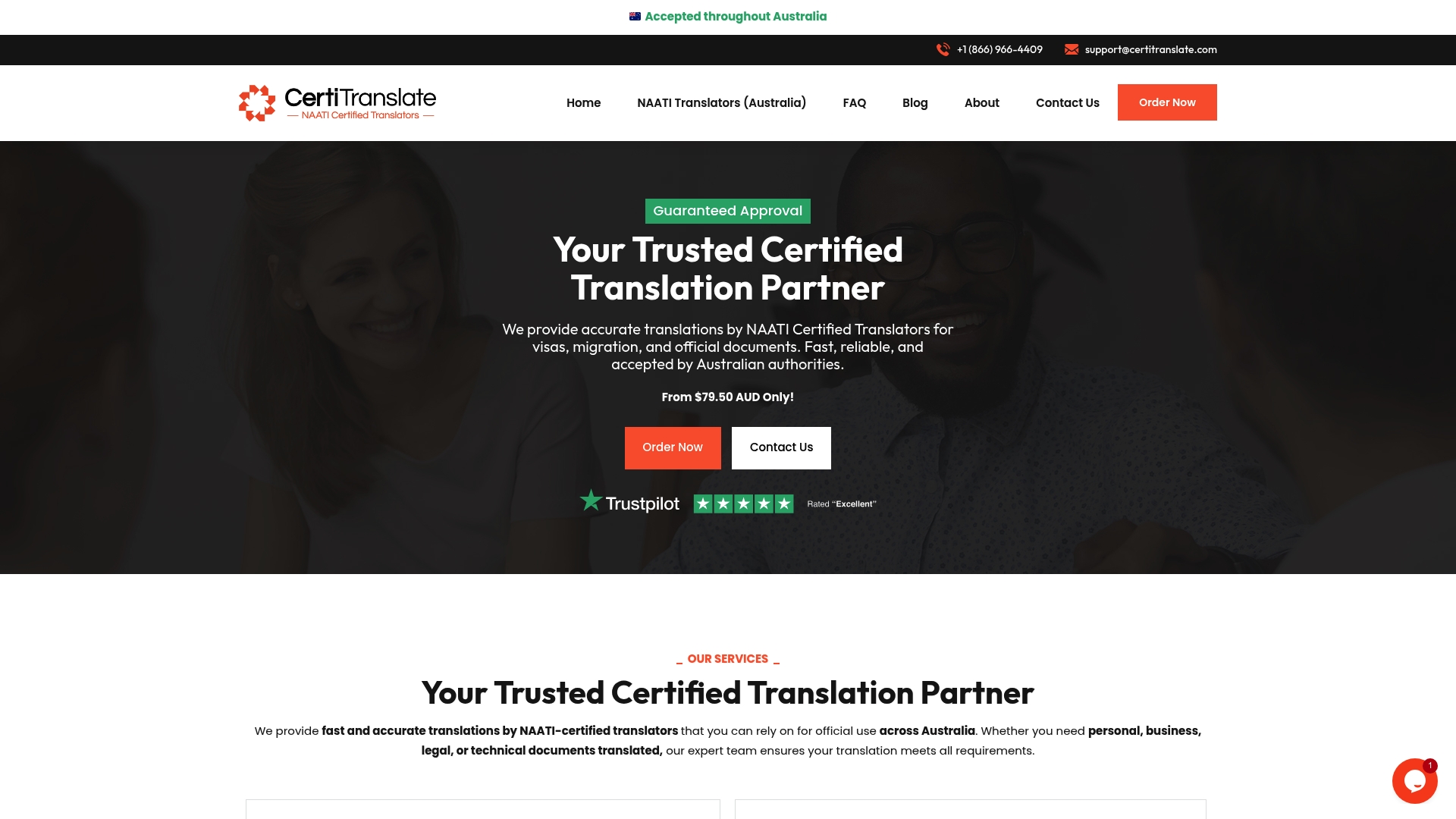
Whether you need a birth certificate translated for immigration or a full set of academic transcripts certified for university admission, Certitranslate delivers accurate, officially recognised translations with fast turnaround. The process is straightforward: upload your document, receive a quote, and get your certified translation ready to submit. Explore Certitranslate’s NAATI-certified translation services and request a quote today.
FAQ
What documents require a NAATI-certified translation in Australia?
The Department of Home Affairs requires NAATI-certified translations for all non-English documents submitted with visa applications, including passports, birth certificates, marriage certificates, and police clearances. DFAT also requires NAATI-certified translations for any document being apostilled for overseas use.
Can I use an overseas-certified translator for Australian immigration?
Australian authorities do not recognise overseas translation credentials because there is no equivalent online verification system. The Department of Home Affairs requires translations completed by NAATI-certified translators when the application is lodged from within Australia.
How do I verify a NAATI-certified translator’s credentials?
Search the translator’s NAATI number at directory.naati.com.au. The directory lists the translator’s name, credential level, and language pair. If the details do not match the stamp on your translation, the document is not valid.
Do I need a full translation or an extract translation for my visa?
Extract translations cover key data fields and are sufficient for civil records such as birth and marriage certificates. Full translations are required for legal documents, tribunal submissions, and academic transcripts where the entire content will be assessed.
How many migration points does a NAATI credential provide?
Holding a NAATI credential earns 5 bonus points on the Australian skilled migration points test. The Credentialed Community Language test is the most accessible pathway for bilingual applicants seeking this points advantage.
Recommended
- How to Choose the Right Certified Translator for Your Needs – CertiTranslate – Translations by NAATI Certified Translators
- Translate birth certificate for immigration: 2026 guide – CertiTranslate – Translations by NAATI Certified Translators
- What is certified translation: a complete guide – CertiTranslate – Translations by NAATI Certified Translators
- What is a translated professional membership certificate? – CertiTranslate – Translations by NAATI Certified Translators