


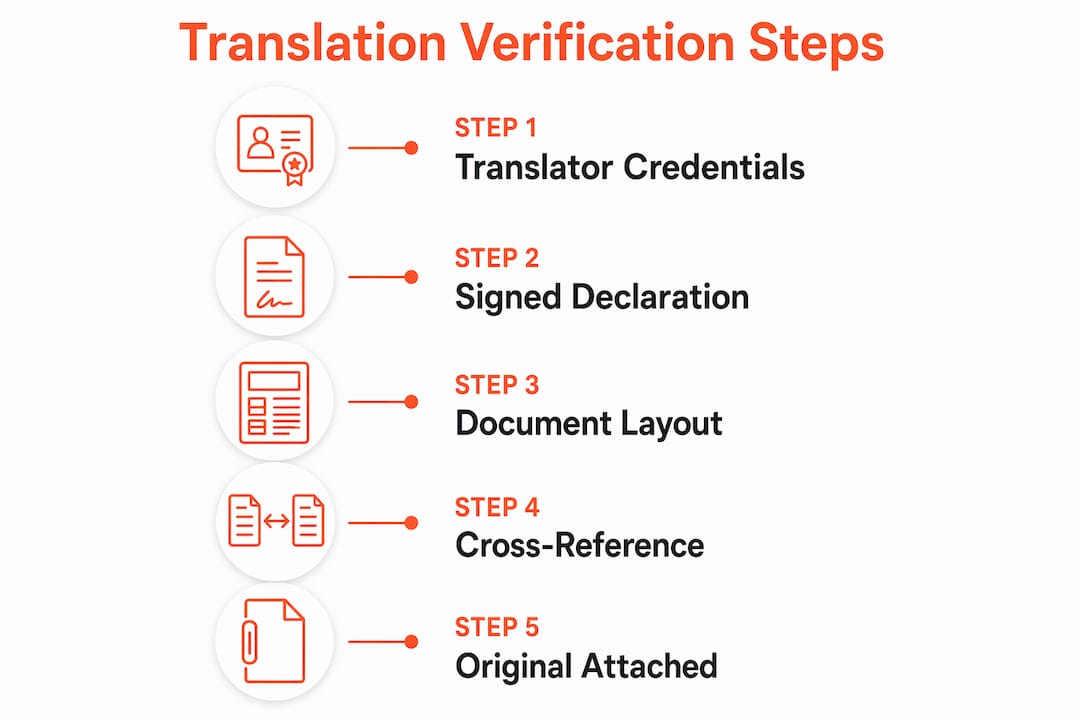
A verified visa translation must carry a signed translator declaration, the translator’s full name and contact details, their accreditation credentials (a NAATI practitioner number where applicable), the date, a statement of accuracy, and a copy of the original foreign-language document. The Department of Home Affairs uses those elements to confirm both the translator’s identity and the translation’s reliability before a case officer processes your application.
Three registries and authorities sit at the centre of the visa translation verification process: the Department of Home Affairs itself, the NAATI Find a Translator directory (where anyone can look up a practitioner number), and Australian missions and consulates for embassy-certified translations.
Before you lodge, run through these three checks:
- Enter the translator’s NAATI Credential Practitioner Number (CPN) into the NAATI Find a Translator directory and confirm the name, language direction, and credential status are active.
- Request a signed translator declaration and a scanned copy of the working copy showing how the translated text maps to the source document.
- Keep the original foreign-language document alongside the translation — Home Affairs requires both.
Table of Contents
- Which visa documents usually need an English translation?
- Who can translate documents for Australian visa use?
- What makes a translation ‘certified’ for visa purposes?
- How does the Department of Home Affairs verify translations?
- How to verify a translator yourself before lodging
- What do certified translations cost and how long do they take?
- Applicant checklist: what to lodge with your translated documents
- Common mistakes that cause translations to fail verification
- How Certitranslate meets Australian verification standards
Which visa documents usually need an English translation?
Most documents that carry personal data, legal status, or financial standing will need an English translation for an Australian visa application. The categories Home Affairs and Australian missions most commonly require include:
- Identity documents (national ID cards, driver licences)
- Birth, marriage, and divorce certificates
- Police clearance and character certificates
- Passport bio-data pages and any relevant visa pages
- Medical reports and health assessments
- Educational transcripts and qualification certificates
- Financial documents, bank statements, and affidavits
For routine civil records such as birth certificates or passport data pages, an extract translation covering the key data fields (names, dates, places, endorsements) usually suffices. Full translations remain necessary for legal proceedings, tribunal evidence, and complete contracts, where legal completeness is the standard.
| Document type | Inside Australia | Outside Australia |
|---|---|---|
| Birth/marriage/divorce certificate | NAATI-credentialled translator preferred | Qualified translator with full credentials; embassy option available |
| Police clearance certificate | NAATI-credentialled translator preferred | Qualified translator with verifiable contact and qualifications |
| Passport bio-data page | NAATI-credentialled translator preferred | Qualified translator; embassy attestation accepted |
| Educational transcripts | NAATI-credentialled translator preferred | Qualified translator with credential details |
| Medical/health reports | NAATI-credentialled translator preferred | Qualified translator; check mission requirements |
| Financial affidavits | NAATI-credentialled translator preferred | Qualified translator with verifiable contact and qualifications |
For a full breakdown of which documents need translation for a visa application, Certitranslate has a dedicated guide.
Who can translate documents for Australian visa use?
Inside Australia, NAATI-credentialled translators are the expected standard for government submissions. NAATI credentials confirm that a practitioner is competent in both English and the relevant community language and operates under a professional code of conduct. Most Australian government agencies require NAATI credentials when they are available for the language pair in question.

Outside Australia, the rules are more flexible but no less specific. Home Affairs accepts translations from a “qualified translator” who endorses the translation with their full name, address, telephone number, and details of their qualifications and experience. If you are offshore and unsure whether a local translator meets that standard, contacting the Australian mission in your country is the recommended first step.
NAATI issues credentials by language direction (for example, Spanish to English) and assigns each practitioner a unique CPN. That number is what case officers and applicants use to verify credentials online. An active CPN in the correct language direction is the clearest signal a translation will pass scrutiny.
Pro Tip: Embassy or consulate-stamped translations carry strong official weight, particularly for applicants in countries where NAATI-credentialled translators are not available. Australian missions overseas advise applicants to confirm attestation practices with the specific mission before submitting, as procedures vary by post.
What makes a translation ‘certified’ for visa purposes?
Certification is not a stamp alone. A translation is considered verifiable when it contains every one of the following elements:
- A signed certification statement asserting the translation is a true and accurate rendering of the source document
- The translator’s full name, contact address, and telephone number
- The translator’s NAATI practitioner number (CPN) or, for offshore translators, clear details of qualifications and experience
- The language direction (for example, “French to English”)
- The date the translation was completed
- The translator’s signature
- A copy of the original foreign-language document attached to the translation
Layout fidelity matters too. Officers cross-reference the translation’s structure against the original, checking that page numbers, table rows, and signature blocks appear in the same positions. Stamps and seals in the source document must be described in English rather than left blank or reproduced as images without explanation. A translation that skips these structural details gives a case officer reason to pause.
NAATI’s digital stamp and QR code allow credential verification without a physical stamp, though some agencies still prefer a physical attestation. Check the specific requirements of the visa subclass or agency before deciding which format to request.
A quick pre-submission checklist:
- Signed certification statement present? ✓
- Translator’s full name, address, and phone number included? ✓
- CPN or qualification details listed? ✓
- Language direction stated? ✓
- Date of translation included? ✓
- Translator’s signature present? ✓
- Copy of original document attached? ✓
How does the Department of Home Affairs verify translations?
Verification is a two-step manual process. First, a case officer checks for the visual markers: the certification statement, translator signature, stamp or QR code, and CPN. Second, where a CPN is present, the officer looks it up in the NAATI directory to confirm the practitioner’s name, language direction, and credential status. An expired or inactive credential can render a previously compliant translation non-compliant, even if the translation itself is accurate.

Officers also cross-reference names, dates, and document layout between the translation and the original. A name spelled differently across two documents in the same application is a common trigger for follow-up requests. Consistency across every document in your application packet matters as much as the translation itself.
Australian missions apply similar checks for offshore applications, with embassy-stamped translations providing an additional layer of official attestation that case officers recognise.
Pro Tip: Present your translation and the original document in the same order and orientation. Include the translator’s working copy annotations if available. This reduces the likelihood of a follow-up request and signals to the case officer that the translation was prepared with care.
How to verify a translator yourself before lodging
Follow these steps before you submit anything.
-
Request a signed certification statement and working copy. Ask the translator for a signed declaration of accuracy and a scanned copy of the working copy showing how each section of the translated text maps to the source. A sample certification states fluency in both languages, declares accuracy, and includes the translator’s contact details and signature.
-
Obtain the translator’s CPN or qualification evidence. For a NAATI-credentialled translator, this is a unique number tied to their credential direction. For an offshore translator, ask for written details of their qualifications, professional memberships, and a verifiable contact address.
-
Look up the CPN in the NAATI Find a Translator directory. Confirm the practitioner’s name matches the translation, the language direction is correct, and the credential status is active. If a CPN returns no result, the translation is treated as non-compliant for Home Affairs purposes. Do not submit it.
-
For embassy or consulate translations, confirm attestation practices. Contact the issuing mission directly to confirm their stamping process and request the stamped original. For offshore translators without NAATI credentials, verify their contact address independently and request written qualification details.
If a lookup fails or credentials cannot be confirmed, commission a fresh translation from a NAATI-credentialled translator. Resubmitting with unverifiable credentials rarely succeeds and adds weeks to processing. For guidance on choosing the right certified translator, Certitranslate’s guide covers the key questions to ask.
Verification checklist:
- CPN confirmed active in NAATI directory? ✓
- Translator name on translation matches directory entry? ✓
- Language direction correct for your document? ✓
- Signed declaration received? ✓
- Working copy available if requested? ✓
- Original document ready to attach? ✓
What do certified translations cost and how long do they take?
Turnaround varies by document type and translator availability. Routine passport or birth record translations can be completed same-day to within 48 hours. Complex legal documents, notarised translations, or documents requiring embassy attestation take longer, sometimes several business days.
Cost drivers include language rarity (less common language pairs attract higher rates), document length, whether a full or extract translation is needed, and whether statutory attestation or embassy stamping is required. Rush services add to the base cost.
When supporting documents need to be mailed alongside a translation, factor in postage and processing time on top of the translation turnaround.
Pro Tip: Start the translation and verification process earlier than feels necessary. A NAATI credential lookup that returns an unexpected result, or a translator who needs to reissue a declaration, can add several days before you can lodge. Build that buffer into your application timeline.
Applicant checklist: what to lodge with your translated documents
Home Affairs documentation guidance requires translated documents to be presented with the original. Failure to include translations can delay processing or result in the document not being considered at all.
| Item | Notes |
|---|---|
| Copy of original foreign-language document | Clear scan or photocopy; must be legible |
| English translation with signed declaration | Includes certification statement asserting accuracy |
| Translator’s full name, address, and phone number | Must appear on the translation itself |
| NAATI CPN or qualification details | Active CPN preferred; offshore translators provide written qualifications |
| Date of translation | Must appear on the translation |
| Embassy/consulate attestation (if used) | Stamped original; confirm mission’s attestation format |
| Translator’s working copy (if requested) | Attach when the case officer or mission has asked for it |
| Extract translation or full translation | Full translation for legal/tribunal documents; extract for civil records |
For applications where financial documents are involved, verified translations carry the same weight in immigration contexts as they do in financial applications such as foreign national mortgage qualification, where lenders require the same standard of endorsed, verifiable translation.
Common mistakes that cause translations to fail verification
Most translation rejections come down to a small number of avoidable errors.
- Missing translator signature or contact details. Without a signature and verifiable contact information, there is no way to authenticate the translation. Fix: always request a signed declaration with the translator’s full name, address, and phone number before accepting delivery.
- No certification statement. A translation without a statement asserting accuracy is not a certified translation. Fix: use standard certification wording that explicitly declares the translation is a true and accurate rendering of the source.
- Unverifiable or expired NAATI credentials. An expired CPN or a number that returns no result in the NAATI directory renders the translation non-compliant. Fix: look up the CPN before lodging, not after.
- Machine-only translations without human review. Automated translations are not accepted for visa purposes. Fix: commission a human NAATI-credentialled translator and confirm the translation was not produced by machine alone.
- Untranslated stamps and seals. Stamps and seals left as images without English description are a red flag. Fix: the translator must describe every stamp and seal in English within the translation.
- Inconsistent name spellings across documents. A name spelled differently on a birth certificate translation versus a passport translation triggers manual review. Fix: confirm spelling consistency across all documents before lodging.
For legal documents, character certificates, and tribunal evidence, the stakes are higher. An error in these categories can affect the outcome of a visa decision, not just cause a delay.
How Certitranslate meets Australian verification standards
Certitranslate’s process is built around the NAATI certification requirements that Australian government agencies expect. Each job is assigned to a credentialled translator whose CPN is active and whose language direction matches the document. The certification wording follows the standard declaration format, and layout fidelity to the original is maintained throughout.
For applicants who need embassy attestation guidance or are lodging from offshore, Certitranslate can advise on the additional steps required for the relevant Australian mission.
Key takeaways
A verified visa translation requires a signed declaration, active NAATI credentials, and the original document attached — case officers check all three before processing an application.
| Point | Details |
|---|---|
| Mandatory elements | Every accepted translation needs a signed declaration, CPN or qualifications, language direction, date, and original document attached. |
| NAATI CPN lookup | Enter the translator’s CPN in the NAATI Find a Translator directory to confirm active status and correct language direction before lodging. |
| Offshore applications | Home Affairs accepts qualified translators outside Australia provided they supply verifiable contact details and qualification evidence; embassy attestation is a strong fallback. |
| Common rejection triggers | Missing signature, expired credentials, machine-only translations, and untranslated stamps cause most verification failures. |
| Certitranslate | Certitranslate uses NAATI-credentialled translators and provides the full set of verification elements — signed declaration, CPN, language direction, and original document copy — with each job. |
The detail most applicants overlook
The verification process for visa translations is more mechanical than most applicants expect. Case officers are not reading translations for quality; they are scanning for the presence or absence of specific markers. A beautifully accurate translation with a missing CPN or an expired credential fails the same way a poor one does.
The single most avoidable mistake is submitting a translation without first running the CPN through the NAATI directory. It takes two minutes. Yet a significant number of applications arrive with credentials that are expired, mistyped, or belong to a different language direction entirely. The fix is always the same: check before you lodge, not after you receive a request for further information.
There is also a subtler issue with name consistency. Translators working from different source documents sometimes render a foreign name differently across two translations in the same application. That inconsistency flags a manual review even when both translations are otherwise correct. The applicant is the only person in a position to catch it before lodgement, because they are the only one who sees the full document set.
Verification is not bureaucratic friction. It is the mechanism that protects applicants from fraudulent translations and gives case officers a reliable basis for decisions. Understanding how it works puts you in control of the outcome.
Certitranslate: NAATI-certified translations for visa applications
Preparing a visa application means getting the translation right the first time. Certitranslate provides NAATI-certified translation services for the full range of visa documents — identity records, police certificates, educational transcripts, financial affidavits, and more — with every job delivered by a credentialled translator whose CPN is active and verifiable.
Each translation includes the signed declaration, NAATI practitioner number, language direction, translator contact details, and a copy of the original document. That is the complete package a case officer checks. For applicants lodging from offshore or needing embassy attestation guidance, Certitranslate can advise on the additional steps for the relevant Australian mission.
Get your certified translation started today — submit your documents and receive a quote, with turnaround options to suit your lodgement timeline.
Useful sources and further reading
| Source | What it covers |
|---|---|
| Department of Home Affairs — document attachment guidance | Requirements for attaching translated documents to citizenship and visa applications, including NAATI and offshore translator standards |
| Language services guidelines — Department of Home Affairs | Why NAATI credentials are preferred for government submissions and what credentials confirm |
| NAATI — Frequently asked questions | CPN lookup process, digital stamp and QR verification, and what a failed lookup means for compliance |
| Australian mission — visas and migration | Embassy and consulate attestation practices and advice for offshore applicants |
| Australian Embassy in the USA — translation of foreign documents | Specific guidance on translating documents for Australian visa applications lodged from the United States |
| DFAT — Australian embassies and consulates overseas | Directory of Australian missions for applicants seeking local embassy attestation |
| Sample certification of translation | Template certification wording covering accuracy declaration, language fluency statement, and required contact details |
Recommended
- Translate documents for Australian immigration: 2026 guide – CertiTranslate – Translations by NAATI Certified Translators
- Why original documents accompany translations: 2026 guide – CertiTranslate – Translations by NAATI Certified Translators
- Certified Translations for Australia
- CertiTranslate – Translations by NAATI Certified Translators