


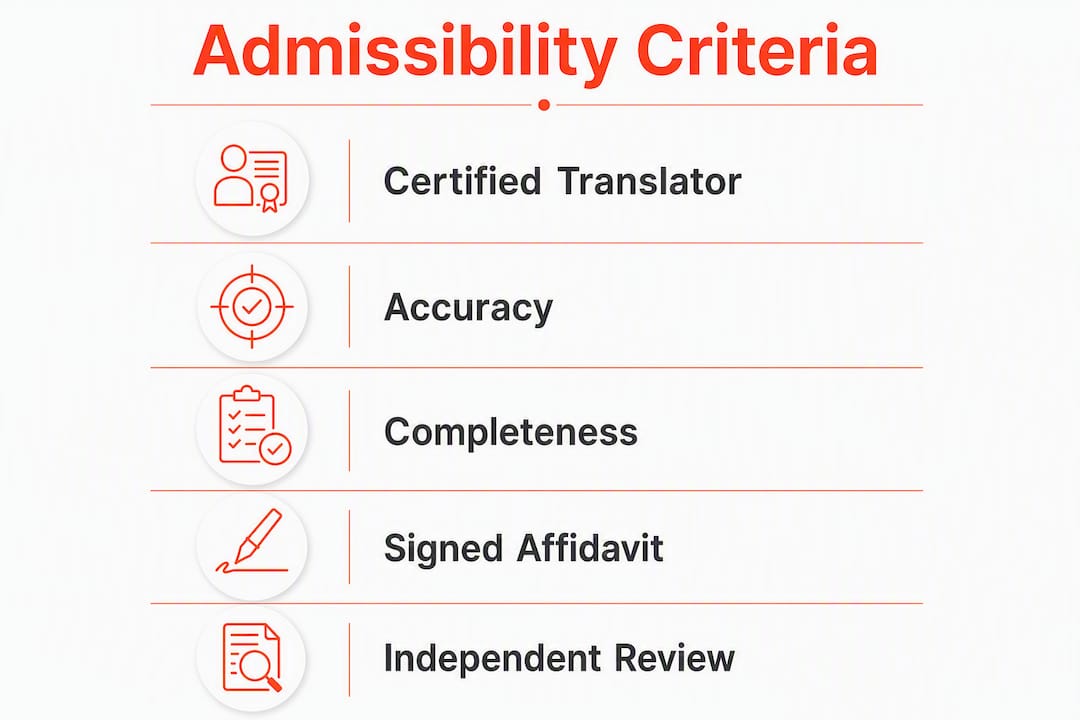
A translation is admissible in Australian courts when it is accurate and complete, produced by a suitably qualified translator (NAATI-certified where available), and accompanied by a signed statement or affidavit that establishes the translator’s identity, qualifications, and the provenance of the source documents. Get all three right and the translation stands. Miss any one of them and you risk the document being rejected, challenged, or given little weight by the judge.
The five things courts look for, in plain terms:
- Accuracy and completeness: the translation must faithfully render the meaning and legal effect of the original, including all names, dates, and legal terms.
- Qualified translator: NAATI certification is the recognised Australian standard; experience in legal translation matters too.
- Signed certification or affidavit: the translator must attach a statement confirming their identity, qualifications, and that the translation is true and correct.
- Document provenance: originals or certified copies must accompany the translation to establish chain of custody.
- Appropriate handling in disputed matters: contested translations may require independent review or expert evidence.
Pro Tip: Never submit a raw machine translation as evidence. Even AI tools that produce fluent-sounding output routinely misrender legal terms, omit qualifications, and miss jurisdictional nuance. If machine translation was used as a drafting aid, a NAATI-certified translator must review, correct, and certify the final version before it goes anywhere near a court file.
Table of Contents
- What ‘admissible’ actually means under Australian evidence law
- Core admissibility criteria: what courts look for in a translated document
- What ‘certified translation’ means in Australia: NAATI and the practical elements
- Who can give evidence about a translation in court?
- How courts test whether a translation is accurate and authentic
- Common reasons translated evidence is rejected or weakened
- How to prepare court-ready translations: a step-by-step checklist
- Translator statement and affidavit: what must be included
- Timeline and cost expectations for court-ready translations in Australia
- How Certitranslate ensures translations are court-admissible in Australia
- Key takeaways
- The part of legal translation most practitioners underestimate
- Certitranslate: court-ready translations without the guesswork
- Authoritative sources and further reading
What ‘admissible’ actually means under Australian evidence law
Admissibility is the threshold question: can this document be received into evidence at all? A translated document clears that threshold when it is relevant to a fact in issue, authentic (the court can be satisfied it is what it purports to be), and presented in a form the rules permit. Once admitted, the court then decides how much weight to give it — a separate question entirely.
A translation that is admitted into evidence is not automatically believed. Weight depends on the quality of the translation, the qualifications of the translator, and whether the opposing party has had a fair opportunity to challenge it. Admissibility is the floor, not the ceiling.
Australian courts operate under a patchwork of rules. At the federal level and in most states, the Evidence Act 1995 (Cth) and its state equivalents govern relevance, authenticity, and hearsay. Procedural rules layer on top: in New South Wales, UCPR reg. 31.62 sets out specific verification steps and the interpreter’s responsibilities when sight-translating affidavits for witnesses who require an interpreter. Queensland courts and tribunals publish guidelines recommending NAATI-certified translations for documents in languages other than English. The Australian Government Department of Home Affairs applies similar standards for visa and migration documents.
Three points of jurisdictional variation are worth knowing:
- Other states and territories: — Most follow the uniform evidence law framework, but local practice directions can impose additional formatting or certification requirements. Always check the relevant court’s practice notes before filing.
The practical upshot: there is no single national rule that covers every situation. The admissibility checklist below reflects common ground across jurisdictions, but local rules can add requirements on top.
Core admissibility criteria: what courts look for in a translated document
Courts and registrars assess translated evidence against a consistent set of factors. Meeting all of them is the safest path to admission without challenge.
Accuracy and completeness
The translation must render the full meaning and legal effect of the source document, not just a summary or a paraphrase. Names, dates, reference numbers, and legal terms must be reproduced precisely. AUSIT best practice recommends retaining original official names and foreign legal terms in the source language, followed by the English equivalent in square brackets or as a footnote. This preserves authenticity and gives the court a clear audit trail between the original and the translation.
Qualified translator

NAATI (National Accreditation Authority for Translators and Interpreters) certification is the primary trust signal in Australia. A NAATI-certified translator has passed standardised competency testing and is bound by professional standards. For legal translation specifically, subject-matter expertise matters alongside the NAATI credential: a translator certified for general translation who has never handled court documents is a weaker choice than one with a track record in legal work.
Signed certification or translator affidavit
The translation must be accompanied by a written statement from the translator. At minimum, that statement should confirm the translator’s name and qualifications, that the translation is true and correct to the best of their knowledge, and identify the source documents. For contested matters, a sworn affidavit before an authorised witness is preferable to a simple certificate of accuracy.
Document provenance and chain of custody
- Attach the original source document (or a certified copy) to the translation.
- Present the original and translation side by side where possible.
- Keep a record of how the original was obtained, stored, and handled.
- Include the translator’s contact details so the court can reach them if needed.
Pro Tip: Ask your translator to number each page of the translation to correspond with the original. A court that cannot match a translated page to its source page will ask questions you do not want to answer at a directions hearing.
What ‘certified translation’ means in Australia: NAATI and the practical elements
The phrase “certified translation” is used loosely in everyday conversation, but in the Australian legal and government context it has a specific meaning. A certified translation is one where a qualified translator attests, in writing, that the translation is accurate and complete. NAATI certification of the translator is the mechanism that gives that attestation credibility.
NAATI is Australia’s recognised accreditation framework for translators and interpreters. When a NAATI-certified translator signs a translation, they are staking their professional accreditation on its accuracy. That is why courts, the Department of Home Affairs, and most government agencies treat NAATI certification as a primary trust signal for official document translations.
The practical elements a certified translation should include:
| Element | What it looks like in practice |
|---|---|
| Translator’s full name | Printed clearly on the certification statement |
| NAATI credential | Level or credential number; copy of NAATI certificate attached |
| Statement of accuracy | “I certify that this is a true and correct translation of the original document” |
| List of source documents | Each document identified by type, date, and language |
| Date of translation | Date the certification was signed |
| Translator’s signature | Wet or electronic signature on the statement |
| Stamp or seal | Used by some translators; expected by some courts and agencies |
| Source document copy | Attached to the translation for provenance |
Certificate of accuracy vs sworn affidavit: a certificate of accuracy is a unilateral statement by the translator. A sworn affidavit is made before an authorised witness (a justice of the peace, solicitor, or notary public) and carries greater evidentiary weight because the translator is legally accountable for its contents. For uncontested matters — a visa application, a university enrolment — a certificate of accuracy usually suffices. For contested litigation, a sworn affidavit is the safer choice and is often what courts expect.
Where NAATI certification is not available for a particular language pair, courts shift focus to demonstrable translator competence: relevant qualifications, professional memberships (such as AUSIT), and independent verification of the translation. The burden of establishing that competence falls on the party tendering the document.
Who can give evidence about a translation in court?
Language professionals appear in Australian court proceedings in three distinct capacities, and the legal consequences of each role differ.
The translator as declarant
A translator who has produced a written translation can be called to verify it. In this role, the translator is a witness of fact: they confirm their identity, qualifications, and that the translation is accurate. They are not giving opinion evidence about meaning. This is the most common scenario when a translation is tendered in evidence.
The translator as expert witness
Where the accuracy of a translation is genuinely in dispute, a translator (or a second linguist) may be called as an expert witness to give opinion evidence on the meaning of particular terms, the accuracy of the rendering, or the significance of any differences between competing translations. Expert evidence rules apply: the witness must be qualified, must confine their opinion to their area of expertise, and must comply with the court’s expert witness code of conduct.
The interpreter at hearing
An interpreter assists a party or witness who cannot communicate adequately in English during the proceedings themselves. Under the Judicial Council on Cultural Diversity standards, interpreters owe duties of accuracy and impartiality and are treated as officers of the court. They cannot advocate for a party, and they must interpret everything said without omission or addition.
Sight translation
A fourth scenario: an interpreter may be asked to sight-translate a written document aloud during a hearing. UCPR reg. 31.62 permits the court to request that an interpreter correct, clarify, or explain a sight translation shown in court.
Courts assess all language professionals against the same core criteria:
- Qualifications and accreditation (NAATI preferred)
- Impartiality and absence of conflict of interest
- Prior involvement with the parties or the matter
- Willingness to be cross-examined on their work
How courts test whether a translation is accurate and authentic
Once a translated document is tendered, the opposing party has several procedural tools to challenge it. Understanding those tools helps you prepare translations that survive scrutiny.
Procedural mechanisms courts use
Courts can order clarifications or independent reviews and may require translators to correct or explain translations shown in proceedings. In practice, challenges tend to follow a predictable sequence:
| Procedural step | Likely outcome |
|---|---|
| Registrar queries certification | Party files supplementary affidavit; translation admitted with minor delay |
| Opposing party challenges accuracy | Directions hearing; timetable set for expert evidence |
| Court requests independent review | Independent translator appointed; added cost and delay of weeks to months |
| Independent review confirms accuracy | Translation admitted; original translator’s costs may be recoverable |
| Independent review finds material error | Translation excluded or admitted with reduced weight; retranslation ordered |
How courts examine the translation itself
- Sampling: the court or an expert compares selected passages of the translation against the original to check for omissions, additions, or misrenderings.
- Cross-examination: the translator is called and questioned on specific word choices, particularly where a term has more than one plausible meaning.
- Comparison with originals: the court checks that all pages, clauses, and annexures in the original appear in the translation.
- Review for legal effect: the focus is not just linguistic accuracy but whether any difference between the original and the translation changes the legal rights or obligations at issue.
The practical lesson: insufficient briefing of the translator is one of the most common reasons courts find translated evidence unreliable. A translator who did not know the legal context of the document is more likely to produce ambiguous renderings that invite challenge.
Common reasons translated evidence is rejected or weakened
Most admissibility failures are procedural rather than purely linguistic. A single mistranslated word rarely sinks a document on its own; a missing affidavit or a broken chain of custody often does.
- Inaccuracies and omissions that change legal effect: — misrendering a contractual obligation, omitting a date, or translating a defined legal term as a generic equivalent can alter what the document says in law. Courts are alert to this, especially in contract and property disputes.
Pro Tip: The highest-risk item on any translation file is the affidavit. Before you file, confirm the translator has signed it, the authorised witness has signed and dated it, and the NAATI certificate is attached. Everything else can usually be remedied; a missing affidavit on the day of a hearing cannot.
How to prepare court-ready translations: a step-by-step checklist
Follow these steps from brief to filing and you will cover the main admissibility bases in every Australian jurisdiction.
- Gather originals. Locate the original source documents. Certified copies are acceptable where originals are unavailable, but document why the original is not available.
- Brief the translator with case context. Provide the case name or matter number, the court or tribunal, the legal issues the document relates to, any relevant terminology lists, and the intended use of the translation. A well-briefed translator produces a better translation and a stronger affidavit.
- Specify the certification required. Tell the translator upfront whether you need a certificate of accuracy (uncontested matter) or a sworn affidavit (contested matter). Do not leave this to the translator to decide.
- Request the translator’s CV and NAATI evidence. Ask for a copy of the NAATI certificate and a brief CV confirming experience in legal translation. File these with the translation.
- Request side-by-side delivery. The translation should be formatted to correspond page-for-page and paragraph-for-paragraph with the original. This makes cross-checking straightforward for the court.
- Check for stamps, signatures, and dates. Confirm the certification statement is signed, dated, and includes all required elements before the document leaves the translator’s hands.
- Arrange swearing of the affidavit. If a sworn affidavit is required, the translator must appear before a justice of the peace, solicitor, or notary public. Allow time for this step — it cannot be done by email.
- Keep chain-of-custody records. Note how and when you received the original, who handled it, and where it was stored. A simple file note is sufficient.
- Commission an independent review for high-stakes matters. In contested or high-stakes litigation, a dual-verification approach — primary translator plus independent reviewer — is accepted risk-mitigation practice. Build this into your timetable.
- Disclose on time. Check the court’s timetabling orders for expert evidence and disclosure. Late translations are a common source of adjournment applications and cost orders.
Pro Tip: When briefing the translator, include a short glossary of the key legal terms the case turns on. If the dispute is about a particular contractual clause or a statutory concept, tell the translator what it means in the Australian legal context. This one step reduces the chance of an ambiguous rendering more than any other.
- For a template instruction brief, include: matter name and number, court/tribunal, document list with dates and languages, required certification type, key terminology, deadline, and contact details for queries.
- For competing translations in a dispute: disclose both translations simultaneously, flag the differences in a schedule, and let the court direct how to resolve them rather than arguing the point in correspondence.
Translator statement and affidavit: what must be included
A sworn affidavit is commonly preferred for contested proceedings over a simple certificate of accuracy. It should list each source document, the associated translation, and attach the translator’s credentials and NAATI certificate where available.
Mandatory elements of a translator affidavit:
- Full name and contact details of the translator
- Qualifications: NAATI credential level and number, plus any relevant professional memberships
- Copy of NAATI certificate attached as an exhibit
- List of source documents: each identified by document type, date, issuing authority, and language
- Statement of accuracy: “I certify that the attached translation is a true and correct translation of the above-mentioned documents to the best of my knowledge and ability”
- Declaration that the translator has no conflict of interest in the matter
- Date and place of swearing or affirming
- Signature of the translator
- Signature and details of the authorised witness (JP, solicitor, or notary public)
Certificate of accuracy vs sworn affidavit: a certificate suffices for most uncontested official submissions — visa applications, university enrolments, government agency requirements. A sworn affidavit is the right choice whenever the translation may be challenged, the matter is contested, or the court’s practice directions require it.
A sworn affidavit does more than satisfy a procedural requirement. It shifts the evidentiary burden: the opposing party must now produce positive evidence of inaccuracy rather than simply asserting doubt. In practice, that deters speculative challenges and reduces the chance of an independent review being ordered.
Simple structural template (adapt as required):
I, [Full Name], of [Address], [NAATI credential and number], do solemnly and sincerely declare that:
1. I am a NAATI-certified translator in [language pair].
2. I have translated the following documents from [source language] into English: [list documents].
3. The translations attached hereto as Exhibits [A, B, C] are true and correct translations of the said documents to the best of my knowledge and ability.
4. I have no personal interest in the outcome of the proceedings in which these translations are to be used.
Declared at [place] on 2026 before me: [authorised witness name, capacity, signature].
This is structural guidance only, not a prescribed legal form. Confirm the required form with the relevant court or a solicitor before use.
Timeline and cost expectations for court-ready translations in Australia
Realistic planning prevents the most avoidable problem in translation for litigation: running out of time before a filing deadline.
Typical turnaround ranges:
- Standard certified translation: 2–5 business days for most documents of moderate length.
- Complex legal documents (contracts, court judgments, technical evidence): 5–10 business days, depending on length and language rarity.
- Rush turnaround: 24–48 hours is possible for shorter documents with most major language pairs, usually at a premium.
- Sworn affidavit swearing: add 1–2 business days for the translator to attend a JP or solicitor, particularly in regional areas.
- Independent review (dual-verification): add 3–7 business days on top of the primary translation.
Pricing factors:
- Language rarity: common European languages cost less than rare or endangered language pairs where qualified translators are scarce.
- Document length and complexity: per-word pricing is standard; highly technical or legally dense documents take longer and cost more.
- Sworn affidavit: most translators charge an additional fee for preparing and swearing a formal affidavit.
- Forensic review or expert witness preparation: specialist work attracting specialist rates; obtain a quote before committing.
- Urgency: rush fees typically apply for turnarounds under 48 hours.
Scheduling advice:
- Allow at least two weeks from instruction to filing for any matter where an independent review is possible.
- Build the affidavit-swearing step into your timetable explicitly — it is the step most often forgotten until the last day.
- For disclosure deadlines, work backwards from the court date and add a buffer for queries from the registrar.
Ways to manage cost without compromising admissibility:
- Prioritise the documents the case actually turns on for immediate full certification; hold secondary documents until needed.
- Provide clean, legible originals — poor-quality scans increase translation time and cost.
- Supply a terminology glossary upfront to reduce back-and-forth queries.
- Consolidate documents into a single instruction rather than sending them piecemeal.
How Certitranslate ensures translations are court-admissible in Australia
Certitranslate’s process is built around the admissibility checklist, not around it. Every translation order for legal use goes through a structured intake that captures the matter context, the court or tribunal involved, the required certification type, and any terminology specific to the case.
Process and trust signals Certitranslate provides:
- NAATI-certified translator assigned to every legal translation order, with the translator’s NAATI certificate available for attachment to the affidavit.
- Legal briefing intake: case context, terminology, and intended use are captured before translation begins, reducing the risk of ambiguous renderings.
- Side-by-side delivery: translation formatted to correspond with the original for straightforward court cross-checking.
- Certified statement or sworn affidavit options: Certitranslate can prepare both a certificate of accuracy for uncontested matters and a sworn affidavit for contested proceedings.
- Translator CV provided on request: qualifications and legal translation experience documented for filing with the translation.
- Chain-of-custody record: handling of source documents is tracked from receipt to delivery.
- Over 120 language pairs covered, including less common languages where NAATI-certified translators are available.
For high-stakes matters, Certitranslate can arrange independent review by a second qualified translator, consistent with the dual-verification approach recommended for contested litigation.
Pro Tip: When you place an order with Certitranslate for a court matter, specify in the instructions field: the court name, the matter number, the filing deadline, and whether a sworn affidavit is required. This single step eliminates the most common cause of delay on legal translation orders.

Government agencies including the Department of Home Affairs apply similar standards to official translations, and NAATI certification is listed as acceptable evidence for official submissions across visa and migration processes.
Key takeaways
A translated document is admissible in Australian courts when it is accurate, produced by a NAATI-certified translator, and accompanied by a signed affidavit that identifies the translator’s qualifications and the source documents.
| Point | Details |
|---|---|
| NAATI certification is the standard | Courts and agencies across Australia treat NAATI accreditation as the primary trust signal for legal translations. |
| Affidavit beats certificate | A sworn translator affidavit carries more weight than a simple certificate of accuracy and deters speculative challenges in contested matters. |
| Procedural failures sink admissibility | Missing affidavit, broken chain of custody, or inadequate briefing is more likely to cause rejection than a minor wording difference. |
| Independent review for high-stakes matters | Dual verification (primary translator plus independent reviewer) is accepted practice when translation accuracy is likely to be challenged. |
| Certitranslate covers the checklist | Certitranslate assigns NAATI-certified translators, provides affidavit options, and supplies translator CVs and NAATI certificates for court filing. |
The part of legal translation most practitioners underestimate
The conventional advice on court-admissible translations focuses almost entirely on the translator’s credentials. Get a NAATI-certified translator, attach a statement, done. That framing is not wrong, but it misses where most real-world failures actually happen.
In practice, the documents that get challenged or excluded are rarely the ones with a genuinely incompetent translator. They are the ones where the translator was never told what the case was about, where the affidavit was drafted at the last minute and left unsigned, or where the original document was a third-generation photocopy with no provenance record. The linguistic quality is often fine. The procedural scaffolding is what collapses.
The briefing step is the most undervalued part of the whole process. A translator who understands that a particular clause is the central issue in a contract dispute will handle that clause with a level of care that a translator working blind simply cannot replicate. The difference between a translation that survives cross-examination and one that does not is often traceable to a ten-minute phone call at the start of the matter.
The other thing practitioners consistently underestimate is timing. The affidavit-swearing step requires the translator to physically attend a JP or solicitor. In regional areas, that can take days to arrange. Building that step into the timetable as an afterthought, rather than as a scheduled task with a deadline, is how legal teams end up filing an unsigned certificate the morning of a hearing and hoping no one notices.
Get the briefing right, plan the affidavit step early, and keep the originals. The NAATI credential matters, but it is the procedural discipline around it that actually determines whether the translation holds up.
Certitranslate: court-ready translations without the guesswork
When a translation has to hold up in court, the margin for procedural error is zero. Certitranslate provides NAATI-certified legal translations with the full documentation package courts expect: a signed translator affidavit or certificate of accuracy, a copy of the translator’s NAATI credential, side-by-side formatting, and a chain-of-custody record from receipt to delivery.
For contested matters, independent review by a second qualified translator is available on request. Turnaround is fast, the intake process captures your case context upfront, and the documentation is ready to file. Certitranslate covers over 120 languages, so rare language pairs are not a barrier.
To get a court-ready translation that meets Australian admissibility requirements, request a certified translation quote or explore the NAATI translator benefits to understand exactly what your filing will include.
Authoritative sources and further reading
Official rules, standards, and guidance for court-admissible translations in Australia:
- Uniform Civil Procedure Rules 2005, reg. 31.62 (NSW): the specific NSW procedural rule governing interpreted affidavits and the interpreter’s certification obligations.
- Recommended National Standards for Working with Interpreters in Courts and Tribunals (JCCD): the Judicial Council on Cultural Diversity standards covering interpreter duties, impartiality, and court obligations.
- Guideline: working with interpreters in Queensland courts and tribunals: Queensland-specific guidance recommending NAATI-certified translators for documents in languages other than English.
- AUSIT best practices for translation of official and legal documents: the Australian Institute of Interpreters and Translators’ guidance on certification elements, affidavit requirements, and handling of legal terminology.
- Preparing translated evidence for court (QLS Proctor): practical guidance from the Queensland Law Society on briefing translators, affidavit requirements, and managing contested translations.
- NSW Courts: interpreters and translators: NSW court guidance on arranging interpreters and translators for civil and criminal proceedings.
- Supreme and District Courts Criminal Directions Benchbook, Chapter 21 (Qld): judicial directions on interpreters and translators in Queensland criminal proceedings, including s 131A of the Evidence Act 1977 (Qld).
Check the practice directions of the specific court or tribunal you are filing in. Local directions can impose requirements beyond what these national and state-level sources cover.
This article provides general information about legal translation standards in Australia. It is not legal advice. Confirm current rules and requirements with the relevant court, tribunal, or a qualified legal practitioner before filing translated documents.
Recommended
- Role of translation in civil legal cases in Australia – CertiTranslate – Translations by NAATI Certified Translators
- Why legal terminology requires a specialist translator – CertiTranslate – Translations by NAATI Certified Translators
- How legal contract translation works: a complete guide – CertiTranslate – Translations by NAATI Certified Translators
- What is a sworn translation? your complete guide – CertiTranslate – Translations by NAATI Certified Translators