


Translators in cross-border merger agreements do far more than convert words. They preserve the legal effect of foreign-language clauses, prevent valuation disputes caused by mistranslated earn-out formulas, and ensure regulatory filings satisfy Australian authorities. For any deal team working across language lines, the immediate priorities are: instruct a NAATI-certified legal translator before due diligence begins, and build a deal-specific glossary before a single document goes to translation.
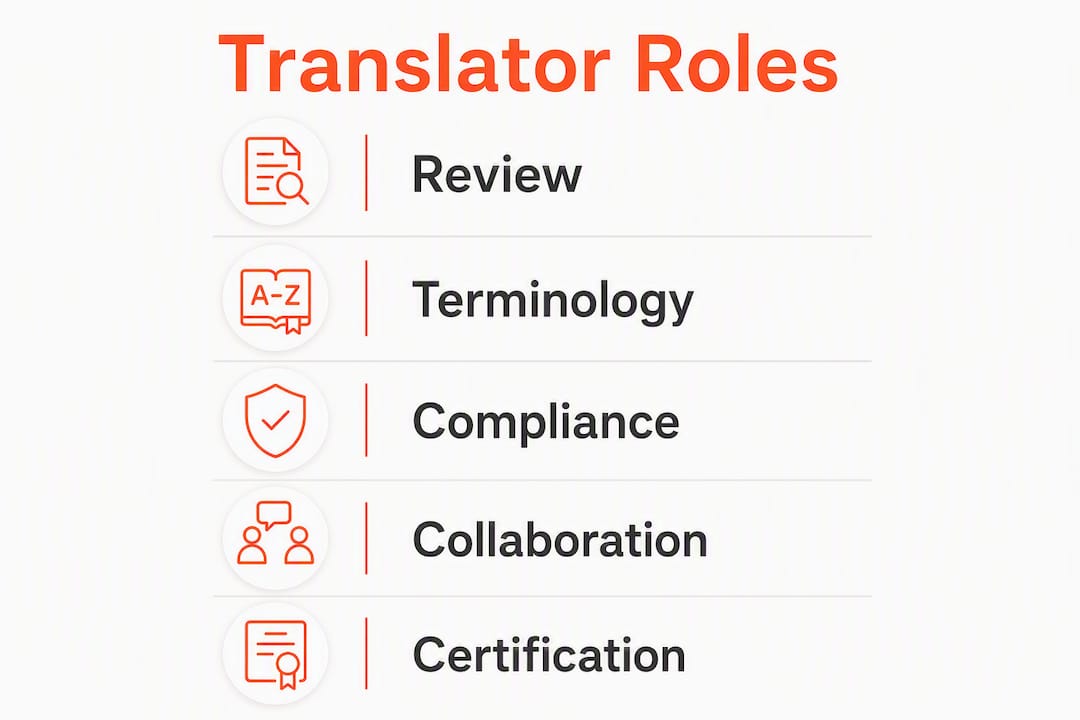
The translator’s core duties in an M&A transaction cover:
- Rendering legal equivalence, not just literal meaning, across source and target languages
- Standardising terminology across every document in the data room
- Preparing certified versions accepted by ASIC, DFAT, and the Australian Business Registry Services (ABRS)
- Maintaining version control so translated drafts stay tied to specific source document versions
Australian deal teams have two primary standards to satisfy: NAATI certification for translations lodged domestically, and DFAT requirements for documents entering legalisation chains. Certitranslate, a NAATI-certified provider, handles both pathways for M&A work across a wide range of languages.
For the deal team, the next steps are concrete: brief your translator alongside legal counsel at the letter of intent stage, identify key documents with the highest valuation or liability exposure, and confirm the certification route required by each receiving authority before translation begins.

Table of Contents
- What do translators actually do in merger agreements?
- Which documents need expert translation in a merger deal?
- What are the most common translation pitfalls in merger agreements?
- Best practices for managing translation risk in cross-border M&A
- What Australian compliance rules apply to translated merger documents?
- How long does M&A document translation take, and what does it cost?
- How do you choose a translator for Australian M&A work?
- Why use a NAATI-certified Australian provider for merger agreement translation?
- Key takeaways
- Why translation belongs on the deal team, not the to-do list
- Certitranslate: NAATI-certified M&A translation for Australian deals
What do translators actually do in merger agreements?
The role of translators in merger agreements goes well beyond substituting words in one language for words in another. A legal translator working on a share purchase agreement (SPA) first analyses the source text to identify concepts that have no direct equivalent in the target legal system, then renders those concepts with equivalent legal effect rather than equivalent vocabulary. That distinction matters in practice: the German concept of Gewährleistung does not map cleanly onto Australian warranty law, and a translator who treats it as a straight synonym creates a clause with different legal consequences than the parties intended.
The practical workflow runs through several layers:
- Source text analysis: identifying jurisdiction-specific concepts, defined terms, and cross-references before drafting begins
- Legal equivalence rendering: choosing target-language formulations that carry the same legal weight, not just the same surface meaning
- Terminology standardisation: applying a deal glossary consistently across the SPA, disclosure schedules, IP assignments, and ancillary documents
- Bilingual clause drafting: where parties agree to a bilingual instrument, drafting both language versions in parallel to prevent divergence
- Certified version preparation: producing the signed, stamped, NAATI-certified output required for lodgement
- Version control: tracking which translated draft corresponds to which source version, critical when documents are amended near close
Quality assurance adds another layer on top of translation itself. A bilingual legal reviewer, ideally a lawyer qualified in both jurisdictions, reads the translated text against the source to catch legal misreadings that a linguistically accurate translation might still contain. Where the stakes are high enough, back-translation (translating the target text back into the source language by a second independent translator) surfaces discrepancies that neither the original translator nor the reviewer caught.
Effective M&A translation functions as a risk-control layer that protects the deal from litigation caused by misaligned translated clauses. A mistranslated termination right or warranty qualification does not just create ambiguity — it can shift liability between parties in ways neither side anticipated at signing.
Accurate legal translation in M&A prevents exactly this: disputes that arise not from what the parties agreed, but from what the translated document says they agreed. Translators and legal counsel also jointly interpret local market practice, helping foreign buyers understand disclosure conventions and regulatory customs that differ from their home jurisdiction.
Which documents need expert translation in a merger deal?
Not every document in a data room requires full translation. Linguistic due diligence focuses on a targeted subset of high-risk documents rather than attempting a full translation of an entire data room, which saves time and directs effort where valuation exposure is greatest. The types of business documents requiring translation in an M&A context fall into two tiers.
Full-document translation is typically required for:
- Share purchase agreements and asset purchase agreements: every clause affects liability allocation; partial translation creates interpretation gaps
- IP filings and assignments: the scope of patent claims and licence grants is set by the exact wording; a narrower translation reduces the asset’s value
- Employment contracts and enterprise agreements: post-close employment liabilities depend on the precise terms; mistranslated notice periods or redundancy entitlements create immediate cost exposure
- Regulatory filings and licences: ASIC, the ATO, and sector regulators require English-language instruments; the translated text becomes the operative document for compliance purposes
- NDAs and confidentiality deeds: breach consequences and carve-outs must be legally equivalent across language versions
- Tax and financial statements: numeric accuracy is non-negotiable; formula errors compound across schedules
Targeted or partial translation is usually sufficient for:
- Disclosure schedules: translate the specific items flagged as material by counsel, not the entire schedule
- Board minutes: translate resolutions and authorisations; background discussion is rarely required
- Material supplier and customer contracts: translate key commercial terms, change-of-control clauses, and termination rights; boilerplate is lower priority
- Due diligence reports prepared by local advisers: translate the executive summary and findings; full translation of supporting appendices is rarely cost-effective
The decision on which tier applies to each document should be made by counsel and the translator together, not by the deal team alone.
What are the most common translation pitfalls in merger agreements?
Translation risk in M&A concentrates in a handful of recurring failure modes. Understanding them lets counsel build controls before they become problems.
Inconsistent terminology across documents is the most common. When an SPA uses one term for a defined concept and the disclosure schedules use a near-synonym, the translated versions can create two different legal meanings where the source documents intended one. A deal glossary, agreed before translation begins, is the primary control.
Jurisdictional concept gaps arise when a legal concept in the source jurisdiction has no equivalent in Australian law. Translators who default to the closest-sounding term rather than explaining the concept in a footnote or drafting a bilingual definition create clauses that courts may interpret differently than the parties intended.
Numeric and formula transcription errors are low-frequency but high-consequence. An earn-out formula with a transposed decimal, or a threshold expressed in the wrong currency, can shift millions of dollars of consideration. Every number in a translated financial schedule should be verified against the source by a second reviewer.
Late translation under time pressure is the operational failure that makes all the others worse. Translation work that starts after the letter of intent leaves no time to act on issues found. When the bulk of the data room goes to translation in the final weeks before close, there is no room for a review cycle, no time to raise queries with the vendor, and no opportunity to renegotiate a clause that the translation reveals is ambiguous.
Version mismatch during notarisation is a procedural failure with serious consequences. Notarisation chains fail when dates or references mismatch the exact source document version; a certified translation tied to an earlier draft of the SPA will be rejected if the lodged instrument is the executed version.
The most damaging translation errors in M&A are not the ones that look wrong. They are the ones that look right in isolation but carry a different legal meaning in the target jurisdiction — and nobody notices until a dispute arises two years after close.
Best practices for managing translation risk in cross-border M&A
The deal teams that manage translation risk well treat it the same way they treat legal or financial due diligence: as a structured process with defined deliverables, not a task to delegate and forget.
-
Integrate translation at the LOI stage. Brief your translator when you brief your lawyers. Identify the five to ten documents with the highest valuation or liability exposure and prioritise those for immediate linguistic review. Full data-room translation can follow, but the high-risk documents need to go first.
-
Build a deal-specific glossary before translation begins. The glossary should cover defined terms from the SPA, jurisdiction-specific concepts, entity names, and any terms where the parties have agreed on a specific translation. Share it with all translators, counsel, and bilingual reviewers working on the deal.
-
Run a structured QA workflow. The sequence is: first translation by a NAATI-certified legal translator → bilingual legal review by a lawyer qualified in both jurisdictions → reconciliation meeting to resolve discrepancies → final certification and version lock. Skipping the reconciliation meeting is where most errors survive into the final document.
-
Handle confidentiality and privilege formally. Every translator and reviewer working on the deal should sign a confidentiality agreement before receiving any documents. Confirm that your translation provider carries professional indemnity insurance and that the coverage extends to M&A work. Privileged documents should be identified and handled under the same protocols as privileged legal advice.
-
Confirm the certification and legalisation route before translation begins. ASIC, DFAT, and ABRS each have specific requirements for translator credentials and document presentation. Discovering that a certification is in the wrong format after the document has been lodged costs time and money that a live deal cannot afford.
Pro Tip: Use back-translation when the translated clause will govern a high-value obligation, such as an earn-out formula, a warranty cap, or a change-of-control trigger. Parallel bilingual drafting, where both language versions are drafted simultaneously rather than one translated from the other, is the stronger approach for bilingual instruments where both versions are contractually operative.
Understanding how legal contract translation works in detail helps counsel set realistic expectations for turnaround and review cycles before the deal clock starts running.
What Australian compliance rules apply to translated merger documents?
Australian law imposes specific obligations on translated documents lodged with domestic authorities, and the requirements differ between agencies.
Section 1304 of the Corporations Act 2001 requires that where an instrument must be lodged or kept for inspection and it is not in English, a certified translation into English must be provided. This applies directly to instruments lodged with ASIC, including foreign company registrations, charges, and constitutional documents.
NAATI certification is the standard for translations lodged with Australian domestic authorities. DFAT requires NAATI credentials and clear translator stamp and signature details for documents entering legalisation chains. ASIC accepts translations made outside Australia under specified overseas certifier categories, but for translations made inside Australia, NAATI professional certified translators are the expected pathway.
A critical distinction that causes problems in practice: a NAATI-certified translation is not the same as a certified copy or an apostille. The certified translation proves language accuracy; it does not prove the source document’s authenticity. Some lodgements with ASIC and ABRS require both a certified copy of the source document and a certified translation. Submitting only the translation will result in rejection.
The practical compliance checklist for Australian M&A filings:
- Tie every certified translation explicitly to the specific source document version (document title, date, and version number in the certification statement)
- Include the translator’s full name, NAATI credential number, and signature on every certified page
- Confirm whether the receiving authority (ASIC, ABRS, ATO, DFAT) requires a certified copy of the source document in addition to the certified translation
- For documents entering a notarisation or apostille chain, verify that dates, version references, and translator details match exactly across every step in the chain
- Check the role of translation in Australian legal proceedings if translated documents may later be tendered in court
AUSIT’s best practice guidelines for official and legal document translation in Australia note that some government departments and courts may impose additional or varying requirements beyond the standard NAATI pathway, so confirming the specific receiving authority’s rules before translation begins is not optional.
How long does M&A document translation take, and what does it cost?
Timeline and cost in M&A translation are driven by document complexity, not word count alone. A 10,000-word SPA with dense defined terms and cross-references takes longer and costs more than a 10,000-word employment contract with standard clauses.
A typical priority translation workflow for a live deal runs:
- Rapid triage (day 1): translator and counsel review the document set, identify high-risk items, and agree on the translation order and glossary
- First translation (days 1–3 for priority documents): NAATI-certified legal translator works from the agreed glossary; standard turnaround for a complex SPA is two to four business days depending on length
- Bilingual legal review (days 3–5): reviewer reads against the source; queries go back to the translator
- Reconciliation and final draft (days 5–6): discrepancies resolved, final text locked
- Certification (day 6–7): certified output produced, tied to the specific source version
The main cost drivers are:
- Document complexity and legal specialisation: IP filings and SPAs attract higher rates than standard commercial contracts
- Required certification level: NAATI certification, DFAT legalisation, and notarisation each add steps and cost
- Volume and urgency: expedited turnaround typically carries a premium
- Bilingual legal review: adds cost but is the single most effective control against legal misreading
- Back-translation: adds a second translation pass; reserve for the highest-stakes clauses
To get an accurate quote, provide the translation provider with: the source file in its final or near-final version (not a draft that will change), the deal glossary if one exists, the target language or languages, the intended certification path, the receiving authority, and the expected use of the translation (lodgement, execution, due diligence review only).
How do you choose a translator for Australian M&A work?
The selection decision for M&A translation is a risk management decision, not a procurement exercise. The cheapest provider who cannot demonstrate NAATI credentials or bilingual legal review capability is not a viable option for documents that will be lodged with ASIC or tendered in court.
Selection checklist:
- NAATI certification at the Professional level in the relevant language pair
- Demonstrated experience with SPAs, IP assignments, employment contracts, and regulatory filings
- Availability of a bilingual legal reviewer (a lawyer, not just a second translator)
- Documented QA process covering first translation, legal review, and reconciliation
- Confidentiality agreement and professional indemnity insurance covering M&A work
- Version control procedures and experience with notarisation and legalisation chains
- References from law firms or corporate counsel on comparable transactions
Questions to ask providers before engaging:
- Can you provide evidence of your NAATI credential number and the language pair it covers?
- What is your process when the bilingual legal reviewer identifies a discrepancy with the translator’s draft?
- How do you handle a glossary provided by the deal team, and what happens when a source term is ambiguous?
- What is your turnaround for a 15,000-word SPA under standard and expedited conditions?
- Have you previously translated documents for lodgement with ASIC or DFAT, and can you describe the certification format you use?
Red flags to watch for: a provider who cannot produce a NAATI credential number on request, no bilingual legal reviewer in the workflow, vague answers about certification format, and no professional indemnity insurance. Understanding why legal terminology requires a specialist translator helps counsel frame these questions and evaluate the answers.
The NAATI certified translator benefits page sets out what NAATI certification actually guarantees, which is useful context when evaluating a provider’s credentials.
Why use a NAATI-certified Australian provider for merger agreement translation?
Certitranslate operates a network of NAATI-certified translators with experience across the legal, technical, and regulatory document types that appear in Australian M&A transactions. The service covers a broad range of languages and is structured specifically for official document translation accepted by Australian authorities, including ASIC, DFAT, ABRS, and the ATO.
For M&A work, Certitranslate’s capabilities include:
- Linguistic due diligence: prioritising high-risk documents and flagging clauses with valuation or liability exposure
- Deal glossary creation and management across the full document set
- Bilingual legal review by reviewers with legal qualifications in the relevant jurisdictions
- NAATI-certified output with full translator credentials, tied to specific source document versions
- DFAT and notary support for documents entering legalisation chains
- Fast turnaround on priority documents, with expedited options for live deals
- Confidentiality agreements and professional indemnity insurance as standard
The documents Certitranslate commonly handles for M&A transactions include share purchase and asset purchase agreements, disclosure schedules, IP filings and assignments, employment contracts, regulatory licences, board resolutions, financial statements, and NDAs.
Pro Tip: When requesting a scope and quote for M&A translation, attach the source documents in their current version (even if not final), specify the target language or languages, identify the receiving authority for each document, and state whether NAATI certification, DFAT legalisation, or notarisation is required. A complete brief at the outset avoids scope changes that delay delivery.
To request a scope and quote, visit Certitranslate’s NAATI translators page and submit the document details, target languages, and certification requirements. The team will confirm turnaround and pricing based on the specific deal context.
Key takeaways
Translators in cross-border merger agreements function as a risk-control layer: engage a NAATI-certified legal translator at the LOI stage, build a deal glossary, and confirm the certification route before a single document goes to translation.
| Point | Details |
|---|---|
| Engage translators early | Brief your translator at the LOI stage, not after signing, to allow time for review cycles and remediation. |
| Prioritise high-risk documents | Focus first on SPAs, IP filings, and employment contracts; these carry the greatest valuation and liability exposure. |
| NAATI certification is required | Australian authorities including ASIC and DFAT require NAATI-certified translations for domestic lodgements. |
| Certified translation and certified copy are different | Some ASIC and ABRS lodgements require both; submitting only the translation will result in rejection. |
| Certitranslate for Australian M&A | Certitranslate provides NAATI-certified legal translation with bilingual legal review, glossary management, and DFAT support. |
Why translation belongs on the deal team, not the to-do list
The conventional framing of translation in M&A is that it is an administrative task: something you hand off once the real work is done. That framing is wrong, and it costs deals money.
The deals where translation causes the most damage are not the ones where a translator made an obvious error. They are the ones where a legally accurate translation rendered a concept from one legal system into the vocabulary of another without flagging that the two concepts are not equivalent. The translated clause looks right. It passes a cursory review. It gets executed. And then, eighteen months after close, a dispute arises over a warranty or a licence scope, and the parties discover that the translated version created an obligation neither of them intended.
The fix is not better translators. It is earlier translators. Integrating linguistic review into due diligence, before the SPA is drafted, means that concept gaps surface when there is still time to negotiate the clause rather than litigate it. It also means the deal glossary is built from the source documents, not retrofitted after the fact.
The other underestimated issue is the collaboration model. Translators working in isolation from counsel produce technically accurate text that may still be legally wrong. The reconciliation meeting between the translator and the bilingual legal reviewer is where the real quality control happens. That meeting should be a scheduled deliverable in the deal plan, not an optional extra that gets cut when the timeline compresses.
For Australian deals, the practical note is this: build a central terminology repository from each transaction and carry it forward. The glossary from a Japanese acquisition becomes the starting point for the next one. That accumulated institutional knowledge is worth more than any single translation.
Certitranslate: NAATI-certified M&A translation for Australian deals
Cross-border merger agreements demand more than fluency. They demand legal precision, certified credentials, and a process that holds up under scrutiny from ASIC, DFAT, and the courts. Certitranslate delivers exactly that: NAATI-certified translators with M&A experience, bilingual legal reviewers, and certification support for every Australian lodgement pathway.
The documents Certitranslate handles for M&A transactions include SPAs, IP assignments, employment contracts, regulatory filings, disclosure schedules, board resolutions, and NDAs, across more than 120 languages. Every translation is tied to a specific source version, carries full NAATI credentials, and is backed by professional indemnity insurance.
To get started, visit the certified translation services page and submit your source documents, target languages, receiving authority, and certification requirements. For a detailed overview of what NAATI certification means for your filing, the benefits of professional certified translation page sets out what you can expect from a properly credentialled provider. Request your M&A translation scope and quote today.
Recommended
- Certified translation for import/export agreements: 2026 guide – CertiTranslate – Translations by NAATI Certified Translators
- How legal contract translation works: a complete guide – CertiTranslate – Translations by NAATI Certified Translators
- Why legal terminology requires a specialist translator – CertiTranslate – Translations by NAATI Certified Translators
- Certified translation of a power of attorney: 2026 guide – CertiTranslate – Translations by NAATI Certified Translators