


A translated court order is a certified English version of a judicial order issued in another language, prepared for official use in Australian legal or immigration proceedings. You need one when submitting foreign court documents to the Department of Home Affairs, registering an overseas parenting order in the Federal Circuit and Family Court of Australia, or presenting foreign evidence in civil or criminal proceedings.
The most common uses are:
- Visa and immigration applications where a foreign court order forms part of the evidence
- Child migration and custody matters requiring proof of parental responsibility
- Registration and enforcement of overseas judgments in Australian courts
- Family law proceedings involving overseas parenting, divorce, or property orders
Certification matters from the start. Australian authorities generally expect a translator’s signed statement confirming accuracy, along with the translator’s name, address, and qualifications. Translators accredited by NAATI (the National Accreditation Authority for Translators and Interpreters) are widely recognised as meeting this standard.
Table of Contents
- What a complete translated court order file must contain
- When do you actually need a translated court order in Australia?
- How translated orders are accepted in Australian legal and immigration processes
- How to get a certified translation of a court order for use in Australia
- Certified translation, notarisation, and affidavits: what’s the difference?
- Common problems that cause rejections and how to avoid them
- Key takeaways
- The detail most people overlook
- Certitranslate: NAATI-certified translations for Australian courts and immigration
What a complete translated court order file must contain
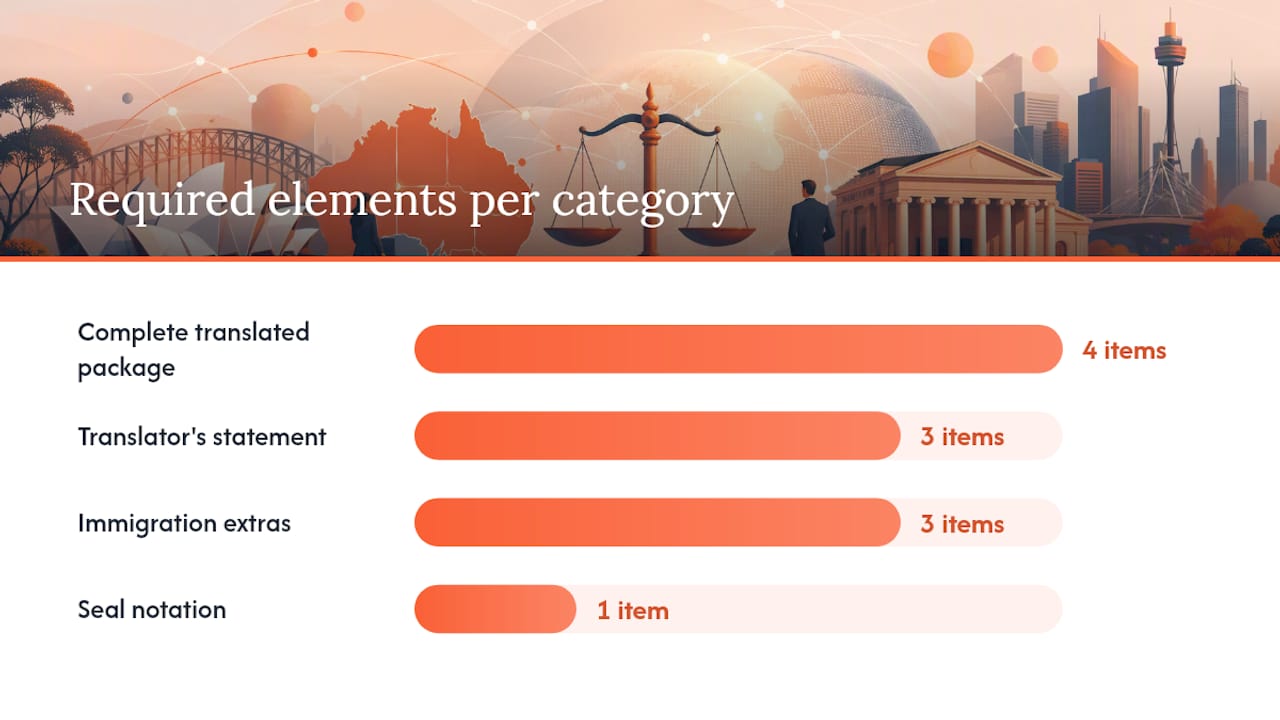
A translated court order is not just the translated text. Courts and immigration offices expect a full package, and a missing page or absent certificate is enough to trigger a rejection.
The package typically includes:
- A complete English translation of every page of the original order, including headers, footers, seals, and stamps
- A certified copy of the original foreign-language order
- All exhibits, annexures, and attachments that form part of the order
- A translator’s signed certificate or statement in English
The Attorney-General’s Department is explicit: every document served in Australia must be in English or accompanied by an English translation, and that translation must include a statement confirming its accuracy along with the translator’s name, address, and qualifications. The Department even provides a downloadable template for translation certificates.
The translator’s statement itself needs to cover specific ground. It should confirm:
- That the translation is accurate and complete to the best of the translator’s knowledge
- The translator’s full name, address, and professional qualifications or NAATI accreditation number
- The date the translation was completed
“Every document including exhibits must be in English or translated into English for service in Australia.” — Attorney-General’s Department, Serving Foreign Legal Documents in Australia
For immigration submissions, courts often also ask for a bilingual format (original and translation side by side), numbered pages, and sometimes duplicate sets. If the order carries an official seal or stamp, the translation should note its presence and describe it, even if the seal itself cannot be reproduced.
When do you actually need a translated court order in Australia?
Several distinct situations trigger the requirement, and they come up more often than people expect.
Immigration applications. The Department of Home Affairs requires translated legal documents when a foreign court order is relevant to a visa decision. This includes child migration visas, partner visas where a divorce decree is needed, and any application where custody or guardianship arrangements must be evidenced. The immigration document translation process for these submissions follows specific formatting rules that differ from general document translation.
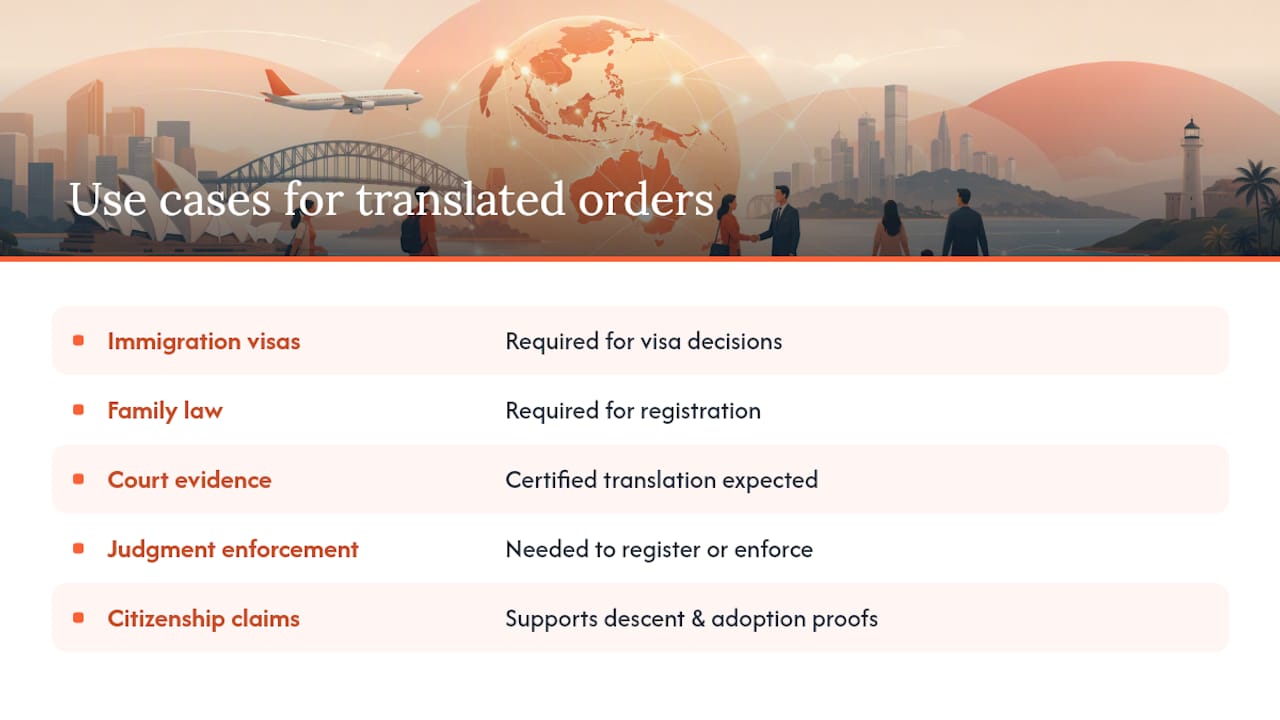
Family law and parenting orders. Australia has processes to register overseas family law orders, and registration requirements typically include certified copies of the order, certificates from local authorities in the originating country, and translations where the order is not in English. Once registered, a foreign parenting order is treated as if it were made by an Australian court.
Court proceedings involving foreign evidence. When a party to Australian litigation needs to rely on a foreign court order as evidence, the document must be in English or accompanied by a certified translation. Under the Foreign Evidence Act 1994 (Cth) and applicable court rules, the court has discretion over how foreign documents are admitted, but a certified translation is the baseline expectation.
Registration and enforcement of foreign judgments. To register or enforce a foreign judgment in Australia, applicants must file the foreign judgment together with a certified translated copy where necessary. Once registered, a recognised foreign judgment becomes enforceable in the same way as a local judgment.
Citizenship and descent claims. Translated court orders can also support citizenship by descent applications where a foreign adoption order, parentage declaration, or name-change order must be presented to Australian authorities. Services like Roots Recovered work alongside translation providers on exactly these kinds of genealogy and citizenship matters.
How translated orders are accepted in Australian legal and immigration processes
A certified translation carries real legal weight, but only when it meets the receiving authority’s requirements. Courts and government agencies treat the translator’s certificate as the primary trust signal. NAATI accreditation reinforces that signal because it demonstrates the translator has been independently assessed for competency in legal language.
When a translated order is used as evidence, the court may ask for the original to be produced alongside the translation. The Federal Circuit and Family Court of Australia takes compliance with orders seriously: once a court order is made, parties must comply, and any translated order used in contravention or enforcement proceedings must be complete and accurate. An incomplete translation can undermine the entire application.
A certified translation accepted by the Department of Home Affairs or an Australian court is not just a language exercise. It is a legal document in its own right, and it carries the same obligation for accuracy as the original order.
For some purposes, a certified translation alone is not enough. An apostille or legalisation may be required when the originating country is a party to the Hague Apostille Convention and the receiving Australian authority needs to verify the authenticity of the original document’s signatures or seals. This is separate from the translation itself.
Pro Tip: Before ordering an apostille or embassy legalisation, confirm with the receiving authority whether they actually require it. Many Australian immigration and court submissions accept a certified translation and certified copy without any apostille, and paying for one unnecessarily adds cost and time.
How to get a certified translation of a court order for use in Australia
The court order translation process is straightforward when you follow the right sequence.
- Check the receiving body’s specific requirements. The visa office, court registry, or Family Law Section may have their own format rules. Some require bilingual PDFs; others specify the number of copies. Confirm before you order.
- Gather your documents. Collect the original order, all pages and exhibits, and a certified copy if you have one. Scan everything as a clear, high-resolution PDF. Blurry scans are one of the most common causes of delay.
- Choose a NAATI-certified translator. Ask specifically for a translator’s signed certificate in English that includes their full name, address, and NAATI accreditation number. Knowing how to choose the right certified translator for your document type matters here — legal translation requires specialist terminology knowledge, not just language fluency.
- Request any additional services upfront. If the receiving authority requires notarisation, an apostille, or a translator’s affidavit, confirm this before the translation begins. Ordering these after the fact adds turnaround time.
- Submit with duplicates and comply with filing rules. Many courts and immigration offices require two or three certified copies. Check whether the original foreign-language document must be attached to each copy of the translation.
Pro Tip: Ask your translator to include their contact details on the certificate. Courts and immigration officers occasionally need to verify credentials directly, and a certificate with a phone number or email address on it resolves that query without delay.
Understanding why original documents accompany translations is also worth reading before you submit — it explains what supporting documentation to include and why providers ask for originals or certified copies alongside the translated text.
Certified translation, notarisation, and affidavits: what’s the difference?
These three terms are often confused, and mixing them up can mean ordering the wrong service.
- Certified translation means the translator has signed a statement confirming the translation is accurate and complete, and has provided their name, address, and qualifications. In Australia, this is the standard form of attestation for most immigration and court submissions. NAATI accreditation is the most recognised credential for this purpose.
- Notarisation involves a notary public witnessing and authenticating signatures, not verifying the accuracy of a translation. A notary may be asked to verify that the person signing the translator’s certificate is who they claim to be, but notarisation does not replace the translator’s own accuracy statement. The difference between notarised and certified translation in Australian legal contexts is worth understanding before you pay for a service you may not need.
- Affidavit or statutory declaration from the translator is a sworn statement, made before a justice of the peace or solicitor, in which the translator formally attests to the accuracy of the translation. Under the Federal Circuit and Family Court of Australia (Family Law) Rules 2021, Rule 8.07, a translation filed with a letter of request must be accompanied by an affidavit that sets out the translator’s full name, address, and qualifications. This is a stricter requirement than a standard certificate.
- A sworn translation or affidavit of translation involves the translator making a formal oath that the translation is accurate. Different jurisdictions and bodies vary in which form they accept, so always confirm with the receiving authority.
Pro Tip: Most Australian immigration submissions and standard court filings accept a certified translation with a signed translator’s certificate. An affidavit is specifically required for letters of request and some foreign evidence procedures. Check the rule that applies to your matter before ordering.
Common problems that cause rejections and how to avoid them
Most translation rejections are preventable. The issues that come up repeatedly are:
- Missing pages or exhibits. If the original order has five pages and the translation covers four, it will be rejected. Count every page, including cover sheets and signature pages.
- Poor-quality scans. A blurry or partially cut-off scan means the translator cannot produce an accurate translation, and the receiving authority may question whether the document is complete.
- No translator statement or certificate. A translation without a signed certificate is treated as an unofficial document regardless of how accurate it is.
- Name and date discrepancies. Names must be transliterated consistently across all documents in a submission. A name that appears differently in the translation than in the passport or visa application creates a red flag.
- Machine-translated text without certification. Using an AI or online tool to translate a court order and then submitting it as a certified translation is not acceptable. The translator’s personal attestation is what gives the document its legal standing.
Before submitting, run through this checklist:
- Every page of the original order is included in the translation
- The translator’s signed certificate is attached and contains their name, address, and qualifications
- All exhibits and annexures are translated
- Names, dates, and case numbers match across all documents
- The required number of copies is prepared
- Any additional authentication (apostille, notarisation) has been confirmed as required
Pro Tip: If you are filing under a court deadline, flag this to your translation provider at the time of ordering. Expedited services are available, but the provider needs to know upfront. Requesting urgency after a translation is already in progress rarely speeds things up.
Key takeaways
A translated court order must be a complete, certified English translation with a signed translator’s statement to be accepted by Australian courts or the Department of Home Affairs.
| Point | Details |
|---|---|
| Certification is mandatory | Every translation needs a signed statement with the translator’s name, address, and qualifications to be accepted officially. |
| NAATI accreditation matters | NAATI-qualified translators are the recognised standard for immigration and court submissions across Australia. |
| Affidavits apply in specific cases | Letters of request under Family Law Rules 2021 require a translator’s affidavit, not just a certificate. |
| Check requirements before ordering | Apostilles, notarisation, and duplicate copies vary by authority — confirm before paying for extra services. |
| Certitranslate provides compliant translations | Certitranslate’s NAATI-certified translators deliver signed certificates and complete packages accepted by Australian authorities. |
The detail most people overlook
The most consistent problem with translated court orders is not the translation itself. It is the package. A translator can produce a technically accurate, NAATI-certified translation and still have it rejected because an exhibit was missing, the scan was too dark to read clearly, or the certificate did not include a street address.
Courts and immigration officers are not being difficult when they reject incomplete submissions. They are applying rules that exist precisely because the stakes in these matters are high: custody arrangements, visa outcomes, enforcement of judgments. An incomplete or ambiguous document creates genuine legal risk.
The practical habits that make the biggest difference are small ones. Name your files clearly (include the document type, language, and date in the filename). Supply a certified copy of the original alongside the translation, not just a photocopy. Make sure the translator’s certificate is on a separate page, signed in ink or with a verifiable digital signature, and that it references the specific document being translated. These details take minutes to get right and can save weeks of back-and-forth.
Turnaround for a standard certified translation of a court order is typically a few business days for most language pairs. Complex orders with many exhibits or rare language combinations take longer. If you are working toward a court filing date or a visa deadline, build in buffer time and communicate the deadline clearly when you place the order. Involving a solicitor early is worth considering for contested family law matters or enforcement proceedings where the translation forms a central piece of evidence.
Certitranslate: NAATI-certified translations for Australian courts and immigration
Getting a court order translation right the first time saves you from the delays that come with resubmissions. Certitranslate works with NAATI-certified translators across more than 120 languages, producing certified translations that include a signed translator’s certificate, full-page coverage of every exhibit, and clear evidence of translator credentials — the exact package that Australian courts and the Department of Home Affairs expect.
Every order comes with a signed certificate of accuracy, a bilingual PDF where required, and guidance on whether notarisation or an apostille applies to your specific submission. For immigration matters, Certitranslate’s translators understand the Department of Home Affairs’ formatting expectations. For court filings, the delivery package is structured to meet the requirements of the Federal Circuit and Family Court of Australia.
To get started, visit Certitranslate’s document translation service or check the NAATI-certified translator page to confirm language availability and request a quote. If you are unsure whether your order needs an affidavit or apostille, the team can advise before you commit to a service level.
Recommended
- Role of translation in civil legal cases in Australia – CertiTranslate – Translations by NAATI Certified Translators
- Why original documents accompany translations: 2026 guide – CertiTranslate – Translations by NAATI Certified Translators
- Notarized vs certified translation: legal guide for Australia – CertiTranslate – Translations by NAATI Certified Translators
- Will translation in Australia: what you need to know – CertiTranslate – Translations by NAATI Certified Translators