


A will translation is a certified English rendering of a testamentary document, produced so Australian courts, probate registries, and financial institutions can assess a deceased person’s wishes. If the original will is in another language, or the testator did not read English, you will almost certainly need a NAATI-certified translation before probate can proceed. Gather the original will, any codicils, and the attestation page, then contact a NAATI-accredited translator or Certitranslate to begin.
What you need at a glance:
- The original will (every page, including the signature and witness page)
- Any codicils or amendments
- A death certificate
- A NAATI-certified translator who specialises in legal documents
- A signed translator attestation statement with the translator’s NAATI credential number
Pro Tip: Ask the translator upfront whether they can also provide a sworn affidavit. Some probate registries request one in addition to the standard certified translation, and arranging it at the same time saves a second round of fees.
Table of Contents
- When do you actually need a will translation?
- Who can translate a will, and what will courts actually accept?
- How to prepare and order a will translation for probate
- Which Australian institutions accept translations, and what do they need?
- What does a will translation cost, and how long does it take?
- Common reasons translations get rejected, and how to avoid them
- How Certitranslate handles will translations for Australian probate
- How to choose the right translator for a will
- What happens if a will translation is incorrect or fraudulent?
- When should you re-translate or update a will translation?
- How to securely submit and store translated wills for probate
- Key takeaways
- Why certified translations prevent estate disputes
- Certitranslate: NAATI-certified will translations, ready when you need them
- Useful sources and further reading
When do you actually need a will translation?
Not every estate involving a multilingual family requires a formal translation. The trigger is almost always the document itself or the filing jurisdiction.
- The original will is written in a language other than English. A will does not need to be in English to be valid, but a certified translation is required at the time of death before the estate can be distributed.
- The testator could not read or speak English. A translator must have read and explained the entire will to the testator in the presence of witnesses before signing. Courts will want evidence of that process.
- You are filing probate in Australia for an overseas will. Foreign wills generally need certified translation and sometimes notarisation before an Australian probate registry will accept them.
- Foreign assets or beneficiaries are involved. Overseas banks, land registries, or trustees may require their own certified copy alongside the Australian grant of probate.
- Immigration authorities request estate documents. The Department of Home Affairs requires certified translations for non-English documents submitted with visa or residency applications.
The distinction between probate filing and informal family use matters here. A bilingual family member reading a will aloud at a kitchen table is fine for personal understanding. The moment you need to file with a Supreme Court, open a deceased estate account, or transfer title, you need a formal certified translation on the record.
Who can translate a will, and what will courts actually accept?
Australian courts do not accept just any bilingual person’s word. The accepted standard is a NAATI-accredited translator, and the reasons are practical, not bureaucratic.

NAATI (the National Accreditation Authority for Translators and Interpreters) sets the professional benchmark for language services in Australia. A NAATI-certified translator has demonstrated competency at a recognised level, holds a credential number, and is bound by a code of ethics. When a translation carries that credential, courts and registries have a verifiable, accountable record of who produced it.
The Supreme Court of NSW made the stakes clear in Rogic v Samaan [2018] NSWSC 1464, where the court cautioned against bilingual solicitors acting as translators in their own cases. Being bilingual is not the same as being a qualified translator, and a solicitor who doubles as interpreter risks professional compromise if the accuracy of the translation is later questioned.
| Credential type | When it applies | Accepted for probate? | Key limitation |
|---|---|---|---|
| NAATI-certified translator | Document translation for courts, registries, banks | Yes, widely accepted | Must include signed attestation and NAATI number |
| Sworn/affidavit translator | Where registry requires a sworn statement | Yes, with affidavit | Additional cost and witnessing step |
| Notarised translation | Foreign documents, cross-border probate | Sometimes required | Notarisation confirms identity, not translation accuracy |
| Bilingual solicitor | Legal advice only | Not recommended | Court has explicitly flagged professional conflict risk |
| Family member or friend | Informal use only | No | No accountability; courts will reject |
A few practical points worth noting:
- The translator’s signed certification statement and NAATI number are the fastest trust signals a registry will check. They should appear on the translation cover page, not buried in a footnote.
- Notarisation and certified translation are different things. Notarisation confirms the identity of the person signing a document; it does not verify the accuracy of the translation itself. Some foreign wills require both.
- Where a bilingual lawyer is involved, keep the translator separate. Even if the solicitor speaks the client’s language, an independent certified translator should verify and sign the translation to avoid evidentiary challenges later.
How to prepare and order a will translation for probate
Getting the paperwork right before you contact a translator saves time and money. Courts are unforgiving about incomplete submissions.
Documents to collect before ordering:
- Original will (every page, not just the signature page)
- Attestation/witness page(s) showing the testator’s and witnesses’ signatures
- All codicils or amendments, in order
- Any notarisation stamps or apostilles on foreign documents
- Death certificate (certified copy)
- Executor’s identification documents
What the translator delivers:
- A complete certified English translation of every page
- A signed attestation statement confirming accuracy and completeness
- The translator’s full name and NAATI credential number on the cover
- Scanned copies of the original document attached to the translation
- A sworn affidavit if the registry or court requires one
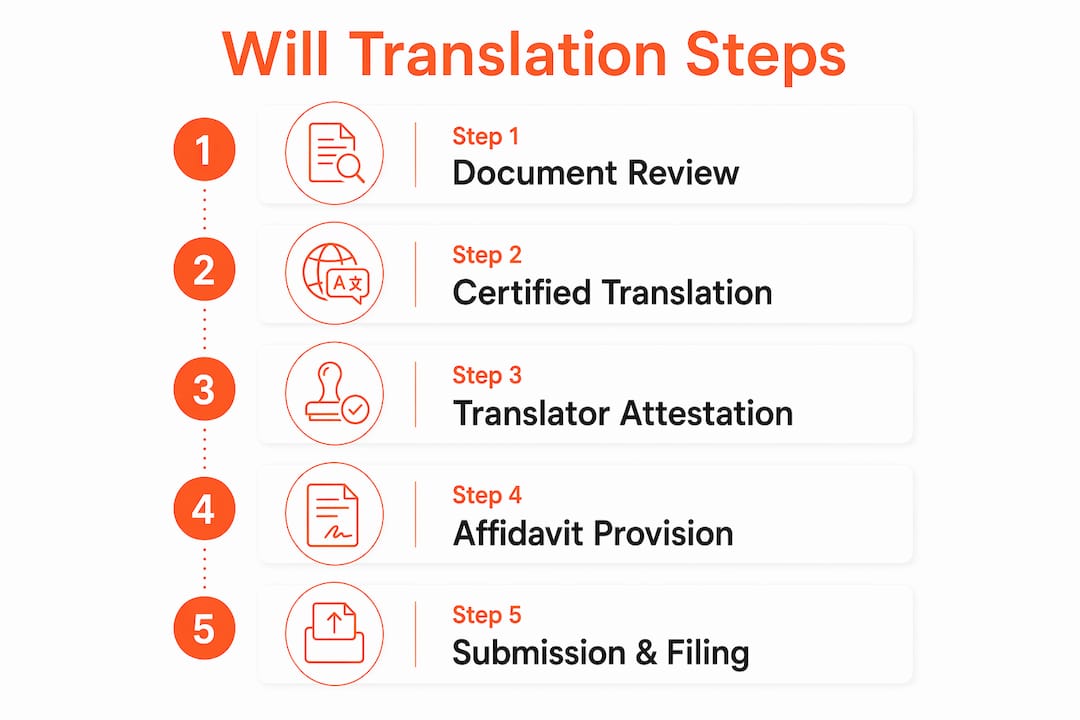
Step-by-step ordering process:
- Scan all documents at high resolution (300 dpi minimum; colour preferred for stamps and seals).
- Request a written quote that specifies word count, language pair, turnaround, and whether an affidavit is included.
- Confirm the scope in writing: which pages, which codicils, and whether notarisation or witnessing is needed.
- Provide originals or certified copies if the translator needs to inspect physical stamps or seals.
- Review the draft translation against the original before signing off, even if you only check names, dates, and figures.
- Request the final certified package: translation, attestation, NAATI credential, and scanned originals.
Execution procedure for a non-English testator
When the testator cannot read English, the translator must read and explain the entire will to them in the presence of two independent witnesses. The translator then informs the witnesses that the testator understands and approves the will before anyone signs. The attestation clause in the will should record these circumstances explicitly. Courts assessing testamentary capacity for a non-English speaker will look for exactly this kind of documented evidence.

Pro Tip: Scan at colour and 300 dpi or higher. Blurry or black-and-white scans that obscure notary stamps are one of the most common reasons a registry sends a translation back for resubmission.
| Document | Why it matters | Who provides it |
|---|---|---|
| Original will (all pages) | Courts verify the translation against the source | Executor/family |
| Attestation/witness page | Confirms valid execution | Executor/family |
| Codicils | Must be translated in full alongside the will | Executor/family |
| Death certificate | Required for probate filing | Registry/hospital |
| Translator attestation | Confirms accuracy and NAATI credentials | NAATI translator |
| Translator affidavit | Required by some registries | NAATI translator + JP/notary |
Which Australian institutions accept translations, and what do they need?
The short answer: Supreme Court probate registries in every state and territory, banks administering deceased estates, trustees, insurers, and the Department of Home Affairs all commonly require NAATI-certified translations for non-English wills.
Each body has its own supporting document requirements, but the core package is consistent:
- Original will or a notarised copy
- Complete certified English translation with translator attestation and NAATI number
- Death certificate
- Witness affidavits where execution is in question
- Translator affidavit where the registry specifically requests one
Foreign wills often require both certified translation and notarisation before NSW probate registries will accept them. Courts also check the formal and substantive validity of the foreign will under the law of the country where it was made, so a translation alone is sometimes not enough.
Registry requirements vary by state. The NSW Supreme Court probate registry, for instance, has specific filing instructions that differ from Victoria’s. Check the local probate registry’s current requirements before you file, not after. A wills and estates lawyer, such as those at Elamine Lawyers, can confirm what your specific registry expects and flag any state-specific caveats before you submit.
What does a will translation cost, and how long does it take?
Pricing for certified will translations in Australia depends on several variables. There is no flat rate, and any quote that does not specify scope should be treated with caution.
Factors that affect price:
- Word count and document length. Most translators price per word or per page. A short, simple will costs less than a multi-page document with codicils and notarisation stamps.
- Language pair. Common languages (Mandarin, Arabic, Vietnamese, Greek, Spanish) are generally priced lower than rare or less-resourced languages where fewer NAATI-accredited translators exist.
- Legal complexity. Wills contain specialist terminology. A translator with legal translation experience may charge a premium, but the accuracy is worth it.
- Affidavit or sworn statement. If the registry requires a sworn affidavit, expect an additional fee for the witnessing step and any JP or notary involvement.
- Urgency. Rush turnarounds (24–48 hours) attract a premium over standard 3–5 business day delivery.
Get a written quote that itemises each deliverable: the translation itself, the attestation statement, any affidavit, and scanned originals. Verbal quotes are not useful when a probate registry later asks what was included.
Common reasons translations get rejected, and how to avoid them
Rejections are almost always preventable. The same mistakes appear repeatedly.
- Partial translations. Every page of the will must be translated, including the attestation clause, witness signatures, and any notarisation stamps. Translating only the “main body” and skipping the execution page is a common error.
- Poor scan quality. Blurry images, missing pages, or scans that obscure stamps give registries grounds to request resubmission.
- Missing translator attestation. A translation without a signed statement of accuracy and the translator’s NAATI number is not a certified translation. It is just a document.
- Family member or beneficiary translators. Courts will not accept a translation produced by someone with a financial interest in the estate. The conflict is too obvious.
- No record of the execution process. For non-English testators, courts want evidence that the will was read and explained to them. Without file notes or an attestation clause recording this, capacity can be challenged.
If a translation is rejected, ask the registry for the specific reason in writing. The fix is usually one of three things: obtain a sworn affidavit from the translator clarifying the process, provide the original document or a notarised copy, or commission a fresh translation with a more detailed attestation. A translator affidavit and careful execution records can also reduce the need for courts to subpoena witnesses, which saves time and money for everyone involved.
Pro Tip: Keep a file note of every step: who translated, when, what was read to the testator, who witnessed, and what the testator said. If probate queries arise months later, that record is your first line of defence.
How Certitranslate handles will translations for Australian probate
Certitranslate’s team of NAATI-certified translators handles the full scope of what probate registries and courts expect.
- Certified translation with signed attestation: every translation includes a signed statement of accuracy, the translator’s full name, and their NAATI credential number on the cover page.
- Scanned originals attached: the certified package includes scanned copies of the source document so registries can verify the translation against the original.
- Optional affidavit or notary liaison: where a registry requires a sworn affidavit, Certitranslate can arrange the additional witnessing step.
- Accepted for probate and immigration: translations are formatted to meet the requirements of Australian Supreme Court probate registries and the Department of Home Affairs.
The process is straightforward. Upload your scanned documents, receive a written quote with a clear scope, confirm whether an affidavit or notarisation is needed, and receive the certified English translation with all attachments. For complex estates or cross-border matters, Certitranslate can advise on what the specific registry is likely to require.
Visit Certitranslate’s will translation guide for a full breakdown of deliverables and how to order.
How to choose the right translator for a will
Not every NAATI-accredited translator is the right fit for a will. Accreditation sets the floor; legal experience sets the ceiling.
Look for a translator who holds NAATI certification at the Professional level or above for the relevant language pair. Verify the credential directly on the NAATI website before engaging anyone. Beyond accreditation, ask whether the translator has experience with wills, probate documents, or legal instruments specifically. Legal translation requires familiarity with testamentary terminology that a general translator may not have.
Ask for a sample attestation statement before you commit. The statement should include the translator’s full name, NAATI number, a declaration of accuracy and completeness, and the date. If a translator cannot produce a clear example, that is a signal to keep looking. For guidance on what to ask and what to check, Certitranslate’s translator selection guide covers the key questions in plain language.
What happens if a will translation is incorrect or fraudulent?
A mistranslation in a will is not a minor administrative error. Courts treat the translated document as the legal record of the testator’s wishes, so an inaccuracy can directly affect how assets are distributed.
A minor misinterpretation can have major consequences for estate distribution. If a beneficiary’s name is rendered incorrectly, a specific bequest is mistranslated, or a condition attached to a gift is omitted, the estate may be distributed in a way the testator never intended. Correcting that after probate is granted is expensive and sometimes impossible.
Fraudulent translations carry more serious consequences. Submitting a knowingly false translation to a court or registry can constitute fraud, potentially exposing the executor or the person who commissioned the translation to criminal liability. Australian courts have the power to set aside a grant of probate if fraud is later established, which can unwind asset transfers and trigger litigation.
The practical protection is straightforward: use a NAATI-certified translator with legal experience, retain the original documents, and keep a complete record of the translation process. If a dispute arises later, that paper trail is what courts will examine first.
When should you re-translate or update a will translation?
A certified translation is tied to the document it was produced from. If that document changes, the translation needs to change with it.
The most common trigger is a codicil. If the testator adds or amends a codicil after the original translation was completed, the new codicil must be translated separately and attached to the existing certified translation. Submitting the original translation without the updated codicil is effectively an incomplete record.
Other triggers include: discovery of a later will that supersedes the one already translated; a court order requiring a fresh translation due to quality concerns with the original; or new evidence about the testator’s capacity or intentions that requires the translation record to be supplemented with an affidavit. In each case, the approach is the same: commission a fresh certified translation of the new or amended document, obtain a new attestation, and file the updated package with the relevant registry or institution. Do not attempt to annotate or amend an existing certified translation yourself.
How to securely submit and store translated wills for probate
Certified translations are legal records. Treat them accordingly.
Submit certified translations to probate registries as part of a complete filing package, not as standalone documents. Keep a copy of everything you submit, including the cover letter, the certified translation, the attestation page, scanned originals, and any affidavits. Registries can lose documents, and having a complete duplicate set means you are not starting from scratch if something goes missing.
For storage, keep both a physical copy and a secure digital copy. Password-protected cloud storage with access limited to the executor and the estate’s solicitor is a sensible baseline. Physical copies should be stored with the original will, ideally in a fireproof location or with the solicitor managing the estate. Do not store the only copy of a certified translation in the same location as the original will. If one is lost or damaged, you want the other to survive.
If the estate spans multiple jurisdictions, each jurisdiction may need its own certified copy. Order multiple certified copies at the time of translation rather than returning to the translator later. It is almost always cheaper to do it in one round.
Key takeaways
NAATI-certified translations are the accepted standard for Australian probate, and gathering the complete document set before ordering avoids the most common delays and rejections.
| Point | Details |
|---|---|
| NAATI certification is the standard | Australian courts and registries accept NAATI-certified translations; other credentials are not reliably accepted. |
| Gather documents before ordering | Collect all will pages, attestation/witness pages, codicils, and the death certificate before contacting a translator. |
| Avoid family translators | Courts reject translations from anyone with a financial interest in the estate; use an independent NAATI-certified translator. |
| Request attestation and affidavit | Always ask for a signed attestation with the translator’s NAATI number; request a sworn affidavit if the registry requires one. |
| Certitranslate for probate and immigration | Certitranslate provides NAATI-certified will translations with signed attestations, scanned originals, and optional affidavit support. |
Why certified translations prevent estate disputes
The cases that end up in litigation are rarely about the will itself. They are about whether the testator understood what they were signing, whether the translation was accurate, and whether anyone kept a proper record of the process.
A NAATI-certified translation with a detailed attestation does three things at once: it gives the court a verifiable record of who translated the document, it creates an accountable chain of evidence for the testator’s intentions, and it reduces the grounds on which a disgruntled beneficiary can challenge the process. File notes and witness affidavits do the same for the execution stage.
The estates that attract the most scrutiny are those where shortcuts were taken: a bilingual relative translated the will, no one recorded the execution process, or the translation was produced without a formal attestation. Those shortcuts feel like savings at the time. They rarely are. Getting a proper certified translation at the outset, with full attestation and meticulous records, is the most cost-effective risk management available to an executor dealing with a non-English will.
Certitranslate: NAATI-certified will translations, ready when you need them
Probate doesn’t wait, and neither should your translation. Certitranslate gives executors and families a direct path to certified will translations that Australian courts and registries accept, without the back-and-forth of chasing credentials or reformatting documents.
Every translation comes from a NAATI-accredited translator with legal document experience, includes a signed attestation statement with the translator’s credential number, and arrives with scanned originals attached. For estates that need a sworn affidavit or notary liaison, Certitranslate can arrange that in the same order. Turnaround is fast, the scope is confirmed in writing before work begins, and the final package is formatted for probate filing from day one.
If you are managing an estate with a non-English will, order your certified translation through Certitranslate today and have a court-ready document in hand before your next registry deadline.
Useful sources and further reading
The sources below are primary references for Australian probate requirements, NAATI accreditation, and will execution rules.
- LawHub Victoria — Does a will need to be in English?: confirms that a will does not need to be in English but requires certified translation at the time of death.
- NSW Government — Learn about wills: overview of will requirements and translated factsheets in multiple languages.
- State Library of NSW — Making a valid will: detailed execution requirements under the Succession Act 2006 (NSW).
- Matthews Folbigg Lawyers — Wills for non-English speaking clients: explains the Supreme Court’s caution about bilingual solicitors acting as translators.
- Mentor by Lawyers — Role of translator for non-English wills: execution procedure when the testator does not speak English.
- WMD Law — Testamentary capacity for non-English speakers: how courts assess capacity and the role of certified translators in evidencing comprehension.
- Legal Finda — Translation and notarisation of a foreign will in NSW: practical guide to cross-border probate requirements.
- Certitranslate — Translate a will or testament: publisher’s dedicated resource on will translation deliverables and ordering.
- Certitranslate — Notarised vs certified translation guide for Australia: explains when notarisation is needed alongside a certified translation.
Check your local probate registry early. Requirements vary between states and territories. The NSW Supreme Court probate registry, the Supreme Court of Victoria, and their counterparts in other states each publish their own filing instructions. Confirm what your registry requires before you order, not after.
| Source | Best for |
|---|---|
| LawHub Victoria | Language requirements for wills |
| NSW Government wills page | General will requirements and multilingual factsheets |
| State Library NSW — valid will guide | Execution requirements under NSW succession law |
| Matthews Folbigg Lawyers | Translator independence and bilingual solicitor risks |
| Legal Finda — foreign will guide | Cross-border probate and notarisation requirements |
| Certitranslate will translation guide | Ordering a certified translation and understanding deliverables |
Recommended
- Notarized vs certified translation: legal guide for Australia – CertiTranslate – Translations by NAATI Certified Translators
- Why original documents accompany translations: 2026 guide – CertiTranslate – Translations by NAATI Certified Translators
- Translate documents for Australian immigration: 2026 guide – CertiTranslate – Translations by NAATI Certified Translators
- Immigration translation accepted by government: Australia guide – CertiTranslate – Translations by NAATI Certified Translators