


If you are lodging a permanent residency application in Australia, you almost certainly need a NAATI-certified translation for any document not in English. The Department of Home Affairs does not accept the government’s Free Translating Service for visa or citizenship submissions. That service is for settlement purposes only.
Three things to know before you go any further:
- The Department of Home Affairs requires that non-English documents submitted with immigration applications be accompanied by certified translations.
- TIS National delivers the Free Translating Service on behalf of Home Affairs, but translations for visa or citizenship documents are explicitly excluded from that service.
- NAATI (National Accreditation Authority for Translators and Interpreters) is the recognised credentialling body in Australia, and a NAATI-certified translator is what Home Affairs expects.
The Free Translating Service covers up to 10 personal documents, but not the ones you need for your PR application.
Table of Contents
- What does the Department of Home Affairs require for translations?
- Can you use the Free Translating Service for your PR application?
- How to order a NAATI-certified translation that Home Affairs will accept
- How to prepare and attach translated documents to your PR application
- What do NAATI-certified translations typically cost and how long do they take?
- Questions to ask before you order a certified translation
- Why professional NAATI-certified translation is the right choice for PR applicants
- Key takeaways
- What most applicants get wrong about translation for PR
- Get your immigration translations right with Certitranslate
- Useful sources
What does the Department of Home Affairs require for translations?
Home Affairs is direct on this: any document that is not in English must be translated into English before it is submitted. The translation must be completed by a qualified translator, and for immigration purposes that means a NAATI-certified translator.
NAATI certification is the industry credential that verifies a translator’s competence for official use in Australia. It is not a style preference. Immigration officers routinely check for it, and a translation produced without it can be rejected outright.
What Home Affairs expects with each translated document: a signed certification statement from the translator confirming the translation is true and correct; the translator’s full name, contact details, and NAATI credential number; and either the original document or a certified copy, depending on what the application form specifies.
| Element | What to include |
|---|---|
| Certified translation | Full translation of the document into English |
| Translator statement | Signed declaration: “true and correct translation” |
| Translator credentials | Name, NAATI number, contact details |
| Original or certified copy | As specified by the application form |
Home Affairs directs applicants to TIS National for settlement-related translation needs, but that relationship does not extend to visa submissions. For PR applications, you need a paid, NAATI-certified translation.
Can you use the Free Translating Service for your PR application?
No. And this is the most common mistake applicants make.
TIS National’s eligibility rules are unambiguous: documents required for visa or citizenship applications are not eligible for the Free Translating Service. Submitting a free-service translation with your PR application will not be accepted and can cause processing delays.
The Free Translating Service is designed for settlement, not immigration lodgement. Here is who it actually covers:
- Permanent residents and selected temporary or provisional visa holders
- Applicants whose visa was granted within the previous two years
- Applicants who are onshore and hold a valid visa at the time of application
- Applicants aged 18 or over (someone else can apply on your behalf)
Even if you qualify, the service covers up to 10 personal documents, and most translations are provided as extract summaries of up to 100 words. Full translations are only provided on reasonable evidence of need. For a PR application, that level of detail is rarely sufficient.
Quick eligibility check before you rely on the free service:
- [ ] My visa subclass is listed as eligible by TIS National
- [ ] My visa was granted within the last two years
- [ ] I am currently onshore with a valid visa
- [ ] The document I need translated is a personal settlement document, NOT a visa application document
- [ ] I have created a Free Translating Service account to submit documents through the portal
If you tick all five boxes and the document is genuinely for settlement purposes, the free service may work. For PR lodgement documents, it will not.
How to order a NAATI-certified translation that Home Affairs will accept
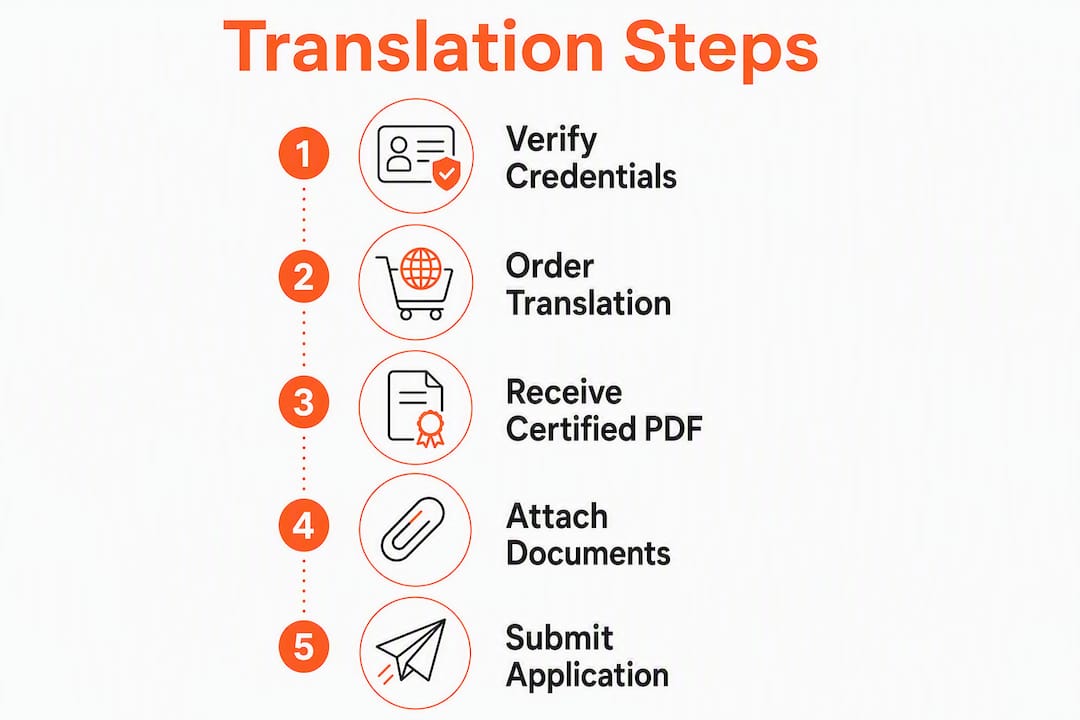
Start by verifying the translator’s credentials before you hand over any documents. A legitimate NAATI-certified translator will provide their NAATI number, which you can cross-check on the NAATI website directly.

The certification statement on the translated document must explicitly say the translation is “a true and correct translation of the original document.” That exact wording matters. A vague statement like “translated by” without a certification declaration is not sufficient for immigration purposes.
What to check on the translator’s certificate:
- NAATI credential type (Certified Translator is the relevant level for most immigration documents)
- Translator’s full name and contact details
- NAATI credential number
- Signed certification statement with the date of translation
Ask whether the translator has experience with immigration document translation. Immigration documents carry specific terminology, and a translator who works primarily in commercial contracts may not be familiar with the phrasing Home Affairs expects on a police clearance or birth certificate.
Pro Tip: Request a receipt or order confirmation that references the specific document translated. If Home Affairs queries the translation later, that paper trail is your first line of defence.
Acceptable delivery is typically a PDF with the certification statement on the same page as, or immediately following, the translated text. Some applications require a wet-ink signature; confirm this with your migration agent or the application instructions before ordering.
How to prepare and attach translated documents to your PR application
Getting the translation right is only half the job. How you attach it to your application matters just as much.
For each non-English document, include:
- The certified English translation (PDF preferred)
- The translator’s signed certification statement
- A scan of the original document or a certified copy, as the form specifies
File naming makes a real difference when case officers are reviewing large applications. Use a consistent format: [DocumentType]_[Language]_Translation.pdf (for example, BirthCertificate_Vietnamese_Translation.pdf). Avoid generic names like scan001.pdf.
When uploading through the ImmiAccount portal, attach the translation and the original as a single merged PDF where possible. This keeps the document pair together and reduces the chance of a case officer missing the original.

Pro Tip: If you are submitting several translated documents, create a simple index page that lists each document, its language, and the translator’s NAATI number. Place it at the front of your document bundle. Case officers process high volumes; anything that makes their job easier tends to move your file faster.
Common documents that require certified translation for PR applications include birth certificates, marriage certificates, police clearances, academic transcripts, and identity documents.
What do NAATI-certified translations typically cost and how long do they take?
Pricing varies by language pair, document complexity, and urgency. Most providers price per page or per document for standard personal documents.
| Document type | Typical turnaround | Notes |
|---|---|---|
| Birth certificate | several business days | Standard; longer for rare language pairs |
| Police clearance | several business days | May require specialist terminology check |
| Academic transcript | a few business days | Complexity depends on length |
| Urgent/same-day | Same day or next day | Attracts a premium fee |
Language pair is the biggest cost driver. Common European languages to English are generally less expensive than less common language pairs, which require specialist translators. Document complexity matters too: a one-page birth certificate is straightforward; a multi-page academic transcript with institutional stamps takes longer.
Be cautious of unusually low quotes. A certified translation that costs a fraction of the market rate often means the translator is not NAATI-certified, the certification statement is missing, or the translation has not been proofread. Any of those issues can result in rejection.
Questions to ask before you order a certified translation
Run through this checklist with any provider before you commit:
Questions to ask:
- Do you hold a current NAATI certification, and can you provide your credential number?
- Will the certification statement explicitly say “true and correct translation of the original”?
- Do you have experience translating documents for Australian immigration submissions?
- What is your revision policy if Home Affairs requests a correction?
- What file format will the translation be delivered in, and will the certification statement be included in the same file?
Red flags to watch for:
- No NAATI credential number provided on request
- Certification statement is vague or missing entirely
- No clear turnaround commitment in writing
- Price is significantly below the market range for your language pair
- No revision or correction policy stated
Document the answers. If a provider is reluctant to confirm their NAATI credentials in writing, that tells you everything you need to know. Keep a copy of all correspondence; if your application is queried, you will want evidence of due diligence.
Why professional NAATI-certified translation is the right choice for PR applicants
The NAATI-certified translation is not just a formality. It is the credential that tells a case officer the translation was produced by someone whose competence has been independently verified. For a PR application, where a single rejected document can delay your case by weeks, that assurance matters.
Certitranslate provides NAATI-certified translations specifically for immigration use, with translators who understand the terminology and formatting Home Affairs expects. The service covers over 120 languages and includes the signed certification statement required for official submission.
Certitranslate’s immigration translation process: upload your document, select your language pair and service type (immigration), and receive a NAATI-certified translation with a signed certification statement, ready to attach to your Home Affairs application. Turnaround options include standard and urgent delivery.
The immigration document translation process at Certitranslate is built around the specific requirements of Australian visa and PR submissions, not a generic translation workflow. That distinction reduces the risk of a formatting or certification error that could slow your application.
Key takeaways
For permanent residency applicants, the single most important rule is this: the Free Translating Service cannot be used for visa or PR lodgement documents, and only NAATI-certified translations will be accepted by the Department of Home Affairs.
| Point | Details |
|---|---|
| Free service exclusion | TIS National explicitly excludes visa and citizenship documents from the Free Translating Service. |
| NAATI is required | Home Affairs expects translations from NAATI-certified translators for all immigration submissions. |
| Up to 10 documents | The Free Translating Service covers up to 10 personal documents, but only for settlement purposes. |
| Certification statement | Every translation must include a signed statement confirming it is a true and correct translation. |
| Use Certitranslate | Certitranslate provides NAATI-certified, immigration-ready translations across 120-plus languages. |
What most applicants get wrong about translation for PR
The persistent belief that the Free Translating Service covers PR applications is the single most damaging misconception in this space. It is understandable: the service is government-backed, free, and associated with Home Affairs. But the eligibility rules are clear, and applicants who rely on it for their visa submissions face avoidable delays.
What I find equally concerning is how many applicants focus entirely on getting a translation and skip the verification step. They receive a document, it looks official, and they attach it. Then a case officer flags that the translator has no NAATI credential, or the certification statement is missing a date, and the whole application stalls.
The other thing most guides do not mention: keep a record of every translation you order, including the translator’s NAATI number, the date of translation, and the document it covers. If Home Affairs requests clarification months later, that record is what you reach for. Certitranslate’s process includes this documentation as standard, which is one less thing to manage when you are already navigating a complex application.
Get your immigration translations right with Certitranslate
When your PR application depends on certified translations, the cost of getting it wrong is measured in weeks of processing delay, not dollars. Certitranslate gives PR applicants direct access to NAATI-certified translators with immigration-specific experience, signed certification statements, and delivery formats that meet Home Affairs requirements.
Select “immigration” as your service type, upload your documents, and receive a translation that is ready to attach to your application. Certitranslate covers 120-plus languages with standard and urgent turnaround options. For applicants who need to understand exactly what certified translation means before ordering, the certified translation guide is a useful starting point. Visit certitranslate.com to place your order or get a quote today.
Useful sources
- Department of Home Affairs — Free Translating Service: official overview of the service and its settlement purpose.
- TIS National — Free Translating Service eligibility: eligibility rules, visa subclass requirements, and the explicit exclusion of visa/citizenship documents.
- TIS National — Before you apply: account setup, document requirements, and the portal submission process.
- TIS National — About the Free Translating Service: explains extract summaries and when full translations are provided.
- NAATI credential verification: check a translator’s current NAATI certification status before ordering.
- Certitranslate — immigration document translation: step-by-step guidance on ordering certified translations for Australian immigration submissions.
- Certitranslate — documents needing translation for visa applications: list of commonly required documents for PR and visa lodgement.
This article is general information only, not legal or migration advice. Visa subclass eligibility rules and document requirements can change. Confirm current requirements with the Department of Home Affairs or a registered migration agent before lodging your application.
Recommended
- Certified Translations for Australia
- Translate documents for Australian immigration: 2026 guide – CertiTranslate – Translations by NAATI Certified Translators
- Immigration translation accepted by government: Australia guide – CertiTranslate – Translations by NAATI Certified Translators
- CertiTranslate – Translations by NAATI Certified Translators