


Translate technical manuals in this order: scope the project and identify risks → build a bilingual terminology glossary → load translation memory ™ assets → complete professional translation with SME review → run desktop publishing (DTP) and layout adaptation → conduct linguistic quality assurance (LQA) and compliance sign-off → deliver with version control documentation. Getting that sequence right is the difference between a manual that passes a commissioning audit and one that grounds a production line.
Before you brief anyone, do these now:
- Gather all editable source files (InDesign, Word, XML, DITA) and flag any scanned PDFs that will need OCR treatment
- Confirm the target language variant (e.g. Simplified Chinese vs Traditional, European Spanish vs Latin American)
- Identify safety-critical segments: warning labels, lockout/tagout procedures, HMI strings
- Pull any previous translations and existing TM exports from your authoring system
- Note the applicable standards (IEC 82079-1 for instructions for use, any relevant AS/NZS standards)
- Assign an internal subject-matter expert (SME) who will approve terminology and review the draft
- Contact a NAATI-certified translator with domain experience for your industry sector
- Record the target delivery format and any regulatory submission window that sets your hard deadline
Treat this process as an engineering control, not a language task. Certitranslate and the industry guidance underpinning this guide both frame it that way.
Table of Contents
- What does the step-by-step technical manual translation workflow look like?
- What are the biggest risks in technical manual translation?
- How do you build a bilingual terminology glossary for a technical manual?
- How does QA and regulatory compliance work for Australian technical manuals?
- Which tools and file formats should you use for technical manual translation?
- What drives timeline and cost for a technical manual translation project?
- Pre-delivery sign-off checklist
- Key takeaways
- Why the step-by-step sequence matters more than any single tool
- Certitranslate handles the full technical manual translation workflow
- Useful sources and further reading
What does the step-by-step technical manual translation workflow look like?
Stage 1: Project intake and scoping

Start with a structured brief. Collect source files, confirm word counts, identify non-editable formats, and flag legacy scanned PDFs upfront. A reputable project manager will report format limitations honestly rather than promise flawless automation. Agree on scope, timeline, and acceptance criteria before any translation begins.
Stage 2: Terminology extraction and glossary build
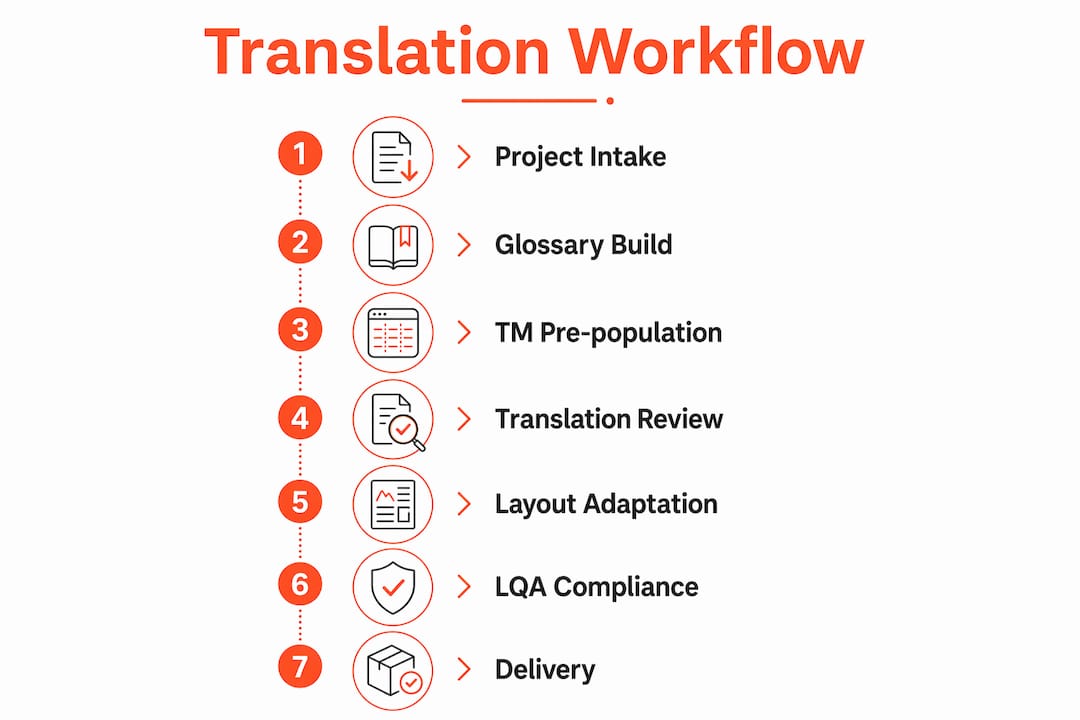
Extract domain-specific terms before a single sentence is translated. This is the highest-leverage step in the entire process. A pre-approved bilingual glossary shared with every translator and reviewer is what prevents field-level confusion later.
Stage 3: TM loading and pre-population
Load the approved glossary and any existing TM segments into your CAT platform. Pre-populate the project so translators work from validated matches, not from scratch. Translation memory reduces cost on revisions and enforces consistency across document versions.
Stage 4: Professional translation and second-linguist review
A translator with SME background completes the draft. A second, independent linguist then reviews against the source for accuracy, terminology adherence, and fluency per ISO 17100:2015 requirements. Queries go to the project manager, not left as guesses.
Stage 5: DTP and layout adaptation
Translated content goes into the original design files. Plan for noticeable text expansion in languages such as German or French — diagrams and UI callouts overflow if the layout has no flex built in. Number diagram elements and place explanatory text in separate editable layers to reduce rework.
Stage 6: LQA and compliance sign-off
Run structured LQA with error categorisation across terminology, accuracy, fluency, style, and formatting. Document scores and approvals for audit. An in-country technical reviewer confirms safety wording and label consistency against the physical system.
Stage 7: Delivery and version control
Deliver in the agreed formats (PDF, XML, InDesign package) with a version tag, change log, and TM export. Tag every file with the language variant, version number, and approval date.
Responsibility matrix
| Stage | Client | Translator | SME/Reviewer | DTP | Project Manager |
|---|---|---|---|---|---|
| Scoping and brief | Provides files and standards | — | Confirms terminology scope | — | Manages intake |
| Glossary build | Approves terms | Extracts candidates | Approves bilingual entries | — | Coordinates |
| Translation | — | Translates | Available for queries | — | Tracks progress |
| Second-linguist review | — | Addresses queries | Reviews domain accuracy | — | Manages handoff |
| DTP | Reviews layout | — | Checks label alignment | Formats and adapts | Signs off DTP |
| LQA and sign-off | Final approval | Addresses LQA findings | In-country validation | Checks overflow | Issues release |
| Delivery | Accepts and archives | — | — | — | Delivers with version notes |
Pro Tip: Flag safety-critical segments and legacy PDFs at scoping, not mid-project. Discovering a 200-page scanned manual after the glossary is built adds scope, cost, and schedule risk that a one-page intake form would have caught.
What are the biggest risks in technical manual translation?
| Risk | Consequence | Mitigation |
|---|---|---|
| Mistranslated safety instruction | Life-safety incident, regulatory non-conformity | SME review of all safety segments; in-country validation |
| Inconsistent terminology across labels, HMI and manual | Operator confusion, commissioning failure | Bilingual glossary built and approved before translation starts |
| Non-editable scanned PDF | OCR errors embedded in final text, missed segments | OCR → human clean-up → segmentation workflow; flag in brief |
| Text expansion causing diagram overflow | Truncated safety labels, broken UI callouts | Plan layout flex at DTP stage; use numbered labels with separate text tables |
| No version control | Outdated translations in the field | Structured change logs and version tagging on every delivery |
Safety and compliance warning: Mistranslated safety labels, lockout procedures, or warning notices are not editorial errors — they are engineering failures. In Australia, non-conforming safety documentation can trigger WorkSafe investigations, product recalls, and liability exposure. Treat every safety segment as a critical path item with its own sign-off checkpoint, separate from the main translation workflow.
A reputable translation partner will be transparent about what OCR can and cannot guarantee on legacy formats. If a vendor promises a perfect automated result from a scanned PDF with no caveats, that is a red flag, not a selling point.
How do you build a bilingual terminology glossary for a technical manual?
A glossary built after translation starts is almost useless. Build it first, in this order:
- Extract terms from source files: safety labels, part names, UI strings, abbreviations, and process names
- Classify by criticality: safety-critical (highest priority) → part names and UI strings → general technical terms
- Add context and references: note the applicable standard (e.g. IEC 82079-1, AS/NZS 4024) and the source document section
- Draft bilingual entries with the translator, then submit for SME and safety officer approval
- Publish to the TM and share with all translators and reviewers before work begins
- Govern updates: any new term approved mid-project gets added to the glossary and TM immediately, with a version note
Glossary template columns (CSV format):
| Column | Purpose |
|---|---|
| Source term | Exact string from source document |
| Approved translation | Validated target-language equivalent |
| Part of speech / context | Noun, verb, UI label, warning header |
| Reference standard | IEC 82079-1, AS/NZS, client style guide |
| Notes | Usage restrictions, do-not-translate flags |
| Approved by | Engineer, safety officer, in-country reviewer |
| Date approved | DD/MM/YYYY |
| TM tag | Exact match, fuzzy, do-not-translate |
Pro Tip: Limit the first-pass glossary to safety labels, UI strings, and part names — the terms where a wrong translation causes a real problem. A 50-term approved glossary used consistently beats a 500-term glossary that nobody finished reviewing before the deadline.
How does QA and regulatory compliance work for Australian technical manuals?
The QA chain for a technical manual in Australia runs in this order: translator with SME background → independent second-linguist review → in-country technical reviewer → DTP verification → final compliance sign-off. Skipping any link in that chain creates an undetected error class.
Acceptance criteria to document for audit:
- Terminology consistency score against the approved glossary (every deviation logged and resolved)
- LQA scoring across error categories: terminology, accuracy, fluency, style, formatting
- Traceable approvals: named SME, date, version number
- TM application rate and fuzzy-match handling log
- Safety label and warning notice consistency across HMIs, diagrams, and manual text
- Compliance with IEC 82079-1 (instructions for use) and any applicable AS/NZS standards
On NAATI credentials: NAATI certification is the Australian standard for translators working on documents submitted to government bodies, courts, and regulated authorities. For technical manuals going to WorkSafe, the Department of Home Affairs, or a regulatory body, a NAATI-certified translator is the appropriate choice. For purely internal operational manuals, a specialist SME translator without NAATI certification may be acceptable — but confirm this with the receiving authority before you start.
Note: This article is general information, not professional legal or regulatory advice. Confirm acceptance requirements with the relevant Australian authority or a qualified professional for your specific project.
Which tools and file formats should you use for technical manual translation?
Supply editable source files wherever possible: InDesign, FrameMaker, Word, XML, or DITA. Scanned PDFs are the single biggest source of format-driven errors and schedule blowouts.
Core tool categories for a professional workflow:
- CAT/TM platforms (SDL Trados Studio, memoQ, Phrase): segment, leverage TM matches, enforce glossary
- Terminology management (MultiTerm, integrated termbases): link approved glossary to CAT in real time
- OCR for legacy scans (ABBYY FineReader): convert scanned PDFs to editable text, then human clean-up before segmentation
- DTP suites (Adobe InDesign, Adobe FrameMaker): reflow translated text, manage text expansion, handle diagram labels
- QA tools (Xbench, built-in CAT QA modules): run regex checks, number consistency, tag verification, and terminology hits
Scanned PDF workflow: OCR conversion → human review and clean-up of OCR artefacts → segmentation in CAT → glossary and TM application → translation → DTP in a reconstructed editable file. Quote this workflow explicitly in your brief and set realistic expectations: OCR introduces errors that human review catches, not automation.
DTP QA checks to run before sign-off:
- Text overflow in diagram callouts and UI screenshots
- Font compatibility and character rendering in target language
- Hyperlink and cross-reference integrity in digital formats
- Numbered diagram labels matched to translated text tables
- Safety symbol placement unchanged after text reflow
What drives timeline and cost for a technical manual translation project?
The main drivers are content volume, content complexity, format type (editable vs scanned), number of target languages, SME review intensity, and whether a rush timeline applies. A 100-page editable XML manual in one language is a fundamentally different project from a 300-page scanned legacy manual in four languages with a commissioning deadline.
Cost and timeline factors:
- Word count and repetition rate (high TM leverage reduces cost significantly)
- Format complexity: editable files cost less than scanned PDFs requiring OCR and reconstruction
- Number of SME review cycles and regulatory submission windows
- Language pair: some language pairs have fewer available specialist translators in Australia
- Rush premiums for compressed timelines, particularly around plant shutdown windows
- Version control discipline: translating only changed segments is far cheaper than resubmitting full manuals
Quote-request template fields to include:
- Editable source files with word count and format details
- Target language variants (specify regional variant)
- Existing glossary and TM exports
- Applicable standards and regulatory submission requirements
- Change log notes if this is a revision project
- Target delivery format and hard deadline
Pre-delivery sign-off checklist
Before accepting a translated manual, verify each of the following:
- [ ] All glossary terms applied consistently; deviations documented and resolved
- [ ] TM matches reviewed and confirmed; fuzzy matches edited and approved
- [ ] SME sign-off recorded with name, date, and version number
- [ ] DTP check complete: no text overflow, correct fonts, diagrams intact
- [ ] Diagram labels aligned with translated text tables
- [ ] Safety labels and warning notices match HMI and on-site labelling
- [ ] Hyperlinks and cross-references verified in digital output
- [ ] Version tag, language variant, and change log attached to delivery package
Red flags that should stop delivery:
- Unresolved terminology queries or glossary deviations with no approval
- Mismatched UI labels between manual and HMI screenshots
- Missing editable source files for diagrams
- Unresolved OCR artefacts in reconstructed text
- No named SME approval on safety-critical segments
Record acceptance with a signed approval document, an LQA score against the agreed threshold, and version notes attached to the delivery package. That record is your audit trail if a compliance question arises later.
Key takeaways
Accurate technical manual translation in Australia requires a risk-aware, sequenced workflow: glossary first, safety labels before body text, SME review at every critical stage, and version control on every delivery.
| Point | Details |
|---|---|
| Glossary before translation | Build and approve the bilingual glossary before any translation starts to prevent field-level terminology errors. |
| Safety labels and UI first | Translate safety labels, warning notices, and UI strings before the main manual body so the text matches the physical system. |
| NAATI credentials matter | Use a NAATI-certified translator for documents submitted to Australian regulatory bodies or government authorities. |
| Plan for text expansion | Languages like German and French expand by roughly 20%, so build layout flexibility into DTP from the start. |
| Certitranslate for certified projects | Certitranslate provides NAATI-certified translators with SME review and DTP support for technical manual projects across Australia. |
Why the step-by-step sequence matters more than any single tool
Most translation problems in technical manuals are not language problems. They are sequencing problems. A glossary built after translation starts cannot fix inconsistent terminology already embedded in 200 pages. A DTP check run without layout flex built in cannot fix overflowing safety callouts without a full reflow. The sequence is the quality control.
Certitranslate treats translation as an engineering control, not a language service. When a project arrives with a legacy 300-page manual needing urgent safety label alignment across three languages for a commissioning window, the first action is not to start translating. It is to extract every safety label, part name, and UI string, build a bilingual glossary with the client’s engineering team, get SME approval on every critical term, and only then open the CAT tool. That sequence is what allows a compressed timeline to produce a compliant output rather than a fast one that fails the site audit.
The most common escalation in technical manual projects is a terminology dispute discovered during in-country validation, after the main translation is complete. A glossary-first workflow makes that escalation rare rather than routine.
Certitranslate handles the full technical manual translation workflow
When a technical manual project needs NAATI-certified translators, SME review, and DTP support under one roof, Certitranslate covers the complete workflow: scoping and glossary build, TM implementation, professional translation with second-linguist review, DTP and layout adaptation, LQA, and version-controlled delivery. Every project is handled by translators with domain expertise in your industry sector, not generalists working from a dictionary.
To get an accurate quote, submit your editable source files, target language variants, existing glossary or TM exports, applicable standards, and your delivery deadline. Certitranslate will confirm scope, flag any format risks upfront, and map the workflow to your timeline. For projects requiring certified translation accepted by Australian authorities, NAATI credentials are confirmed before any work begins.
Request a quote at certitranslate.com and receive a scoped project plan, not just a word-count price.
Useful sources and further reading
The highest-value references for Australian technical manual translation projects:
- NAATI (National Accreditation Authority for Translators and Interpreters) at naati.com.au — the authoritative source for verifying translator credentials and understanding when NAATI certification is required for Australian regulatory submissions.
- IEC 82079-1 (Preparation of information for use — instructions for use) — the international standard governing the structure, content, and quality requirements for instructions for use; directly applicable to technical manuals in most regulated industries.
- ISO 17100:2015 (Translation services — requirements for translation services) — sets the process and competence requirements for professional translation workflows, including second-linguist review and final verification.
- Australian Department of Home Affairs at homeaffairs.gov.au — confirms which translated documents require NAATI-certified translators for visa and immigration submissions; relevant when technical manuals intersect with regulatory lodgement.
- Safe Work Australia at safeworkaustralia.gov.au — the primary reference for safety labelling requirements and workplace health and safety obligations that affect translated safety documentation in Australia.
- AS/NZS 4024 series (Safety of machinery) — the Australian and New Zealand standard series covering safety requirements for machinery documentation, including translated operator manuals and safety instructions.
Involve your in-country reviewer and the relevant industry regulator early for safety-critical documentation. Regulatory acceptance requirements vary by sector, and confirming them before translation starts avoids costly rework at the submission stage.
Recommended
- How import export documents are translated: 2026 guide – CertiTranslate – Translations by NAATI Certified Translators
- How tender document translation works: a complete guide – CertiTranslate – Translations by NAATI Certified Translators
- Technical Translation – CertiTranslate – Translations by NAATI Certified Translators
- Types of business documents requiring translation – CertiTranslate – Translations by NAATI Certified Translators