


If you need a certified translation accepted by Australian authorities, the fastest and most reliable acudocx.com alternatives are NAATI-certified providers. Certitranslate leads the shortlist as a purpose-built, Australia-ready service. Beyond that, your practical options fall into four categories:
- Certitranslate — NAATI-certified translators, transparent pricing, documented turnaround, and acceptance for immigration, legal, and business submissions across Australia.
- NAATI-certified local agencies — established firms with in-house certified translators; suits complex or high-volume work where face-to-face consultation matters.
- NAATI-certified freelance translators — individual practitioners listed in the NAATI public directory; often cost-effective for straightforward documents in common language pairs.
- Specialist platforms and hybrid services — workflow tools that pair machine pre-translation with NAATI-certified human review; useful for agencies managing volume, but require careful vetting.
Pro Tip: Before placing any order, look up the translator’s practitioner number in the NAATI public directory. NAATI is the certifying authority, not a translation provider — verification is your responsibility, not the platform’s.
Table of Contents
- Which acudocx.com alternatives work best for Australian official use?
- How do you choose between these alternatives?
- What should you expect to pay, and how long will it take?
- How do you verify NAATI credentials and confirm authority acceptance?
- When can free tools replace a certified service?
- Why Certitranslate is a dependable Australia-ready alternative
- Key takeaways
- The credential gap most people miss
- Certitranslate: NAATI-certified translations, ready for Australian authorities
- Useful sources and verification links
Which acudocx.com alternatives work best for Australian official use?
The table below compares the four categories across the dimensions that matter for official Australian submissions.
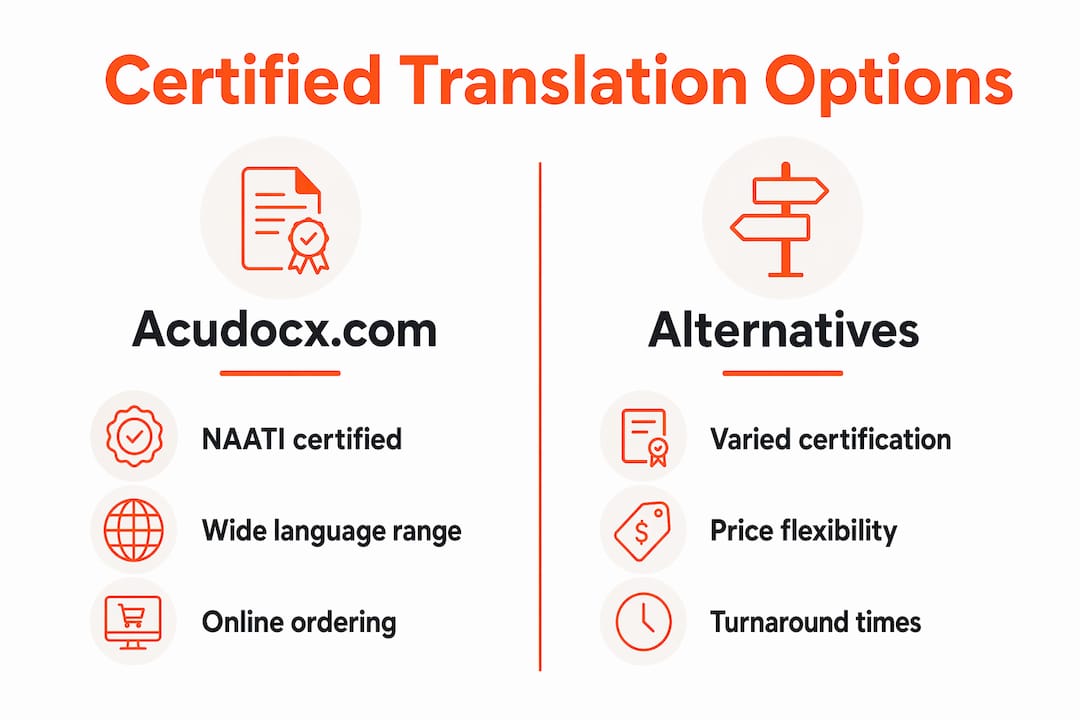
| Category | Best for | NAATI-certified translator | Typical pricing shape | Turnaround / rush | Document types | Ease of ordering | Accepted by AU authorities | Support / revisions |
|---|---|---|---|---|---|---|---|---|
| Certitranslate | Immigration, legal, business — all volumes | Yes | Per page / per project, transparent | Fast standard; rush available | Legal, immigration, technical, personal | Fully online | Yes | Online support, correction policy |
| NAATI-certified local agencies | Complex legal, court, high-volume | Yes | Per word or per page; quotes vary | Standard turnaround times are usually a few days, with rush options often available upon negotiation. | All types, including notarisation | Phone / email / in-person | Yes | Account manager, revisions |
| NAATI-certified freelancers | Common language pairs, budget-sensitive | Yes (verify individually) | Per word; lower overhead | Varies by availability | Standard documents | Direct contact | Yes, if credential verified | Direct with translator |
| Specialist platforms / hybrid | Agency volume, draft-to-certified workflows | Depends on platform | Subscription or per-project | Variable | Broad, but check certification step | Platform dashboard | Only if NAATI review step confirmed | Platform support |
Verdict by use case:
- Need it fast and accepted first time? Certitranslate’s documented SLA and online workflow make it the lowest-friction choice.
- Complex court or notarised documents? A NAATI-certified local agency with a dedicated account manager reduces back-and-forth.
- Tight budget, common language pair? A verified NAATI freelancer can work, provided you check their credential type matches your document category.
- High-volume agency work with drafts already prepared? A hybrid platform can cut costs, but only if the NAATI-certified review step is explicit and documented.
Pro Tip: When evaluating similar sites to acudocx.com, ask each provider to confirm the credential type (Certified Translator vs Recognised Practising Translator) — the NAATI certification system defines these levels, and some document types require the higher credential.

How do you choose between these alternatives?
Start with a short checklist before you commit to any provider.
Credential and acceptance checks:
- Verify the translator’s NAATI practitioner number via the public directory.
- Confirm the credential type covers your language pair and document category.
- Ask whether the translation will carry all DFAT-required elements on every page.
- Check that the digital stamp includes a legible web address under the QR code.
Practical questions to ask any provider:
- Can you provide the translator’s NAATI practitioner number before I pay?
- What is your standard turnaround, and what does a rush surcharge cost?
- Do you offer a preview of the certified stamp before final delivery?
- What is your correction or refund policy if a submission is rejected?
- How do you handle document confidentiality and data deletion?
Red flags that rule a provider out:
- No NAATI practitioner number available on request.
- Vague SLA (“a few days”) with no written commitment.
- No stamp preview or sample certification page offered.
- Certification described as “equivalent to NAATI” rather than NAATI-issued.
Pro Tip: Ask for a screenshot of a sample certified stamp at the exact print size you will submit. A stamp that looks fine on screen can render the QR web address illegible when printed at A4 — and that alone causes DFAT rejections.
What should you expect to pay, and how long will it take?
Certified translation pricing in Australia typically runs on a per-page or per-word basis. Industry guidance indicates that standard and certified translation pricing varies depending on service level, language pair, and certification requirements. Rare language pairs, technical or legal content, and notarisation all push costs higher.
What drives the price:
- Language pair availability (some NAATI-tested languages have fewer practitioners).
- Document complexity and word count.
- Certification and notarisation or apostille fees.
- File preparation (handwritten originals, poor scan quality, multi-page documents).
Rush options typically carry a surcharge. Same-day and 24-hour delivery are available from some providers, including Certitranslate, but weekend and after-hours requests usually attract an additional fee. Standard turnaround for a straightforward document runs 1–3 business days with most reputable providers.
Comparing quotes fairly: always specify the identical scope — number of pages, certified stamp included, file format, and whether legalisation is needed. A quote that omits the certification fee looks cheaper but isn’t.
Note: Certified or NAATI-accredited translation is required for Australian government documents including visa applications, citizenship documents, court documents, and academic transcripts. For internal business material, a professional non-certified translator is often sufficient.
How do you verify NAATI credentials and confirm authority acceptance?
Step-by-step verification:
- Go to the NAATI public directory and search by the translator’s name or practitioner number.
- Record the practitioner number, credential type, and language pair listed.
- Confirm the credential is current (not lapsed or suspended).
- Cross-check the credential type against NAATI’s certification system to confirm it suits your document category.
What must appear on every translated page (per DFAT requirements):
- Translator’s full name.
- NAATI practitioner ID.
- Language pair and certification type.
- Date of translation.
- Signature or digital authentication statement.
- For digital stamps: a legible web address under the QR code.
Translations completed by certified translators can still be rejected if any of these elements are missing from even one page. Resizing a digital stamp too small is one of the most common causes of rejection — the QR web address becomes unreadable at submission scale.
Pro Tip: Request a PDF preview of the certified stamp at the exact size you will print or submit. Compare it against the DFAT checklist above before you finalise the order. This single step prevents most resubmissions.
When can free tools replace a certified service?
The short answer: they can’t, for official submissions. Machine translation tools like Google Translate are fine for understanding a document informally or preparing a draft. They are not acceptable for visa applications, court documents, or any official Australian government submission that requires NAATI-certified translation.
A hybrid workflow — machine pre-translation followed by NAATI-certified human review and certification — can reduce costs for agencies handling volume. The risks are real, though:
- Machine output often misses mandatory legal or technical terminology.
- The certification step must be performed by a NAATI-credentialed translator, not just a bilingual reviewer.
- Formatting and stamp rules still apply in full, regardless of how the draft was produced.
Pro Tip: If you are testing a low-cost hybrid service, run one non-critical document through the target authority first before committing a full batch. A single rejection on a visa or court submission costs far more than the saving.
Why Certitranslate is a dependable Australia-ready alternative
Certitranslate is built specifically for the Australian certified translation market. Every translation is completed by a NAATI-certified translator, and the service covers over 120 languages with industry-specific expertise across legal, immigration, and technical documents.
What sets it apart from generic acudocx.com replacement options:
- NAATI-certified translators on every order, with practitioner numbers available on request.
- Transparent pricing with no hidden certification fees.
- Documented SLAs and rush delivery options, including same-day for eligible documents.
- Digital stamp process aligned with DFAT requirements, including legible QR web address.
- Correction policy and customer support for any submission issues.
- Acceptance for Australian immigration documents, legal agreements, and business submissions.
How to order:
- Upload your document via the Certitranslate online portal.
- Confirm the language pair and document type.
- Select standard or rush delivery.
- Review the certified stamp preview before final delivery.
- Receive the completed translation with NAATI certification elements on every page.
For agencies comparing top acudocx alternatives across multiple document types, Certitranslate’s language coverage and documented workflow reduce the coordination overhead that comes with managing multiple freelancers or platforms.
Key takeaways
For official Australian submissions, NAATI certification is non-negotiable — verify the practitioner number, confirm DFAT stamp elements on every page, and always request a stamp preview before finalising any order.
| Point | Details |
|---|---|
| Verify NAATI credentials first | Search the NAATI public directory for the practitioner number and confirm the credential type before ordering. |
| Check every DFAT stamp element | Every translated page must show the translator’s name, practitioner ID, language pair, date, and legible QR web address. |
| Compare quotes on identical scope | Specify certified stamp, page count, file format, and legalisation needs so quotes are genuinely comparable. |
| Machine translation has hard limits | Free tools are acceptable for informal use only; official submissions require NAATI-certified translation. |
| Certitranslate covers the full checklist | NAATI-certified translators, transparent pricing, rush options, and DFAT-aligned stamps across 120+ languages. |
The credential gap most people miss
Most people searching for acudocx.com alternatives focus on price and turnaround. Those matter, but the credential gap is where submissions actually fail. A translation can look perfect, be delivered in 24 hours, and still get rejected because the digital stamp was resized to fit a page layout and the QR web address became unreadable at print scale.
The other thing worth saying plainly: NAATI certification is not a rubber stamp that any provider can claim. The NAATI certification system defines specific credential levels, and the difference between a Certified Translator and a Recognised Practising Translator matters for certain document categories. Providers who describe their translators as “NAATI-equivalent” or “NAATI-accredited” without a verifiable practitioner number are not meeting the standard.
For agencies managing translation workflows across multiple clients, the administrative cost of a single rejection — resubmission fees, delays, client trust — outweighs any saving from a cheaper provider. The selection criteria in this article are not bureaucratic box-ticking. They are the practical difference between a document that clears and one that doesn’t.
Certitranslate: NAATI-certified translations, ready for Australian authorities
When you need a certified translation accepted by Australian immigration, courts, or government agencies, Certitranslate delivers without the guesswork. Every order is handled by a NAATI-certified translator, priced transparently, and stamped to DFAT specifications — so what you receive is ready to submit, not a draft that needs checking.
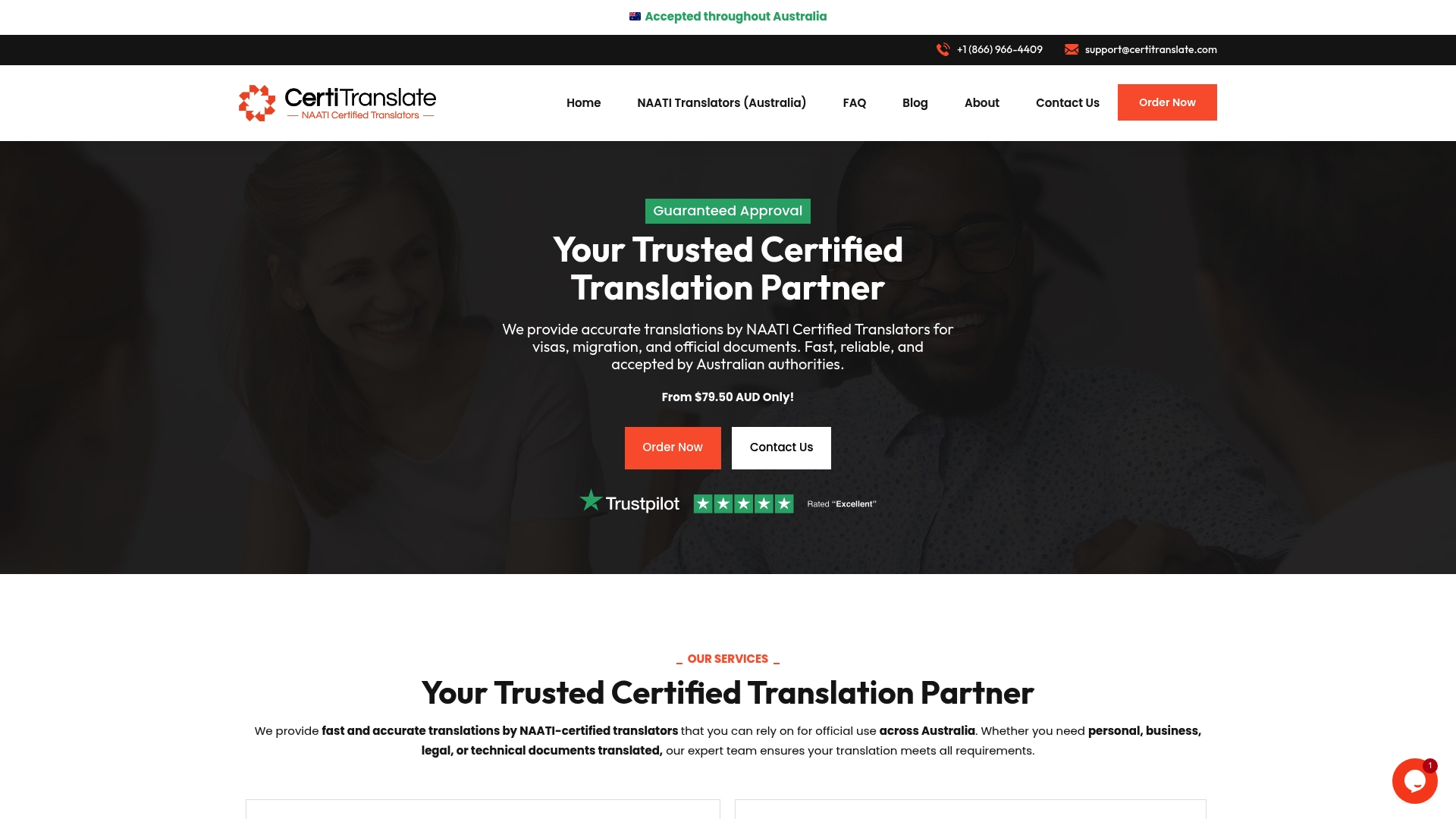
Rush delivery is available for time-sensitive visa and legal submissions. The online ordering process takes minutes: upload your document, confirm the language pair, and choose your turnaround. You can request a stamp preview before the final file is released. For agencies, Certitranslate’s NAATI-certified translator services cover 120+ languages and handle legal, immigration, technical, and business documents under one workflow. Get your quote today at certitranslate.com.
Useful sources and verification links
The sources below are the primary references for credential verification, DFAT compliance, and ordering guidance.
- NAATI public directory and FAQ — search for any translator’s practitioner number and credential status; the starting point for every verification.
- DFAT translation requirements (NAATI) — the definitive checklist of mandatory elements required on every translated page for DFAT legalisation acceptance.
- NAATI certification system — explains credential levels (Certified Translator, Recognised Practising Translator) and which languages are available for testing.
- NAATI Certified Translator page — details on the Certified Translator credential, including practice test formats and the $165 (incl. GST) assessed practice test fee.
- Certitranslate services — full overview of document types, language coverage, and ordering options for Australian certified translation.
- Certitranslate immigration translation guide — step-by-step guidance for immigration-specific document translation and acceptance requirements.
- Notarised vs certified translation guide — clarifies when notarisation is required in addition to NAATI certification, relevant for court and legal submissions.
Sourced guidance: Certified or NAATI-accredited translation is required for Australian government documents — visa applications, citizenship documents, court documents, and academic transcripts. For internal business material, a professional non-certified translator is often sufficient. (PatchMap)
Recommended
- NAATI certified translator benefits: your complete guide – CertiTranslate – Translations by NAATI Certified Translators
- How to Choose the Right Certified Translator for Your Needs – CertiTranslate – Translations by NAATI Certified Translators
- NAATI Certified Translators | Fast & Accurate Services | CertiTranslate
- LP NAATI Translate – CertiTranslate – Translations by NAATI Certified Translators