


Tender document translation is the specialised process of converting contract and proposal documents into another language while preserving their legal, technical, and operational integrity. Getting this wrong is not a minor inconvenience. A mistranslated clause in a tender can void a bid, trigger a contract dispute, or cost a business the contract entirely. Understanding how tender document translation works means understanding a structured, multi-stage workflow governed by standards like ISO 17100 and the TEP (Translation, Editing, Proofreading) model, not a simple word-for-word conversion exercise. Certitranslate applies this exact framework to every tender project it handles.
What are the key steps in the tender document translation process?
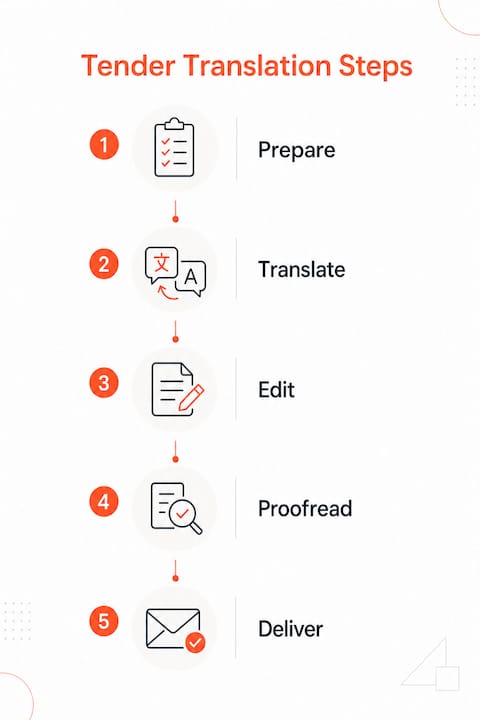
Tender document translation follows a defined sequence. Skipping any stage introduces risk that compounds through every subsequent step.
-
Source document preparation. Before a single word is translated, the source documents must be finalised and locked. Editable file formats (such as Word or InDesign) are required. Scanned PDFs with text embedded in images create serious problems at this stage. Any ambiguous terms, undefined acronyms, or inconsistent phrasing must be resolved before translation begins. Ambiguous source text is the single greatest cause of cascading errors in tender translation. Fixing ambiguity before translation is far cheaper than correcting errors after delivery.
-
Terminology glossary and translation memory setup. A project-specific glossary is built before translation starts. This glossary maps every domain-specific term, product name, and legal phrase to its approved equivalent in the target language. Translation Memory ™ technology stores previously translated segments so identical or similar text is never re-translated from scratch. TM reduces both cost and inconsistency across large, multi-document tender packages.
-
Translation by a subject-matter expert. The translator assigned to a tender must hold domain knowledge relevant to the contract. An infrastructure tender requires a translator who understands civil engineering terminology. A pharmaceutical supply tender requires someone with life sciences expertise. About 65% of technical errors in translated documents stem from a lack of domain knowledge, not linguistic skill. This is why generalist translators are unsuitable for tender work.
-
Editing and proofreading under the TEP model. Once the first translation draft is complete, a second qualified linguist edits it for accuracy, terminology consistency, and adherence to the glossary. A third linguist then proofreads for grammar, style, and formatting. The ISO 17100-compliant TEP model mandates these three review stages, which is why it is the benchmark for professional tender translation services.
-
Desktop publishing and layout adaptation. Translated text rarely fits the original layout. Language expansion in target languages such as German or Finnish can require 25–35% more space than the English source. Desktop Publishing (DTP) specialists reformat diagrams, callouts, tables, and page layouts to accommodate the expanded text without breaking the document structure.
-
Final quality assurance and delivery. A final QA check confirms the translated document matches the source in structure, numbering, and completeness. The client receives the finished file in the agreed format, ready for submission.
Pro Tip: Request editable source files from your internal team before briefing a translation provider. Locked PDFs add time and cost to every stage that follows.
Why does subject-matter expertise matter so much in tender translation?
Subject-matter expertise is not optional in tender translation. It is the difference between a document that wins a contract and one that disqualifies a bid.
Tender documents contain highly technical specifications, legal obligations, and financial conditions. A translator without domain knowledge will default to literal word conversion. That approach produces text that is grammatically correct but technically wrong. An incorrect unit of measure, a misrendered compliance clause, or a mistranslated liability cap can have serious legal and financial consequences.

Creating a terminology glossary before translation begins prevents multiple names appearing for the same component or obligation across a document set. Inconsistency in terminology is one of the most common and most damaging errors in tender translation. A glossary eliminates it at the source.
The benefits of combining subject-matter expertise with proper terminology management include:
- Consistency across document versions. When a tender package includes a Request for Proposal, technical specifications, and pricing schedules, every document must use identical terminology. TM tools enforce this automatically.
- Reduced revision cycles. Translators who understand the subject matter ask fewer clarifying questions and produce fewer errors in the first draft.
- Lower long-term costs. TM technology means that when a tender document is updated, only the changed segments need re-translation. Unchanged text is reused from the memory at a reduced rate.
- Legal defensibility. Consistent, expert-reviewed terminology creates a clear audit trail if a translated clause is ever disputed.
Pro Tip: Provide your translation provider with any previous tender documents, technical specifications, or contracts in the target language. These become reference material for the glossary and reduce terminology queries significantly.
How does ISO 17100 affect tender translation quality?
ISO 17100 is the international standard for translation services, covering translator qualifications, revision stages, project management procedures, and client communication requirements. Working with an ISO 17100-certified provider means the workflow is documented, auditable, and structured, not dependent on the habits of individual freelancers.
For tender documents, this matters because procurement authorities and legal teams often require evidence that a translation was produced under a recognised quality framework. ISO 17100 provides that evidence.
| ISO 17100 requirement | What it means for tender translation |
|---|---|
| Documented translator qualifications | Only translators with verified credentials and domain experience work on the project |
| Mandatory revision stage | A second qualified linguist reviews every translated segment before delivery |
| Project management procedures | Deadlines, file management, and client communication follow a defined process |
| Error categorisation | Errors are classified by severity, allowing targeted correction rather than full re-translation |
| Client review stage | The client has a formal opportunity to review and approve the translation before final delivery |
The TEP model sits inside the ISO 17100 framework. Translation, Editing, and Proofreading are three distinct stages performed by three different linguists. No single translator reviews their own work. This separation is what makes the model reliable for high-stakes documents like tenders. You can read more about how certified translation standards apply to regulated documents in Certitranslate’s dedicated guide.
What practical challenges arise in tender document translation?
Tender translation projects face a predictable set of challenges. Knowing them in advance allows you to plan around them rather than react to them.
- Ambiguous source text. Vague phrasing in the original document forces translators to make interpretive choices. Those choices may be wrong. Preparing source documents using Simplified Technical English (STE) or a controlled vocabulary can cut translation costs by up to 30% by removing ambiguity before it reaches the translator.
- Text embedded in images. Technical diagrams, flowcharts, and scanned pages with non-editable text require manual extraction before translation. This adds time and cost. Always supply editable source files where possible.
- Layout breakdown from language expansion. A document designed for English text will not automatically accommodate a German or Finnish translation that runs 25–35% longer. Without DTP specialists, tables overflow, headings wrap incorrectly, and page numbering breaks. These issues must be planned for, not fixed after the fact.
- Version control failures. Tender documents are frequently updated during a procurement process. Without a version control system, translators may work from outdated source files, producing translations that do not match the final submission requirements.
- Inconsistent terminology across a document package. When different sections of a tender are translated by different people without a shared glossary, the same term can appear in multiple forms. Procurement evaluators notice this. It signals a lack of rigour.
Each of these challenges has a direct solution: editable files, a pre-built glossary, DTP resources, version tracking, and a single coordinating project manager. The importance of tender document translation quality becomes clear when you consider that a single formatting error or terminology inconsistency can trigger a non-compliance ruling from a procurement panel.
How can businesses tailor tender translations to specific markets?
Accurate translation is not enough on its own. A tender submitted to a Spanish government authority requires Spanish as spoken in Spain, not Latin American Spanish. The vocabulary, legal references, and regulatory citations differ between variants. Specifying the correct language variant at the outset is a basic requirement that many businesses overlook.
-
Define the target audience and language variant. Brief your translation provider with the specific country, regulatory environment, and intended reader. A tender for a Chilean infrastructure project uses different legal terminology than one for a Spanish public works contract.
-
Supply reference documentation. Provide any applicable regulatory standards, previous contracts in the target language, and industry-specific glossaries. This material reduces translator queries and improves first-draft accuracy.
-
Implement version control. Maintain a change log that tracks which sections of the tender have been updated. Version control systems allow translation providers to update only the changed segments, using TM for unchanged text. This keeps costs down and turnaround times short.
-
Treat the tender as a document ecosystem. A tender package includes multiple interconnected documents. The technical specifications must align with the pricing schedule, which must align with the compliance declarations. Translation must be managed across all documents simultaneously, not file by file, to maintain coherence.
Working with a provider who assigns a dedicated project manager to your tender package is the most reliable way to maintain consistency across all these elements. For businesses operating in Australia, legal translation services that combine domain expertise with project management discipline produce the most consistent results.
Key takeaways
Accurate tender document translation requires structured preparation, subject-matter expertise, ISO 17100-compliant review, and active terminology management across every document in the package.
| Point | Details |
|---|---|
| Preparation is the foundation | Finalise source documents and resolve ambiguities before briefing a translation provider. |
| Glossaries prevent costly errors | Build a project-specific terminology glossary before translation begins to enforce consistency. |
| ISO 17100 and TEP set the standard | Three-stage review by separate linguists is the minimum for reliable tender translation. |
| Language expansion needs planning | Budget for DTP work when translating into languages that expand 25–35% beyond English. |
| Version control protects accuracy | Track document changes and use Translation Memory to update only revised segments. |
What I’ve learned from watching tender translations go wrong
The most expensive tender translation mistakes I have seen share a common cause. The business treated translation as the last step rather than an integrated part of the tender preparation process. They finalised the English document, sent it to a provider with a tight deadline, and expected a clean result. What they got was a translation that reflected every ambiguity, inconsistency, and formatting problem in the source.
The glossary is where most projects either succeed or fail. Businesses that invest two or three hours in building a term list before translation starts save days of revision and thousands of dollars in rework. Businesses that skip it discover the problem when a procurement panel flags inconsistent terminology in their submission.
The other mistake I see repeatedly is treating tender translation as a linguistic task rather than a technical and legal one. A translator who is fluent in German but has no background in construction contracts will produce a document that reads well and means something different from what was intended. Domain knowledge is not a bonus. It is a prerequisite.
The businesses that get this right brief their translation provider the same way they brief a legal adviser: with context, reference material, and clear specifications. They do not send a PDF and wait. They engage early, supply editable files, and build the glossary collaboratively. That approach consistently produces translations that pass procurement scrutiny without revision.
— David
Certitranslate’s approach to tender document translation
Certitranslate works with NAATI-certified translators who hold domain expertise across legal, technical, and commercial sectors. Every tender translation project follows the ISO 17100 framework, with the full TEP workflow applied as standard. Terminology glossaries are built before translation begins, and Translation Memory is maintained across document versions to keep costs down on updated submissions.
For businesses preparing tenders in Australia or submitting to international procurement processes, Certitranslate delivers translations that meet regulatory requirements and hold up to legal scrutiny. Read the complete guide to certified translation standards to understand what a compliant translation looks like, or explore Certitranslate’s NAATI-certified translators to find the right specialist for your tender project.
FAQ
What is tender document translation?
Tender document translation is the process of converting contract and proposal documents into another language while preserving their legal, technical, and operational meaning. It requires subject-matter expertise and a structured quality workflow, not general translation skills.
How many review stages does a professional tender translation involve?
The ISO 17100-compliant TEP model mandates three review stages: translation, editing, and proofreading, each performed by a separate qualified linguist. This structure minimises errors in legal and tender documents.
Why does language expansion matter in tender translation?
Languages such as German or Finnish can require 25–35% more space than English source text. Without Desktop Publishing specialists to reformat the document, tables, headings, and page layouts break, which can make a submission appear unprofessional or non-compliant.
How does a terminology glossary improve tender translation accuracy?
A glossary maps every domain-specific term to its approved equivalent in the target language before translation begins. This prevents inconsistent terminology across a multi-document tender package and reduces revision cycles significantly.
What is Translation Memory and how does it reduce tender translation costs?
Translation Memory stores previously translated segments and reuses them when identical or similar text appears in updated documents. This means only changed sections need re-translation, which reduces both cost and turnaround time for revised tender submissions.
Recommended
- How legal contract translation works: a complete guide – CertiTranslate – Translations by NAATI Certified Translators
- How import export documents are translated: 2026 guide – CertiTranslate – Translations by NAATI Certified Translators
- Immigration document translation process: a complete guide – CertiTranslate – Translations by NAATI Certified Translators
- Types of business documents requiring translation – CertiTranslate – Translations by NAATI Certified Translators