


A certified translation of a quality assurance document accepted by Australian authorities requires one thing above all else: a NAATI-credentialled translator. Beyond that, every translated page must carry the translator’s full name, NAATI Credential Practitioner Number (CPN), a signed certification statement in English, the date, and an official stamp. Miss any one of those elements and the Department of Home Affairs, DFAT, a court, or a university admissions office can reject the submission outright.
The minimum compliance checklist before you lodge anything:
- Translator holds a current NAATI certification issued under the post-2018 system
- Full name, CPN, date, and signature appear on every translated page
- A signed English certification statement is attached
- Official stamp (physical or NAATI digital stamp with QR code) is present
- Translation is labelled as full or extract
If you need a compliant version now, Certitranslate’s NAATI-certified translators can prepare and certify your QA documents for any Australian authority.
Table of Contents
- What Australian authorities require on a certified translation
- How QA documents are translated: the step-by-step workflow
- Quality controls that prevent rejections
- Translating diagrams, tables, seals, and technical terminology
- How long translations take and what drives the price
- Where and how to submit certified translations in Australia
- Certified translation, notarisation, or sworn translation: which do you need?
- How Certitranslate ensures accurate, compliant translations
- Key takeaways
- The mistakes clients make, and how to avoid them
- Certitranslate: certified QA translations accepted across Australia
- Useful sources and further reading
What Australian authorities require on a certified translation
NAATI and DFAT set the standard for what must appear on every certified translation submitted to an Australian authority. The mandatory elements are: the translator’s full name, NAATI CPN, a signed certification statement written in English, the date of translation, and the translator’s official stamp on every page of the translation.
For DFAT legalisation specifically, the stamp must also include the translator’s practitioner ID, the language pair, the type of certification, and either a physical signature or the words “Digitally Authenticated by NAATI” alongside a legible web address beneath a QR code. DFAT stopped accepting translations from translators accredited under the former NAATI accreditation system from 1 July 2018, so any credential issued under the old scheme is no longer valid for official submissions.
A NAATI translator stamp accompanied by the required information functions as an official certificate for DFAT legalisation purposes. Without the CPN, practitioner ID, and a legible QR code or signature, the translation cannot proceed to apostille or authentication.
Different authorities have slightly different expectations. The Department of Home Affairs accepts NAATI-certified translations directly for visa and migration applications. Courts typically require certified translations to be filed alongside the original document. Universities generally accept NAATI-certified translations for enrolment and credit recognition, though some institutions ask for hard copies with a wet signature. Always confirm the specific requirements with the receiving body before lodging.
Pro Tip: Check the certified translations for Australia page before you submit — it lists authority-specific requirements so you can confirm your translation package is complete.
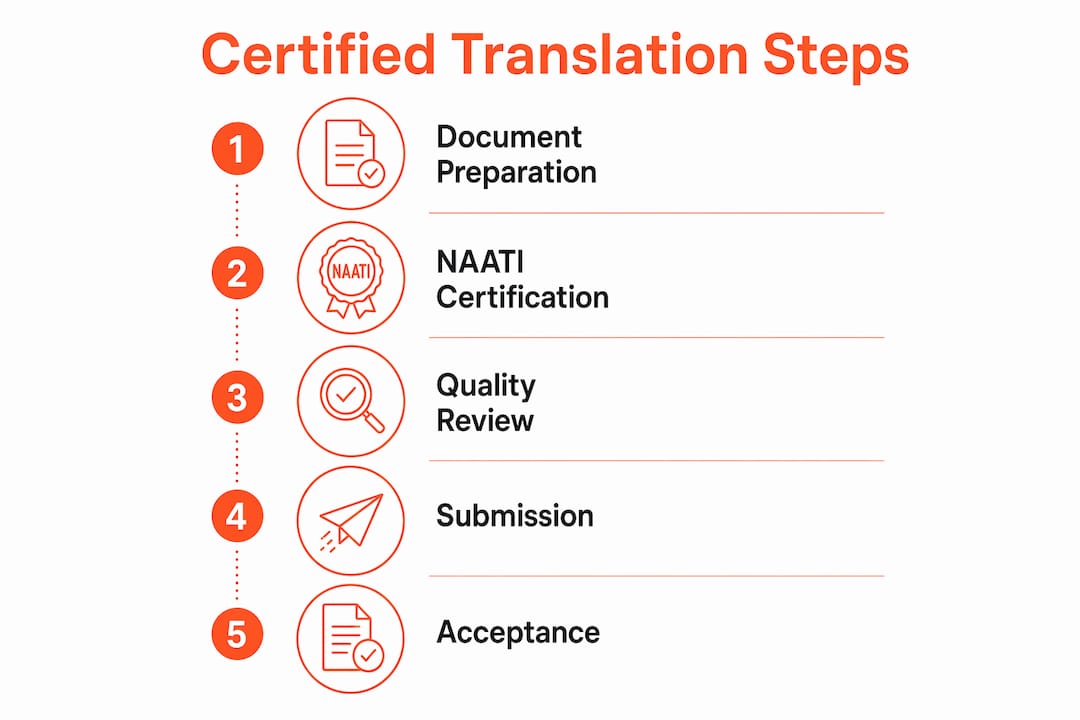
How QA documents are translated: the step-by-step workflow
The quality assurance translation process follows a clear sequence. Skipping steps is where most compliance problems originate.
- Intake and verification. The translator or agency confirms the document scope: is this a full translation or an extract? They identify all official seals, stamps, attachments, and handwritten elements. Clients are responsible for providing genuine originals — NAATI-certified translators cannot verify authenticity; they translate what they receive.
- Preparation. The language pair is confirmed, a subject-matter-matched translator is assigned, and any existing termbase or glossary is loaded into the translation memory ™ tool. For QA documents, this step often includes building a project-specific glossary for technical terms.
- Translation draft. The translator produces the draft, cross-checking against the termbase and TM matches. For technical QA materials, diagrams and tables are handled separately (see the section on technical considerations below).
- Self-check and review. The translator reviews the draft against the source. For complex QA files, an in-house subject-matter expert (SME) checks terminology accuracy. Structured QA workflows compensate for the fact that short official texts are often translated by a single linguist with limited scope for external review.
- Client confirmation. A draft is sent to the client to confirm names, dates, addresses, and any technical values before the translation is finalised. This single step catches the majority of factual errors in official documents.
- Certification. The translator signs and stamps every page, adds the NAATI CPN and certification statement, and dates the translation. The statement confirms the translation is accurate and complete to the best of the translator’s knowledge.
- Delivery. The client receives the certified translation in the agreed format: digitally signed PDF, hard copy, or both. Documents destined for DFAT legalisation or court filing are packaged with the original attached as required.
Quality controls that prevent rejections
Academic research confirms that most quality problems in official document translation come from process gaps, not language ability. The three most common rejection causes are a missing certification statement, incorrect document type identification, and an incomplete transcription of seals or stamps.
Structured controls address each of these directly:
- Termbases and translation memory keep technical terminology consistent across pages and projects, reducing the chance of a term being translated differently in two places.
- Dual-pass editing means a second reviewer checks the certified output against the source before delivery, catching omissions the original translator may have missed.
- Page-by-page certification checks confirm the stamp, CPN, date, and signature appear on every page, not just the cover sheet.
- Client confirmation step (described in the workflow above) catches factual errors in names, dates, and numeric values before the certification is issued.
- Automated QA rules flag formatting inconsistencies and terminology errors before human review, provided the tool is fed an approved glossary and aligned TM.
Pro Tip: Ask your translation provider whether they use a page-by-page certification checklist. If they cannot describe their QA process, that is a signal to look elsewhere.
Translating diagrams, tables, seals, and technical terminology
QA documents rarely contain plain text alone. Test data sheets, standard operating procedures (SOPs), and audit reports typically include tables, flowcharts, diagrams, and official seals. Each element needs a specific approach.
- Diagrams and flowcharts: preserve the original visual and translate captions and labels only. Provide an attached plain-text transcription or layered PDF so assessors can cross-check numeric values and units without losing the original formatting.
- Tables: translate all text within the table cells. Do not reformat the table structure unless the target language requires it for readability.
- Seals and stamps: DFAT advises translators not to alter the appearance of official seals. Where clarification is needed, add the word “Seal” or “Stamp” in brackets beside the element. Handwritten text within a seal should be transcribed and translated.
- Technical terminology: a maintained glossary and translation memory are the highest-leverage tools for QA materials. They protect brand-specific terms, product names, and regulatory references from being translated inconsistently across a multi-page document.
For businesses translating ongoing QA documentation, supplying an existing termbase to your translation provider at the outset cuts both turnaround time and long-term localisation costs.

How long translations take and what drives the price
Turnaround for a certified QA document translation depends on several compounding factors. Simple single-page certificates can often be completed quickly. More complex multi-page technical QA reports with diagrams, tables, and rare language pairs require significantly longer, especially when SME review and client confirmation are needed.
The main price drivers:
- Word count and document complexity — tables, diagrams, and handwritten text all take longer than clean typed prose
- Language rarity — less common language pairs command higher rates due to limited translator availability
- Expedited turnaround — rush fees apply when standard timelines cannot be met
- Hard copy certification — physical stamped copies cost more to produce and post than digital PDFs
- Glossary build — first-time technical projects may include a setup cost for termbase creation
Pro Tip: Provide the clearest possible scan of your original document and share any previous translations or existing glossaries. Both reduce preparation time and can lower your quote.
Where and how to submit certified translations in Australia
Knowing how QA document translation works is only half the job. Getting the submission right matters just as much.
- Department of Home Affairs (immigration): accepts NAATI-certified translations directly. The translation must accompany the original or a certified copy. Check the immigration translation guide for document-specific requirements.
- DFAT (legalisation/apostille): requires the full stamp with CPN, practitioner ID, QR code or digital authentication, and signature. The original document must be attached to the translation.
- Courts: certified translations are filed alongside the original. Some courts require an affidavit from the translator; confirm with the court registry before filing.
- Universities: most accept NAATI-certified translations for enrolment and credit recognition. Requirements on hard copy versus digital vary by institution — check the university acceptance guide for specifics.
Before lodging with any authority, verify whether originals must accompany the translation. The guide on original documents covers when certified copies are acceptable and when only the original will do.
Certified translation, notarisation, or sworn translation: which do you need?
| Method | Who issues it | Typical use case | Accepted by Australian authorities? |
|---|---|---|---|
| NAATI certified translation | NAATI-credentialled translator | Immigration, courts, universities, DFAT | Yes — the standard requirement |
| Notarised translation | Translator + notary public | Cross-border commercial documents, some overseas submissions | Depends on the receiving authority |
| Sworn/affidavit translation | Translator who swears an oath before a JP or court | Some court proceedings, overseas legal use | Accepted in specific court contexts |
For almost every Australian immigration, legal, or university submission, a NAATI certified translation is the correct and sufficient choice. Notarisation adds a notary’s seal to the translator’s certification and is typically required when the document will be used overseas or when a foreign authority specifically requests it. DFAT legalisation (apostille or authentication) is a separate step required when an Australian document needs to be recognised in another country, or when a foreign document needs to be authenticated for Australian use in certain contexts.
For a detailed comparison, the notarised vs certified translation guide covers the legal distinctions for Australian use.
How Certitranslate ensures accurate, compliant translations
Certitranslate’s translations are completed by NAATI-certified translators across more than 120 languages, with subject-matter specialists assigned to technical, legal, and QA documentation. Every translation carries a translation accuracy guarantee, meaning it is accepted by Australian authorities or Certitranslate will correct it at no additional cost.
The operational controls built into every project:
- Project-specific termbases and translation memory loaded before work begins
- Client confirmation step for names, dates, and technical values before certification is issued
- Page-by-page certification check: stamp, CPN, date, and signature verified on every page
- Signed English certification statement on every translated page
- Digital and hard copy delivery options for DFAT, court, and immigration lodgement
Pro Tip: When ordering a technical QA translation, flag the document type and any industry-specific terminology in your upload notes. This lets Certitranslate assign the right subject-matter specialist from the outset.
Key takeaways
A certified translation of a QA document accepted in Australia must be completed by a current NAATI-credentialled translator and include the translator’s full name, CPN, signed certification statement, date, and stamp on every page.
| Point | Details |
|---|---|
| NAATI credential is non-negotiable | Only translators certified under the current NAATI system are accepted by DFAT, immigration, courts, and universities. |
| Every page must be certified | The stamp, CPN, date, and signature must appear on every translated page, not just the first. |
| Process controls prevent rejections | Missing certification text and incomplete seal transcription are the most common rejection causes; structured QA workflows prevent both. |
| Technical QA files need specialist handling | Diagrams, tables, and technical terminology require a subject-matter-matched translator and a maintained termbase. |
| Certitranslate covers all Australian authorities | NAATI-certified translators, accuracy guarantee, and 120+ languages for immigration, legal, and technical QA submissions. |
The mistakes clients make, and how to avoid them
The most common problem is not a language error. It is a missing certification statement or a stamp that appears only on the first page of a multi-page document. Clients often do not realise the stamp and CPN must appear on every page until a submission comes back rejected.
The second most frequent issue is unclear originals. A low-resolution scan of a document with an embossed seal or handwritten annotations forces the translator to make judgement calls about what is written, which increases the risk of transcription errors. Providing a high-quality scan, or better yet the physical original, removes that uncertainty entirely.
Client collaboration also speeds things up considerably. When a client confirms names, dates, and technical values at the draft stage, the final certified translation goes out faster and with fewer corrections. The projects that drag on are almost always the ones where the client is unavailable to confirm a detail and the translator has to hold the file.
Certitranslate: certified QA translations accepted across Australia
Getting a QA document translated for Australian official use means one thing: the translation has to be right the first time. Certitranslate gives you NAATI-certified translators with subject-matter expertise in technical, legal, and QA documentation, a translation accuracy guarantee, and delivery formats accepted by the Department of Home Affairs, DFAT, courts, and universities.
To order, upload your document, note the document type and any technical terminology or glossaries you already have, and select your turnaround preference. Certitranslate handles the rest, from termbase setup through to signed, stamped certification on every page. Visit the NAATI certified translators page to get started, or go straight to certified translation services for a full overview of what is included.
Useful sources and further reading
- NAATI DFAT translation requirements — official guidance on mandatory elements for certified translations submitted to DFAT and Australian authorities
- Quality and integrity in the translation of official documents — academic research on common quality issues and process controls in official document translation
- Linguistic asset management — practical guidance on termbases and translation memory for technical documentation
- Technical terminology management — why glossaries and approved term lists matter for QA and technical translation projects
- Certitranslate blog — process guides, compliance updates, and case studies for Australian certified translation needs
Recommended
- Why original documents accompany translations: 2026 guide – CertiTranslate – Translations by NAATI Certified Translators
- Translate documents for Australian immigration: 2026 guide – CertiTranslate – Translations by NAATI Certified Translators
- Certified Translations for Australia
- Languages most translated for Australian visas: 2026 guide – CertiTranslate – Translations by NAATI Certified Translators