


Technical terminology accuracy is the consistent, correct use of domain-specific terms in a document or its translation so that every technical concept carries exactly the meaning the source intended. In Australia, the bodies that shape this standard are NAATI, which certifies translators and assesses their terminology handling, AUSIT, which publishes best-practice guidance for official and legal documents, and services like Certitranslate, whose NAATI-certified translators apply documented QA workflows to every project.
Three things you can do right now:
- Request a project glossary before translation begins, so key terms are agreed and locked in writing.
- Ask for a bilingual review, where a second qualified translator checks the target text against the source term by term.
- Verify NAATI certification by asking for the translator’s NAATI credential number before accepting any document intended for official submission.
Key takeaways
Technical terminology accuracy requires correct, consistent use of domain-specific terms across both source documents and their translations, verified through glossaries, bilingual review, SME validation, and documented QA.
| Point | Details |
|---|---|
| Core definition | Accuracy means every technical term carries its exact intended meaning, consistently, across the whole document. |
| Why it matters | Errors in technical terms create legal, safety, and commercial risk; Australian practitioners cite accuracy as the primary quality criterion. |
| Verification steps | Request a project glossary, bilingual review, SME sign-off, and a revision log with every technical translation. |
| Australian standards | NAATI certification and AUSIT best-practice guidance set the accuracy benchmark for official and legal documents in Australia. |
| Certitranslate | Certitranslate provides NAATI-certified translation with documented glossaries, bilingual review, and SME validation for technical and official documents. |
Table of Contents
- What does technical terminology accuracy actually cover?
- Why does accuracy in technical terminology matter so much?
- How is accuracy verified in practice?
- Why does context change what “accurate” means?
- What tools and processes keep terminology consistent?
- What are the most common errors and what do they cost?
- How do NAATI and AUSIT shape accuracy standards in Australia?
- A practical checklist for assessing terminology accuracy
- What should translators and clients each do to protect accuracy?
- How Certitranslate puts these practices into action
- The part of accuracy that most guides skip over
- Certitranslate: NAATI-certified translation with documented QA
- Sources
What does technical terminology accuracy actually cover?
Technical terms function as compact shorthand that encodes domain-specific meaning within a shared conceptual framework. Accuracy, then, is not about choosing a word that is roughly equivalent; it is about choosing the one term that carries the precise technical sense the source document intends, consistently, every time it appears.
The concept applies in two related but distinct contexts. In technical writing, accuracy means that specifications, procedures, and labelling use the correct, standardised terms for the field, with no ambiguity about what a component, process, or measurement refers to. In translation, it adds a second layer: the translator must identify the correct target-language equivalent for each source term, preserve institutional names and measurement conventions, and flag any source-text errors rather than silently correcting them.
Document types where this standard applies most directly include:
- Technical manuals and operating instructions
- Safety procedures and work-health-and-safety documentation
- Patents and intellectual property filings
- Contracts, licence agreements, and regulatory submissions
- Engineering drawings and specifications
- Regulated forms (immigration, customs, pharmaceutical labelling)
Why does accuracy in technical terminology matter so much?
Accurate technical terminology reduces legal, safety, and commercial risk. A single wrong term can change what a contract obliges a party to do, render a patent claim unenforceable, or cause a worker to misuse equipment.
Consider a safety manual for industrial machinery translated with “stop” used interchangeably for both an emergency stop and a routine shutdown. An operator following the wrong procedure could bypass a safety interlock. The physical consequence is injury; the legal consequence is liability. Neither is recoverable by issuing a correction notice after the fact.
The commercial stakes are just as concrete. A mistranslated clause in a supply agreement, where the source term for “exclusive distribution rights” is rendered as “preferred supplier,” shifts the entire commercial relationship. The buyer loses exclusivity; the supplier gains flexibility they were never meant to have. That kind of error does not show up until a dispute arises, at which point the cost of correction is measured in legal fees, not revision hours.
A survey of Australian practitioners found that accuracy and completeness are cited as primary quality criteria for official document translation, yet many respondents reported challenges often tied to source-text quality or knowledge gaps.
That figure points to something practitioners know well: the risk is not always a careless translator. It is often an ambiguous source document meeting a translator who lacks the domain knowledge to resolve the ambiguity correctly.
How is accuracy verified in practice?
Professional teams use a layered QA workflow rather than a single check. The standard process a client can reasonably request looks like this:
- Source brief — client supplies the source document, audience description, intended use, regulatory recipients, and any existing reference materials or glossaries.
- Glossary creation — translator builds or adopts a project-specific termbase, mapping source terms to approved target equivalents before translation begins.
- Translation with CAT/TM tools — computer-assisted translation tools and translation memory flag repeated terms and enforce consistency across the document.
- Bilingual review — a second qualified translator reads the target text against the source, checking terminology, completeness, and register.
- SME validation — a subject-matter expert (engineer, lawyer, pharmacist) confirms that domain-specific terms are correct for the field and jurisdiction.
- Final QA check — a systematic pass against the checklist below, covering units, labels, institutional names, and numeric values.
- Delivery with revision log — the translator delivers the final document alongside a record of decisions made, terms queried, and any source-text issues noted.
SAE J2450, an industry framework originally developed for automotive technical content, categorises translation errors by type and severity, illustrating how domain-specific metrics can be applied to measure and compare accuracy across projects.
Pro Tip: Involve your SME at step two, not step five. If the glossary is built with domain-expert input before translation begins, the SME review at step five becomes a confirmation rather than a correction exercise, which is far less expensive and far less disruptive to the timeline.
A practical QA checklist for clients and reviewers:
- Every key term matches the approved project glossary
- Institutional and organisation names are reproduced exactly, not translated or paraphrased
- All numeric values, units of measurement, and tolerances match the source
- Labels, headings, and warnings appear in the correct positions and with the correct wording
- No source-text section has been omitted
- Register (formal, technical, user-facing) is consistent throughout
- A revision log or decision record accompanies the final file
- SME sign-off is documented where the subject matter requires it
Why does context change what “accurate” means?
Accuracy is not a fixed target. The same source term can have two correct translations depending on the domain, the jurisdiction, and the audience reading the document.
A practical example: the term “valve” in a hydraulic engineering specification and in a user-facing maintenance guide for the same equipment may legitimately use different target-language equivalents. The engineering specification goes to a qualified engineer who expects the technical standard term. The maintenance guide goes to a field technician who may be more familiar with a common-use term. Both translations can be accurate for their audience; neither is accurate for the other’s audience.

AUSIT’s guidance reframes accuracy as systematic handling of names, headings, dates, and institutional designations, not simply word-for-word equivalence. That framing matters because it shifts the question from “is this a correct word?” to “is this the correct word for this document, this audience, and this regulatory context?”
When commissioning a translation, supply the following to your translator:
- Who will read the document and what is their technical background
- What the document will be used for (regulatory submission, internal training, court filing, product labelling)
- Which authority or institution will receive it
- Any existing reference materials, previous translations, or approved glossaries
- The target jurisdiction’s relevant standards or naming conventions
What tools and processes keep terminology consistent?
The main tools used to maintain terminology accuracy are glossaries and termbases, translation memory ™, computer-assisted translation (CAT) tools, controlled language, and machine translation with post-editing. Each has a specific role and a specific failure mode.
- Glossary / termbase — a structured list of approved source and target terms. Prevents ad hoc choices during translation. Fails when it is incomplete, out of date, or not shared with the SME who approved it.
- Translation memory ™ — stores previously translated segments and proposes them when similar text recurs. Enforces consistency across large documents and projects. Fails when old TM entries contain errors that get propagated forward without review.
- CAT tools (such as SDL Trados, memoQ, or Phrase) — software environments that combine TM, termbase lookup, and QA checks in one interface. NAATI’s guidance lists technological competency, including proficiency with CAT and TM tools, as an expected capability for translators producing accurate specialised translations.
- Controlled language — a restricted subset of the source language (simplified grammar, approved vocabulary) used in source documents to reduce ambiguity before translation begins. Common in aerospace and defence documentation.
- Machine translation with post-editing (MTPE) — MT engines can process large volumes quickly, but they do not understand domain context. An MT engine will choose a statistically probable term, not necessarily the correct technical one.
A word of caution on MT-only workflows: machine translation without post-editing by a qualified human is not an acceptable approach for any document where terminology accuracy carries legal, safety, or regulatory consequences. The engine has no way to know that a term is a defined term of art in a contract, or that a measurement unit must follow a specific national standard. Post-editing by a domain-qualified translator, followed by SME validation, is the minimum standard for technical content.
What are the most common errors and what do they cost?
Most terminology errors come from four sources: ambiguous source documents, inconsistent or missing glossaries, lack of SME involvement, and translators working outside their domain of expertise.
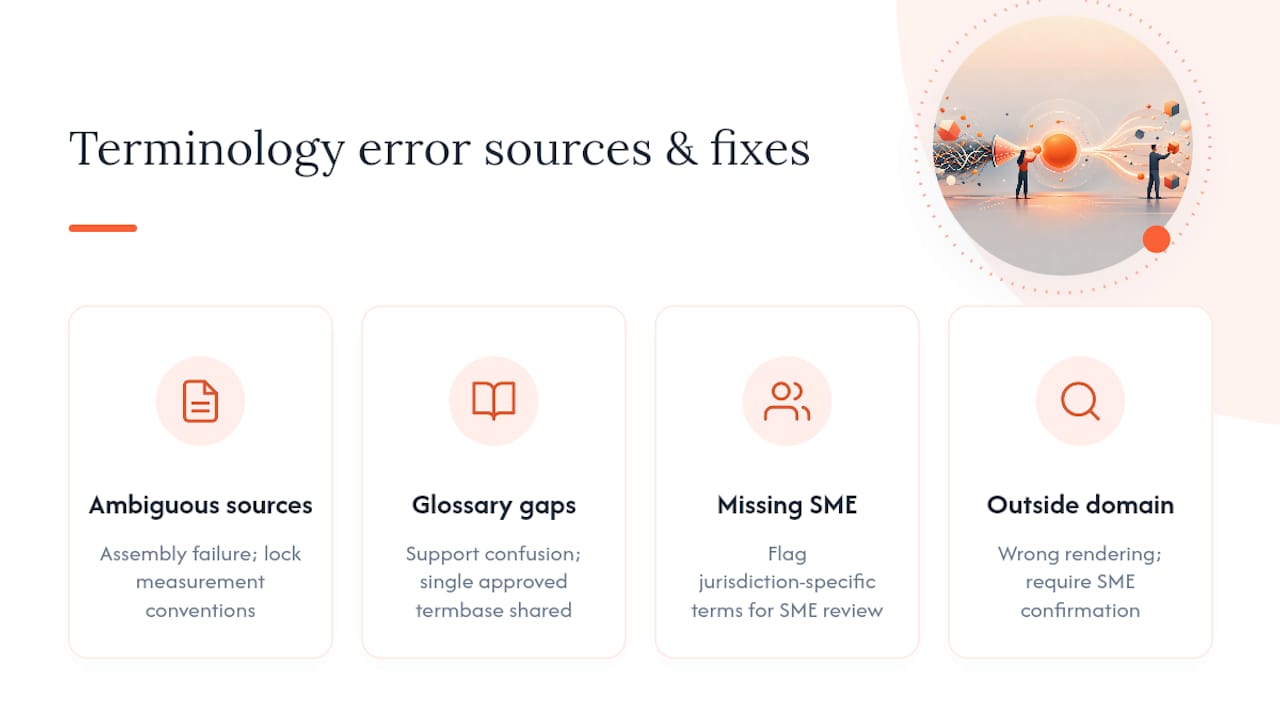
Unit conversion in a safety manual. A maintenance procedure specifies a torque value in Newton-metres. The translator, working without a project glossary, renders it in foot-pounds using an approximate conversion factor rather than the exact value specified by the equipment manufacturer. The resulting figure is within the plausible range, so no automated QA check flags it. A technician follows the translated procedure, under-torques a critical fastener, and the assembly fails in service. The prevention: lock measurement conventions in the glossary at project start and require the translator to reproduce source values exactly, flagging any conversion for SME confirmation.
Mistranslated legal term altering liability. A commercial lease agreement uses the term “make good,” a defined term in Australian property law meaning the tenant must restore the premises to their original condition at lease end. A translator unfamiliar with Australian property law renders it as “repair damage,” which implies only reactive maintenance. The tenant interprets the translated clause as requiring only damage repair, not full restoration. The dispute costs both parties more in legal fees than the restoration work itself would have. The prevention: flag jurisdiction-specific defined terms for legal SME review before finalising the translation.
Inconsistent coined technical term across a product suite. A manufacturer introduces a proprietary process name, “ColdBond,” across a suite of product manuals. Without a shared termbase, three translators working on different manuals each choose a different target-language rendering. Downstream, the client’s technical support team cannot match customer queries to the correct manual. The prevention: a single approved termbase entry for every proprietary term, shared across all translators on the project from day one.
How do NAATI and AUSIT shape accuracy standards in Australia?
In Australia, NAATI sets certification standards and defines the competencies translators must demonstrate; AUSIT publishes best-practice guidance that shapes how those competencies are applied to official and legal documents.
NAATI’s competency framework identifies four areas directly relevant to terminology accuracy:
- Thematic competency — knowledge of the subject matter being translated (law, engineering, medicine), which determines whether a translator can recognise and correctly render domain-specific terms.
- Transfer competency — the ability to move meaning accurately between languages without distortion, omission, or addition.
- Research competency — the capacity to conduct terminology research, build and maintain knowledge banks, and resolve ambiguous terms using authoritative sources.
- Technological competency — proficiency with CAT tools, TM, and termbases, which are the practical mechanisms for enforcing consistency.
NAATI’s Certified Translator assessment tests translation and revision tasks using rubrics that make accuracy, register, and terminology handling explicit scoring criteria. The assessment rubrics define banded performance levels specifying how much distortion, omission, or register mismatch is permissible at each grade, which gives clients a concrete framework for defining accept/reject criteria on their own projects.
When do you need a certified translation in Australia?
- Immigration applications to the Department of Home Affairs, where NAATI certification is required for all documents not in English.
- Court and tribunal proceedings, where translated evidence must meet accuracy standards the court can rely on.
- University and academic admissions, where transcripts and qualifications must be accurately rendered for assessment.
- Regulated professional registrations (medical, legal, engineering), where credential documents must reflect exact qualifications.
- Business and commercial contracts submitted to Australian regulatory bodies or used in Australian legal proceedings.
For immigration specifically, the immigration document translation process involves specific formatting and certification requirements beyond terminology accuracy alone.
A practical checklist for assessing terminology accuracy
Use this checklist as a pass/fail tool when reviewing a translated technical document. For each item, the evidence to request is noted alongside.
- Glossary match — every key technical term in the target text corresponds to an entry in the approved project glossary. Evidence: the project glossary and a spot-check of 10–15 high-frequency terms.
- Institutional names — organisation names, regulatory bodies, and official designations are reproduced exactly as specified, not paraphrased or translated. Evidence: compare source and target side by side for all named entities.
- Numeric and unit checks — all figures, tolerances, measurements, and dates match the source exactly. Evidence: a line-by-line numeric audit of the target document.
- Label fidelity — warnings, cautions, safety notices, and diagram labels appear in the correct positions with the correct wording. Evidence: visual comparison of source and target layout.
- SME sign-off — for documents where domain knowledge is required (medical, legal, engineering), documented SME approval is present. Evidence: a signed review note or email confirmation from the SME.
- Revision log — a record of terminology decisions, source-text queries, and any deviations from the glossary is attached to the delivery. Evidence: the revision log file.
- Sample bilingual check — a qualified second translator has reviewed at least a representative sample of the target text against the source. Evidence: the bilingual reviewer’s name and credential.
Minor errors (a single inconsistent term that does not change meaning, a formatting deviation) warrant a targeted revision of the affected passages. Major errors (a term that changes a safety instruction, a legal obligation, or a numeric value) require a full re-review of the affected section by the original translator and SME before the document is accepted.
What should translators and clients each do to protect accuracy?
Accuracy is a shared responsibility. The projects where it holds up best are the ones where expectations are documented before translation begins, not negotiated after a problem surfaces.
What clients should do:
- Supply the original source document, not a scan or photocopy where text is ambiguous.
- Provide context: audience, intended use, regulatory recipient, and any jurisdiction-specific naming conventions.
- Share existing glossaries, previous translations, and reference materials.
- Identify an SME contact who can answer domain-specific queries during the project.
- Approve the project glossary before translation begins, not after.
What translators should do:
- Build or adopt a project termbase and populate it before starting the first segment.
- Use CAT and TM tools consistently, and flag TM matches that may be outdated or context-inappropriate.
- Conduct a bilingual self-review before submitting, checking terminology against the approved glossary.
- Document every significant terminology decision and every source-text query in a revision log.
- Refer domain-specific ambiguities to the client’s SME rather than resolving them unilaterally.
Project brief items that lock in quality:
- Agreed glossary with version control and sign-off date
- Named QA steps (bilingual review, SME validation) and who is responsible for each
- Glossary ownership (who maintains and updates it across the project lifecycle)
- Number of revision rounds included and what triggers an additional round
- Acceptance criteria, referencing NAATI rubric bands or a project-specific error taxonomy
- Delivery format specifying that a revision log accompanies the final document
For legal terminology specifically, the project brief should also name the jurisdiction whose legal definitions govern the document, since the same term can carry different legal meanings in different Australian states or in different countries.
How Certitranslate puts these practices into action
Certitranslate uses NAATI-certified translators, documented project glossaries, SME checks, and revision logs on every project where technical terminology accuracy is a requirement.
The workflow runs as follows:
- Project intake — client supplies source documents, context, audience, and any existing reference materials; a project brief is confirmed in writing.
- Glossary creation — the assigned NAATI-certified translator builds a project termbase, drawing on the client’s materials and domain-specific reference sources.
- Translation — carried out using CAT tools with TM integration, enforcing consistency against the approved termbase throughout.
- Bilingual review — a second qualified translator checks the target text against the source, term by term, flagging any deviation from the glossary.
- SME validation — for technical, legal, or medical documents, a subject-matter expert confirms domain-specific terminology before sign-off.
- Final QA check — a systematic pass against numeric values, labels, institutional names, and completeness.
- Delivery with revision log — the client receives the certified translation and a documented record of decisions and queries.
Trust signals to look for when placing an order:
- NAATI certification number for the assigned translator, verifiable on the NAATI register
- Published QA protocols describing the bilingual review and SME validation steps
- Revision log delivered with the final document
- Acceptance by Australian authorities confirmed for the document type
Certitranslate’s translation accuracy guarantee covers every certified document, with NAATI-certified translators, documented QA, and acceptance by Australian government bodies and institutions.
For a detailed look at how technical manuals are handled specifically, the technical manual translation guide walks through each stage of the workflow.
The part of accuracy that most guides skip over
Most writing on terminology accuracy focuses on process: glossaries, CAT tools, SME review. That is all correct and necessary. What gets less attention is the judgement call that sits underneath every process step.
A glossary tells a translator which term to use. It does not tell them when the approved term is technically correct but pragmatically wrong for the audience reading the document. A safety warning written in the precise language of an engineering standard may be accurate and unreadable to the field technician who needs to act on it. A legal clause translated with perfect terminological fidelity may be accurate and incomprehensible to the business owner who needs to understand their obligations.
The real skill in technical translation is knowing when accuracy and clarity pull in different directions, and having the domain knowledge and professional judgement to resolve that tension correctly. That is what NAATI’s competency framework is actually testing when it assesses thematic and transfer competency together, not just one or the other. A translator who knows the terms but cannot transfer meaning to the right register for the right audience has only half the job done.
Clients should ask not just “is this NAATI certified?” but “does this translator have documented experience in my domain?” The credential confirms the baseline. The domain experience is what determines whether the judgement calls go right.
Certitranslate: NAATI-certified translation with documented QA
For documents where technical terminology accuracy carries legal, regulatory, or safety weight, Certitranslate offers certified translation by NAATI-accredited translators across more than 120 languages, with a documented QA process built around the practices described in this article.
Every project includes:
- Project-specific glossary creation and client sign-off before translation begins
- Bilingual review by a second qualified translator
- NAATI certification for documents submitted to Australian authorities
- Revision log delivered with the final document
- SME validation available for technical, legal, and medical content
Certitranslate translations are accepted by the Department of Home Affairs, Australian courts, universities, and regulated professional bodies. To get a quote or discuss your project’s terminology requirements, visit the certified translation services page or go directly to NAATI-certified translators to place an order.
Sources
The following sources underpin the guidance in this article. Australian-jurisdiction sources are marked accordingly.
- AUSIT best practices: Translation of official and legal documents
- Translation of personal official documents: What Australian practitioners say
- Certified Translator – NAATI
- Technical terms – MIT
Recommended
- What is a translation accuracy guarantee? – CertiTranslate – Translations by NAATI Certified Translators
- Technical manual translation step by step: a guide for professionals – CertiTranslate – Translations by NAATI Certified Translators
- Why legal terminology requires a specialist translator – CertiTranslate – Translations by NAATI Certified Translators
- How legal contract translation works: a complete guide – CertiTranslate – Translations by NAATI Certified Translators