


Translation quality assurance for official submissions means a NAATI-certified translation carrying the required formal verification elements, plus a provider-backed accuracy guarantee. Before you upload anything, verify the translator’s practitioner number or scan the digital stamp’s QR code. Get that check wrong and everything after it, however well translated, risks rejection.
TL;DR:
- Verify the practitioner’s Certified Practitioner Number and scan the digital QR code to ensure the translator’s credential is valid and current at the time of translation.
- Confirm that the translation includes all formal elements such as certification statement, signature or digital stamp, and accurate language direction; layout fidelity is nearly as important as linguistic accuracy.
- Ensure consistency of name transliteration across all related documents and decide whether an extract or full translation is necessary based on the document’s purpose.
- Use NAATI’s online directory or QR code scan to verify the credential type and active status, paying attention to whether the translation’s date falls within the practitioner’s valid credential period.
- Anticipate longer turnaround times for complex or technical documents and be cautious of unusually low quotes, which may indicate shortcuts or credential issues.
Table of Contents
- What NAATI certification actually requires
- Your pre-lodgement quality assurance checklist
- How to verify a translator’s credential before you rely on it
- What turnaround and pricing actually look like
- How Certitranslate builds quality assurance into every certified translation
- Where most submissions actually go wrong
- Getting your documents translated properly, without the guesswork
- Sources
What NAATI certification actually requires
Australian authorities won’t accept just any translated document. The Department of Home Affairs requires certified translations for non-English paperwork, and any translation completed inside Australia has to come from a NAATI-credentialed practitioner. That single requirement shapes everything else in this guide.
NAATI issues two relevant credential types, and the difference matters more than most applicants realise. “Certified” is the current, full credential; “Recognised Practising” sits a rung below and signals a translator working toward full certification. For visa applications, court documents, or anything with real stakes attached, insist on a Certified practitioner. Don’t accept a Recognised Practising translation for a high-stakes submission if you can help it.
Every certified translation needs specific formal elements stamped onto the page, not just accurate wording:
- A certification statement declaring the translation is a true and accurate rendering of the original
- The translator’s full name and their 9-character Certified Practitioner Number, always starting with “CPN”
- The date of translation
- A signature or the NAATI digital stamp
- Clear indication of the language direction (the language translated from and into)
If your documents originate overseas, get them translated by a NAATI-certified practitioner rather than relying on a translation stamped by an authority in the source country. NAATI itself is a standards body, not a translation service, and it’s explicit that human expertise should stay central to official document work. That’s also why NAATI recommends AI translation tools only be used under a certified professional’s direct oversight for high-risk material, never as a stand-in for one.
Your pre-lodgement quality assurance checklist
Most rejections trace back to two or three preventable errors. Run through this before you submit anything to ImmiAccount, a court registry, or a university admissions office.
- Verify the CPN and QR code. Search the practitioner number through NAATI’s directory or scan the digital stamp directly rather than trusting the name on the letterhead alone.
- Confirm credential currency. A translator’s certification needs to have been active on the date the translation was produced, not necessarily today.
- Check layout fidelity. Headings, tables, stamps, seals, and signature blocks from the original need to be mirrored in the translation, or clearly annotated where an exact visual match isn’t possible.
- Confirm name transliteration consistency. If your name appears across a passport, birth certificate, and marriage certificate, the transliterated spelling needs to match across every translated document.
- Decide between extract and full translation. Civil records like birth or marriage certificates often only need an extract covering key data fields for immigration purposes, while legal proceedings or a case officer’s specific request usually calls for a full translation.
- Ask for proof of domain expertise, sample pages, and an accuracy guarantee before you commit to a translator, particularly for technical, medical, or legal content.
Pro Tip: Photograph or scan your original documents before sending them anywhere. If a translator ever queries an illegible seal or a handwritten annotation, you’ll have a backup reference instead of scrambling to find the physical document again.
Layout fidelity trips up more applicants than people expect. NAATI’s own guidance on translator competencies treats visual accuracy as almost as important as linguistic accuracy, because case officers are trained to expect a translation that visually echoes the source document, not a clean reformatted version that’s easier to read but harder to cross-check.
How to verify a translator’s credential before you rely on it
Two tools do the heavy lifting here, and both take under a minute to use. NAATI’s online directory lets you search by practitioner number or name to confirm a credential is current. Alternatively, scanning the QR code on a digital stamp pulls up the same verification instantly.
When you get a result back, check three things:
- Language direction — does the credential cover the specific language pair used in your document, in the correct direction?
- Credential type — Certified or Recognised Practising, and does that match what the deliverable claims?
- Validity status — was the credential active and current at the time the translation was produced?
Here’s a detail that catches people out: NAATI credentials must be renewed regularly to remain current, but a translation produced while the credential was current stays valid indefinitely. If a digital stamp shows a translation date sitting inside the practitioner’s valid period, the translation should be accepted by an authority even if that practitioner’s credential has since lapsed or expired. Don’t panic if you find a translator’s certification has expired since your document was completed. What matters is whether it was current on the day the work was done.
What turnaround and pricing actually look like
Certified translation timing splits roughly into three bands. An urgent extract translation of a straightforward document like a birth certificate can often turn around within a day or two. A standard extract typically takes a few business days. Full translations of longer or more technical documents, particularly anything requiring a second-linguist revision, usually need longer.
A few things push timelines out: dense legal or technical terminology, poor-quality scans of the original, and documents needing extensive layout replication with tables, stamps, or handwritten annotations.
Pricing tends to follow one of three models:
- Per source word — common for longer documents like contracts or academic transcripts
- Per document — typical for standard civil records like birth or marriage certificates
- Per job — used for bundled submissions covering multiple related documents
Treat unusually cheap quotes with caution. A price well below the market rate for a certified translation often signals a translator working outside their credentialed language pair, skipping the required formal elements altogether, or cutting corners on review. Rush turnaround, layout matching for complex originals, and second-linguist revision on high-stakes documents all add legitimate cost, and that’s usually money well spent given what’s riding on acceptance.
How Certitranslate builds quality assurance into every certified translation
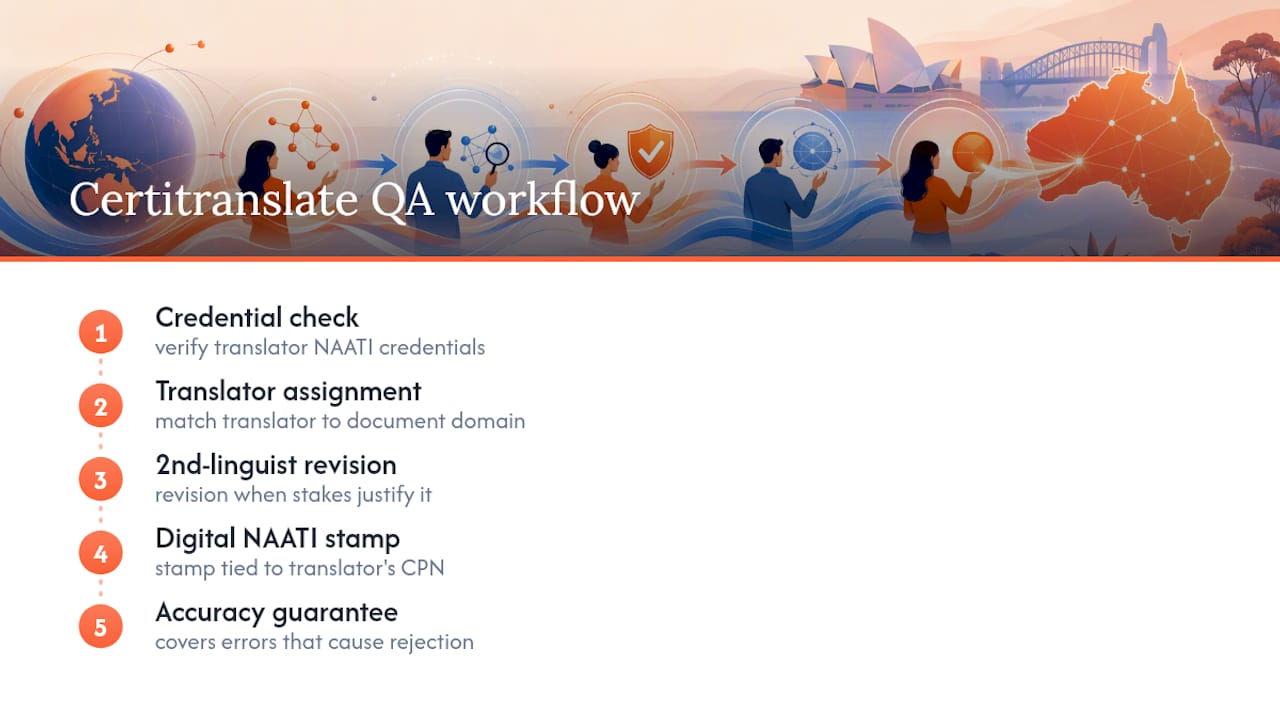
Certitranslate assigns every project to a NAATI-certified translator matched to the document’s specific field, whether that’s immigration paperwork, a commercial contract, or an academic transcript. Domain matching matters because terminology errors in specialised documents are one of the more common causes of a translation getting queried or rejected.
The workflow runs through credential verification first, translator assignment second, then a second-linguist revision pass on documents where the stakes justify it. Every finished translation carries a NAATI digital stamp generated against the translator’s current CPN, so anyone checking it, whether that’s a case officer or a university admissions team, can verify it independently in seconds. Certitranslate backs each certified translation with an accuracy guarantee, covering the reader against the kind of error that causes a rejection down the line.
When you place an order, ask for the combined original-and-translation PDF formatted for direct upload, a note confirming consistent name transliteration across all your documents, and the digital stamp details up front. Having those three things sorted before lodgement removes most of the friction that otherwise turns up at the worst possible moment, right when a case officer is reviewing your file.
Where most submissions actually go wrong
Most of the delays I’ve seen traced back to two things: a credential that didn’t check out, or a translation that didn’t visually match its source closely enough for a case officer to feel confident cross-referencing it. Neither is a translation quality problem in the traditional sense. Both are verification and layout problems, and both are entirely preventable if you check them before you lodge anything.
If you do nothing else, do three things: verify the CPN against NAATI’s directory, check that stamps, signatures, and table structures from the original appear somewhere in the translation, and make sure your name is spelt identically across every translated document you’re submitting together. Inconsistent transliteration between a passport translation and a marriage certificate translation is a small, dumb reason to get bounced back, and it happens constantly.
None of this requires expertise. It requires ten minutes and a willingness to check rather than assume.
— David
Getting your documents translated properly, without the guesswork
Certitranslate exists for exactly the scenario this guide walks through: official submissions where a formatting slip or an unverifiable credential can cost you weeks. Every translation comes from a NAATI-certified practitioner matched to your document’s subject matter, carries the formal certification elements case officers expect, and is backed by an accuracy guarantee rather than a vague promise of quality.
If you’re preparing an immigration lodgement, start with the immigration document translation process page to see exactly how documents move from upload to verification-ready PDF. For a broader look at what certified translation covers and when you need it, the complete guide to certified translation walks through the fundamentals. If your documents involve English test scores or other visa evidence alongside your translations, it’s worth checking which English language tests Australian authorities currently accept.
Ready to move forward? Request a quote through Certitranslate’s immigration translation guide, ask for a digital-stamp-ready PDF and a firm turnaround estimate, and get your documents into the queue before the deadline sneaks up on you.
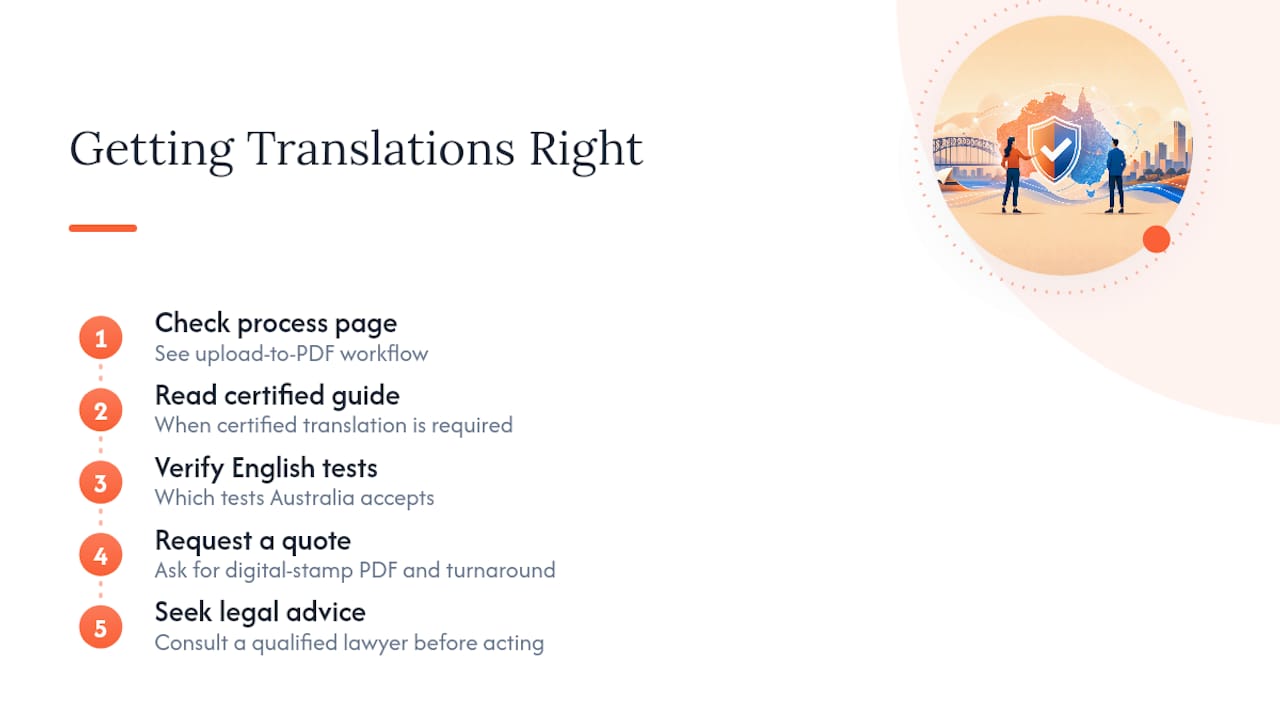
This article is general information, not a substitute for advice from a qualified lawyer. Consult a qualified legal professional about your own circumstances before acting on anything here.