


Yes, handwritten documents can be translated for official use, but only a NAATI-certified translator’s signed declaration will get them through the door. The minimum deliverable is a complete page-by-page translation, a certification statement carrying the translator’s NAATI practitioner number, and either the original document or a certified copy attached. Before you order anything, get clear colour scans of every handwritten page and write out the correct English spelling of every name that appears.
TL;DR:
- Handwritten translations must be signed by a NAATI-certified translator including their number, full name, certification language, signature, and date, or they are not accepted.
- All visible elements of the original document, such as stamps, seals, notes, and annotations, must be reproduced exactly in the translation without alterations.
- Proper preparation involves colour scanning of each page, full-page captures, clear spelling of names, and indicating the translation’s intended purpose for accuracy.
- Most delays arise from poor document preparation or incomplete certification details rather than translation quality, so thorough review and checklists prevent rejection.
- Costs vary based on document complexity, language, and turnaround time, with higher fees for illegible handwriting or urgent deadlines, and verification requires checking the translator’s credentials online.
Table of Contents
- What do Australian authorities require for handwritten translation acceptance?
- How do you prepare a handwritten document for translation?
- How do translators handle handwriting, and what’s the turnaround?
- What are the most common rejection reasons, and how do you fix them?
- What counts as a legally accepted handwritten document?
- What does NAATI-certified handwritten translation typically cost?
- How do you verify a translator’s NAATI certification before engaging them?
- How do you handle a discrepancy or dispute over a translation?
- How Certitranslate delivers accepted handwritten document translations
- Author perspective: common pitfalls and advice from experience
- Sources
What do Australian authorities require for handwritten translation acceptance?
Authorities don’t accept a translation just because it’s accurate. They accept it because it carries specific, checkable proof that a qualified person produced it, and handwritten documents raise that bar rather than lower it.
The Department of Foreign Affairs and Trade requires translators to include their NAATI practitioner ID, full name, the language pair they’re certified in, a signature or stamp (or digital NAATI authentication), and the date of translation. Miss any one of those fields and the document is functionally unusable for visa, court, or enrolment purposes, no matter how good the translation itself reads.
There’s a second rule that trips people up constantly: everything visible on the original has to appear in the translation. That means stamps, seals, marginal notes, crossed-out words, and even scrawled annotations from a registrar or notary. NAATI guidance is explicit that stamps and seals must be reproduced as seen, never altered, with bracketed clarifying text added only where genuinely needed. A translator who quietly skips an illegible margin note because it seemed unimportant has just created a rejection.
Key certification elements an accepting authority checks:
- NAATI practitioner number printed clearly on the declaration
- Translator’s full name and the specific language pair certified
- Signature or stamp on every page, not just the final one
- Date the translation was completed
- A statement confirming it’s a true and accurate translation of the attached document
Where DFAT legalisation or an apostille is involved, that practitioner stamp becomes even more important, since the authenticating body is verifying the translator’s credentials against the NAATI register, not just eyeballing the paper.
If your translator works outside Australia, the equivalent applies. Home Affairs guidance asks for the translator’s full name, contact details, and qualifications instead of a NAATI number, since NAATI accreditation doesn’t extend overseas. Either way, the missing-detail problem is the single biggest cause of a bounced submission, and it’s entirely avoidable.
How do you prepare a handwritten document for translation?
Most delays trace back to poor preparation rather than translator error. A few minutes of setup before you order saves days of back-and-forth later.
- Scan or photograph every page in colour, not black and white. Handwriting nuance, ink colour, and faint stamps often get lost in grayscale.
- Capture the full page, including margins, stamps, and any handwritten additions squeezed into corners. A cropped scan is one of the fastest ways to lose a critical detail.
- Use a stable, high-resolution format like PDF or high-quality JPEG. Blurry phone photos taken at an angle make legibility assessment slower and can push your quote up.
- Write out the English spelling of every name on the document, especially where the original uses a non-Latin script. Service NSW specifically flags this requirement for handwritten or non-Latin alphabet documents, and it prevents your translator from guessing at a transliteration that later mismatches your passport or visa paperwork.
- Confirm whether the original or a certified copy needs to travel with the translation. Some authorities want it stapled or bound together; others accept a digital pairing.
- Note your intended use (visa subclass, court matter, university enrolment) when you place your order, since this changes what the translator’s declaration needs to state.
Pro Tip: Keep a single folder with your scans, your name-spelling list, and the accepting authority’s exact document checklist. When a translator asks a clarifying question, you’ll answer in one email instead of three.
How do translators handle handwriting, and what’s the turnaround?
Handwriting isn’t uniform, and neither is the process for translating it. A properly run translation service starts with an assessment stage: the translator (or a project coordinator) reviews legibility, script complexity, and volume before quoting a price or a delivery date. Cramped medical notes or a century-old ledger entry take longer to decode than a neatly printed affidavit, and that difference shows up in both cost and turnaround.
Once the assessment is done, the actual translation work runs through several checks:
- Page-by-page translation, with every stamp, seal, and annotation reproduced or bracketed
- A second-set-of-eyes review, often a peer check, before certification
- The signed translator declaration attached, carrying the NAATI practitioner number
- Digital authentication or a physical stamp applied, depending on how the document will be used
- Final formatting matched to the original layout so an assessor can compare them side by side
Standard turnaround for a straightforward handwritten document usually runs a few business days; expedited options exist for urgent visa or court deadlines. What extends that window? Illegible handwriting that needs the translator to query the source, rare language pairs with fewer certified practitioners available, and any requirement for DFAT legalisation or an apostille layered on afterward.
Expect your final deliverable as a signed PDF carrying the translator declaration, plus a physical certified copy if your accepting authority insists on original ink signatures rather than a digital version.
What are the most common rejection reasons, and how do you fix them?
Rejections almost always trace back to one of four fixable problems, not to the quality of the translation itself.
- Unsigned or missing NAATI details. Request a corrected reissue that includes the full practitioner number, name, and signature on every page, not just a cover sheet.
- Missing elements from the original. If a stamp, seal, or handwritten note got left out, ask the translator to reissue with those marks reproduced verbatim, bracketed if a note needs explaining.
- Illegible handwriting the translator couldn’t confidently render. Options here include a certified transliteration with bracketed uncertainty flagged, a witness statement supporting the translation, or going back to the issuing authority for a cleaner reissue of the original.
- Wrong document type submitted alongside the translation. If the authority wanted a certified copy and got a photo, you’ll need to get the original certified by an authorised person before resubmitting.
Pro Tip: Before resubmitting anything, ask the accepting authority exactly which field triggered the rejection. A vague “document incomplete” notice often means one missing signature line, not a translation redo.
What counts as a legally accepted handwritten document?
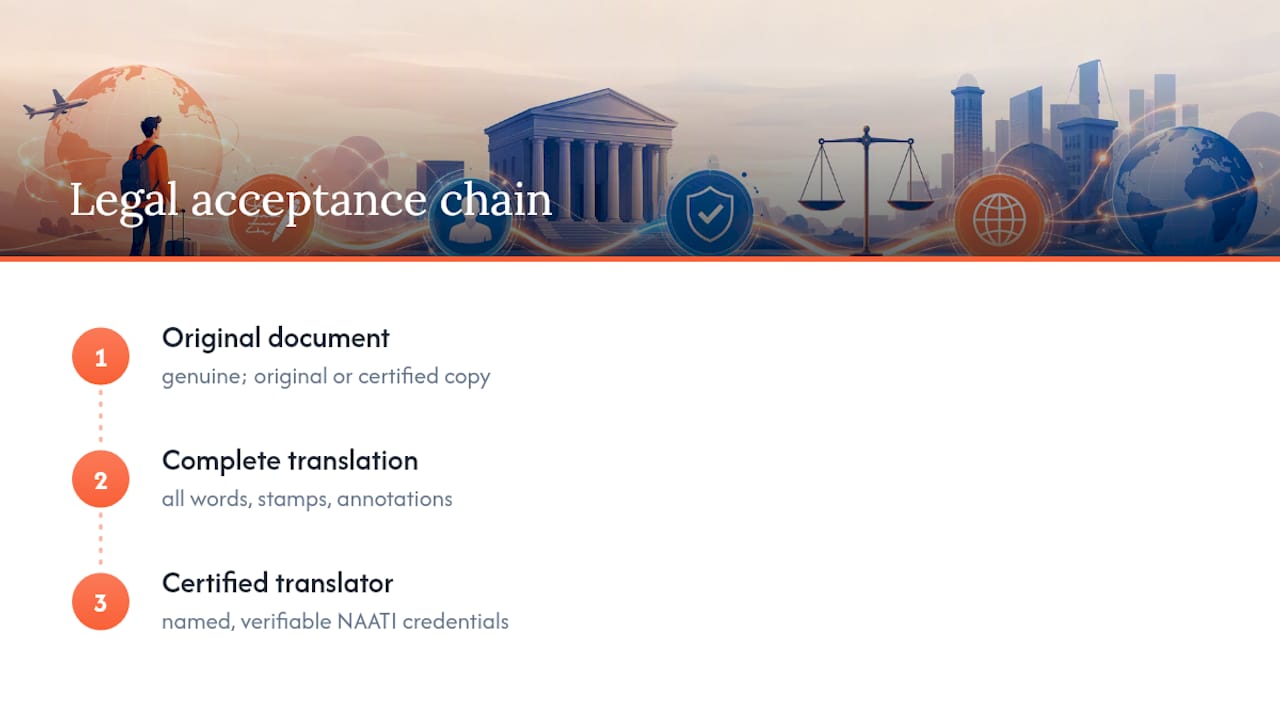
A handwritten document earns acceptance through its certification, not its neatness. Authorities aren’t grading penmanship. They’re checking whether the translation carries a complete, verifiable chain of proof back to a qualified translator and the original source.
That chain has three links. First, the original document itself has to be genuine and, where required, either presented in its original form or as a certified copy. Second, the translation must be complete: every word, stamp, and annotation accounted for, with nothing summarised or paraphrased. Third, the certification statement has to name a real, checkable translator, with credentials an assessor can verify independently.
A handwritten letter, an affidavit scrawled by hand, an old birth certificate filled out by a registrar decades ago, all of these qualify once they’re translated under that framework. What doesn’t qualify is a translation done by a bilingual friend, a free online tool, or anyone without formal certification, regardless of how accurate the wording turns out to be. TIS National’s free translating service illustrates the boundary well: it covers personal documents for eligible applicants but explicitly excludes anything needed for a visa or citizenship application, because those categories demand the accountability a NAATI-certified declaration provides.
What does NAATI-certified handwritten translation typically cost?
Pricing for handwritten documents tends to sit above standard typed-document rates, and there’s a straightforward reason: legibility assessment takes real time before a single word gets translated.
Most certified translation services price by document complexity and word count rather than a flat per-page rate, which means a short, clearly written note costs less than a dense, faded, multi-page letter in cramped cursive. Rare language pairs also push pricing up, simply because fewer NAATI-certified practitioners are available to take the work. Expedited turnaround for a visa deadline or court date typically carries a premium on top of the standard quote.
The one cost mistake worth avoiding is picking the cheapest quote sight unseen. A translator who hasn’t actually assessed your handwriting sample before quoting is guessing, and a guess that turns out too low often means a rushed job, a missed stamp, or a resubmission down the track that costs more than the saved dollars ever did. Ask for a quote based on an actual look at your scanned pages, not a generic per-document estimate.
How do you verify a translator’s NAATI certification before engaging them?
Checking credentials takes two minutes and removes almost all the risk in this process. NAATI maintains a public online directory where you can search a translator’s practitioner number, name, and certified language pairs directly. If a translator can’t produce a practitioner number, or the number doesn’t match their name in the directory, that’s a hard stop, not a minor concern.
Beyond the directory check, ask directly whether the translator’s certification covers the specific language pair on your document, since some practitioners are certified for one direction only (say, Vietnamese to English but not the reverse). Confirm whether their certification is current, as NAATI credentials require periodic renewal. For documents heading to DFAT for legalisation, it’s also worth confirming the translator has handled that specific pathway before, since DFAT’s stamping and authentication requirements are stricter than a standard visa submission.
If your translator is based overseas rather than in Australia, NAATI accreditation won’t apply. Instead, verify their stated qualifications and ask for contact details you can independently confirm, as Home Affairs guidance requires exactly that information on the declaration itself.
How do you handle a discrepancy or dispute over a translation?
Discrepancies happen more often with handwritten documents than typed ones, simply because handwriting leaves room for genuine interpretation. A faded numeral, an ambiguous letter, or a name spelled two different ways across a document can all trigger a question from the accepting authority.
The first step is always to go back to the translator, not the authority, and ask for a written clarification of how a specific word or figure was rendered. A reputable NAATI-certified translator will document their reasoning, and many will add a bracketed note directly into the certified translation explaining an ambiguous character or mark. This is far stronger than an informal email exchange, because it becomes part of the official record attached to the declaration.

If the dispute concerns whether the translation matches the original at all, the accepting authority may request a second opinion from another certified translator. Keep every version of your submission, the correspondence, and the dates involved. That paper trail matters if you need to explain a delay to a visa caseworker or a court registrar later. For genuinely contentious cases, particularly in migration matters where document provenance affects eligibility, it’s worth getting advice from a migration lawyer alongside the translator, since the two issues (translation accuracy and legal eligibility) aren’t the same thing and shouldn’t be resolved through the same channel.
How Certitranslate delivers accepted handwritten document translations
Certitranslate is built around exactly the problem this article has been walking through: getting a handwritten document over the finish line without a second attempt. Every translation runs through NAATI-certified translators with specific experience in immigration, legal, and technical terminology, so a birth certificate, an affidavit, or a business filing gets handled by someone who’s seen that document type before, not a generalist guessing at context.
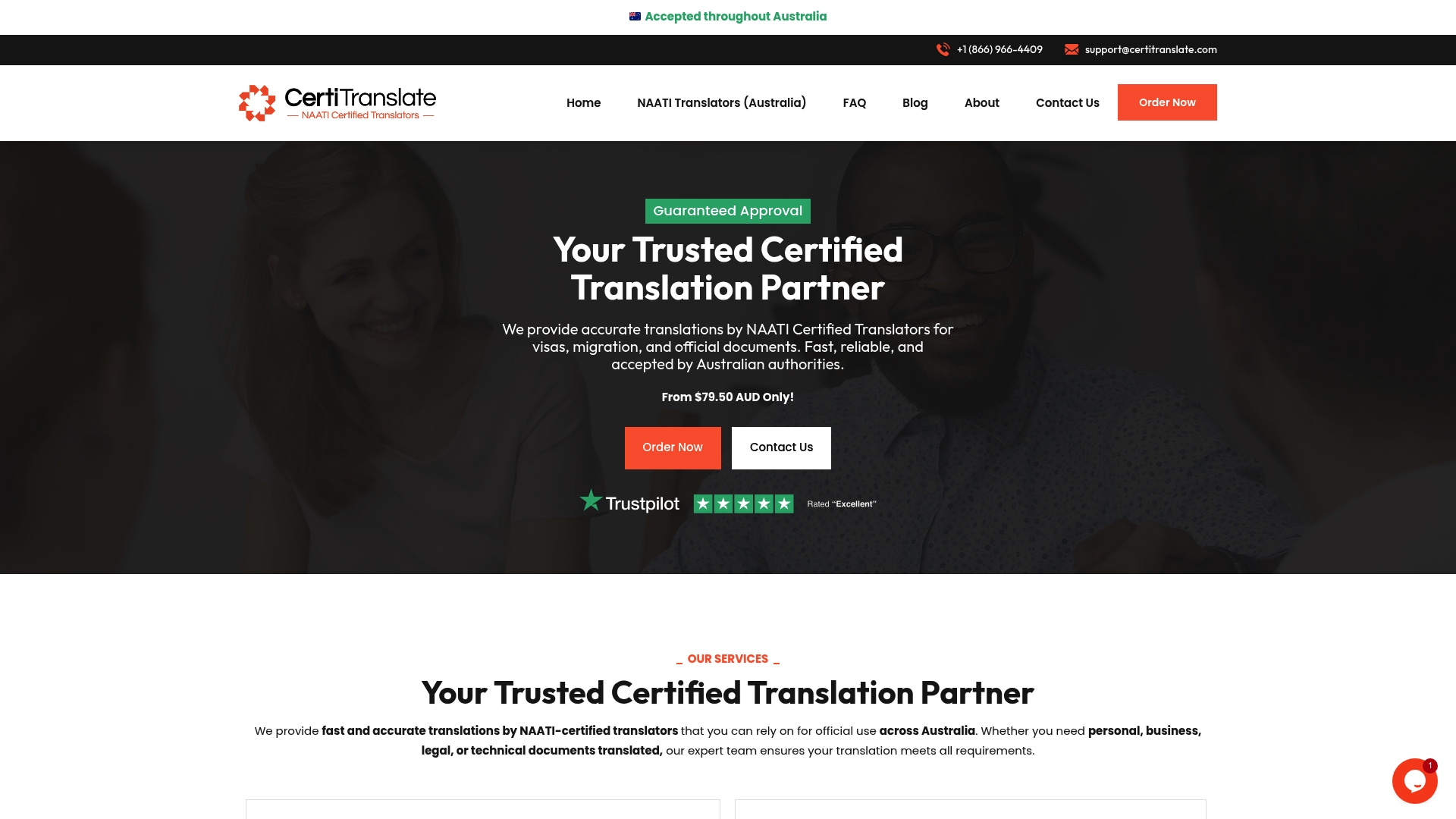
Ordering is straightforward: upload your scanned pages, note your intended use (visa, court, university, or business filing), and choose a standard or expedited turnaround. Every completed translation arrives as a signed declaration carrying the translator’s NAATI practitioner number, so you or the accepting authority can verify it independently in minutes. If a specific authority has its own quirks, Certitranslate’s support team can talk you through what that body typically expects before you submit.
The upside for you is fewer resubmissions and less second-guessing. Start with Certitranslate’s document translation service and get a quote based on your actual scanned pages rather than a generic estimate.
Author perspective: common pitfalls and advice from experience
The small omissions cause almost every delay I’ve seen discussed around this topic: a translator’s stamp missing from page three of a four-page document, a name spelled one way on the translation and another way on the visa form, a margin note nobody thought worth including. None of these are translation quality failures. They’re process failures, and every one of them is preventable.
My advice is blunt: build a pre-submission checklist before you order anything, and if your case has an unusual wrinkle, call the accepting authority and ask how they want it handled rather than assuming. Keep a dated record of every version you submit. It costs nothing and it will save you weeks if something gets questioned later.
— David
This article is general information, not a substitute for advice from a qualified lawyer. Consult a qualified legal professional about your own circumstances before acting on anything here.
Sources
- DFAT Requirements for Translators – NAATI
- 1300t – Application for Australian citizenship General eligibility
- Apply for document translation services | Service NSW
- Free Translating Service eligibility – TIS National