

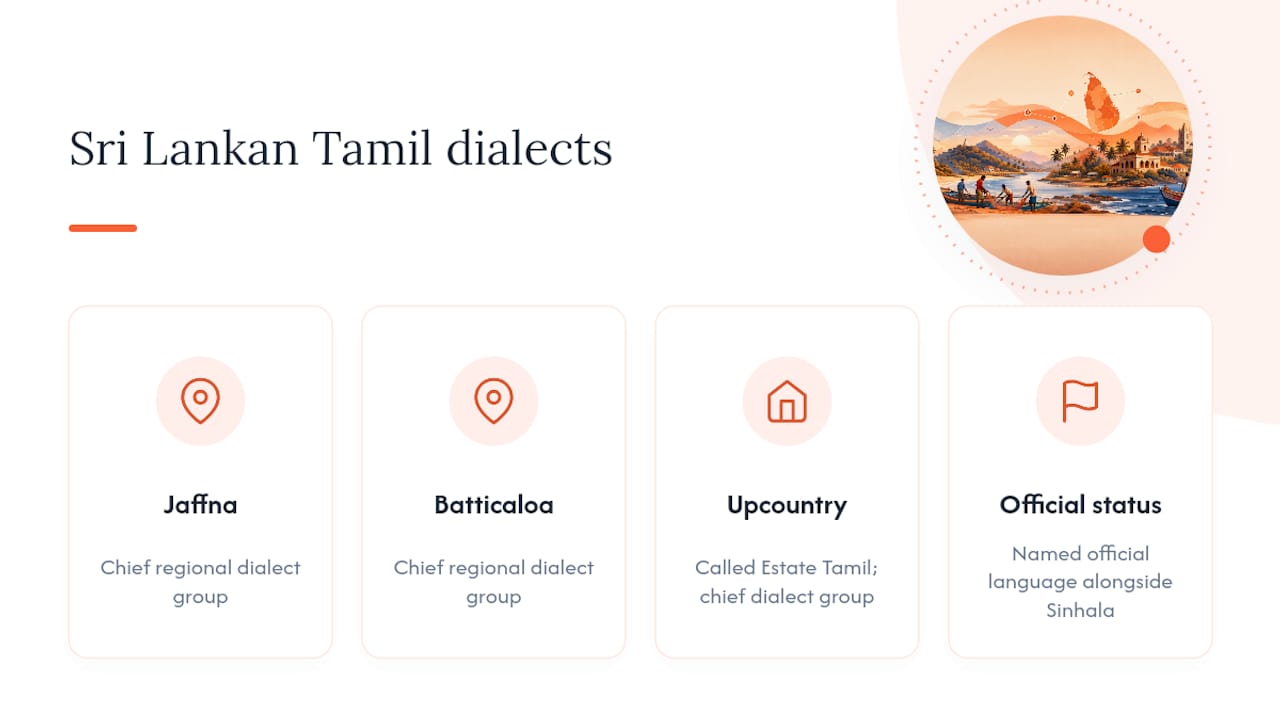
Sri Lankan Tamil is the term linguists use for the family of Tamil dialects native to Sri Lanka, distinct from continental Indian Tamil, and it holds constitutional status as one of the country’s two official languages. Two facts anchor everything that follows: the constitution names Tamil an official language alongside Sinhala, and the language splits into several regional dialect groups, chiefly Jaffna, Batticaloa and Upcountry (or Estate) Tamil. What follows covers those dialects in detail, the linguistic features that set them apart, and the legal and demographic reality of Tamil in Sri Lanka today.
Key Takeaways
Sri Lankan Tamil is a constitutionally recognised official language built from several distinct regional dialects, not a single uniform variety of Indian Tamil.
| Point | Details |
|---|---|
| Four main dialect groups | Jaffna, Batticaloa, Negombo and Upcountry (Estate) Tamil each carry distinct sounds and vocabulary. |
| Constitutional official status | Sinhala and Tamil are both official languages, with laws published in both plus an English translation. |
| Demographic footprint | Sri Lankan Tamils make up about 12.3% of the population, Indian Tamils around 2.76%. |
| Diglossia affects learners | Literary Tamil taught in schools differs sharply from spoken dialects, which can confuse learners trained on Indian Tamil materials. |
| Regional variation in daily use | Tamil dominates administration in the Northern Province, with strong presence in the Eastern and Central Provinces. |
Table of Contents
- What counts as Sri Lankan Tamil?
- What are the main Sri Lankan Tamil dialects?
- What makes Sri Lankan Tamil sound different?
- Is Tamil an official language in Sri Lanka?
- Who speaks Tamil in Sri Lanka today?
- How does Sri Lankan Tamil compare to Indian Tamil?
- How is Tamil used in education, media and daily life?
- Why accurate knowledge of Tamil dialects and status matters
- Frequently asked questions about Tamil in Sri Lanka
- Sources
What counts as Sri Lankan Tamil?
“Sri Lankan Tamil” covers the varieties spoken by communities who have lived on the island for centuries, plus the separate Upcountry or Estate Tamil spoken by descendants of 19th century plantation migrants from India. Both sit apart from mainland Indian Tamil, though all three trace back to the same linguistically conservative dialect family.
The timeline runs roughly like this:
- Classical roots: Tamil arrived and took hold on the island well over a thousand years ago, sharing common ancestry with the language recorded in early Tamil literature.
- Medieval continuity: Kingdoms in the north and east sustained Tamil as an administrative and literary language for centuries, largely isolated from later shifts in mainland Tamil.
- Colonial era: Portuguese, Dutch and British rule introduced loanwords and reshaped education and administration, particularly around Negombo and coastal trading centres.
- 19th–20th century differentiation: Plantation migration from South India created Estate Tamil as a distinct branch, while Jaffna and Batticaloa dialects kept diverging from each other and from India.
Underneath all of this sits diglossia, a split between the formal Literary Tamil used in writing, broadcasting and education, and the everyday spoken dialects that vary sharply by region. That gap matters for anyone trying to learn the language, not just academics studying it.
What are the main Sri Lankan Tamil dialects?
Sri Lankan Tamil breaks into four broadly recognised regional groups, each tied to a specific geography and social history. The dialect classification most linguists use treats these as related but genuinely distinct varieties, not minor accents of one another.
- Jaffna Tamil: spoken across the Jaffna Peninsula and much of the Northern Province, and widely regarded as the most phonologically conservative variety, preserving sounds and word forms that have shifted elsewhere.
- Batticaloa Tamil: centred on the Eastern Province, often described as sounding closer to Literary Tamil in its rhythm and vocabulary than the Jaffna variety, with its own distinct intonation.
- Negombo Tamil: spoken by Tamil-speaking Catholic communities on the west coast, carrying noticeable Sinhala influence from centuries of close contact with Sinhala speaking neighbours.
- Upcountry (Estate) Tamil: used across the central highlands, particularly Nuwara Eliya and the tea plantation districts, shaped by generations of contact between varied Indian Tamil dialects and Sinhala in a shared workplace setting.
For a rough mental map: Tamil functions as the main language of daily administration in the Northern Province, holds strong minority status through much of the Eastern Province, and appears as a plantation community language scattered through the Central Province highlands, with the coastal Negombo variety sitting as a smaller, geographically compact pocket on the west coast.
What makes Sri Lankan Tamil sound different?

The most cited feature is phonological conservatism: Sri Lankan Tamil varieties, especially Jaffna Tamil, resist adopting voiced stops that have become standard in many Indian Tamil dialects. A word that comes out with a “b” or “g” sound in Chennai Tamil often stays closer to its unvoiced “p” or “k” root in Jaffna speech, a pattern linguists point to as one of the clearest markers separating the two.
A few features worth knowing:
- Archaic vocabulary retention: everyday words and grammatical endings that have faded from mainland use often survive intact in Sri Lankan speech.
- Conservative grammar: older verb forms and case markings persist, particularly in Jaffna Tamil, giving it a formal, almost literary flavour even in casual conversation.
- Diglossia in practice: the gap between Literary Tamil, taught in schools and used in print, and the colloquial dialects is sharp enough that materials built for Indian Tamil learners can fall short once a learner tries to follow everyday Sri Lankan speech.
For learners, this means textbook Tamil and street Tamil in Jaffna can feel like two different registers of the same language, not a smooth continuum.
Is Tamil an official language in Sri Lanka?
Yes. The Sri Lankan constitution names Sinhala and Tamil as the country’s two official languages, with English serving as the link language between them. That is not a symbolic gesture: laws and subordinate legislation must be enacted and published in both Sinhala and Tamil, with an English translation provided alongside.
“Sinhala and Tamil shall be the official languages” of Sri Lanka, with laws required to be published in both, together with an English translation.
In the Northern and Eastern Provinces, Tamil is the language of administration by default. Courts across the island are constitutionally required to offer interpretation and translation for Tamil speakers, though availability of Tamil-speaking officials varies province by province in practice. Bodies like the National Languages Division and the Department of Official Languages exist specifically to coordinate this policy on the ground, training officials and translators to keep the constitutional promise functional rather than theoretical.
Who speaks Tamil in Sri Lanka today?
Recent census figures put Sri Lankan Tamils at roughly 12.3% of the national population, with Indian (Upcountry) Tamils at around 2.76%. Combined, Tamil speakers form a substantial minority whose weight is heavily concentrated by province rather than spread evenly across the island.
- The Northern Province is majority Sri Lankan Tamil, with Tamil functioning as the primary language of daily life and administration.
- The Eastern Province carries a significant Tamil population, sharing space with Sinhala and Muslim (Tamil-speaking Moor) communities.
- The Central Province highlands hold most of the Upcountry Tamil population, tied historically to the tea plantation economy.
Many Tamil speakers outside these heartlands are functionally bilingual or trilingual, moving between Tamil, Sinhala and English depending on setting, a pattern the broader demographic record of the island confirms is now standard in mixed urban areas like Colombo.
How does Sri Lankan Tamil compare to Indian Tamil?
Written Literary Tamil travels well between Sri Lanka and India. Formal documents, news broadcasts and religious texts are largely mutually intelligible on the page. Spoken colloquial Tamil is where things get harder.
- Phonology diverges sharply: the voiced/voiceless stop contrast that mainland speakers use freely often sounds archaic or simply different to Sri Lankan ears, and vice versa.
- Vocabulary drifts: centuries of separate development mean everyday words for common objects or actions can differ enough to cause a genuine pause in conversation.
- Estate Tamil sits apart from both: it developed through direct contact between assorted Indian Tamil dialects and Sinhala on plantations, producing phonological and morphological patterns found nowhere in mainland India and distinct from Jaffna or Batticaloa speech too.
Pro Tip: If you’re learning Tamil for use in Sri Lanka specifically, don’t rely solely on Chennai based courses or apps. Look for region specific audio and, where formal accuracy matters, get written material checked against actual Sri Lankan usage rather than assuming Indian Tamil resources transfer cleanly.
How is Tamil used in education, media and daily life?
Tamil is written using the standard Tamil script, and formal writing in Sri Lanka stays close to Literary Tamil conventions rather than the more localised spoken dialects. Spelling and grammar taught in schools mirror the pan-Tamil literary standard, which is part of why written communication crosses the Sri Lanka-India divide far more easily than speech does.
- Government schools in Tamil-majority areas teach through the Tamil medium, with English and Sinhala taught as additional subjects.
- Tamil-language print, radio, television and online news remain active and widely consumed in the Northern and Eastern Provinces.
- Outside those regions, Tamil speakers frequently switch to Sinhala or English for daily transactions, schooling or work, reflecting the practical bilingualism common in mixed communities.
Why accurate knowledge of Tamil dialects and status matters
Getting the dialect and legal detail right matters well beyond academic curiosity, particularly where Tamil documents need to hold up in an education, immigration or legal setting. Certitranslate works with these distinctions daily, producing certified Tamil translations that respect regional terminology and meet the formal standards Australian institutions expect.

Whether you’re translating an academic record, a legal contract, or immigration paperwork originally issued in Tamil, the difference between colloquial phrasing and the Literary Tamil standard can affect whether a document is accepted without question. Certitranslate’s NAATI-certified translators handle this gap as a matter of course, and our guide on what certified translation actually involves explains why that certification carries weight with Australian authorities. If you’re weighing up who should handle a Tamil document that needs to be accepted the first time, our breakdown of how to choose the right certified translator is a practical next step.
Frequently asked questions about Tamil in Sri Lanka
Is Tamil an official language of Sri Lanka?
Yes. The constitution names both Sinhala and Tamil as official languages, with English as the link language between them.
What is the difference between Sri Lankan Tamil and Indian Tamil?
Sri Lankan Tamil tends to preserve older vocabulary and grammatical forms and resists the voiced consonant shifts common in many Indian Tamil dialects, making spoken varieties harder to follow across the two countries even though written Literary Tamil remains largely shared.
Which regions of Sri Lanka speak Tamil?
Tamil is the majority language of the Northern Province, has a strong presence in the Eastern Province, and is spoken by Estate Tamil communities concentrated in the Central Province highlands.
What is Estate Tamil?
Estate or Upcountry Tamil is the variety spoken by descendants of 19th century plantation migrants from India, shaped by long contact with Sinhala and other Tamil dialects in the central highlands, and distinct from both mainland Indian Tamil and Jaffna Tamil.
Why does Tamil in Sri Lanka matter for document translation?
Legal, immigration and academic documents drafted in colloquial or regional Tamil need translators familiar with both the formal Literary standard and regional usage to ensure official acceptance, which is why working with NAATI-certified translators matters for anything submitted to an Australian authority.
Sources
- Constitution of the Democratic Socialist Republic of Sri Lanka
- Press release — Census 2024 figures (Statistics Sri Lanka)
- Sri Lankan Tamil dialects — Wikipedia
- Standardization or restandardization: The case for ‘Standard’ Spoken Tamil
Recommended
- Will translation in Australia: what you need to know – CertiTranslate – Translations by NAATI Certified Translators
- Simple Bahasa Indonesia translations accepted in Australia – CertiTranslate – Translations by NAATI Certified Translators
- Translated workplace safety standards: what they are and why they matter in Australia – CertiTranslate – Translations by NAATI Certified Translators
- What is a sworn translation? your complete guide – CertiTranslate – Translations by NAATI Certified Translators