


A birth certificate translation for immigration is defined as a certified English rendering of a foreign-language birth certificate, produced by a NAATI-accredited translator and accepted by Australian authorities. The Department of Home Affairs requires that all non-English documents submitted with visa or citizenship applications be accompanied by an English translation completed by a NAATI-certified translator. This applies to every birth certificate written in a language other than English, without exception. Understanding this requirement before you lodge your application saves time, money, and significant frustration.
What do you need to translate a birth certificate for immigration?
The starting point for any immigration document translation is your original foreign birth certificate. The Department of Home Affairs requires applicants to submit both the original foreign document and the certified English translation together. Submitting only one without the other causes delays or outright refusal. This rule applies regardless of which visa stream or citizenship pathway you are pursuing.
Before ordering a translation, confirm which visa or immigration programme requires it. Requirements differ across partner visas, skilled migration visas, student visas, and citizenship applications. Knowing the exact programme means you can ask your translator for the correct format and any programme-specific annotations.

NAATI stands for the National Accreditation Authority for Translators and Interpreters. It is the body that sets and verifies translation standards across Australia. NAATI certification verifies a translator’s skills and accuracy, which is why Australian immigration authorities require it for all translated documents. A translation produced by someone without NAATI accreditation will not be accepted, regardless of how accurate it appears.
Depending on your case, other documents may also require certified translation alongside your birth certificate. Common examples include:
- Marriage or divorce certificates
- Passports or national identity cards
- Police clearance certificates
- Academic transcripts and qualifications
- Adoption orders or guardianship documents
Check which documents need translation for your specific visa type before you begin, so you can order everything at once and avoid multiple rounds of submissions.
Pro Tip: Request a certified copy of your original birth certificate from the issuing authority before sending anything to a translator. Translators work from the original, and immigration authorities may ask to sight it.
How do you choose a NAATI-certified translator?
Selecting the right translator is the single most consequential decision in the birth certificate translation process. Choosing a NAATI-certified translator reduces the risk of application rejection or delays caused by translation errors or uncertified documents. Many visa applicants experience exactly those delays when they use uncertified services, often because they prioritised cost over compliance.
Three main options exist for obtaining a certified translation in Australia:
- Certified translation agencies such as Certitranslate, which employ NAATI-accredited translators across a wide range of languages and specialise in immigration document translation
- Freelance NAATI-certified translators, who can be found through the NAATI online register and may offer competitive rates for straightforward documents
- TIS National’s free translating service, which provides up to 10 personal document translations at no cost for eligible permanent residents and visa holders. TIS National is contactable on 131 450.
Before engaging any translator, ask these questions:
- Are you currently NAATI-certified, and in which language pair?
- Do you have experience translating birth certificates for immigration purposes?
- What is your standard turnaround time, and do you offer an expedited option?
- Does your certified translation include a signed certification statement?
Cost varies by language pair, document length, and turnaround time. Avoid any service that cannot provide a NAATI credential number on request. The small saving from an uncertified translation is never worth a rejected application.
Step-by-step process to translate your birth certificate
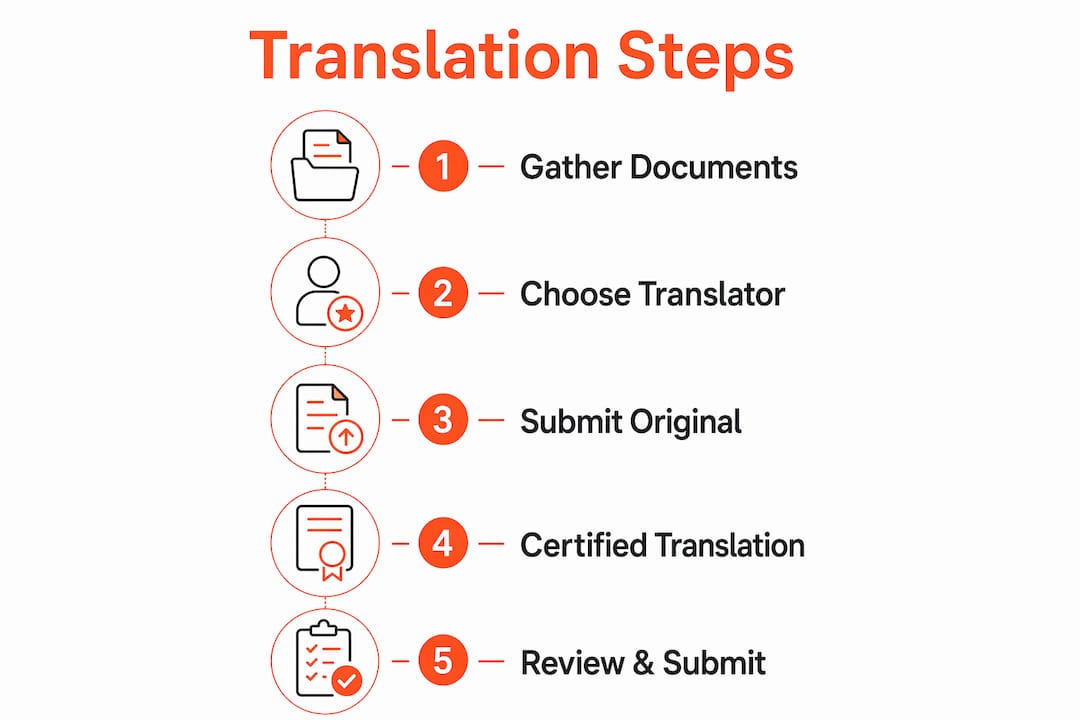
A clear process removes guesswork and keeps your application on track. Follow these steps in order.
-
Obtain your original birth certificate. Source a certified copy directly from the issuing authority in your country of birth. Do not send your only original to a translator. Keep at least one certified copy for your own records.
-
Confirm your translation requirements. Check the Department of Home Affairs website or your migration agent’s advice for the exact format required by your visa programme. Some programmes require specific annotations or a particular layout.
-
Select a NAATI-certified translator. Use the NAATI online register or engage a specialist agency such as Certitranslate. Verify the translator’s accreditation before submitting your documents.
-
Submit your documents for translation. Provide the original birth certificate or a certified copy. Include any supporting context, such as the visa subclass you are applying for, so the translator can format the translation correctly.
-
Review the completed translation. Check that all names, dates, and place names match the original exactly. Confirm that the translation includes a signed certification statement confirming accuracy and the translator’s credentials. Certified translations always include this statement as a mandatory element.
-
Lodge the translation with your application. Submit both the original document and the certified English translation together. Do not separate them.
The table below summarises the key elements your certified birth certificate translation must contain.
| Element | Why it matters |
|---|---|
| Full name of the translator | Identifies the accredited professional responsible |
| NAATI credential number | Confirms the translator meets Australian immigration standards |
| Signed certification statement | Verifies the translation is accurate and complete |
| Date of translation | Confirms the translation is current at time of lodgement |
| Complete rendering of all text | Partial translations are rejected by the Department of Home Affairs |
Translation turnaround times vary between providers. Plan ahead and allow buffer time before your visa deadline.
What are the most common mistakes when translating birth certificates?
Errors in immigration document translation are more common than most applicants expect, and they carry real consequences. Common mistakes include missing stamps or official annotations on translated birth certificates, incomplete translations, and failure to provide the original document alongside the translation. Each of these errors can cause delays or outright rejection of your application.
The most frequent problems are:
- Using an uncertified translator. A bilingual friend or an online machine translation tool does not meet the Department of Home Affairs standard. Only NAATI-certified translators produce accepted translations.
- Submitting an incomplete translation. Every word on the original document must appear in the translation, including stamps, annotations, and marginal notes. Leaving anything out invalidates the translation.
- Separating the original from the translation. These two documents must travel together through every stage of your application.
- Ignoring programme-specific requirements. Some visa streams require additional declarations or specific formatting. Always check the requirements for your exact visa subclass.
- Leaving translation too late. Turnaround times vary, and expedited services cost more. Ordering early gives you time to correct errors without missing deadlines.
Pro Tip: Once you receive your certified translation, scan and save a digital copy immediately. If the physical copy is lost in transit, you have a backup to share with your translator for a quick reprint.
The immigration document translation process has more moving parts than most applicants realise. Treating it as a last-minute task is the single biggest mistake you can make.
Key takeaways
A NAATI-certified translation of your birth certificate is a non-negotiable requirement for any Australian immigration application involving non-English documents, and submitting both the original and the certified translation together is the only format the Department of Home Affairs accepts.
| Point | Details |
|---|---|
| NAATI certification is mandatory | Only NAATI-accredited translators produce translations accepted by Australian immigration authorities. |
| Submit original and translation together | Lodging one without the other causes delays or refusal of your application. |
| Free options exist for eligible applicants | TIS National offers up to 10 free personal document translations for eligible permanent residents and visa holders. |
| Certification statement is required | Every valid certified translation must include a signed statement confirming accuracy and translator credentials. |
| Plan ahead for deadlines | Turnaround times vary, so order your translation well before your visa lodgement date. |
What I have learned from watching applicants navigate this process
The applicants who sail through the birth certificate translation process share one habit: they treat the translation as the first step, not the last. They order it before they book flights, before they resign from jobs, and well before any visa deadline. The applicants who struggle almost always left it too late or assumed a bilingual colleague could handle it.
The second pattern I have noticed is that people underestimate how much detail matters. A birth certificate from certain countries contains stamps, registry numbers, and marginal annotations that look like background noise. Every single one of those elements must appear in the English translation. Immigration officers are trained to compare the original and the translation line by line. A missing stamp is not a minor oversight. It is grounds for rejection.
My honest recommendation is to engage a specialist agency rather than a freelance translator for immigration documents. Not because freelancers are less capable, but because agencies carry institutional accountability. If something is wrong, there is a clear process for correction and a team behind the outcome. For a document as consequential as a birth certificate in an immigration context, that accountability matters.
Double-check your translator’s NAATI credential number on the NAATI public register before you hand over any documents. It takes two minutes and eliminates the most common source of application rejection entirely.
— David
Certitranslate: NAATI-certified birth certificate translations
Certitranslate specialises in certified translation for immigration, with a team of NAATI-accredited translators covering a wide range of languages. Every birth certificate translation Certitranslate produces includes the signed certification statement, translator credentials, and complete rendering that the Department of Home Affairs requires.
Turnaround is fast, the process is straightforward, and every translation is checked for completeness before delivery. For applicants who need confidence that their documents will be accepted, the benefits of professional certified translation are clear: accuracy, compliance, and no costly resubmissions. Get your birth certificate translation right the first time with Certitranslate.
Preguntas frecuentes
Does my birth certificate translation need to be NAATI certified?
Yes. The Department of Home Affairs requires all non-English documents submitted with Australian visa or citizenship applications to be translated by a NAATI-certified translator.
Do I need to submit the original birth certificate with the translation?
Yes. You must submit both the original foreign birth certificate and the certified English translation together. Submitting only the translation is not accepted and may result in delays or refusal.
Can I use a free translation service for my birth certificate?
TIS National offers up to 10 free personal document translations for eligible permanent residents and visa holders. Contact TIS National on 131 450 to check your eligibility before ordering a paid service.
How long does a certified birth certificate translation take?
Turnaround times vary by provider and language pair. Standard services typically take a few business days, while expedited options are available at additional cost. Order well ahead of your visa lodgement deadline.
What happens if my translation is rejected by the Department of Home Affairs?
A rejected translation usually means the document was produced by an uncertified translator, is incomplete, or is missing the required certification statement. You will need to commission a new certified translation from a NAATI-accredited translator and resubmit with the original document.
Recommended
- Immigration document translation process: a complete guide – CertiTranslate – Translations by NAATI Certified Translators
- Why universities require certified translations: 2026 guide – CertiTranslate – Translations by NAATI Certified Translators
- Why police clearance needs certified translation: 2026 guide – CertiTranslate – Translations by NAATI Certified Translators
- What documents need translation for a visa application? – CertiTranslate – Translations by NAATI Certified Translators