


Every non-English document in your visa application requires a certified translation before an immigration authority will accept it. This is not a recommendation. It is a legal requirement enforced by Australian Home Affairs, USCIS, UKVI, and Canadian IRCC alike. Knowing what documents need translation for a visa application is the difference between a smooth approval and a costly rejection. The term used across immigration systems is “certified translation,” meaning a qualified translator attests in writing that the translation is complete and accurate.
What documents need translation for a visa?
Visa document translation requirements activate the moment any non-English content appears in a document on your visa checklist. That covers more categories than most applicants expect.
The core document types that require certified translation include:
- Civil status documents. Birth certificates, marriage certificates, and divorce decrees are the most commonly requested. Every page must be translated, including back-page annotations.
- Identity documents. Passport biographical pages, national identity cards, and any foreign-language endorsements or entry stamps.
- Education records. Academic transcripts, diplomas, and award letters issued in a language other than English.
- Employment and financial evidence. Employer reference letters, payslips, and bank statements issued by foreign institutions.
- Legal records. Police clearance certificates, court orders, and criminal history checks from overseas authorities.
- Stamps, seals, and handwritten notes. Any non-English text on a document, regardless of where it appears, must be translated. This includes marginalia, official stamps, and handwritten corrections.
That last point catches many applicants off guard. A language scan of all documents before lodgement is the single most effective way to catch missing translation elements before an immigration officer does.
Pro Tip: Lay every document flat and read it page by page, including the back. If you see any non-English character, word, or stamp, it needs to go to a certified translator.

What certification standards must visa translations meet?
Certification requirements differ by country, but the underlying principle is the same across all major immigration systems: the translator must formally attest that the translation is complete, accurate, and produced by a competent professional.
Here is how the four major immigration authorities define those requirements:
-
Australia (NAATI). The Department of Home Affairs requires translations by NAATI-certified translators. NAATI, the National Accreditation Authority for Translators and Interpreters, is Australia’s recognised credentialling body. A certified translation must include the translator’s full name, NAATI credential number, signature, and date.
-
United States (USCIS). Under 8 CFR 103.2(b)(3), every foreign-language document submitted as evidence must have a full English translation. The translator must certify completeness, accuracy, and their own competency to translate from the source language. USCIS does not accept summary or partial translations under any circumstances.
-
United Kingdom (UKVI). UKVI certified translations must be complete and faithful reproductions of the original. The certification must include the translator’s full name, signature, date, and contact details. Machine translations and partial translations are explicitly disallowed.
-
Canada (IRCC). Canadian IRCC requires all supporting documents to be in English or French, or submitted with a certified translation package. That package must include the English or French translation, a translator affidavit, and a certified photocopy of the original document.
The IRCC’s “translation package” approach is worth noting because it goes further than most systems. A translation alone is not enough. The affidavit and certified copy must accompany it, or the submission is incomplete.
Pro Tip: Before submitting, check the specific immigration authority’s current checklist. Requirements are updated periodically, and a checklist from two years ago may not reflect current standards.
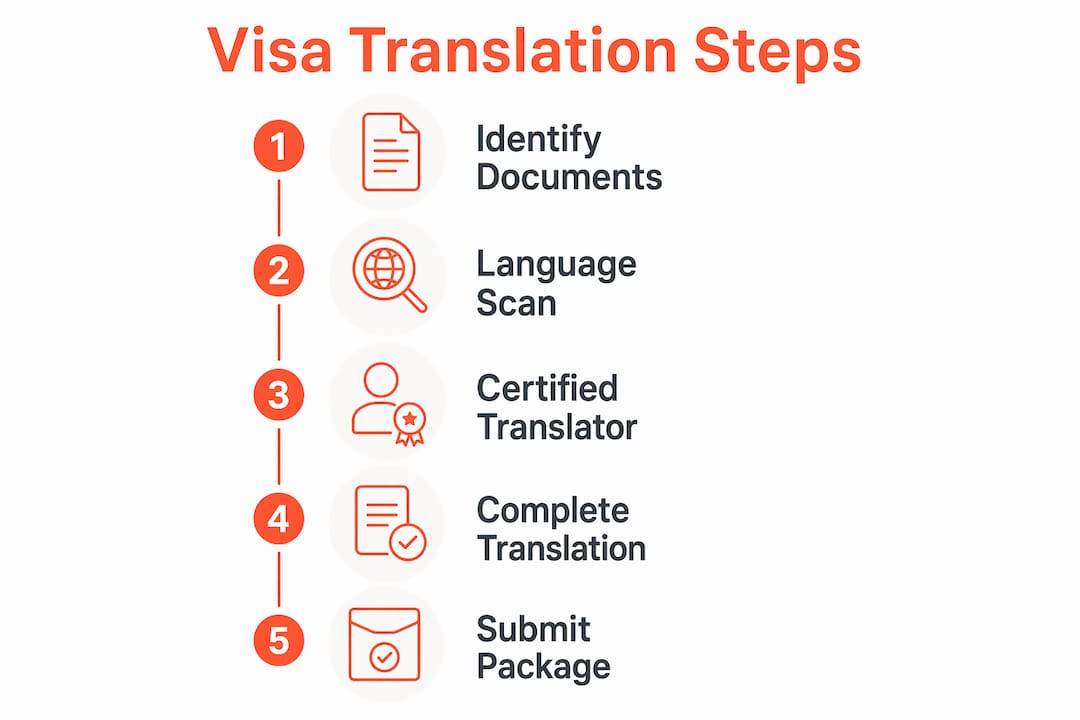
The translator certification must explicitly confirm the completeness and accuracy of the entire document. Missing even a small section can invalidate the translation for USCIS and equivalent authorities.
Common translation mistakes that cause visa rejections
Most visa translation rejections are avoidable. They stem from a small set of recurring errors that applicants make when they underestimate what “complete translation” actually means.
- Translating only the main pages. A birth certificate often has a back page with registration details or official annotations. Submitting only the front page translation is an incomplete translation and grounds for rejection.
- Missing stamps and seals. Official stamps carry legal weight. Omitting stamps and marginalia from a translation is one of the most common reasons immigration officers flag documents as unusable.
- Using machine translation. Tools like Google Translate produce output that no immigration authority accepts as certified. UKVI explicitly bans machine translations. USCIS requires a human translator to certify competency.
- Asking a bilingual friend. A friend who speaks the language fluently is not a certified translator. Their translation carries no legal standing with any immigration authority.
- Missing the certification affidavit. The translation text alone is not sufficient. The translator must attach a signed statement confirming their qualifications and the accuracy of the translation.
- Inconsistency between translation and original. Names, dates, and reference numbers must match exactly between the original document and the translation. Even a minor spelling variation in a name can trigger a request for clarification.
The immigration document translation process is more thorough than most applicants anticipate. Building in extra time before your lodgement deadline gives you room to fix errors without delaying your application.
How do you choose the right certified translator for visa documents?
Choosing the right translation provider is as important as knowing which documents to translate. A translation from an unqualified provider will be rejected regardless of how accurate the text is.
- Verify NAATI certification for Australian applications. For Australian visa applications, the translator must hold a current NAATI credential. You can verify credentials directly on the NAATI website. An uncredentialled translator’s work will not be accepted by the Department of Home Affairs.
- Check that the translator lists their contact details. Every certified translation must include the translator’s name, credentials, signature, and contact information. If a provider does not include these details as standard, look elsewhere.
- Use a specialist visa translation service. General translation agencies do not always understand immigration-specific formatting and certification requirements. Specialist services like Certitranslate work exclusively with immigration, legal, and official documents, so their output is formatted to meet authority requirements from the outset.
- Ask about turnaround time upfront. Visa applications have fixed deadlines. Confirm the provider can deliver certified translations within your timeframe before committing.
- Confirm the service covers all document types you need. Some providers handle standard certificates but not legal records or financial documents. Confirm the full scope before you start.
Pro Tip: Ask your translation provider whether their certification format has been accepted by the specific immigration authority you are applying to. A reputable provider will know the answer immediately.
Certitranslate’s team of traductores certificados por NAATI covers the full range of visa document types, from civil status certificates to police clearances, with certifications formatted to meet Australian immigration standards.
Key takeaways
Every non-English document in a visa application requires a certified translation that is complete, accurate, and produced by a qualified translator whose credentials are formally documented.
| Point | Details |
|---|---|
| All non-English content must be translated | Any text, stamp, seal, or annotation in a foreign language requires certified translation. |
| Certification must name the translator | Include the translator’s full name, credentials, signature, date, and contact details. |
| NAATI certification is required in Australia | Only NAATI-credentialled translators produce translations accepted by the Department of Home Affairs. |
| Partial translations cause rejections | Every page, including backs and annotations, must be translated in full. |
| Machine and informal translations are rejected | UKVI, USCIS, and IRCC all require human-certified translations with a formal competency declaration. |
What I have learned from watching visa applications succeed and fail
After working across hundreds of visa translation cases, the pattern is consistent. Applicants who get rejected almost never had the wrong documents. They had the right documents, translated incompletely.
The most overlooked element is the back page. A marriage certificate from the Philippines, a police clearance from India, a bank statement from Brazil. Each of those documents has a reverse side with registration numbers, official stamps, or certifying signatures. Applicants translate the front and assume the job is done. Immigration officers do not make that assumption.
My strongest recommendation is to treat every document as a two-sided object before you hand it to a translator. Check both sides. Check the margins. Check whether any stamps contain text. Then hand the entire document to a NAATI-certified translator, not just the pages that look important to you.
The second thing I have seen cause unnecessary delays is leaving translation to the last week before lodgement. Certified translation takes time, especially if documents need to be sourced from overseas registries first. Starting the translation process four to six weeks before your lodgement date gives you a realistic buffer for corrections and reissues.
Professional review before submission is not a luxury. It is the step that separates applicants who get approved on the first attempt from those who spend months responding to requests for further information.
— David
Certitranslate: certified visa translations that meet authority standards
Visa applications do not give you a second chance to fix a translation error after lodgement. Getting it right the first time requires a provider who understands exactly what each immigration authority expects.
Certitranslate provides NAATI-certified translations for the full range of visa documents, including birth and marriage certificates, police clearances, academic transcripts, and financial records. Every translation includes the certification affidavit and translator credentials required by Australian Home Affairs, USCIS, UKVI, and IRCC. Turnaround times are fast, and the process is straightforward from upload to delivery. If you are preparing a visa application and need certified translations that will be accepted without question, Certitranslate is the place to start.
Preguntas frecuentes
What documents need certified translation for a visa?
All non-English documents on your visa checklist require certified translation. This includes birth and marriage certificates, passports, academic transcripts, bank statements, police clearances, and any document containing non-English stamps or annotations.
Does every page of a document need to be translated?
Yes. Complete translation of all pages is required, including back pages, stamps, seals, and handwritten notes. Partial translations are rejected by all major immigration authorities.
Can I use Google Translate for visa documents?
No. UKVI explicitly bans machine translations, and USCIS requires a human translator to certify their competency. No immigration authority accepts machine-generated translations as certified documents.
What must a certified translation include?
A certified translation must include the full translated text, the translator’s name, credentials, signature, date, and contact details. Canadian IRCC also requires a translator affidavit and a certified copy of the original document.
Do I need a NAATI-certified translator for Australian visa applications?
Yes. The Department of Home Affairs requires translations by NAATI-credentialled translators. Translations produced by uncredentialled individuals, regardless of their language ability, are not accepted.
Recommended
- Immigration document translation process: a complete guide – CertiTranslate – Translations by NAATI Certified Translators
- Types of business documents requiring translation – CertiTranslate – Translations by NAATI Certified Translators
- CertiTranslate – Translations by NAATI Certified Translators
- Certified translation for import/export agreements: 2026 guide – CertiTranslate – Translations by NAATI Certified Translators