


A translator declaration is a signed statement on a translated document certifying that the translation is accurate and identifying who produced it, backed by a stamp or seal. For most official uses in Australia, that translator must hold current NAATI certification, the recognised national standard. This applies whether you’re lodging documents with DFAT for legalisation, filing with ASIC, applying to a university like ANU, registering with AHPRA, or submitting a visa or citizenship application.
TL;DR:
- Translations inside Australia must be done by a NAATI-certified translator, and the declaration must include a signed statement, full name, practitioner ID, date, and a stamp or digital QR code.
- Overseas translations are accepted if certified by a notary public or an authorized professional under local law; Australian authorities enforce stricter requirements for local translations.
- Confirm individual requirements per institution, as DFAT, ASIC, universities, and AHPRA each have specific rules on submission format, validation details, and acceptable certification standards.
- Verify the translator’s credentials, supply high-quality source documents, and ensure the declaration is properly formatted to avoid delays or rejection.
- Using a reputable translation service that checks declaration formatting and stamp readability can prevent procedural errors that lead to document rejection.
Table of Contents
- What is a translator declaration and who can issue one in Australia?
- What must the declaration actually contain?
- How DFAT, ASIC, universities and AHPRA treat translations differently
- Getting a compliant translation: the practical steps
- A checklist and template to confirm your translation will be accepted
- Why compliance checks matter more than the translation itself
- Order a translator declaration that clears the first check
- Sources
What is a translator declaration and who can issue one in Australia?
NAATI itself doesn’t translate anything. It certifies individual practitioners, who then sign, stamp, and date the translations they produce. Think of NAATI as the licensing body, not the workshop. When you order a translation, you’re engaging a certified person or an agency that employs one, and that distinction matters if you’re ever asked to verify credentials.
Overseas translations aren’t automatically ruled out; West Legal & Associates provide resources that can help confirm legal requirements when submitting translated documents to authorities. ASIC accepts translations completed abroad if they’re certified by a notary public, someone with lawful custody of the original document, or a translator authorised under that country’s own laws. Translations done inside Australia, though, must come from a NAATI professional translator. Other bodies vary in how flexible they are, so confirming with the receiving institution before you pay for a translation saves both money and time.
Finding a legitimate practitioner isn’t guesswork. Three reliable paths exist:
- Search the official NAATI online directory for a verified practitioner ID
- Use an agency that employs NAATI-certified translators and can supply credential checks before you order
- Check eligibility for TIS National’s free service if you’re a new arrival or hold an eligible visa
What must the declaration actually contain?
Authorities don’t just check that a translation exists. They check that it carries specific, verifiable proof of who did the work and how they’re licensed. Miss one element and the whole document can bounce back to you, often weeks after you needed it.
A compliant translator declaration needs to include:
- A signed statement of accuracy confirming the translation is a true and complete rendering of the original, including the language direction (for example, Mandarin to English)
- The translator’s full name exactly as it appears on their NAATI credential
- A NAATI practitioner ID, which lets any receiving body verify the translator independently
- The date of translation, on every page where required
- A stamp or seal, either physical or the NAATI digital stamp, with a readable QR code and web address
- The translator’s signature, appearing wherever the receiving institution asks for it, sometimes on each page rather than just the final one
Some submissions also require the original document or the copy used as the working reference to be physically bound to the translation. This is common with DFAT legalisation requests and some university applications.
Pro Tip: Rejections usually come down to one of three things: a missing practitioner ID, a digital stamp resized so small the QR code won’t scan, or a declaration printed on a separate cover letter instead of the translation itself. NAATI’s own guidance flags all three as recurring problems, and they’re entirely avoidable if you check before lodging.
How DFAT, ASIC, universities and AHPRA treat translations differently
Not every Australian institution applies the same level of scrutiny, and knowing where your document is headed changes what you need to check.
- DFAT requires NAATI credentials for translations used in legalisation, and the stamp must show practitioner ID, credential details, name, date, and a scannable QR code on every translated page, not just the last one.
- ASIC accepts NAATI-certified translations for documents produced in Australia, but allows notarised or foreign-authorised translations for documents translated overseas, provided the certifying party meets ASIC’s stated conditions.
- Universities, including ANU, typically require a complete English translation with the translator’s signature, date, and accreditation details on record, and reserve the right to reject anything from an unapproved source.
- AHPRA and its national boards require supporting documents in languages other than English to carry an English translation, and specify that translations completed within Australia must come from a NAATI-accredited translator.
The safest habit, regardless of which body you’re dealing with, is to check that institution’s current published guidance before you commission anything. Rules shift, and a translation that satisfied one university five years ago might not satisfy the same university today.
Getting a compliant translation: the practical steps
Ordering a certified translation is straightforward once you know the sequence. Skipping steps is what causes the delays.
- Check your eligibility for free translation first. TIS National’s Free Translating Service covers eligible visa holders and new arrivals for a defined list of personal documents. If you don’t qualify, move to a paid NAATI-certified provider.
- Verify the translator before you commit. Ask for their NAATI practitioner ID and, if you’re unsure, request a sample of how their declaration is worded and formatted.
- Supply clear source material. Give the translator originals or high-quality scans, tell them exactly where the translation will be lodged, and mention any institution-specific formatting rules you’ve already found.
- Decide on delivery format upfront. Some bodies want a hard copy with a physical stamp; others accept a digital file with a readable NAATI digital stamp. Confirm before ordering, not after.
- Check the finished translation against your checklist. Confirm the signature, practitioner ID, legible stamp and QR code, and correct language direction appear on every relevant page.
Pro Tip: If your document is going to more than one institution, such as a visa application and a university enrolment, ask upfront whether one certified translation will satisfy both, or whether you need separate copies with fresh original bindings. It’s cheaper to ask before ordering than to pay twice.
A checklist and template to confirm your translation will be accepted
Before you lodge anything, run through this quickly:
- Does the translator hold current NAATI certification, or an accepted overseas equivalent for your specific receiving body?
- Is the language direction stated correctly?
- Is the practitioner ID visible and legible?
- Is the stamp or digital QR code readable, not shrunk or blurred?
- Is the declaration printed on the translation itself, not a separate letter?
- Is the original or working copy bound to the translation, if the institution requires it?
A standard declaration reads roughly like this, adaptable to the translator’s own wording:
Match this against whichever institution’s rules apply, since DFAT, ASIC, and AHPRA each check slightly different details on top of the base declaration.
Why compliance checks matter more than the translation itself
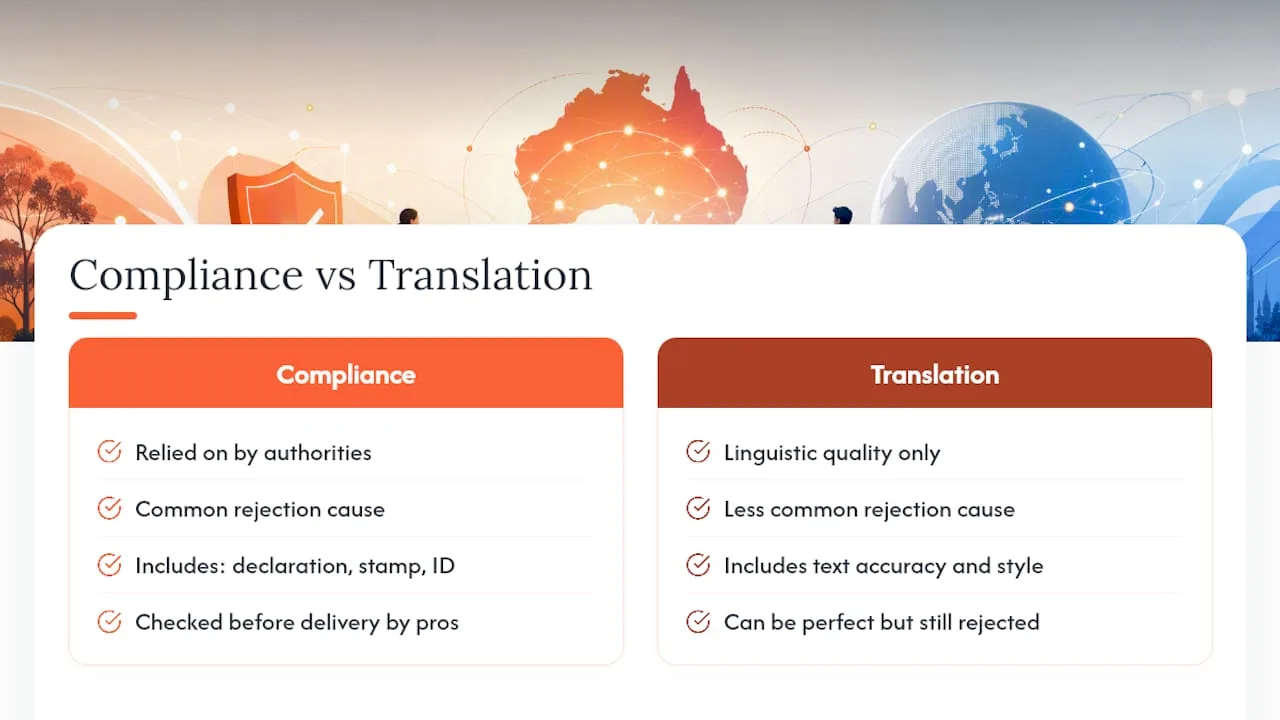
Most people assume the hard part of a certified translation is the language work. It isn’t. The declaration, the stamp, and the practitioner ID are the legal instrument an authority actually relies on, and a linguistically perfect translation with a poorly formatted declaration gets rejected just as fast as a bad one.
Some professional translation providers build every translation around that reality, ensuring their translators hold current NAATI certification, and every document goes through a check for stamp readability, correct declaration placement, and practitioner ID visibility before delivery. Reviewing DFAT and AHPRA rejection patterns makes one thing obvious: the failures are almost always procedural, not linguistic, which is exactly the gap a proper quality check is meant to close.
— David
Order a translator declaration that clears the first check
Using a reputable translation service can be an alternative to chasing down a translator and hoping their declaration format holds up. Typically, such services provide a translator accredited through NAATI, a correctly formatted declaration on the translation itself, and a stamp checked for QR readability before delivery, helping to avoid discovering formatting problems after lodging official applications.
We cover immigration, legal, academic, and technical documents, and every order goes through a check against the exact requirements of DFAT, ASIC, AHPRA, or your university before it’s sent back to you. Upload your original document or a clear scan, tell us where it’s being lodged, and choose your turnaround. If you’re weighing up whether a certified translation is even what you need, our complete guide to certified translation walks through the basics before you order.
Sources
- DFAT requirements for translators – NAATI
- Translation of documents | ASIC
- Document certification and translation | ANU
- Free Translating Service | TIS National
- Translating documents | AHPRA