


Original documents accompany translations because they serve as the primary evidence that officials use to verify the accuracy and authenticity of any certified translation. The translation is the accessible version. The original is the proof. The Australian Department of Home Affairs mandates that non-English documents must be submitted with both a certified English translation and a copy of the original for visa and citizenship applications. Skipping either one triggers a Request for Further Information, which stalls your application and adds weeks to processing times. Understanding why this pairing matters is the first step to getting it right.
Why original documents accompany translations in Australia
The requirement for originals to accompany translations is not a bureaucratic formality. It reflects a fundamental principle in document verification: a translation is only as trustworthy as the source it comes from. Australian authorities treat translations as secondary tools. They cross-reference every translated detail against the original to confirm nothing has been added, removed, or misrepresented.
The Department of Home Affairs sets the clearest standard. Non-English documents submitted for visa or citizenship applications must include both a certified English translation and a copy of the original. Failure to submit both is one of the most common causes of processing delays and Requests for Information. That rule applies whether you are submitting a birth certificate, a marriage certificate, a police clearance, or a foreign court order.

NAATI, the National Accreditation Authority for Translators and Interpreters, sets the professional standard for certified translators in Australia. A NAATI-certified translator must translate every detail of the source document, including seals, watermarks, signatures, and marginal notes, to maintain document integrity. The original document makes that verification possible. Without it, there is no way to confirm the translation is complete.
The distinction between a certified copy and a certified translation is also worth understanding clearly. A certified copy is a photocopy of the original, signed by an authorised person to confirm it is a true copy. A certified translation is a translated version of the document, accompanied by a translator’s declaration. Both are required. One does not replace the other.
Pro Tip: When preparing your application, keep the original document, the certified copy, and the certified translation as a set. Submit them together, in the same order, every time.
Why can’t certified translations replace original documents?
Most applicants assume a certified translation is sufficient on its own. It is not. Authorities treat translations as secondary documents that require simultaneous verification against the originals. A translation without its source document is like a map without a territory. It describes something, but there is nothing to confirm it is accurate.
“The original document acts as the primary evidence, while the translation acts as the key that unlocks that evidence for decision-makers. Separating the two removes the ability to verify either one.”
The original document carries physical features that a translation cannot replicate. These include:
- Official seals and stamps from the issuing authority
- Handwritten signatures from registrars, notaries, or court officials
- Watermarks embedded in the paper
- Marginal notes, corrections, or endorsements
- The physical format and layout of the original
Each of these features tells an assessor something about the document’s authenticity. A certified translation must describe all of them. Omissions or partial translations cause rejection by Australian authorities, and there is no appeal process that restores lost processing time.
Submitting a translation without the original also creates a verification gap. If an assessor cannot confirm that the translated text matches the source, they have no basis for accepting the document. That gap results in a Request for Information at best, and outright rejection at worst.
How do officials verify translations against original documents?
Verification is a structured process, not a spot check. When an assessor receives a translated document, they follow a specific sequence to confirm its validity.
- Check the translator’s declaration. The declaration must include the translator’s full name, NAATI credential number, language pair, signature, and date. This declaration confirms the translator’s credentials and is the first thing an assessor reviews.
- Compare the translation layout against the original. Assessors look at whether the structure of the translation mirrors the original. Headings, sections, and fields should correspond directly.
- Cross-reference key details. Names, dates, reference numbers, and issuing authority details are checked against the original. A single discrepancy, such as a misspelled name or a transposed date, can trigger a Request for Information.
- Confirm all document features are described. Seals, signatures, and watermarks noted in the original must appear in the translation. Missing descriptions raise immediate red flags.
- Assess document legibility. Physical or certified copies of originals are preferred over digital photos because they provide better legibility and verification reliability. Digital images or scans alone are frequently not accepted.
Common discrepancies found during verification include names transliterated differently across documents, dates formatted inconsistently, and seals described in the translation but absent from the copy submitted. Each of these discrepancies adds processing time and, in some cases, leads to outright refusal.
Pro Tip: Before submitting, hold the original and the translation side by side. Confirm every seal, signature, and date appears in both. If anything is missing from the translation, request a correction before lodging.
Best practices for submitting original documents with translations
Proper preparation prevents the most common causes of rejection. The top mistakes applicants make include submitting incomplete translations, separating originals from translations, and using translators without NAATI accreditation.
Document types that typically require an original plus translation
The following document types almost always require both the original and a certified translation for Australian legal, immigration, and academic purposes:
- Birth certificates
- Marriage and divorce certificates
- Academic transcripts and qualifications
- Police clearances and criminal records
- Passports and national identity documents
- Court orders and legal agreements
- Medical records and vaccination certificates
- Business registration documents
For academic submissions, Australian universities accepting certified translations require the same pairing as immigration authorities. The original transcript and the certified translation must be submitted together.
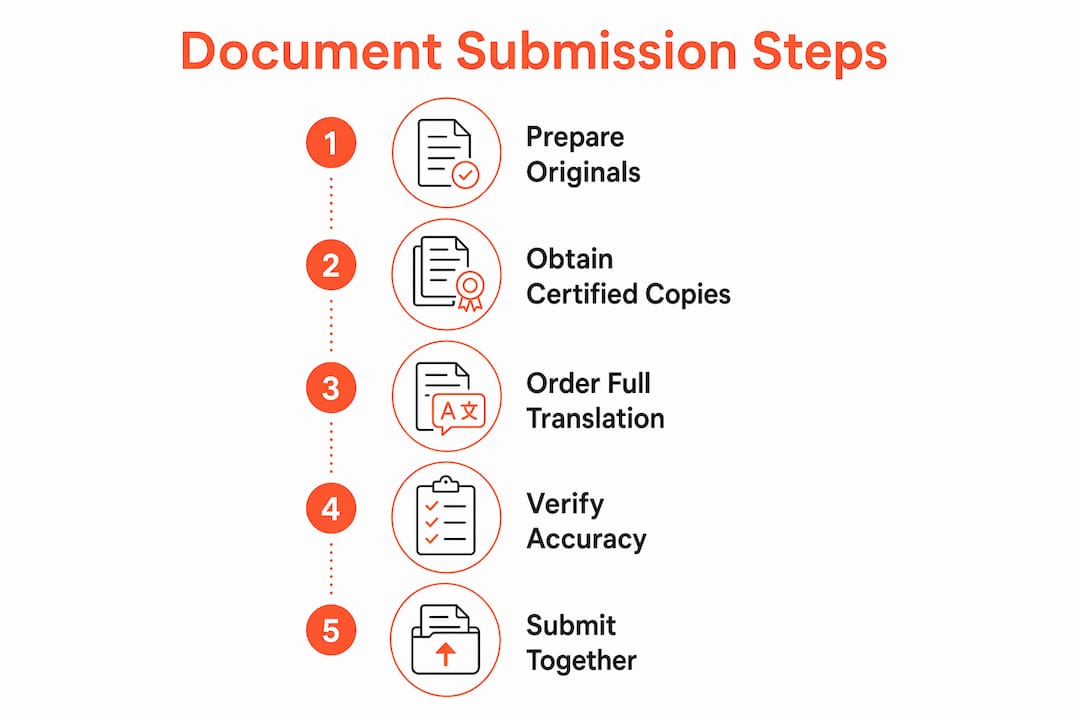
How to prepare your documents for submission
Preparation matters as much as the translation itself. Follow these steps to avoid the most common errors:
Bind documents correctly. Keep the original, the certified copy, and the certified translation together as a set. Do not separate them across different envelopes or upload them as unrelated files.
Order a full translation. Partial or summary translations are universally rejected. Every page, every seal, and every marginal note must be translated in full.
Use a NAATI-certified translator. Only translators with current NAATI accreditation produce translations accepted by the Department of Home Affairs, Australian courts, and universities. Verify the translator’s credential number before engaging them.
Check legibility before submitting. Faded originals, torn pages, or low-resolution scans create verification problems. If the original is damaged, obtain a certified replacement from the issuing authority before commissioning a translation.
Confirm the format required. Some authorities accept digital submissions. Others require physical documents. Confirm the required format before preparing your set.
| Submission element | Requirement |
|---|---|
| Original document | Physical or certified copy, legible and complete |
| Certified translation | Full translation by a NAATI-certified translator |
| Translator’s declaration | Name, NAATI number, language pair, signature, date |
| Document binding | Originals and translations kept as a set |
| Format | Physical preferred; digital only where explicitly accepted |
Managing multilingual documents adds complexity. If a document contains text in more than one language, the entire document must be translated, including any sections in a language other than the target language. For multi-page sets, each page must be translated and numbered to match the original.
Key takeaways
Original documents must accompany translations because authorities use them as primary evidence to verify that every certified translation is accurate, complete, and authentic.
| Point | Details |
|---|---|
| Originals are primary evidence | Translations are secondary tools; officials verify them against the original document. |
| Both documents are mandatory | The Department of Home Affairs requires a certified copy of the original and a certified translation together. |
| Full translation is non-negotiable | Seals, watermarks, signatures, and marginal notes must all appear in the translation. |
| NAATI accreditation is required | Only NAATI-certified translators produce translations accepted by Australian authorities. |
| Preparation prevents rejection | Binding documents as a set and confirming legibility before submission avoids the most common errors. |
What I have learned from watching applications fail
I have reviewed enough failed applications to know that the problem is almost never the translation itself. The problem is the assumption that a good translation is enough. It is not. The original document is not a formality. It is the anchor that gives the translation its authority.
The most frustrating cases are the ones where the translation is technically perfect but the application still stalls. A NAATI-certified translator did everything right. The declaration was complete. The language was accurate. But the applicant submitted a digital photo of the original instead of a certified copy, and the assessor could not confirm legibility. Three weeks lost, for a problem that takes ten minutes to fix.
Organisations submitting documents on behalf of employees or clients face a different version of this problem. They often manage large volumes of documents across multiple languages and assume that a consistent process protects them. What actually protects them is understanding the immigration document translation process well enough to catch errors before submission, not after.
The value of pairing originals with translations is not just regulatory compliance. It is trust. When an assessor receives a complete, well-prepared set of documents, they can process it without interruption. That is the outcome worth working toward.
— David
Certitranslate: certified translations that meet Australian standards
Certitranslate works with NAATI-certified translators who understand exactly what Australian authorities require when originals and translations are submitted together. Every translation includes a compliant translator’s declaration, covers all document features including seals and signatures, and is prepared as a complete set ready for submission.
Whether you are applying for a visa, enrolling at an Australian university, or submitting documents for a legal matter, Certitranslate prepares translations that hold up to scrutiny. Read the complete guide to certified translation services to understand what a compliant translation looks like and how to get one that meets the 2026 requirements of the Department of Home Affairs.
Preguntas frecuentes
Why do translations need originals for Australian visa applications?
The Department of Home Affairs requires both a certified copy of the original and a certified English translation for all non-English documents. Submitting one without the other triggers a Request for Further Information and delays processing.
Do translations require original documents for university enrolment?
Australian universities require the same pairing as immigration authorities. Academic transcripts must be submitted with both the original document and a certified translation from a NAATI-accredited translator.
What happens if I submit a translation without the original?
Authorities treat the submission as incomplete and issue a Request for Information. In some cases, the application is refused outright, requiring a full resubmission with the correct documents.
Can a digital scan replace the original document?
Physical or certified copies of originals are preferred over digital photos because they provide better legibility and verification reliability. Digital images alone are frequently not accepted by Australian authorities.
What must a NAATI translator include in a certified translation?
A NAATI-certified translator must translate every detail of the source document, including seals, watermarks, signatures, and marginal notes, and attach a declaration with their full name, NAATI credential number, language pair, signature, and date.
Recommended
- How import export documents are translated: 2026 guide – CertiTranslate – Translations by NAATI Certified Translators
- Types of business documents requiring translation – CertiTranslate – Translations by NAATI Certified Translators
- Certified translation for import/export agreements: 2026 guide – CertiTranslate – Translations by NAATI Certified Translators
- Immigration document translation process: a complete guide – CertiTranslate – Translations by NAATI Certified Translators