


Import export document translation is the certified rendering of trade documents, such as commercial invoices, certificates of origin, and customs declarations, into the language required by customs authorities and trading partners. Getting it wrong is not a minor inconvenience. Inaccurate or uncertified translations cause shipment seizures, customs fines, and rejected transactions. Regulatory bodies including the Australian Border Force and customs authorities worldwide demand translations that match the original content precisely. NAATI certification, the Australian standard for translator accreditation, is the benchmark that separates compliant translations from costly guesswork. Understanding how import export documents are translated is the first step to protecting your shipments and your business.
What types of documents require translation in import and export?
Common import and export documents needing translation include commercial invoices, packing lists, bills of lading, certificates of origin, and customs declarations, each with different language requirements per jurisdiction. The language rules vary widely. Some countries accept English as a default; others require translation into their official language before customs will process a shipment.
German customs, for example, requires product descriptions on customs declarations to appear in German. Disputed inspections trigger certified translation demands regardless of the original document language. Customs authorities generally accept documents in English or the local language but require translations for less common languages such as Ukrainian, Russian, Chinese, and Arabic.

The table below shows the most common trade documents and their typical translation requirements.
| Document type | When translation is required |
|---|---|
| Commercial invoice | When the destination country’s official language differs from the invoice language |
| Packing list | Required in markets where customs cannot process English descriptions |
| Bill of lading | Needed for ports requiring local language documentation |
| Certificate of origin | Mandatory when preferential tariff treatment is claimed |
| Customs declaration | Required when product descriptions must appear in the local language |
| Letters of credit | Always require certified translation due to banking compliance rules |
Pro Tip: Check the specific language requirements of your destination country before shipping. A single untranslated field on a customs declaration can hold an entire container at the port.
How is the import export document translation process carried out?
The import export document translation process follows a clear sequence, and skipping any step creates compliance risk. Businesses must provide translators with clear source documents, the target language, the destination country, and deadlines to avoid delays and non-compliance. Missing that information causes logistical delays and compliance failures in international trade.
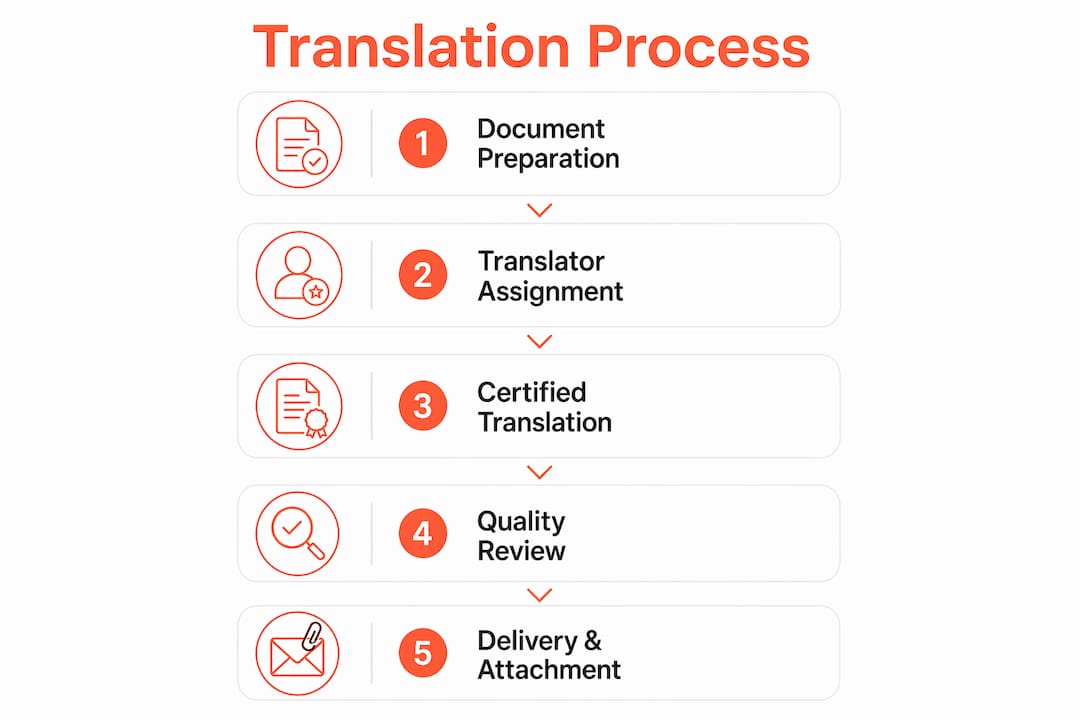
Here is the standard workflow from document preparation to delivery:
- Prepare clean source documents. Scan or export documents at high resolution. Blurry or incomplete copies force translators to guess at figures, which introduces errors into commodity descriptions and values.
- Brief the translator fully. Specify the target language, destination country, the purpose of the translation, and any hard deadlines. A commercial invoice heading to China requires different terminology conventions than one heading to Brazil.
- Assign a specialist translator. Trade documents contain Incoterms, HS codes, and tariff classifications. A general translator without customs knowledge will mishandle these terms. Assign a linguist with documented experience in trade and logistics.
- Apply certified translation where required. Certified translations carry a signed statement from the translator confirming accuracy and completeness. Customs authorities and banks require this for letters of credit, certificates of origin, and disputed declarations. Understanding when certification is mandatory prevents last-minute rejections.
- Quality review. Under ISO 17100 standards, certified translations for externally used documents involve a translator, a reviewer, and a quality assurance auditor. This multi-step process catches errors that a single linguist would miss.
- Attach the translation to the original. Customs authorities often require the translated document to be physically bound to the original. Submitting them separately leads to rejection even when the translation itself is accurate.
- Submit within the required timeframe. Late translations delay customs clearance. Build translation lead time into your shipping schedule, not as an afterthought.
Pro Tip: Always request a glossary of key trade terms from your translator, particularly for HS codes and Incoterms. Consistent terminology across all your shipment documents reduces customs flags significantly.
Why is professional, certified translation critical for trade documents?
Automated translation tools pose a high risk for trade documentation due to inaccuracies in commodity descriptions and Incoterms. Those inaccuracies convert routine clearance into compliance events that cause shipment seizures or fines. A machine translation tool does not understand that “FOB Shanghai” carries specific legal obligations under the Incoterms 2020 rules, and a mistranslation of that term can shift liability for a lost shipment.
Trade finance documents carry even higher stakes. Trade finance translators must understand complex banking practices, and errors in conditions and time limits often cause transaction rejections. Misinterpreting a presentation period or a validity date in a letter of credit can cost the full deal value.
Correct rendering of banking conditions, not just vocabulary, is the biggest challenge in translating trade finance documents. A translator who knows the words but not the banking framework will produce a translation that reads correctly but performs incorrectly.
The benefits of professional certified translation go beyond language accuracy. Certified translations under ISO 17100 involve multiple linguists and quality control, with a documented review process and version traceability to prevent costly errors. That audit trail matters when a customs authority or bank challenges a document.
Key risks of using unqualified or automated translation for trade documents:
- Commodity descriptions that do not match HS code classifications, triggering tariff disputes
- Incoterms rendered incorrectly, shifting liability to the wrong party
- Validity and presentation periods in letters of credit misread, voiding the instrument
- Certificates of origin with errors that disqualify preferential tariff treatment
- Customs declarations rejected because product descriptions do not meet local language standards
Pro Tip: When selecting a translator for trade documents, ask specifically about their experience with Incoterms, HS codes, and the customs requirements of your target market. A NAATI-certified translator with trade expertise is the right choice for Australian businesses.
What practical steps help businesses manage document translation at scale?
High-volume exporters reduce errors by pre-translating standard document templates, which allows focus on variable shipment data. This improves consistency and reduces customs flags caused by terminology variations across shipments. If your commercial invoice template is already translated, your team only needs to update the shipment-specific fields each time.
Maintaining a terminology database linked to your HS codes is equally important. When the same product is described differently across invoices, customs systems flag the discrepancy. A controlled glossary tied to your product catalogue eliminates that risk.
Practical steps for managing translation at scale:
- Pre-translate templates. Translate the static fields of your standard documents once, then update variable data per shipment.
- Build a trade glossary. Create a reference document linking product names, HS codes, and their approved translations in each target language.
- Coordinate early. Engage your translation provider at the same time you book freight, not after the cargo is ready to ship.
- Bind translations to originals. Physical attachment of translations to original documents is a customs requirement in many jurisdictions. Use a consistent binding method across all shipments.
- Integrate with your workflow. If you use an ERP or freight management system, build translation submission into the document generation step rather than treating it as a separate task.
- Work with your customs broker. Customs brokers know the specific language requirements of the markets you ship to. Share your translation workflow with them so they can flag issues before lodgement.
Pro Tip: For businesses shipping to multiple markets, create a country-specific checklist that maps each document type to its translation requirement and the relevant customs authority. Review it annually as language requirements do change.
Key takeaways
Accurate, certified translation of trade documents is the single most reliable way to prevent customs delays, fines, and rejected transactions in international trade.
| Point | Details |
|---|---|
| Document types vary by jurisdiction | Commercial invoices, bills of lading, and certificates of origin each carry different language requirements per destination country. |
| Certification is non-negotiable | Customs authorities and banks require certified translations for letters of credit, certificates of origin, and disputed declarations. |
| ISO 17100 sets the quality standard | Certified trade document translations require a translator, reviewer, and quality auditor to meet ISO 17100 requirements. |
| Physical attachment matters | Translations must be bound to original documents; submitting them separately causes rejection regardless of accuracy. |
| Templates reduce errors at scale | Pre-translating standard document fields and maintaining a trade glossary cuts terminology inconsistencies across high-volume shipments. |
What I have learned from years of watching trade documentation go wrong
The most common mistake I see businesses make is treating translation as the last step before shipping. By the time a container is packed and a vessel is booked, there is no time to fix a rejected translation. The businesses that handle this well treat translation as part of document preparation, not a finishing touch.
The second mistake is assuming that a bilingual employee or a free online tool is sufficient for customs documents. I have seen letters of credit voided because a presentation period was translated as a calendar period instead of a banking day period. That distinction is not in any dictionary. It lives in the knowledge of a specialist who understands trade finance.
Regulatory scrutiny on import and export documentation is increasing, not decreasing. Customs authorities in major trading nations are investing in automated document checking systems that flag terminology mismatches instantly. A translation that passed inspection five years ago may not pass today.
My practical recommendation is straightforward. Select a NAATI-certified translator with documented experience in trade and customs documents. Build translation lead time into your shipping schedule. Pre-translate your templates. And never submit a translation separately from its original document.
The businesses that get this right do not think about it much, because nothing goes wrong. The ones that cut corners spend far more time and money fixing problems than they ever saved on translation costs.
— David
Certitranslate: certified translation for your trade documents
Certitranslate provides NAATI-certified translation services for businesses and individuals handling import and export documentation across Australia. Every translation is completed by a NAATI-certified linguist with expertise in trade and customs terminology, including Incoterms, HS codes, and certificates of origin.
The process is straightforward. Upload your documents, specify your target language and destination country, and receive a certified translation ready for customs submission. Certitranslate’s quality control process meets the standards required by Australian customs authorities and international banking institutions. For a detailed breakdown of what your business needs to prepare, the certified translation guide for import and export agreements covers requirements, timelines, and document checklists in full.
Preguntas frecuentes
What documents need translation for customs clearance?
Common documents requiring translation include commercial invoices, packing lists, bills of lading, certificates of origin, and customs declarations. Language requirements depend on the destination country and the languages involved.
When is a certified translation required for trade documents?
Certified translation is required for letters of credit, certificates of origin, and customs declarations when a customs authority or bank disputes or formally requests verification. Certification confirms the translation is accurate and complete, with the translator’s signed statement attached.
Can I use automated translation tools for import export documents?
Automated translation tools are not suitable for trade documentation. Inaccuracies in commodity descriptions and Incoterms can convert routine customs clearance into a compliance event, resulting in shipment seizures or financial penalties.
What is ISO 17100 and why does it matter for trade document translation?
ISO 17100 is the international standard for translation services, requiring a translator, reviewer, and quality auditor for certified documents. It matters for trade documents because it creates an audit trail that customs authorities and banks can rely on.
Does a translated document need to be attached to the original?
Customs authorities in many jurisdictions require the translation to be physically bound to the original document. Submitting them separately results in rejection, regardless of how accurate the translation is.
Recommended
- Certified translation for import/export agreements: 2026 guide – CertiTranslate – Translations by NAATI Certified Translators
- Types of business documents requiring translation – CertiTranslate – Translations by NAATI Certified Translators
- Immigration document translation process: a complete guide – CertiTranslate – Translations by NAATI Certified Translators
- Why universities require certified translations: 2026 guide – CertiTranslate – Translations by NAATI Certified Translators