


Certified translation is the official, attested English version of a foreign academic document, produced by a qualified professional who signs a declaration of accuracy and completeness. Universities require certified translations because admissions offices cannot assess grades, course titles, or credential dates from documents written in a language their staff cannot read or verify. This requirement applies whether you are submitting a Chinese gaokao transcript, a Brazilian diploma, or a German Abitur certificate. Regulatory bodies including USCIS and credential evaluators such as WES set the benchmark for what counts as a valid certified translation. Understanding why universities require certified translations before you apply saves you from costly delays and rejected applications.
Why do universities require certified translations of foreign documents?
Universities require certified translations to enable line-by-line verification of every academic record submitted in a foreign language. Certified translations become part of the official academic file, and any inaccuracy triggers questions or delays in application processing. That means a single mistranslated grade or omitted course title can stall your entire application.

Certification also provides a legally meaningful attestation of accuracy and completeness. Admissions staff and credential reviewers depend on this attestation to confidently verify grades, credits, and institutional seals without needing to speak the source language themselves. Without it, there is no accountable party if the translation turns out to be wrong.
Credential evaluation agencies add another layer of scrutiny. WES requires translations to be exact, word-for-word, and professional, and they explicitly prohibit applicants from translating their own documents. That rule exists because self-translations introduce a conflict of interest. An applicant has every reason to present their record favourably, which is precisely why an independent, qualified translator is required.
- Admissions offices verify grades, course titles, credit hours, and dates against the original document.
- Certified translations carry a signed attestation, making the translator legally accountable for accuracy.
- Errors or omissions in a translation trigger Requests for Evidence or outright rejection.
- Agencies like WES and ECE require translations that capture all visible elements, including tables and institutional stamps.
- Boston University, for example, requires professionally translated transcripts alongside original documents for admission processing.
Pro Tip: Read the exact translation instructions from each university and evaluator before ordering. Requirements differ, and ordering the wrong format means paying twice.
How do certified translations meet immigration requirements?
Immigration requirements for certified translations are, in many cases, stricter than university requirements. USCIS mandates that all foreign documents include a full English certified translation with the translator’s signed attestation of accuracy and competence. This requirement is codified in USCIS regulation 8 CFR 103.2(b)(3), which means it is not a guideline but a legal obligation.
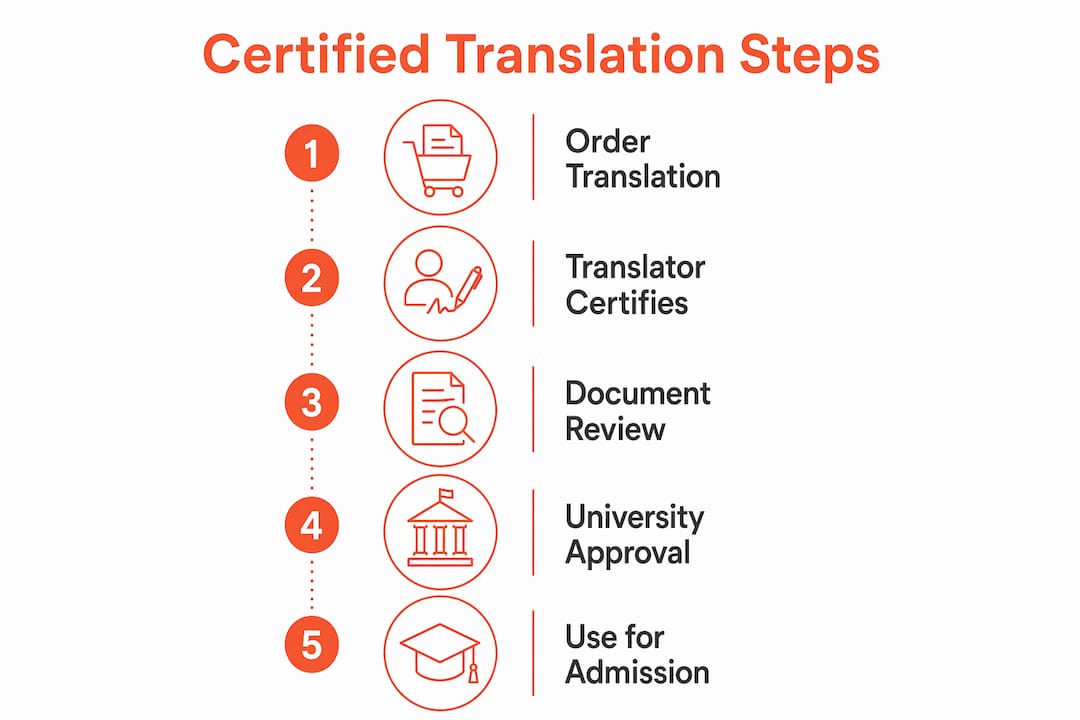
The USCIS standard requires the translation to be complete. Every visible element of the original document must appear in the English version, including tables, footnotes, and institutional seals. Omitting even a minor detail can result in a Request for Evidence, which delays your visa application by weeks or months.
One common misconception is that certified translations must also be notarised. USCIS does not require notarisation. What it requires is the translator’s signed statement confirming their competence in both languages and the accuracy of the translation. That distinction matters because notarisation adds cost and time without adding legal value for immigration purposes.
For international students, the overlap between university and visa document requirements creates a practical opportunity. If you order a translation that meets USCIS standards, it will almost certainly satisfy your university’s requirements as well. The reverse is not always true.
- Obtain the original foreign document in its complete, unaltered form.
- Engage a qualified professional translator who is competent in both the source language and English.
- Confirm the translation includes every visible element: tables, seals, stamps, and footnotes.
- Attach the translator’s signed attestation of accuracy and competence.
- Submit both the original document and the certified translation together.
Pro Tip: Order your immigration translations first. They set the highest standard. If your translation satisfies USCIS, it will work for most Australian and US universities too.
What are the standards for preparing certified translations for universities?
There is no single universal format for certified translations. Each university or evaluator may expect a different presentation or level of detail, which is why checking destination-specific instructions before ordering is critical. Some institutions want the translation to mirror the exact layout of the original. Others only require the content, rendered accurately in English.
Who can certify a translation?
A professional translator who is competent in both languages and is not the applicant must perform the translation. In Australia, NAATI certification is the recognised standard for translators working on official documents. NAATI-certified translators have passed rigorous assessments in their language pairs, which gives universities and immigration bodies confidence in the quality of the work. The role of accredited translators in academic submissions is to provide an independent, qualified attestation that the translation is complete and accurate.
What must the translation include?
Credential evaluators interpret “complete and accurate” strictly. Preserving the structure and all elements of transcripts is essential to confirm course credits and grades authentically. That means the translation must reproduce tables, column headers, grading scales, institutional names, and any stamps or seals visible on the original document. Reformatting or omitting details jeopardises verification and acceptance.
Many universities adopt a two-step process. They require a certified translation first, then a credential evaluation by an agency like WES or ECE where needed. Understanding which step applies to your application prevents you from submitting the wrong document type.
Common reasons universities reject translated documents include:
- Translation performed by the applicant or a family member.
- Missing translator credentials or unsigned attestation statement.
- Omitted elements such as institutional seals, grading scales, or tables.
- Layout that does not match the original document when exact formatting is required.
- Translation submitted without the original foreign language document.
How can you get your certified translations accepted everywhere?
The most practical strategy is to order translations that meet the strictest standard required by any recipient. Ordering to the highest standard avoids repeated translation work and keeps your admissions and visa applications moving. Some students underestimate visa requirements, which are often stricter than university rules, and end up paying for a second translation.
Consistency across documents also matters. If you are applying to multiple universities and lodging a visa application simultaneously, using the same certified translation for all submissions reduces the risk of discrepancies. Admissions offices and immigration officials compare documents carefully. A translation that differs in any detail from the original raises red flags.
Jurisdictional differences affect what counts as a valid certified translation. In Australia, NAATI certification is the accepted standard for immigration document translation. In the United States, USCIS accepts translations from any competent professional, but the signed attestation is non-negotiable. Knowing the rules for each jurisdiction before you apply prevents last-minute surprises.
Pro Tip: Keep a digital copy of every certified translation you order. Universities and immigration bodies sometimes request additional copies months after your initial submission, and having them ready saves time.
Key takeaways
Universities require certified translations because admissions offices and credential evaluators need a legally attested, complete, and accurate English version of every foreign academic document to verify grades, course titles, and institutional credentials without ambiguity.
| Point | Details |
|---|---|
| Certification is a legal attestation | A signed statement from a qualified translator makes the translation officially accountable for accuracy. |
| Self-translations are rejected | Applicants and family members cannot certify their own documents; independent professional translators are required. |
| Format preservation is mandatory | Tables, seals, grading scales, and all visible elements must appear in the English translation. |
| USCIS sets the strictest standard | Ordering to USCIS requirements satisfies most university and immigration bodies simultaneously. |
| NAATI certification applies in Australia | Australian universities and immigration authorities recognise NAATI-certified translators as the qualified standard. |
The mistake I see international students make most often
Most international students I have spoken with assume that any bilingual person can produce a certified translation. They ask a friend, a family member, or even use a machine translation tool, then attach a handwritten note claiming it is accurate. That approach fails almost every time.
The deeper issue is timing. Students often leave translation orders until the week before an application deadline. Certified translations for complex academic records, particularly those involving non-Latin scripts or specialised academic terminology, take time to do properly. Rushing the process leads to errors, and errors lead to rejections or Requests for Evidence that set your application back by months.
What I have found actually works is treating the translation as the first step in your application, not the last. Identify every document that needs translation before you begin filling out application forms. Check the specific requirements for each university and for your visa category. Then order once, to the highest standard, from a NAATI-certified translator who has experience with academic documents.
The other thing worth knowing is that credential evaluation and certified translation are not the same thing. Many students submit a certified translation when the university actually wants a WES or ECE evaluation report, or vice versa. Reading the admissions requirements carefully, before you spend money on translations, is the single most effective way to avoid wasted effort.
— David
Certitranslate for university and visa document translations
International students applying to Australian and US universities need certified translations that hold up under scrutiny from admissions offices, credential evaluators, and immigration authorities.
Certitranslate’s NAATI-certified translators specialise in academic and immigration documents, producing translations that meet the requirements of Australian universities, USCIS, and credential evaluation agencies including WES. Every translation includes the signed attestation of accuracy required by official bodies. Turnaround is fast, and the process is straightforward. Read Certitranslate’s complete guide to certified translation to understand exactly what your documents need before you submit.
Preguntas frecuentes
What is a certified translation for university admissions?
A certified translation is an English version of a foreign academic document produced by a qualified professional, accompanied by a signed statement confirming its accuracy and completeness. Universities require this attestation to verify grades, course titles, and credentials from documents originally written in another language.
Do Australian universities require NAATI-certified translators?
Australian universities and immigration authorities recognise NAATI certification as the standard for official document translation. Using a NAATI-certified translator gives your submission the best chance of acceptance without delays.
Why do universities reject translated documents?
Universities reject translated documents when the translator is the applicant or a family member, when the attestation statement is missing or unsigned, or when the translation omits visible elements such as institutional seals, grading scales, or tables. Checking the specific format requirements of each institution before ordering prevents most rejections.
Is notarisation required for certified translations?
USCIS does not require notarisation for certified translations. What is required is the translator’s signed attestation of competence and accuracy. Most Australian universities and immigration bodies follow the same rule, though you should confirm the specific requirements of each recipient.
Can I use the same certified translation for multiple universities?
Yes. A certified translation that meets the strictest standard required by any recipient, typically USCIS or a credential evaluator like WES, can be submitted to multiple universities without modification. Consistency across submissions also reduces the risk of discrepancies that raise questions during assessment.
Recommended
- Why police clearance needs certified translation: 2026 guide – CertiTranslate – Translations by NAATI Certified Translators
- Certified translation for import/export agreements: 2026 guide – CertiTranslate – Translations by NAATI Certified Translators
- Role of accredited translators in academic submissions – CertiTranslate – Translations by NAATI Certified Translators
- What is certified translation: a complete guide – CertiTranslate – Translations by NAATI Certified Translators