


Accredited translators are credentialled language professionals whose certified translations are the standard required by universities worldwide for international academic documents. The role of accredited translators in academic submissions goes well beyond converting words from one language to another. Universities in Australia, the United States, and the United Kingdom reject applications outright when translations lack proper certification. Bodies like NAATI (National Accreditation Authority for Translators and Interpreters) in Australia and the ATA (American Translators Association) in the United States set the professional benchmarks that institutions rely on. Without a translator holding recognised accreditation, your transcripts, diplomas, and academic certificates carry no official weight.
What do universities require for translated academic documents?
Most universities mandate certified translations for international academic documents, and failure to provide them results in automatic disqualification. The requirement is not a formality. It is a gatekeeping mechanism that protects institutional integrity and ensures every applicant is assessed on verified credentials.
Here is what universities typically require when you submit translated academic records:
-
Certified translation of transcripts and diplomas. Every academic document in a language other than English must be accompanied by a certified translation. This applies to secondary school certificates, undergraduate transcripts, postgraduate diplomas, and any supporting academic records.
-
A signed statement of accuracy. The translator must attach a signed declaration confirming the translation is complete and accurate. This statement holds the professional legally and ethically accountable.
-
Original documents alongside translations. Many institutions require you to submit the original document and the certified translation together, often in a sealed envelope from the issuing institution.
-
Notarisation where required. Notarisation confirms the translator’s identity and the authenticity of their signature. It is a separate process from certification and is not automatically included. Some jurisdictions and institutions require both.
-
Submission deadlines. Late or incomplete translation packages are treated the same as missing documents. Delays caused by uncertified or rejected translations can push your application to the next intake.
Requirements vary between institutions and countries. Some European universities, for example, require sworn translators with local legal recognition for academic equivalency processes. Certain jurisdictions require sworn translators whose status differs from general NAATI or ATA certification. Always confirm the specific requirements directly with the admissions office before ordering your translations.
Pro Tip: Ask the admissions office for their exact translation policy in writing before you commission any translation. Requirements for notarisation, original document presentation, and acceptable certification bodies vary more than most students expect.

How does accreditation guarantee translation accuracy?
Accreditation by a recognised body is the only reliable way to verify translator competency in an industry that has no universal licensing requirement. Anyone can call themselves a translator. Only those who have passed rigorous examinations and agreed to a professional code of ethics can call themselves NAATI certified or ATA certified.
The accreditation process involves several layers of quality assurance:
-
Examination-based credentialling. NAATI and ATA both require candidates to pass standardised tests that assess translation accuracy, terminology, and professional judgement across specific language pairs.
-
Ethical obligations. Accredited translators sign on to codes of conduct that prohibit misrepresentation, require confidentiality, and mandate disclosure of any conflict of interest.
-
Signed accountability. Every certified translation carries the translator’s name, credentials, and signature. This creates a direct line of accountability between the document and the professional who produced it.
-
Prevention of misrepresentation. Professional certification safeguards academic integrity by preventing credential inflation and ensuring that grades, honours, and course titles reflect actual qualifications.
The contrast with uncertified or AI-generated translations is stark. A machine translation tool like Google Translate or DeepL cannot produce a signed statement of accuracy. It cannot be held accountable for errors in specialist academic terminology. Academic translation requires specialist linguistic knowledge that goes beyond literal word substitution, particularly for discipline-specific course titles, grading scales, and institutional naming conventions. An accredited translator understands these nuances. A free online tool does not.
Accreditation by bodies like NAATI or ATA demonstrates both linguistic proficiency and adherence to ethical standards. That combination is what universities are actually checking when they require certified translations.
What are the benefits of using accredited translators for your submissions?
The benefits of accredited translators extend well beyond compliance. They directly affect your application outcome, your timeline, and the credibility of your entire submission package.
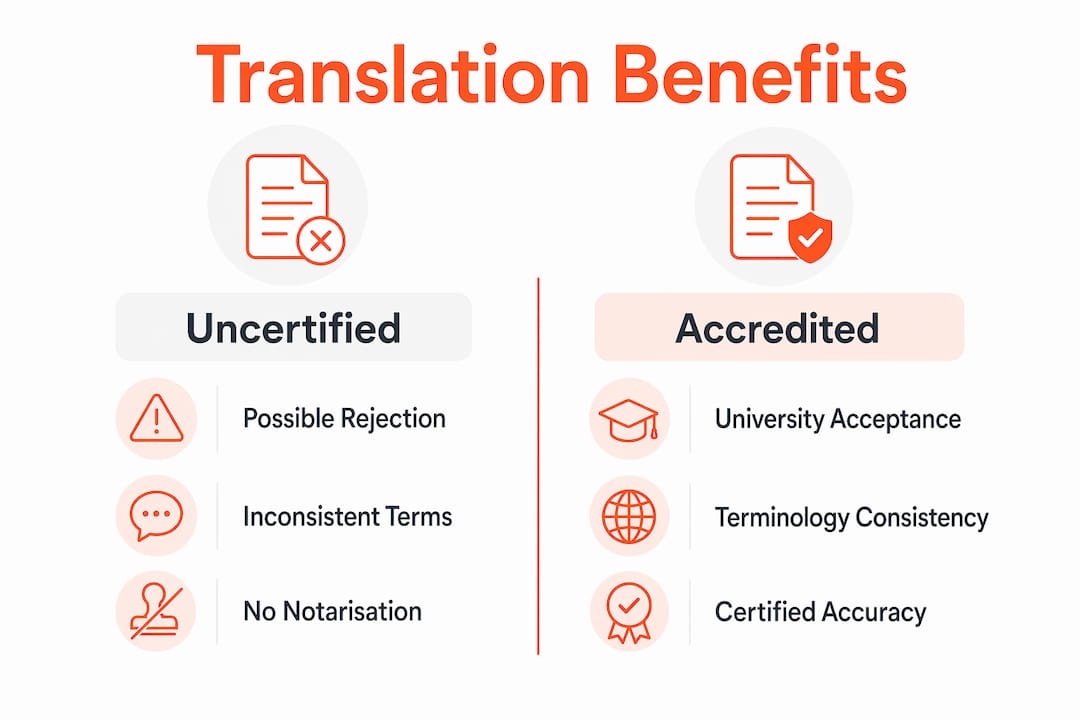
| Benefit | Uncertified translation | Accredited translation |
|---|---|---|
| University acceptance | Likely rejected | Accepted by all major institutions |
| Accountability | None | Signed statement of accuracy |
| Terminology accuracy | Inconsistent | Specialist academic vocabulary |
| Notarisation option | Not available | Available on request |
| Application delays | High risk | Minimal risk |
Terminology consistency is one of the most underrated benefits. Maintaining consistent terminology with glossaries is critical in academic translation. Inconsistent translation of a course title across multiple documents, for example translating “Honours” differently on a transcript versus a certificate, can create confusion for admission officers and trigger requests for clarification or resubmission.
Certified translations typically include a notarised affidavit guaranteeing the correctness of course titles, grades, and honours. That level of detail is what separates a clean application from one that stalls in the admissions queue.
Cost is a real consideration. Academic translation agencies charge approximately €0.20–0.35 per word for specialist academic work. That is a premium over general translation rates. The cost of resubmission, a missed intake, or a rejected application is significantly higher. Treating certified translation as an investment rather than an expense is the right frame.
Pro Tip: If you are submitting documents for multiple universities simultaneously, use the same accredited translator or agency for all of them. Consistent terminology across your full document set reduces the chance of discrepancies that trigger follow-up requests.
How do you choose the right accredited translator or agency?
Selecting the right professional for your academic documents requires more than a Google search. Here is what to verify before you commit:
-
Confirm accreditation status. In Australia, check the NAATI certified translators register directly. In the United States, verify ATA membership. In the United Kingdom, look for ITI (Institute of Translation and Interpreting) membership. Do not rely on a translator’s self-description.
-
Check experience with academic documents. General translation experience is not the same as academic translation experience. Ask specifically whether the translator has handled university transcripts, diplomas, and academic certificates in your language pair.
-
Clarify notarisation requirements upfront. Notarisation is a separate process from certification. If your institution requires a notarised translation, confirm the agency can arrange this before you place your order.
-
Assess turnaround times against your deadlines. Certified translation services that are well-organised can meet tight application deadlines without sacrificing accuracy. Ask for a clear timeline in writing.
-
Review the agency’s acceptance guarantee. Reputable agencies stand behind their work. If a university rejects a translation on technical grounds, the agency should correct and reissue it at no additional cost.
Agencies like Certitranslate specialise in NAATI certified translations for academic and official documents across Australia. Using a dedicated academic translation service rather than a generalist freelancer reduces the risk of terminology errors and compliance gaps. Before you choose a certified translator, review their credentials, sample work, and turnaround commitments carefully.
Pro Tip: Avoid common submission errors by reading Certitranslate’s guide on mistakes with translated documents before you finalise your application package.
Key takeaways
Accredited translators are the non-negotiable standard for academic submissions because certification creates accountability, accuracy, and institutional trust that uncertified translations cannot provide.
| Point | Details |
|---|---|
| Certification is mandatory | Most universities reject applications with uncertified translations outright, regardless of translation quality. |
| Notarisation is separate | Confirm whether your institution requires notarisation in addition to certification before ordering. |
| Terminology consistency matters | Use the same accredited translator across all documents to avoid discrepancies in course titles and grades. |
| Accreditation bodies to know | NAATI (Australia), ATA (United States), and ITI (United Kingdom) are the recognised credentialling bodies. |
| Cost reflects risk reduction | Premium rates for accredited academic translation are far lower than the cost of a missed intake or rejected application. |
What I have learned from watching students get this wrong
Over the years, I have seen students make the same costly mistake repeatedly. They treat the translation requirement as a box to tick rather than a professional standard to meet. They use a bilingual friend, a free online tool, or an uncertified freelancer to save a few hundred dollars. Then they spend months dealing with the fallout.
The detail that surprises most students is the notarisation question. Certification and notarisation are not the same thing, and the difference is not obvious until you are staring at a rejection letter. Certification means a qualified professional has attested to the accuracy of the translation. Notarisation means a notary public has verified the translator’s identity and signature. Some universities require both. Some require only certification. Very few require only notarisation. Getting this wrong adds weeks to your timeline and real cost to your budget.
The other issue I see constantly is terminology drift. A student submits a transcript translated by one provider and a diploma translated by another. The course titles do not match. The grading scale is described differently. The admission officer flags the discrepancy and the application stalls. This is entirely avoidable. One accredited agency, one consistent glossary, one clean submission.
My honest advice: treat your translation package the same way you treat your personal statement. It represents you. It either builds credibility or it undermines it. An accredited translator with academic experience is not a luxury. It is the baseline.
— David
How Certitranslate helps students get their submissions right
Certitranslate works with students across Australia who need certified academic translations that meet university and institutional standards. Every translation is completed by a NAATI certified translator with experience in academic documents, from undergraduate transcripts to postgraduate diplomas and professional certificates.
Certitranslate handles the full process, including notarisation where required, so you are not left managing multiple providers under deadline pressure. Turnaround times are fast, the process is straightforward, and every translation comes with a signed statement of accuracy accepted by Australian universities and government bodies. If you are preparing an application and need to confirm your documents meet institutional requirements, Certitranslate is the place to start.
Preguntas frecuentes
What is an accredited translator?
An accredited translator is a language professional who has passed examinations set by a recognised credentialling body such as NAATI in Australia or the ATA in the United States. Accreditation confirms both linguistic competency and adherence to professional ethical standards.
Do all universities require certified translations?
Most universities require certified translations for any academic document not originally in English, including transcripts, diplomas, and certificates. Submitting uncertified translations typically results in automatic rejection of the application.
Is notarisation the same as certification?
No. Certification means a qualified translator has attested to the accuracy of the translation. Notarisation is a separate step where a notary public verifies the translator’s identity and signature. Some institutions require both, so always confirm with the admissions office.
How do I verify a translator’s NAATI accreditation?
You can verify NAATI accreditation directly through the NAATI online register at naati.com.au. Search by the translator’s name or language pair to confirm their current credentialled status before commissioning any work.
Can I use AI tools to translate academic documents for university?
No. AI translation tools cannot produce a signed statement of accuracy and are not accepted by universities as certified translations. Only a credentialled human translator holding recognised accreditation can produce a translation that meets institutional submission requirements.