


A certified translation is a legally accountable, professionally verified document that regulators require to recognise professional licences across jurisdictions. Without it, your application stalls, your credentials go unverified, and your career progression stops. Understanding why professional licence needs certified translation is not a bureaucratic formality. It is the foundation of cross-border professional recognition in 2026.
Regulatory bodies from the Australian Department of Home Affairs (DHA) to the U.S. Medical Licensing Examination system demand certified translations because they carry a signed Certificate of Accuracy. That certificate names a qualified professional who accepts legal responsibility for every word. Bodies like NAATI in Australia set the accreditation standard that makes this accountability enforceable.
What makes a translation ‘certified’ and why it differs from other types
A certified translation is defined by legal accountability, not linguistic skill alone. The translator signs a Certificate of Accuracy, declares the translation is complete and correct, and accepts professional liability for errors. That signed statement is what regulators actually check.

Certification by a recognised accreditation body separates a certified translation from every other type. In Australia, NAATI accreditation is the benchmark. In other jurisdictions, Ministry of Justice approval or equivalent government authorisation fills the same role. Without that accreditation, the translation carries no enforceable credibility.
The contrast with non-certified and machine-generated translations is stark. Machines lack the legal recourse necessary for regulated documents. An AI tool can produce a fluent-sounding translation, but no algorithm can sign a Certificate of Accuracy or face professional consequences for a mistranslation. Regulators treat AI output as inadmissible for licensing purposes.
Key differences between certified and non-certified translations:
- Certificate of Accuracy: Certified translations include a signed, dated statement of completeness and correctness. Non-certified translations have no such document.
- Translator accountability: The certified translator is personally and professionally liable. Casual translators carry no formal liability.
- Regulatory acceptance: Licensing boards, courts, and immigration authorities accept only certified translations. Non-certified versions are rejected outright.
- Word-for-word fidelity: Certified translations reproduce the full source text. Summaries, paraphrases, or abstracts do not meet the standard.
Pro Tip: Before submitting any translated document to a licensing authority, confirm the translator holds current NAATI accreditation or the equivalent recognised credential in your target jurisdiction. A lapsed or unrecognised accreditation invalidates the translation regardless of its quality.
Why do regulatory bodies insist on certified translations for professional licences?
Regulatory bodies require certified translations because professional licensing decisions carry legal weight. A doctor, nurse, or engineer whose credentials are misrepresented due to a translation error creates liability for the licensing board, the employer, and the public. Certified translation is the mechanism that closes that liability gap.
“Translation is a technical and legal process, not just a linguistic one. Mistranslations of legal terms can cause costly disputes and regulatory actions.” — certified legal contract translation
The consequences of submitting uncertified or inaccurate translations are severe and well-documented:
- Application rejection. Poor translations delay licensing by months because rejected applications must be resubmitted with corrected documents, restarting processing queues entirely.
- Verification failure. Primary source verification systems such as DataFlow require translations to match institutional records exactly. Minor spelling variations cause verification failure and invalidate the entire submission.
- Legal and financial exposure. Healthcare professionals face the highest stakes. HIPAA violation fines reach $2.1 million per incident when patient records are mishandled, including through inaccurate translation.
- Credential invalidation. Some licensing boards treat a failed verification as grounds to refuse the application permanently, not just temporarily.
Healthcare professionals face the sharpest regulatory scrutiny. Why healthcare professionals need certified translations is straightforward: patient safety depends on accurate credential verification. A mistranslated qualification or a misread clinical record can place patients at risk. Regulators treat this as a zero-tolerance issue.
The same logic applies when a shareholder agreement needs certified translation for cross-border legal proceedings, or when a business licence needs certified translation for foreign market entry. Every regulated document that crosses a language boundary requires the same standard of accountability.
Key challenges when preparing certified translations for professional licences
Jurisdiction-specific requirements create the most common pitfalls. What satisfies a licensing board in New South Wales may not satisfy the UAE’s Ministry of Justice or a U.S. state medical board. Some boards reject self-certified or non-notarised translations outright, even when the translator holds recognised accreditation.
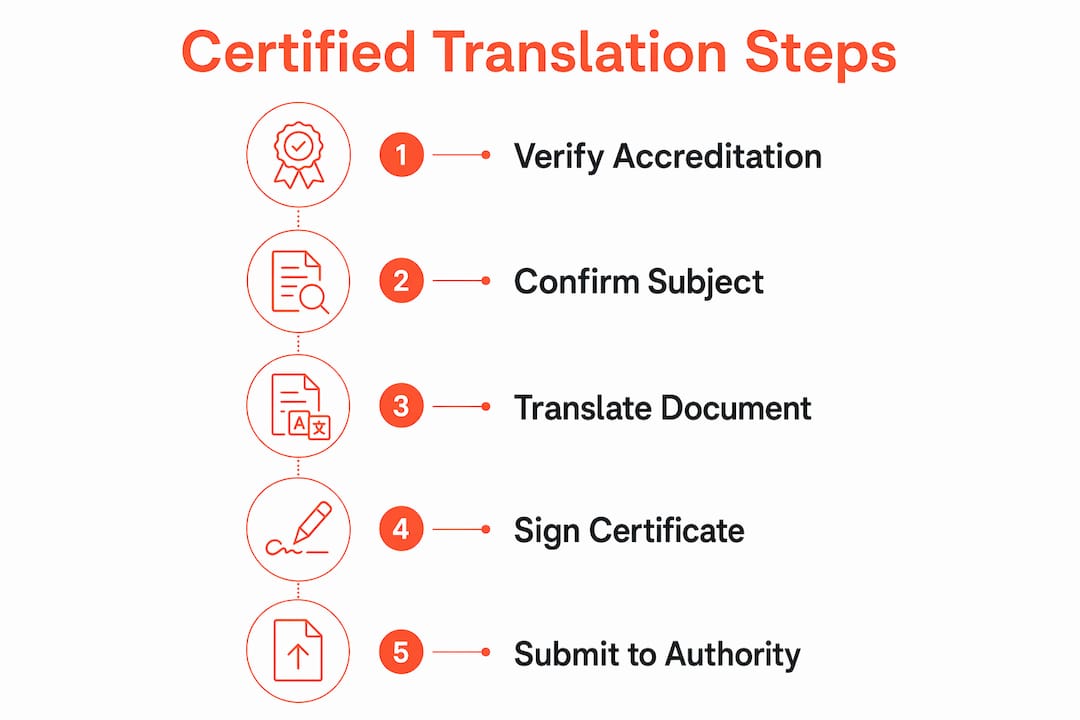
Notarisation adds a second layer of verification that some jurisdictions require beyond the Certificate of Accuracy. A notary public confirms the translator’s identity and signature, giving the document evidentiary weight in court or before a government authority. Not every licensing process requires notarisation, but assuming it is unnecessary without checking is a costly mistake.
The routing of academic documents creates another layer of complexity. Translations must often come directly from the educational institution to the regulatory body, bypassing the applicant entirely. This strict direct-source routing prevents tampering and is enforced by bodies such as CGFNS for nursing licences. Applicants who handle their own academic translations frequently face rejection regardless of translation quality.
Common challenges professionals encounter:
- Jurisdiction mismatch: A translation certified for Australian DHA purposes may not meet U.S. ECFMG or UAE DHA standards without additional steps.
- Outdated accreditation: Translator credentials expire. A translation signed by a translator whose accreditation has since lapsed may be rejected on review.
- Incomplete document sets: Licensing authorities require certified academic documents as a complete package. Missing a single transcript or diploma translation stalls the entire application.
- Secondary verification discrepancies: Even minor formatting differences between the translated document and the original institutional record can trigger a DataFlow or equivalent system failure.
How to obtain certified translations for licensing purposes
Selecting the right certified translator starts with confirming accreditation. In Australia, verify current NAATI accreditation directly through the NAATI register. For other jurisdictions, confirm the translator holds the specific credential the licensing authority names in its requirements. Generic translation qualifications do not substitute for jurisdiction-specific accreditation.
Choosing the right certified translator also means confirming subject-matter expertise. A translator accredited for legal documents may not have the clinical vocabulary needed for medical credential translations. Ask directly whether the translator has handled the specific document type before.
Turnaround times follow a predictable pattern. Short documents such as a single-page licence or passport translation take 24–48 hours for standard processing. Complex documents such as full academic transcripts or multi-page business contracts take 3–5 business days. Build these timelines into your application schedule, not as an afterthought.
Documents that most frequently require certified translation for professional licensing include:
| Document type | Typical use case |
|---|---|
| Academic transcripts and degrees | Medical, nursing, engineering, and legal licensing boards |
| Professional licence from country of origin | Mutual recognition applications and skills assessments |
| Passport and identity documents | Identity verification for DHA, immigration, and board applications |
| Business licences and registration certificates | Foreign market entry and cross-border regulatory compliance |
| Shareholder agreements and business contracts | Legal proceedings and corporate regulatory filings |
Pro Tip: Request a certified copy of the original document before sending it for translation. Licensing authorities often require both the certified translation and the original or a certified copy of the original to be submitted together.
The most common rejection cause is a mismatch between the translated document and what the licensing authority expected. Read the authority’s requirements before commissioning the translation, not after. Confirm whether notarisation is required, whether the document must be routed directly from the issuing institution, and whether the authority accepts digital or only physical submissions.
Key takeaways
A professional licence submitted with an uncertified translation will be rejected. Certified translation is the only format regulators accept because it carries legal accountability, word-for-word accuracy, and a signed Certificate of Accuracy from an accredited professional.
| Point | Details |
|---|---|
| Certification means accountability | A signed Certificate of Accuracy makes the translator legally responsible for every word. |
| Regulatory bodies reject alternatives | AI-generated and non-certified translations are inadmissible for professional licensing purposes. |
| Jurisdiction requirements vary | Confirm notarisation and routing rules for each specific licensing authority before commissioning a translation. |
| Verification systems demand exact matches | Systems like DataFlow reject translations with even minor discrepancies against source records. |
| Turnaround times are predictable | Short documents take 24–48 hours; complex documents take 3–5 business days. |
The cost of getting this wrong is higher than most professionals realise
I have reviewed licensing applications that were delayed by six months or more because of a single uncertified translation. The applicant had used a bilingual colleague to translate a degree certificate. The translation read perfectly. The licensing board rejected it immediately because it lacked a Certificate of Accuracy and the translator held no recognised accreditation. Six months of waiting, reapplying, and lost income followed.
What strikes me most about these situations is that the professionals involved were not careless. They simply did not know that linguistic accuracy and legal certification are two entirely different things. A fluent bilingual speaker can produce a translation that reads correctly in both languages and still be completely inadmissible for regulatory purposes.
The rise of AI translation tools has made this confusion worse. I see professionals submit AI-generated translations with growing frequency, assuming that because the output looks professional, it will be accepted. It will not. Regulators are explicit: a machine cannot accept legal responsibility, and that accountability is the entire point of the certification requirement.
Cross-border professional mobility is increasing. More doctors, engineers, and lawyers are seeking recognition in jurisdictions outside their country of training. That trend makes certified translation more critical, not less. The regulatory frameworks are not relaxing. If anything, primary source verification systems are becoming more stringent, and the margin for error in translation is shrinking.
My advice is direct: treat certified translation as a non-negotiable compliance step, not an administrative inconvenience. Commission it early, confirm the translator’s current accreditation, and check the specific requirements of your target licensing authority before you submit anything.
— David
Certitranslate: NAATI certified translations for professional licensing
Professionals navigating licensing requirements across jurisdictions need translations that meet the exact standard each authority demands. Certitranslate provides NAATI certified translation services delivered by accredited translators with subject-matter expertise across legal, medical, and business documents.
Every translation includes a signed Certificate of Accuracy and full word-for-word fidelity to the source document. Certitranslate handles the full range of business and professional documents that licensing authorities require, from academic transcripts and professional licences to passports and business registration certificates. Fast turnaround, regulatory compliance, and guaranteed acceptance give professionals the confidence to submit without second-guessing.
FAQ
What is a certified translation for a professional licence?
A certified translation is a word-for-word translation accompanied by a signed Certificate of Accuracy from an accredited translator. Licensing authorities require it to verify that foreign credentials are accurately represented.
Why won’t a regular translation be accepted for licensing?
Licensing boards require legal accountability, which only a certified translator can provide. Non-certified translations, including AI-generated outputs, carry no enforceable liability and are rejected as inadmissible.
How long does a certified translation take?
Short documents such as a single licence or passport translation take 24–48 hours. Complex documents such as full academic transcripts or multi-page contracts take 3–5 business days.
Do I need a notarised translation for my professional licence?
Notarisation requirements vary by jurisdiction and licensing authority. Some boards require it as an additional evidentiary step beyond the Certificate of Accuracy. Always confirm the specific requirement with the authority before commissioning the translation.
What documents do healthcare professionals need translated for licensing?
Healthcare professionals typically need certified translations of academic transcripts, degrees, professional licences from their country of training, and identity documents such as passports. Bodies like CGFNS and DHA specify exact document requirements for each application type.
Recommended
- Why police clearance needs certified translation: 2026 guide – CertiTranslate – Translations by NAATI Certified Translators
- What is certified translation: a complete guide – CertiTranslate – Translations by NAATI Certified Translators
- Certified translation of a power of attorney: 2026 guide – CertiTranslate – Translations by NAATI Certified Translators
- Certified translation for import/export agreements: 2026 guide – CertiTranslate – Translations by NAATI Certified Translators