


A translation accuracy guarantee is a signed formal declaration affirming that a translated document is a true, complete, and faithful version of the original, intended for official and legal use. The industry term for this is a Certificate of Accuracy, and it sits at the centre of every credible certified translation. For anyone submitting documents to Australian immigration authorities, courts, or universities, understanding what this guarantee covers, and what it does not, is the difference between acceptance and rejection.
What is a translation accuracy guarantee and what does it include?
A Certificate of Accuracy is a formal written statement attached to a translated document, signed by the translator or agency responsible for the work. It typically includes the translator’s name and credentials, the language pair, the date of translation, and a formal declaration that the translation is accurate and complete. Many certificates also carry an official seal or stamp.
The guarantee is a professional liability instrument, not a marketing term. It tells the receiving institution that a qualified person stands behind the translation’s fidelity to the original. Without it, most government agencies, courts, and universities will not accept a translated document as evidence or supporting material.

Accuracy in translation services does not mean a word-for-word literal match. It means conceptual and functional equivalence within the standards of the target jurisdiction. A birth certificate translated from Arabic to English for an Australian visa application must reflect Australian legal terminology, not just the closest English word for each Arabic term.
Pro Tip: Always check that the Certificate of Accuracy names the specific language pair and document type. A generic statement without these details may not satisfy the requirements of the Department of Home Affairs or a state court.
What quality assurance steps underpin an accuracy guarantee?
Translation Quality Assurance (TQA) is the structured, multi-stage process that makes an accuracy guarantee credible. A guarantee without a documented QA process behind it is just a signature on paper.
A rigorous TQA workflow follows these stages:
- Initial translation by a qualified translator with subject matter expertise in the relevant field, whether legal, medical, or academic.
- Revision by a second linguist who checks for accuracy, terminology consistency, and completeness against the source document.
- Proofreading for grammar, spelling, and fluency in the target language.
- Formatting check to confirm the translated document mirrors the layout and structure of the original.
- Project management review to verify all quality steps are documented and the certificate is correctly completed before delivery.
QA frameworks rely on tools like glossaries, translation memories, and native-speaking subject experts to catch errors that automated checks miss. Automated quality checks combined with human review flag terminology inconsistencies, missing content, and stylistic issues that a single translator working alone would likely overlook. The human review stage is what separates a genuine quality assurance process from a basic spell-check.
Key linguistic metrics assessed during TQA include accuracy, fluency, style, and terminology consistency. Each metric matters independently. A translation can be accurate but unnatural in the target language, which creates problems in legal contexts where phrasing carries specific weight.
Pro Tip: Ask any translation provider to describe their QA process in writing before you commit. A provider who cannot explain the steps clearly likely does not have a formal process in place.
How does a translation accuracy guarantee differ from notarised translations?
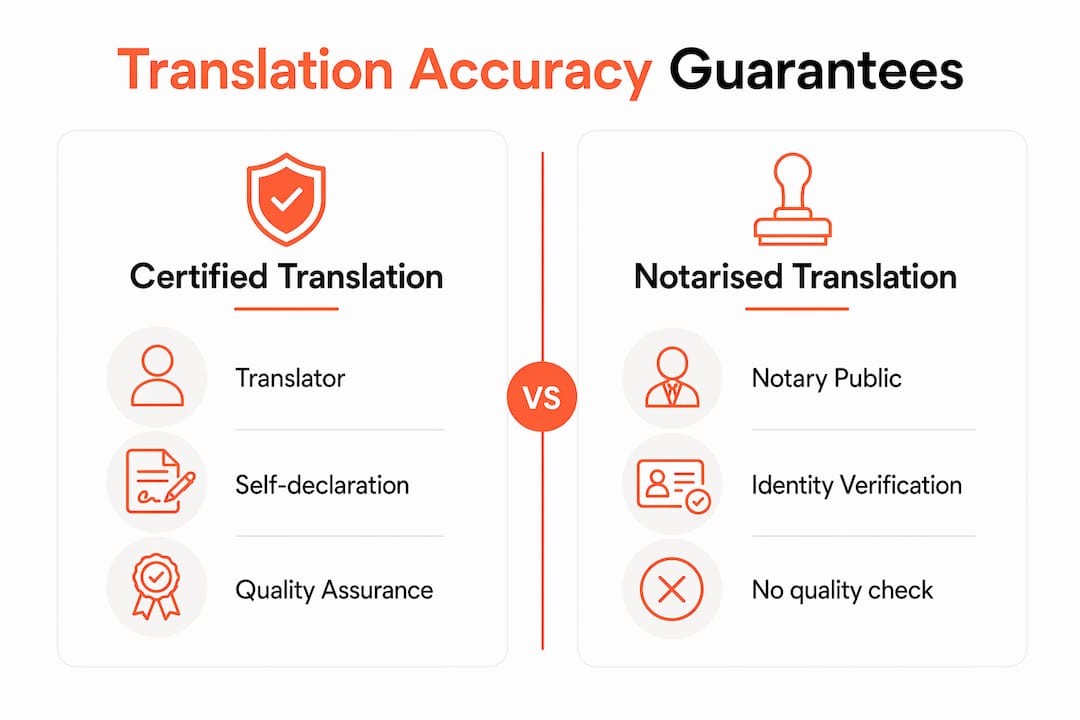
This is one of the most common points of confusion for people preparing official documents. Certified and notarised translations are not the same thing, and mixing them up can cause delays or outright rejection.
| Feature | Certified translation | Notarised translation |
|---|---|---|
| Who signs it | Qualified translator or agency | Notary public |
| What is verified | Accuracy and completeness of the translation | Identity and signature of the translator |
| Linguistic quality check | Yes, by the translator | No |
| When required | Immigration, courts, universities | Some legal proceedings, international documents |
| Covers translation quality | Yes | No |
Notarisation involves a notary public verifying the identity of the person who signed the certificate, not the quality of the translation itself. A notary is not a linguist. Their stamp confirms that the signature is genuine, nothing more.
Certified translation, by contrast, is a self-declaration by the translator. The translator asserts their own qualifications and the accuracy of their work. For most Australian immigration and legal purposes, a certified translation by a NAATI-credentialled translator is the required standard. Notarisation is sometimes required additionally for documents used in certain international legal proceedings, but it does not replace certification.
Understanding this distinction matters practically. Submitting a notarised translation when a certified one is required, or vice versa, wastes time and money. Check the specific requirements of the institution or authority requesting the document before you order.
Why is a translation accuracy guarantee critical for legal, immigration, and business documents?
The stakes of an inaccurate translation are not abstract. Rejected visa applications, inadmissible court evidence, and voided contracts are real consequences that flow directly from translation errors in official documents.
Key risks that an accuracy guarantee helps mitigate include:
- Document rejection by immigration authorities, courts, or universities due to unverified or inaccurate translations.
- Legal invalidity of contracts or agreements where a mistranslated clause changes the meaning of an obligation.
- Commercial misinterpretation in cross-border business dealings where terminology differences between jurisdictions create disputes.
- Delayed processing of visa or residency applications when documents are returned for re-translation.
Contracts should specify the scope of liability and required translator credentials to protect against document rejection in cross-border contexts. This is particularly relevant for businesses managing import and export agreements or legal entities operating across multiple jurisdictions.
A translation accuracy guarantee defines the professional accountability of the translator. It does not guarantee the outcome of any legal or administrative process. The receiving institution, whether a court, consulate, or university, remains the final arbiter of whether a document is accepted.
For academic documents requiring translation, such as transcripts and degree certificates, Australian universities typically require translations by NAATI-credentialled translators. A guarantee issued by an unqualified translator, regardless of how it is worded, will not satisfy this requirement.
High-stakes documents benefit from an additional step: back-translation or comparative analysis by dual-qualified linguistic experts. This process verifies semantic equivalence and creates a documented audit trail, which carries significant weight in legal disputes where the accuracy of a translated document is challenged.
What should you look for when choosing a translation service with an accuracy guarantee?
Not all accuracy guarantees carry equal weight. The value of a guarantee depends entirely on the qualifications of the person issuing it and the process behind it.
When evaluating a translation provider, check for the following:
- NAATI credentials. In Australia, the National Accreditation Authority for Translators and Interpreters (NAATI) sets the benchmark for translator qualifications. A NAATI-credentialled translator is the standard required by the Department of Home Affairs and most Australian courts.
- Documented QA process. Ask for a written description of the quality assurance steps. A provider with a genuine multi-stage process will be able to describe it clearly.
- Certificate of Accuracy included with every translation. The certificate should name the translator, their credentials, the language pair, the document type, and the date.
- Clear liability scope. Understand what the guarantee covers. Errors proven to cause substantial damage may result in liability beyond the translation cost, but guarantees cover linguistic fidelity only, not outcomes.
- Native-speaking subject experts. Legal documents require translators with legal expertise. Medical records require translators with medical knowledge. A generalist translator working outside their field is a risk.
- Revision and correction policy. A reputable provider will correct errors at no additional charge if the translation does not meet the stated standard.
Pro Tip: Request a sample certificate of accuracy before placing an order. If a provider cannot produce one, or if the sample is missing key details like translator credentials and document type, look elsewhere.
Choosing the right certified translator is not just about price. The cheapest option rarely includes a genuine multi-stage QA process, and the cost of a rejected document far exceeds the saving on the initial translation fee.
Key takeaways
A translation accuracy guarantee is only as strong as the qualifications of the translator and the quality assurance process behind it.
| Point | Details |
|---|---|
| Guarantee definition | A Certificate of Accuracy is a signed declaration of fidelity, not a government endorsement. |
| Certification vs notarisation | Certified translations verify accuracy; notarisation only verifies the translator’s identity. |
| TQA process matters | A multi-stage QA workflow covering revision, proofreading, and expert review underpins every credible guarantee. |
| Jurisdiction-specific accuracy | Accuracy means functional equivalence within the target jurisdiction’s legal standards, not literal word-for-word translation. |
| NAATI credentials are the standard | In Australia, NAATI-credentialled translators meet the requirements of immigration authorities, courts, and universities. |
The part most people miss about translation guarantees
People often treat a translation accuracy guarantee as a rubber stamp. They see the certificate, assume the document will be accepted, and move on. That assumption has caused more than a few expensive surprises.
The guarantee is a professional accountability tool. It tells you that a qualified person has declared the translation faithful to the original. What it does not do is guarantee that the receiving institution will accept the document. Certification is a self-declaration by the translator. Courts, consulates, and universities are the final arbiters, and they apply their own standards.
I have seen cases where a perfectly accurate translation was rejected because the translator’s credentials did not meet the specific requirements of the requesting authority. The translation was fine. The credential was not. That is a distinction the guarantee cannot fix.
The other thing people miss is the scope of liability. A guarantee covers linguistic fidelity. It does not cover the outcome of a visa application, a legal dispute, or a business negotiation. If you are using a translated document in a high-stakes context, pair the guarantee with a contract that specifies the translator’s qualifications and the scope of their liability. That combination gives you real protection.
The practical takeaway is this: a strong guarantee from a NAATI-credentialled translator, backed by a documented QA process, is the best available protection against translation-related document rejection. It is not infallible, but it is the professional standard for a reason.
— David
Certitranslate: certified translations with documented accuracy guarantees
Certitranslate provides certified translation services delivered by NAATI-credentialled translators for immigration, legal, and business documents across Australia. Every translation includes a Certificate of Accuracy naming the translator’s credentials, the language pair, and the document type.
The Certitranslate QA process covers initial translation, expert revision, proofreading, and a formatting check before delivery. Clients submitting documents to the Department of Home Affairs, Australian courts, or universities receive translations that meet the specific credential and accuracy standards those institutions require. For documents where the stakes are high, that documented process is what makes the guarantee worth having.
FAQ
What is included in a Certificate of Accuracy?
A Certificate of Accuracy includes the translator’s name and credentials, the language pair, the document type, the date of translation, and a formal declaration of fidelity to the original. Many certificates also carry an official seal or signature.
Does a translation accuracy guarantee mean my document will be accepted?
No. A guarantee confirms the translator’s professional accountability for linguistic fidelity. Final acceptance depends on the receiving institution, such as a court, consulate, or university, which applies its own standards.
What is the difference between certified and notarised translation?
A certified translation is a self-declaration of accuracy by a qualified translator. A notarised translation involves a notary public verifying the translator’s identity and signature, not the quality of the translation itself.
Do I need a NAATI-credentialled translator in Australia?
Yes, for most official purposes. The Department of Home Affairs, Australian courts, and most universities require translations by NAATI-credentialled translators. A guarantee from an unaccredited translator will not satisfy these requirements.
What does translation quality assurance actually involve?
Translation Quality Assurance (TQA) is a multi-stage process covering initial translation, revision by a second linguist, proofreading, formatting checks, and a management review. It uses glossaries, translation memories, and subject experts to catch errors before the final document is delivered.
Recommended
- Role of accredited translators in academic submissions – CertiTranslate – Translations by NAATI Certified Translators
- How to Choose the Right Certified Translator for Your Needs – CertiTranslate – Translations by NAATI Certified Translators
- What is certified translation: a complete guide – CertiTranslate – Translations by NAATI Certified Translators
- CertiTranslate – Translations by NAATI Certified Translators