


A translator seal is the official mark that certifies a translated document’s authenticity and accuracy, confirming it was completed by a qualified professional. For anyone submitting documents to Australian immigration authorities, courts, universities, or businesses, understanding the role of translator seal on documents is not optional. A missing or invalid seal is one of the most common reasons applications are delayed or refused outright. In Australia, the recognised standard is NAATI certification, and Australian government agencies only accept translations completed by NAATI certified or recognised translators.
How does a translator seal function in verifying document authenticity?
A translator seal works by attaching the translator’s professional identity directly to the translated document. Official Australian translations must include the translator’s name, signature, NAATI practitioner ID, and the date of translation on every page. That requirement exists because any page without a seal could be swapped out or altered without detection.
The seal is not merely decorative. It carries legal authority, certifying to courts, agencies, and businesses that the translation is accurate and the translator is qualified. A translator seal provides legal authority as a mark of authenticity and reliability for the translated document. That legal weight is what separates a certified translation from an informal one produced by a bilingual friend or an unverified online service.

Professional translators also use physical measures to reinforce the seal’s protective function. Translators often staple and seal multiple sheets together as a tamper-evident measure to maintain document integrity. This means that removing or replacing a page breaks the seal visibly, alerting authorities to potential tampering.
Pro Tip: Always check that the seal appears on every individual page of your translated document, not just the cover sheet. A seal on the first page only does not meet Australian requirements.
The table below clarifies the differences between the three terms people most commonly confuse.
| Validation type | What it confirms | Who applies it | Legally binding? |
|---|---|---|---|
| Translator seal | Accuracy of translation and translator’s credentials | NAATI certified translator | Yes, for most official submissions |
| Translator stamp | Physical impression of the translator’s details | NAATI certified translator | Yes, often used interchangeably with seal |
| Signature only | Translator’s identity, no credential verification | Any translator | No, not accepted for official use |
Why is the translator seal important for legal, immigration, and business documents?
The translator seal carries real consequences in official settings. Documents missing proper NAATI seals are frequently rejected by immigration and legal authorities, causing delays or outright refusal of applications. A visa application held up by an unsealed birth certificate translation can cost weeks of processing time and significant stress.
Australian government bodies apply strict rules about which translations they will accept. The Department of Home Affairs, the Federal Court of Australia, and state courts all require NAATI-certified translations for documents submitted in languages other than English. Universities follow the same standard. Australian universities accepting certified translations require the NAATI seal as proof of accuracy before enrolling international students or assessing foreign qualifications.
Credential currency matters just as much as the seal itself. NAATI certified translators must renew their credentials every three years to maintain official status. Translations produced by a translator whose NAATI certification has lapsed are not accepted by Australian government agencies. This means you need to verify not just that your translator holds NAATI credentials, but that those credentials are current at the time of translation.
The practical stakes are high across several document types:
- Visa applications: Passports, birth certificates, marriage certificates, and police clearances all require sealed translations.
- Court proceedings: Evidence submitted in a foreign language must carry a NAATI seal to be admissible.
- Business contracts: Import and export agreements, partnership deeds, and regulatory filings require certified translations for legal enforceability.
- University enrolments: Academic transcripts and qualifications from overseas institutions must be sealed to be assessed.
A sealed translation is not a formality. It is the mechanism by which authorities confirm they can trust the document in front of them.
How do translator seals compare to notarisation?
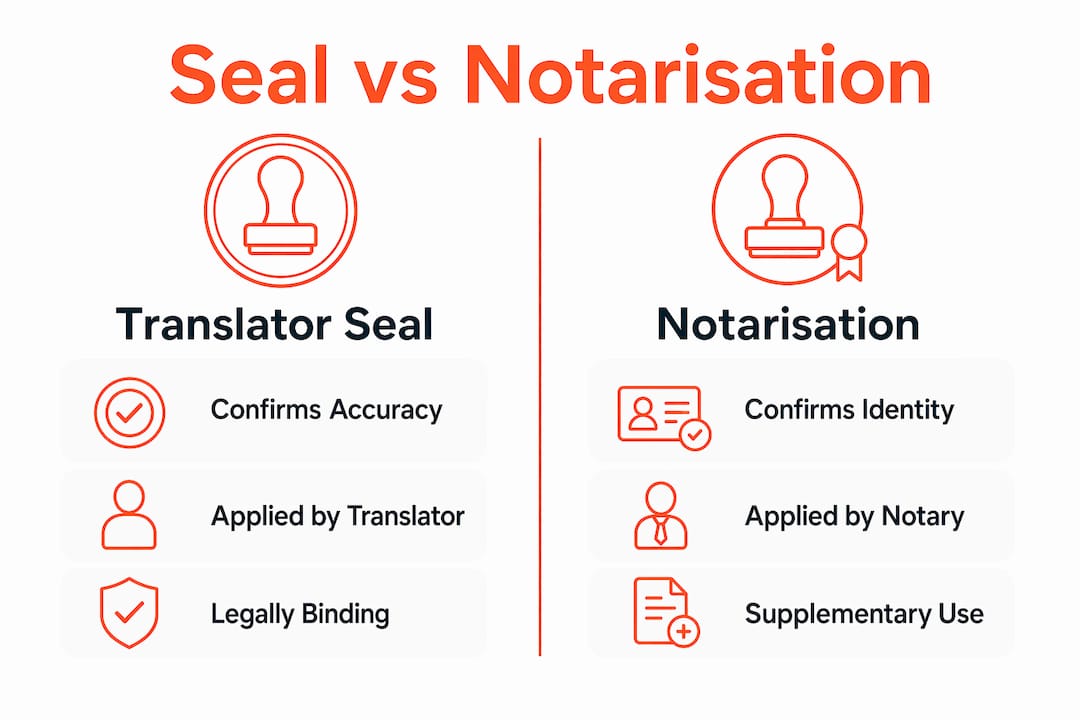
A translator seal and notarisation are two distinct forms of validation, and confusing them is a costly mistake. A translator seal specifically certifies the accuracy of the translation by a qualified professional, whereas notarisation validates signatures or identities only. A notary public does not assess whether the translation is correct. They confirm that the person signing the document is who they claim to be.
For most Australian immigration and legal submissions, a NAATI-sealed translation is sufficient on its own. Notarisation becomes necessary when a foreign jurisdiction requires it, or when an Australian document is being used overseas and must meet that country’s authentication standards. The process of apostille or legalisation adds another layer on top of notarisation for international use.
| Validation method | What it verifies | Typical use case | Sufficient for Australian government? |
|---|---|---|---|
| NAATI translator seal | Translation accuracy and translator credentials | Immigration, courts, universities | Yes |
| Notarisation | Signatory identity or document authenticity | Documents used overseas, some legal proceedings | Depends on jurisdiction |
| Apostille/legalisation | Document’s validity for international use | Foreign government submissions | Required for overseas use only |
One common misconception is that a wax seal or an embossed stamp makes a translation more official. Neither does. The legal weight comes from the NAATI credential attached to the seal, not from its physical appearance. A plain rubber stamp applied by a NAATI-certified translator carries more legal authority than an elaborate wax seal from an uncredentialed source.
What are the practical steps to get a properly sealed translation?
Getting a correctly sealed translation requires attention at every stage, from choosing your translator to checking the finished document.
- Verify NAATI credentials before engaging a translator. Search the NAATI online directory to confirm the translator holds a current credential in the relevant language pair. Expired credentials mean the translation will not be accepted.
- Confirm the translator specialises in your document type. A translator credentialed for general documents may not have the terminology required for legal contracts or medical records. Choosing the right certified translator for your specific needs reduces the risk of errors that could trigger rejection.
- Check the seal appears on every page. The seal must appear on every page of an official translated document. A multi-page document with a seal only on the last page does not meet Australian requirements.
- Submit original documents alongside the translation. Authorities often require the original document and the sealed translation together. Submitting original documents alongside sealed translations is standard practice for official acceptance.
- Check the seal contains all required details. The seal must show the translator’s full name, NAATI practitioner ID, signature, and the date the translation was completed.
Pro Tip: Ask your translator to confirm their NAATI credential expiry date in writing before you pay. A credential that lapses between the translation date and your submission date can still cause problems with some agencies.
The most common pitfalls are avoidable. Translators with lapsed credentials, seals missing from interior pages, and documents submitted without originals account for the majority of rejections. Checking each of these points before submission takes minutes and can save weeks of delays.
Key takeaways
A NAATI translator seal is the single most important element confirming a translated document’s legal validity for Australian immigration, court, and business submissions.
| Point | Details |
|---|---|
| Seal confirms translator credentials | The NAATI seal verifies the translator’s name, practitioner ID, signature, and translation date. |
| Every page must carry the seal | A seal on the cover page only does not meet Australian government requirements. |
| Credentials must be current | NAATI translators renew every three years; lapsed credentials make translations invalid. |
| Seal differs from notarisation | A translator seal certifies translation accuracy; notarisation confirms signatory identity only. |
| Missing seals cause rejection | Documents without a proper NAATI seal are routinely refused by immigration and legal authorities. |
Why I think most people underestimate the translator seal until it’s too late
Having worked closely with certified translation services and the people who rely on them, I’ve seen the same pattern repeat itself. Someone submits a visa application or a court document with a translation that looks perfectly professional. The formatting is clean, the language reads well, and the cover page has a stamp. Then the application comes back rejected because the seal was missing from pages three and four, or because the translator’s NAATI credential had expired six months earlier.
The seal is not a bureaucratic box-tick. It is the mechanism that makes the entire translation legally usable. Without it, the document is just text. With it, the document becomes evidence that a qualified, accountable professional stands behind every word.
What surprises me most is how often people focus on the cost of certified translation and overlook the cost of getting it wrong. A rejected visa application means reapplication fees, lost time, and in some cases, missed deadlines that cannot be recovered. The price difference between a properly sealed NAATI translation and an uncertified one is trivial compared to those consequences.
My advice is straightforward. Before you submit anything, check the seal on every page, verify the translator’s NAATI credential is current, and confirm the document type matches the translator’s area of expertise. These three checks take less than five minutes and eliminate the most common causes of rejection.
— David
Certitranslate: NAATI-certified translations with every seal in place
Certitranslate’s team of NAATI-certified translators applies the correct seal to every page of every document, meeting Australian government requirements for immigration, legal, and business submissions.
Every translation Certitranslate produces includes the translator’s full name, NAATI practitioner ID, signature, and date, exactly as required by the Department of Home Affairs and Australian courts. Turnaround is fast, and acceptance by official bodies is the standard, not the exception. Whether you need a certified document translation for a visa application, a court proceeding, or a business agreement, Certitranslate delivers translations that authorities accept. Get a quote directly from Certitranslate’s document translation service and submit with confidence.
FAQ
What information must a translator seal include?
A translator seal must include the translator’s full name, NAATI practitioner ID, signature, and the date of translation. These details must appear on every page of the translated document.
Does a translator seal expire?
The seal itself does not expire, but the NAATI credential behind it does. NAATI certified translators must renew their credentials every three years, and translations by translators with lapsed credentials are not accepted by Australian government agencies.
Is a translator seal the same as notarisation?
No. A translator seal certifies the accuracy of the translation by a qualified professional. Notarisation confirms the identity of a signatory or the authenticity of a document, but does not verify whether the translation is correct.
What happens if my document is missing a translator seal?
Documents without a proper NAATI seal are routinely rejected by immigration authorities, courts, and universities. This causes processing delays and may require the entire translation to be redone by a certified translator.
Do all pages of a translated document need the seal?
Yes. The seal must appear on every page of an official translated document. A seal on the first or last page only does not satisfy Australian government requirements and will likely result in rejection.
Recommended
- Why original documents accompany translations: 2026 guide – CertiTranslate – Translations by NAATI Certified Translators
- How import export documents are translated: 2026 guide – CertiTranslate – Translations by NAATI Certified Translators
- Types of business documents requiring translation – CertiTranslate – Translations by NAATI Certified Translators
- What is a sworn translation? your complete guide – CertiTranslate – Translations by NAATI Certified Translators