


Bring translated English copies of your overseas vaccination documents to a recognised Australian vaccination provider so they can add them to the Australian Immunisation Register (AIR). Use the Department of Home Affairs Free Translating Service if you’re eligible, or a NAATI-accredited translator if you’re not. Only an AIR Immunisation History Statement is accepted for school and childcare enrolment, so this is the document you’re ultimately working towards.
TL;DR:
- Ensuring that overseas vaccination records contain detailed vaccine names, administration dates, and authentic proof is essential for AIR entry; handwritten notes or screenshots are insufficient.
- Using the Department of Home Affairs Free Translating Service is the quickest option if eligible, but a NAATI-certified translator is necessary otherwise to preserve clinical accuracy.
- Records must be verified against identity documents, with high-quality scans and complete translator declarations to avoid delays during AIR updating.
- Missing records can be managed through serology testing to verify immunity or a catch-up vaccination schedule, especially for children under 20 eligible for free vaccines.
- The AIR update process can take from a few days to two weeks, with delays mainly caused by incomplete or unclear translations, mismatched ID details, or the need for follow-up.
Table of Contents
- What documents does the AIR need from overseas records?
- How do you get vaccination records translated to English?
- How do you get overseas immunisations added to the AIR?
- How long does an AIR update take?
- What if you don’t have your original immunisation records?
- A translator’s checklist for smoother AIR processing
- How Certitranslate gets your immunisation records accepted
- Sources
What documents does the AIR need from overseas records?
Before you spend money on a translation, check your original documents actually contain what a provider needs. Immunisation staff aren’t just looking for a list of vaccine names. They need enough detail to match each dose against the National Immunisation Program schedule and decide what, if anything, still needs to be given.
Your records should show:
- Full name and date of birth, matching what’s on your passport or birth certificate
- The exact vaccine name or brand (not just “measles vaccine,” but the specific product where possible)
- The date each dose was administered
- Evidence of authenticity: a clinic stamp, a doctor’s signature, or an official letterhead
Stamped certificates and official immunisation booklets carry the most weight. A handwritten note from a relative or a screenshot of a messaging app isn’t going to cut it. Digital copies are fine as long as they’re clear, high-resolution photos or scans, not blurry phone shots where a date could be a 3 or an 8. It also helps to bring your birth certificate or passport to the appointment. Providers cross-check identity details against your record, and mismatched spelling of a name (common with transliterated names) is one of the most frequent reasons an entry gets held up.
How do you get vaccination records translated to English?
Not every translation is treated equally, and this is where a lot of people waste weeks. There are two legitimate paths, and which one applies to you depends on your visa and settlement status.
- Check Free Translating Service eligibility. The Department of Home Affairs offers a Free Translating Service for people settling in Australia, generally within a set window of arrival, for personal documents including immunisation records. If you qualify, this is the cheapest and often fastest route.
- Use a NAATI-certified or accredited translator if you don’t qualify. Many vaccination providers specifically prefer NAATI-certified translations for medical documents, because clinical terminology (drug names, doses, batch numbers) needs to survive translation without ambiguity.
- Confirm the translation includes the right paperwork. A valid translation should carry the translator’s signed statement of accuracy, their NAATI number or accreditation details, the date of translation, and a clear reference back to the original document’s pages.
Pro Tip: Ask your translator to keep vaccine brand names and batch numbers exactly as written on the original, even if they look like a string of letters and numbers. Providers use these details to match doses to the Australian schedule, and a “helpful” paraphrase can create more confusion than it solves.
How do you get overseas immunisations added to the AIR?
The process has two sides: what you do as a parent or applicant, and what happens once you’re in front of the provider.
What you need to do:
- Gather your original immunisation records and any supporting identity documents.
- Arrange translation through the Free Translating Service or a NAATI-accredited translator.
- Book an appointment with a recognised vaccination provider, usually a GP who bulk bills the immunisation consultation.
- Bring both the originals and the translated copies. Explicitly ask the provider to record the overseas immunisations on the AIR, not just note them in your personal file.
What the provider does on their end:
- Verifies your identity against your Medicare and immigration documents.
- Maps each translated vaccine entry against the National Immunisation Program schedule to check what counts and what’s missing.
- Records the data through HPOS (Health Professional Online Services) linked to PRODA, or by lodging an IM013 form where digital submission isn’t possible.
- Notes the country of vaccination and the translation evidence against the record, since the AIR requires supporting data, not just a tick box.
Once the update is processed, you request an AIR Immunisation History Statement, either through your Medicare online account, the Express Plus Medicare app, or by asking Services Australia directly. This statement, not your original certificates and not the translation itself, is what schools and childcare centres will actually ask to see. The South Australian Government’s guidance on early childhood services is blunt about this: services won’t accept overseas records directly, translated or otherwise.
How long does an AIR update take?
Set your expectations early, because this is where a lot of frustration comes from. Provider updates lodged directly through HPOS are often reflected quickly, sometimes within days. But Services Australia notes that some updates submitted via form upload, like IM013, can take up to 14 days to process.
Delays usually occur due to avoidable issues such as incomplete translations missing doses or dates, mismatched identity details between translations and ID documents, unclear vaccine names in relation to the Australian schedule, or the provider needing to follow up for clarification, which can extend processing times.
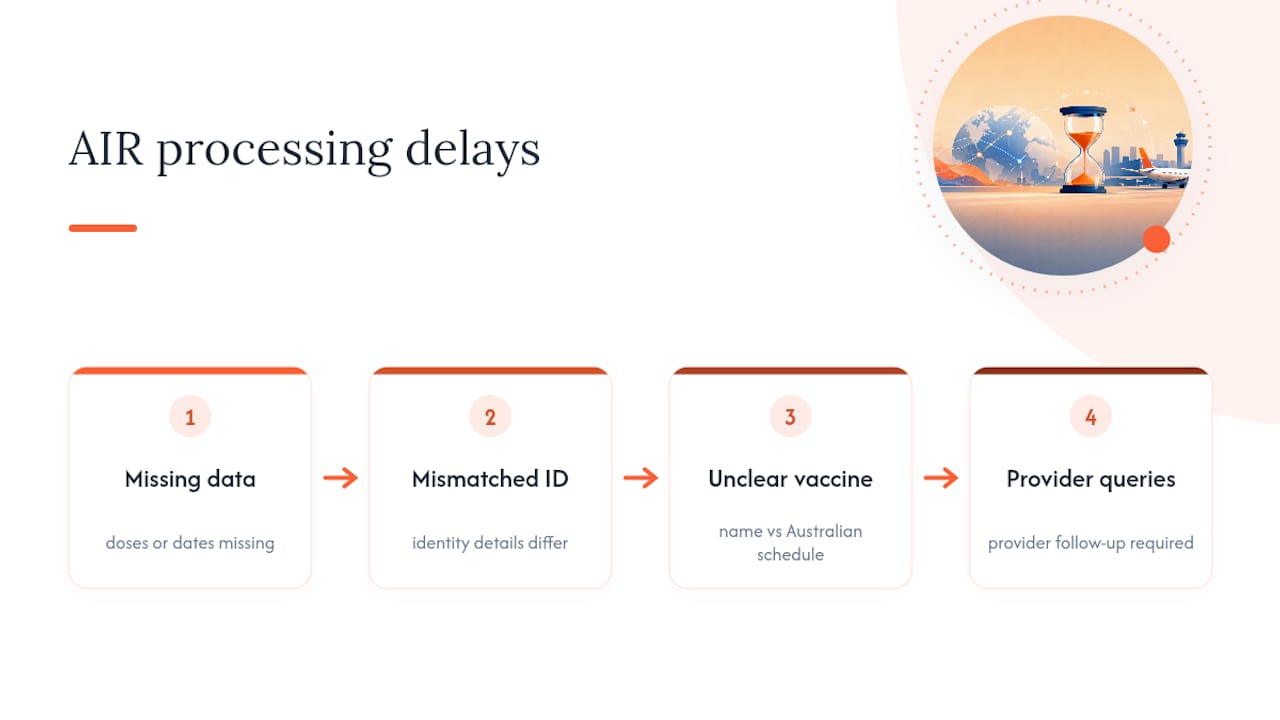
You can cut most of this off at the pass with high-resolution scans, a translator declaration that’s complete and legible, and your own contact details clearly attached in case the provider needs to check something.
What if you don’t have your original immunisation records?
Missing paperwork doesn’t mean starting from zero, but it does mean a different, slower path. Recognised providers have two main tools when there’s nothing to translate.
- Serology testing can show existing immunity to certain diseases (measles, hepatitis B, and varicella are common candidates), which can save you from unnecessary repeat doses.
- A catch-up schedule kicks in when serology isn’t practical or immunity can’t be confirmed. Providers use clinical judgement to decide between testing and revaccination based on age, country of origin, and disease risk.
- Encouragingly, most routine catch-up vaccines are free for eligible people under 20 under the National Immunisation Program.
The AIR records serology results and medical exemption evidence differently to documented overseas vaccinations, so tell your provider upfront which situation applies. Pro Tip: If you suspect your original certificate exists somewhere, even a badly damaged one, bring it anyway. A partial stamp or a half-legible date can sometimes be enough for a provider to accept a dose without resorting to serology or a full catch-up course.
A translator’s checklist for smoother AIR processing
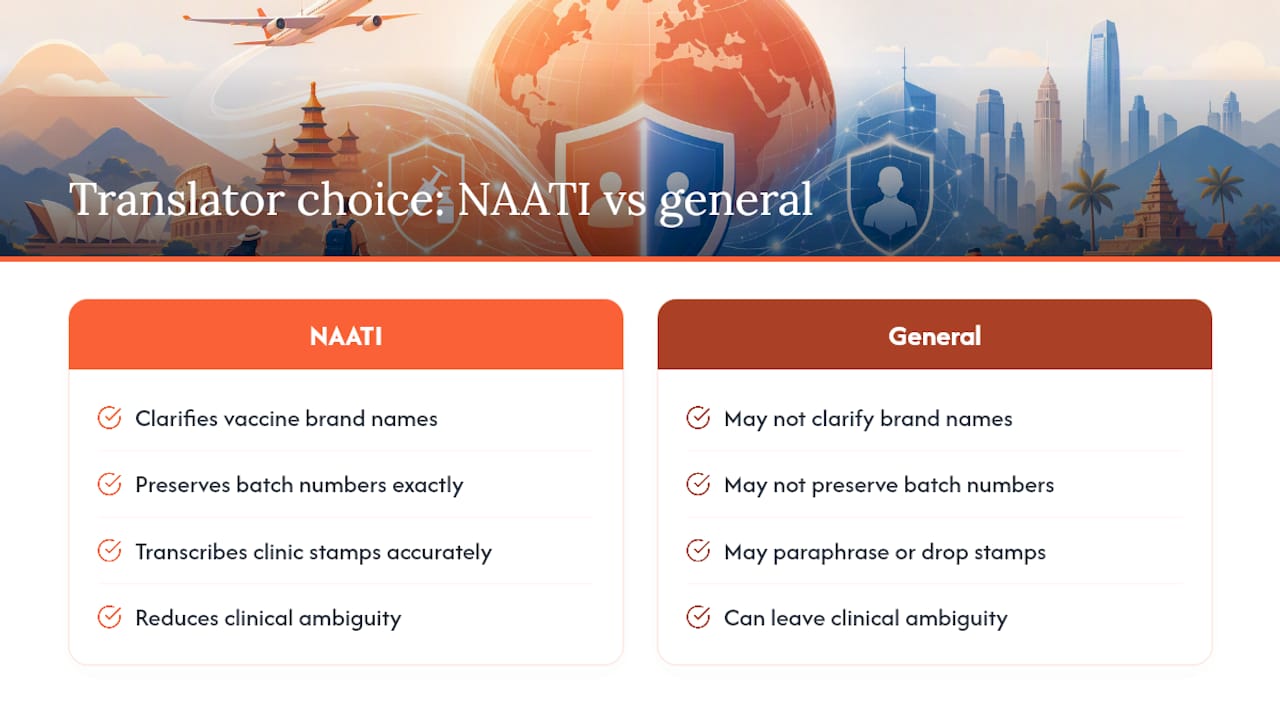
The single biggest time-waster is submitting a translation that raises more questions than it answers. Before your appointment, check that your scans are labelled by document type and date, that originals are packed alongside the translation (not left at home “just in case”), and that the translator’s declaration is fully legible, not cropped out of the photo.
NAATI-qualified translators reduce clinical ambiguity in ways people don’t expect. They clarify vaccine brand names that don’t have an obvious English equivalent, preserve batch numbers exactly as printed, and correctly transcribe clinic stamps that a general translator might paraphrase or drop entirely. That precision is exactly what a GP needs to map a dose to the Australian schedule without guessing.
— David
How Certitranslate gets your immunisation records accepted
There are other ways to get a translation done, including the Free Translating Service if you qualify, or a freelance NAATI translator you find independently. There are services that offer translations by NAATI-certified translators experienced with medical and clinical terminology, so vaccine brand names, batch numbers, and clinic stamps come through exactly as a GP needs them.
Translations generally include the signed translator declaration providers expect to see, referencing the exact pages of your original document, with fast turnaround so you’re not waiting weeks before your provider appointment. Certified translation services typically cover immunisation booklets, clinic certificates, and related personal documents across many languages, matched to what Services Australia and vaccination providers require for AIR entry. If your situation is unusual, missing pages, an unfamiliar vaccine brand, or a document in poor condition, consider consulting a translator for advice on what might be workable before ordering. Start by reviewing what certified translation actually involves, then place your order online.
Sources
- Overseas immunisations — Services Australia
- Children vaccinated overseas — WA Health
- Immunisation requirements for early childhood services — Government of South Australia