


If you need to submit name-change evidence in a language other than English in Australia, you must provide an English translation from a NAATI-accredited translator, or one prepared by an authorised agency on official letterhead where that’s accepted. Do this first: get certified copies of your original documents, then commission the translation before you approach any registry, the Passport Office, or Home Affairs.
TL;DR:
- Translations from overseas are generally rejected for Australian name-change applications, making it essential to use a NAATI-accredited translator based in Australia.
- Different agencies, like BDM, Passport Office, and Home Affairs, demand specific documentation and formatting requirements, influencing how translations are accepted.
- Linking documents such as change-of-name or marriage certificates are crucial for explaining name mismatches rather than relying solely on translation quality.
- Certified copies must be obtained before translation, and agency-specific formats, like signed translator statements, are key to avoiding delays.
- Valid translations include those on official letterhead from NAATI translators in Australia, whereas agency services like TIS National are only accepted for certain contexts.
Table of Contents
- What name-change documents actually need translating?
- Who is allowed to translate these documents?
- How do BDM, the Passport Office and Home Affairs treat translations?
- Why do names mismatch, and what fixes it?
- What’s the step-by-step process, and how long does it take?
- What actually determines whether your translation gets accepted?
- Get your name-change documents translated properly the first time
- Sources
What name-change documents actually need translating?
Anyone changing agencies after a name change usually needs to translate a specific set of documents, not their whole file. The common ones are:
- A foreign-issued birth certificate showing the birth name
- A foreign change-of-name certificate or deed poll equivalent
- A foreign marriage certificate showing a name change through marriage
- Relevant passport pages carrying the old and new names
- A foreign citizenship certificate where it records a name variation
Australian-issued documents are treated differently. A change of name certificate or marriage certificate issued by an Australian Registry of Births, Deaths and Marriages is already in English and stands as primary evidence on its own, so no translation is needed. Some countries issue bilingual certificates with English and the local language side by side. If the English text is complete, legible, and matches the format authorities expect, a translation usually isn’t required either, though it’s worth checking with the receiving agency before assuming this applies.
Who is allowed to translate these documents?
NAATI accreditation is the Australian standard for certified translation, and it’s what registries look for first. The National Accreditation Authority for Translators and Interpreters sets the benchmark that state BDM offices apply, and applicants lodging documents in Australia are generally expected to use a NAATI-accredited translator based here.
Government language services fill a narrower gap. TIS National uses NAATI translators and can produce translations accepted for specific purposes, but only when issued on the agency’s official letterhead, not as a standalone document from an unnamed source.
Overseas translations are the trap most people fall into. Guidance from Western Australia’s BDM makes it explicit: documents translated outside Australia are generally not accepted for in-Australia change-of-name applications, even when the translator held equivalent credentials in their home country.
- NAATI-accredited translators based in Australia: the default for BDM and most official submissions
- TIS National or similar agency services: accepted only on official letterhead, for specific eligible cases
- Overseas-prepared translations: usually rejected outright for BDM change-of-name lodgements
Pro Tip: If you translated a document overseas years ago for a different purpose, don’t assume it will be reused. Ask the receiving agency directly whether it accepts translations completed outside Australia before you rely on an old one.
How do BDM, the Passport Office and Home Affairs treat translations?
Each agency has its own acceptance rules, and mixing them up is one of the fastest ways to get a submission bounced back.
State BDM offices require non-English originals to be translated into English by a NAATI-accredited translator, and applicants inside Australia are expected to use one based here. Certified copies of the originals typically accompany the translation, not the originals themselves.
The Australian Passport Office takes a slightly different approach. It accepts translations from specified government services using NAATI translators, provided they’re submitted on the agency’s own letterhead. Once a translation has been accepted for a passport application, it can usually be reused for future passport services, which saves a second round of fees down the track.
Home Affairs and related identity checks add another layer. Systems such as the Document Verification Service cross-check details against issuing agency records, and the ATO notes that formatting quirks, like multiple hyphens or unusual apostrophes in a translated name, can trip up automated matching even when the translation itself is accurate.
- BDM: NAATI translator in Australia, plus certified copies of originals
- Passport Office: agency letterhead translations, reusable once accepted
- Home Affairs/DVS: consistent name formatting across every document matters as much as the translation itself
Why do names mismatch, and what fixes it?
Transliteration is the usual culprit. Names written in Chinese, Arabic, or Korean script can be rendered into English several valid ways, and Home Affairs guidance acknowledges this variability directly, requiring documentary evidence that links the original “commencement document” to whatever name appears later.
Not every mismatch is a legal name change. A misspelt letter or a dropped accent is often an administrative fix, while a genuinely different name, through marriage, deed poll, or gender transition, needs formal proof. Guidance on statutory declarations treats these as separate categories, and conflating them slows everything down.
Acceptable linking documents include:
- A state-issued change-of-name certificate
- A marriage certificate issued in Australia
- A reissued citizenship certificate reflecting the new name
- A statutory declaration, where the receiving agency allows one
What’s the step-by-step process, and how long does it take?
Work through these steps in order, and you’ll avoid most of the delays people run into.
- Identify the recipient agency and its exact document list. BDM, the Passport Office, and Home Affairs each want slightly different combinations, so confirm before you spend money on translation.
- Get certified copies of your originals. In Australia, a Justice of the Peace, a police officer, or an Australian consular officer overseas can certify copies, and BDM guidance sets out what counts as acceptable identity verification.
- Commission a NAATI-accredited translator in Australia. Ask for a signed translator statement including the NAATI credential number, a declaration that it’s a true and accurate translation, and confirmation of whether stamps and signatures on the original are included.
- Check formatting against the receiving agency’s rules. Agency-letterhead translations, consistent name spelling, and retained originals all matter, particularly since accepted passport translations can be reused later.
Turnaround for a standard NAATI-certified translation typically runs a few business days for straightforward personal documents, though volume and language pair affect this. The most common rejection reasons are outdated document versions, a missing translator statement, and uncertified copies submitted instead of the real thing.
Pro Tip: Keep both the original-language document and its certified translation together in your file. Agencies sometimes ask to sight the original even after they’ve accepted the translation, especially for name-change evidence.
What actually determines whether your translation gets accepted?
Most of the confusion around this topic isn’t about translation quality. It’s about people treating the translation as the proof of a name change, when it’s really just the vehicle that makes an existing government document assessable. A NAATI-accredited translator can produce a flawless rendering of your birth certificate, and it still won’t help if the underlying document doesn’t clearly link your old name to your new one.
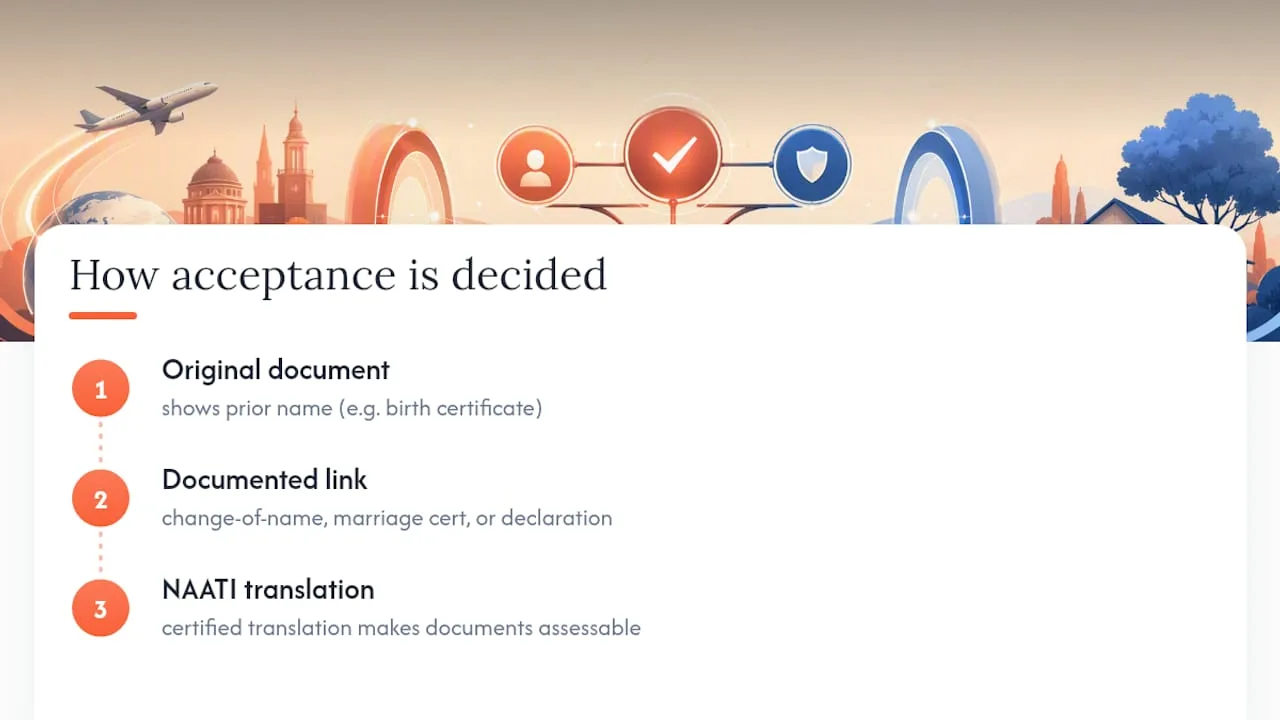
The conventional advice, “get it translated and you’re sorted”, skips the part that actually causes rejections: agencies want a chain of identity, not a single clean document. That means a change-of-name certificate, a marriage certificate, or a statutory declaration often matters more than the translation itself.
If you’re prioritising one thing, prioritise sequencing. Confirm the receiving agency’s exact requirements before you pay for a translation, not after. Certified copies, translator statements, and consistent name formatting across every document you submit will save you more time than shopping around for the cheapest translation quote.
— David
Get your name-change documents translated properly the first time
Certified translation services can handle NAATI certification wording aligned with BDM, the Passport Office, and Home Affairs expectations, reducing uncertainty about whether a translation will be accepted. That matters most when you’re juggling a foreign birth certificate, a marriage certificate, and a citizenship record all at once, each needing to line up with the same spelling of your name.
Every translation comes from a NAATI-certified translator, with the signed statement and accreditation number agencies ask for built in as standard. Certitranslate also advises on certified-copy requirements and agency-specific formatting, so you’re not sending back a second version because the letterhead was wrong or a stamp was missing. Turnaround is fast enough that most personal documents don’t hold up a submission deadline. If you’re ready to move, start with what certified translation actually means for your documents and place your order directly through Certitranslate.