


Technical translation is built for exact, unambiguous meaning, controlled terminology and traceability. General translation is built for natural fluency and audience tone, and it tolerates paraphrase in a way technical work never can. That single distinction decides everything downstream: which translator you hire, what workflow they follow, and how much risk you’re carrying if the wording is wrong.
Two trust anchors sit behind that distinction. NAATI sets the certification bar for translators working on official Australian documents, and ISO 17100 sets the process standard for how a translation gets checked before it’s delivered. CertiTranslate builds its service around both.
- Choose technical translation when a wording error could cause safety, legal, or compliance harm.
- Choose general translation when the goal is tone, readability, and cultural fit, not precision under scrutiny.
- When in doubt, treat the document as technical. It costs more upfront and saves you the recall later.
Key Takeaways
Technical translation demands controlled terminology, subject-matter expertise, and a documented review process, while general translation prioritises natural tone and reads fine with reasonable paraphrase.
| Point | Details |
|---|---|
| Ask the harm test first | If a wording error could cause safety, legal, or compliance harm, treat the document as technical. |
| Terminology control matters more than fluency | A locked term base and translation memory prevent drift across manuals and versions. |
| Review chain beats a cheap quote | Require a subject-matter reviewer and a second qualified reviser under ISO 17100 before price. |
| Machine translation needs governance | Post-editing under ISO 18587 is acceptable; unchecked machine output on regulated text is not. |
| CertiTranslate offers the certified path | NAATI-certified translators handle technical and legal documents with terminology expertise built in. |
Table of Contents
- How technical translation differs from general translation
- When does a document actually need technical translation?
- What does a proper technical translation workflow look like?
- What actually goes wrong when technical content gets general treatment
- How to choose the right translator for a technical job
- How CertiTranslate handles technical translation
- Why the “just translate it” instinct is the real risk
- Get certified technical translation done right
- Where to verify these standards yourself
- Sources
How technical translation differs from general translation
The clearest way to separate the two is to ask what happens if a sentence gets reworded slightly. In general translation, that’s fine, even desirable. In technical translation, it can change a dosage, a torque spec, or a legal obligation.
Purpose and audience. General translation serves readers who want something to feel natural in their language: a marketing email, a personal letter, a blog post. Technical translation serves readers who need to act on the content correctly: an engineer following a wiring diagram, a regulator reviewing a clinical trial protocol, a court checking a contract clause against its source.
Tolerance for paraphrase. A general translator can restructure a sentence to sound better in the target language. A technical translator generally can’t, because the comparative study on translation approaches found that translators with relevant technical formation consistently outperform generalists on specialised material, precisely because they preserve meaning rather than smoothing it over.
Terminology control. Technical work runs on glossaries, translation memory, and locked term lists so “torque” means the same thing on page 4 and page 400. General translation rarely needs a term base at all.
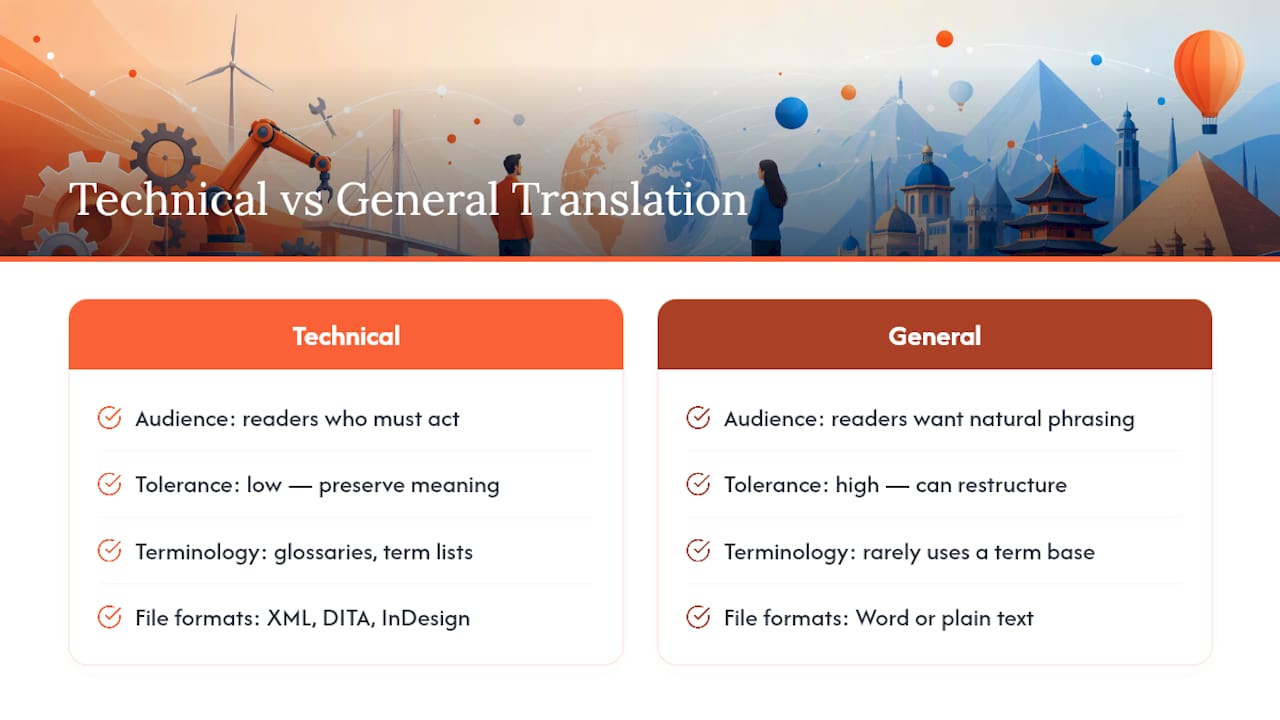
File formats and tooling. Technical projects frequently involve structured content such as XML, DITA, and InDesign files, where layout and numeric accuracy must survive the translation process intact. General translation usually lives in a Word document or a plain text field.
Typical documents. Technical: user manuals, patents, safety data sheets, clinical documentation, engineering specs. General: personal correspondence, marketing copy, general web content, casual business emails.
When does a document actually need technical translation?
Run one test before you brief any job: would a wording error here cause safety, legal, or operational harm? If yes, treat it as technical, no exceptions.
- Content that requires technical translation: user manuals, medical and pharmaceutical documents, engineering and construction specs, legal contracts, patents, safety instructions, regulatory submissions.
- Content that doesn’t: internal newsletters, general marketing collateral, personal letters, casual correspondence, most social media copy.
- Hybrid cases: technical marketing (a product brochure quoting specs), UI strings (short, but wrong terminology breaks the interface), and internal training material that mixes plain instruction with regulated content. Brief these explicitly, tell the translator which parts are technical and which are stylistic, rather than letting them guess.
Pro Tip: If a document will be submitted to a government body, court, university, or professional regulator, treat it as technical and certified by default, even if the language itself reads simply.
What does a proper technical translation workflow look like?
A technical job runs through more checkpoints than a general one, and each checkpoint exists because skipping it has caused real problems somewhere before.
The build starts with a terminology base and translation memory, so every term is locked before translation begins rather than fixed after the fact. Comlogos notes that consistent terminology and workflow controls are what keep technical translation compliant, because errors in this category tend to cause safety, legal, or regulatory problems rather than just awkward phrasing.
Structured files need careful handling too. Manuals, XML/DITA content, InDesign layouts and UI resource strings each carry formatting and numeric data that a straight text swap can wreck.

Review happens in stages: translator, then a subject-matter reviewer who checks technical accuracy, then a second qualified reviser who signs off under the ISO 17100 process. That second-person revision step is the standard’s core requirement, not an optional extra.
Machine translation has a place here, but only inside a controlled post-editing process under ISO 18587, where a qualified human still reviews and corrects the output. Running safety documentation through raw machine translation with no human check is a different risk category entirely, and one worth understanding before you rely on any consumer-grade translation app for anything regulated.
- Terminology base locked before translation starts
- Structured files (XML/DITA, InDesign, UI strings) handled without breaking layout
- Two-stage human review under ISO 17100
- Machine translation only inside a governed ISO 18587 post-editing workflow
- Full audit trail and version control kept for every revision
A centralised terminology base and strong translation memory governance is what actually prevents documents drifting out of sync across versions, which is where most long-term technical translation costs quietly accumulate.
What actually goes wrong when technical content gets general treatment
Fluent-sounding text can still be technically wrong, and that gap is where most damage happens.
- Safety risks: a mistranslated warning label, dosage instruction, or machine operation step can injure someone.
- Regulatory and legal risks: a submission with inconsistent terminology can fail approval, and a contract translated loosely can create liability nobody intended.
- Operational costs: rework, extra support tickets, and version drift across a manual’s translations all cost more than getting it right the first time.
- Hidden inaccuracy: a sentence can read smoothly in the target language and still say the wrong thing technically, because fluency and accuracy are separate qualities that a general translator isn’t trained to reconcile.
Technical translation sits closer to engineering than to creative writing. It rewards traceability, repeatability, and fixed phrasing over elegant variation, which is exactly what safety-critical text needs and exactly what general translation doesn’t optimise for.
TextUnited’s framing puts it plainly: treating technical content as general translation shifts cost downstream into rework and compliance failures rather than removing it. You still pay. You just pay later, and usually more.
How to choose the right translator for a technical job
Vetting a technical translator takes a few extra questions compared to hiring for general content, and skipping them is where most bad outcomes start.
- Confirm subject-matter expertise alongside translation qualifications. Ask for samples in your specific domain, not general writing samples.
- Require NAATI certification when the document needs official acceptance, and ask whether the provider follows an ISO-aligned quality process.
- Ask for evidence of terminology management: a term base, translation memory reuse, and a documented approach to file formats like XML or InDesign.
- Confirm the review chain: who does the subject-matter check, who signs off as second reviser, and what happens if they disagree.
- Clarify turnaround time, whether pricing is per-project or per-word, who carries liability for errors, and what documentation you’ll receive at handover.
Pro Tip: Ask any provider to name their subject-matter reviewer’s background before the job starts, not after delivery. If they can’t name a person, there probably isn’t one.
How CertiTranslate handles technical translation
CertiTranslate works exclusively with NAATI-certified translators who bring industry-specific terminology expertise to legal, technical, and regulatory documents, not just general language fluency.
- Step-by-step process for translating technical manuals without losing formatting or numeric accuracy
- Practical breakdown of common terminology errors and how they get caught before delivery
- Certified translations built for guaranteed acceptance by Australian authorities across visa, legal, and enrolment documents
Why the “just translate it” instinct is the real risk
Most guidance on this topic explains the difference between technical and general translation as a matter of tone or vocabulary. That’s incomplete. The real difference is what a mistake costs. A general translation error produces an awkward sentence. A technical translation error can produce a failed regulatory submission, a voided contract clause, or a genuinely dangerous instruction.
The conventional advice, “hire a native speaker,” falls short here because native fluency says nothing about whether someone understands torque specifications or clinical trial terminology. The comparative study on translator performance makes that gap explicit: technical formation changes outcomes on technical text, independent of general language skill.
If you’re briefing a translation job, prioritise the review chain before the price. Ask who checks the technical accuracy and who signs off as second reviser under an ISO 17100 process. A cheap quote with no named subject-matter reviewer is not a bargain. It’s an unpriced liability sitting in your document.
— David
Get certified technical translation done right
There are other ways to handle a technical document. Some people run it through a translation app, others hand it to a bilingual colleague, and both work fine for a casual email. Neither holds up when a document needs to be accepted by a government body, a court, or a university.
CertiTranslate handles that gap directly. Every technical and legal translation runs through NAATI-certified translators with industry-specific terminology expertise, so the document you submit is built for acceptance the first time, not sent back for correction. If you’re unsure whether your document needs certification, CertiTranslate’s guide to certified translation walks through exactly when it’s required. If you already know what you need, you can start an order with a NAATI-certified translator and get a turnaround estimate before you commit.
Where to verify these standards yourself
Readers who want to check the standards and research behind this article can go directly to the sources. NAATI’s sector overview explains certification requirements for translators working on official Australian documents. The comparative study on translation approaches documents how technical formation affects translation performance on specialised material. Comlogos’s guide to technical translation covers ISO 17100 and ISO 18587 in more detail, and AdHoc Translations’s guide to technical documentation breaks down file-format handling for manuals, XML, and structured content.
Sources
- NAATI sector overview
- Comparative study on translation approaches (2018)
- Comlogos — Technical translation definition & standards
- AdHoc Translations — technical documentation translation guide
Recommended
- Technical manual translation step by step: a guide for professionals – CertiTranslate – Translations by NAATI Certified Translators
- Why legal terminology requires a specialist translator – CertiTranslate – Translations by NAATI Certified Translators
- 10 common technical translation terminology errors to fix – CertiTranslate – Translations by NAATI Certified Translators
- Benefits of professional certified translation explained – CertiTranslate – Translations by NAATI Certified Translators