


Certified translation of a recommendation letter is defined as a translation produced by a NAATI-certified translator who attaches a signed declaration confirming the translation is true and accurate. Australian universities, assessing bodies, and the Department of Home Affairs require this standard. A bilingual friend, a notary, or a Justice of the Peace cannot produce a legally accepted certified translation. Understanding how recommendation letter translation is certified is the first step to avoiding a rejected application, whether you are applying for a student visa, a skilled migration assessment, or university admission.
What does it mean for a recommendation letter translation to be certified?
A certified translation is a complete, accurate rendering of a source document accompanied by a formal statement from the translator. That statement confirms the translation is faithful to the original. Without it, the document carries no official weight in Australia.
The certification statement must include specific details to be valid. Australian assessing bodies will reject translations that are missing any of the following:
- The translator’s full name
- The translator’s signature
- The date the translation was completed
- The translator’s NAATI Credential Professional Number (CPN)
- A declaration that the translation is true and accurate to the best of the translator’s knowledge
The CPN is the most commonly overlooked element. Missing or unverifiable CPN often results in document refusal by Australian bodies. That single omission can cost you weeks of delay.
Certified translation is also fundamentally different from notarisation. A Justice of the Peace can certify that a photocopy matches an original document. A JP cannot certify that a translation is accurate. Those are two separate legal acts, and confusing them is one of the most common mistakes applicants make.
Pro Tip: Ask your translator to send you a sample certification statement before you commit. If it does not include a CPN, a signature, and a date, find a different provider.
Who is authorised to certify recommendation letter translations in Australia?
NAATI-certified translators are the only professionals whose certifications are accepted by Australian government bodies and universities. NAATI stands for the National Accreditation Authority for Translators and Interpreters. It is the sole national standards body for the translation profession in Australia.

NAATI certification is mandatory inside Australia for government and institution acceptance of translated documents, including recommendation letters. Foreign notarisation is not a substitute. An apostille from another country does not replace NAATI certification for documents submitted within Australia.
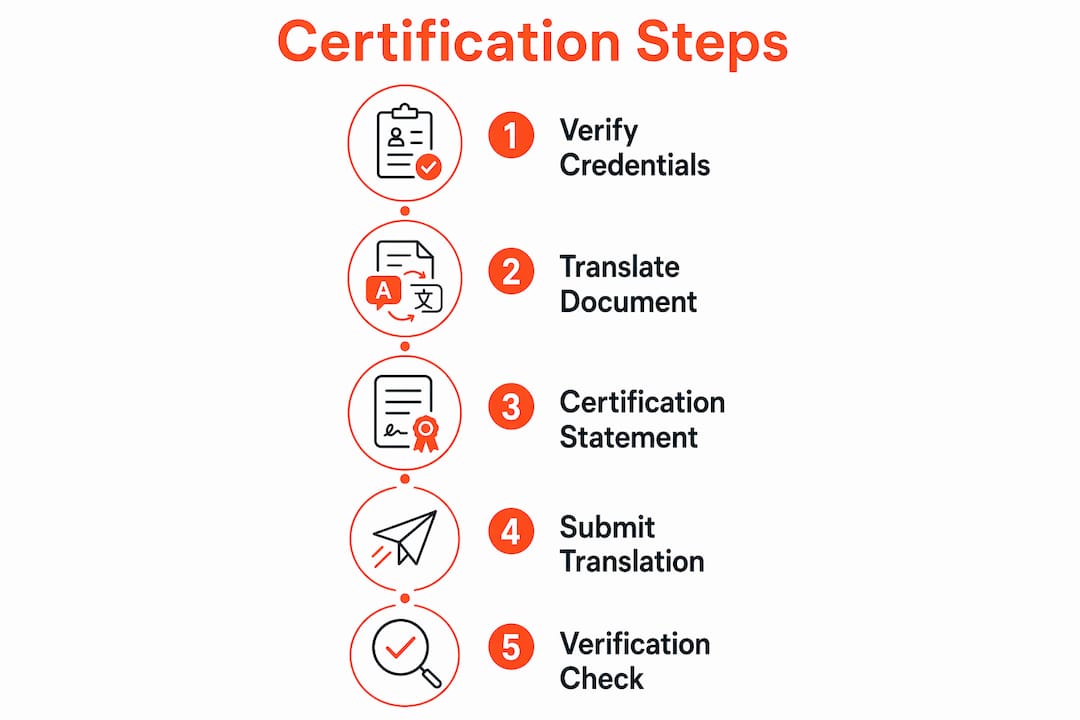
To verify a translator’s credentials, follow these steps:
- Visit the NAATI online directory at directory.naati.com.au.
- Search by the translator’s name or their CPN.
- Confirm the translator holds active certification in the relevant language pair.
- Check that their certification level covers document translation, not just interpreting.
- Save a screenshot of the verification result for your records.
Verification takes under two minutes and protects you from fraudulent or lapsed credentials. Selecting a provider with verifiable NAATI credentials is the single most important quality check you can perform.
For offshore applications, the rules differ slightly. If you are applying from outside Australia, some institutions accept translations completed by a recognised professional translator in your home country. Always confirm the specific requirements with the receiving institution before commissioning a translation, as requirements vary by visa subclass and university.
Notaries and JPs are frequently misunderstood in this context. A JP can certify a copy of an original document but cannot certify the translation itself. Only a NAATI-certified translator can produce a legally recognised certified translation for a foreign language document in Australia.
What are the common pitfalls in certifying recommendation letter translations?
The most damaging mistakes happen before the translation even begins. Applicants often choose the wrong type of certifier, submit incomplete documents, or fail to check institutional requirements. Each error can result in outright rejection.
The most frequent pitfalls include:
- Submitting a notarised copy instead of a certified translation. Notarisation confirms a copy is genuine. It does not confirm the translation is accurate. These are different documents serving different purposes.
- Using a translator without a verifiable CPN. The translator’s unique CPN must appear on the translation. Without it, the receiving body cannot verify the translator’s credentials.
- Providing an original letter without official letterhead or a signature. Official letterhead, signature, and contact details are required for authenticity. A translated letter is only as credible as the original it came from.
- Ignoring institution-specific requirements. Some universities require the translation to be bound with the original. Some visa subclasses have additional formatting requirements. Always read the specific guidelines before submitting.
- Assuming all certified translators are equivalent. A translator certified in Spanish to English is not authorised to certify a Mandarin to English translation. Confirm the translator holds certification in your exact language pair.
Pro Tip: Download the submission checklist from the institution or visa authority before you commission the translation. Give that checklist to your translator so they can format the document correctly from the start.
How to get your recommendation letter professionally certified
Getting a certified translation right the first time saves you significant time and money. The process is straightforward when you follow the correct sequence.
- Obtain the original letter. The original must be signed, on official letterhead, and include the author’s contact details. A scanned copy is generally acceptable, but confirm this with your institution.
- Select a NAATI-certified translator. Use the NAATI directory to verify credentials before engaging anyone. Certitranslate’s NAATI-certified translators specialise in academic and immigration documents.
- Provide the full document. Send every page of the original letter. Partial translations are not accepted by Australian universities or assessing bodies.
- Specify the purpose. Tell the translator whether the translation is for a university application, a visa subclass, or a skills assessment. Each context may have different formatting requirements.
- Review the completed translation. Check that the final document includes the translator’s full name, signature, CPN, date, and certification statement on every page.
- Submit both documents together. Most institutions require the certified translation to be submitted alongside the original foreign language letter.
Turnaround times vary by provider and language pair. Standard delivery typically takes two to five business days. Urgent requests can often be completed within 24 hours at a higher cost. Pricing depends on word count, language pair, and urgency.
| Step | What to do | Why it matters |
|---|---|---|
| Verify translator credentials | Check CPN in NAATI directory | Prevents rejection due to unverifiable certification |
| Provide complete original | Send all pages, including letterhead | Partial documents are not accepted |
| Specify submission purpose | State visa subclass or institution name | Ensures correct formatting and certification wording |
| Review final translation | Confirm CPN, signature, date on every page | Missing details invalidate the translation |
| Submit with original | Attach certified translation to source document | Most bodies require both documents together |
Key takeaways
A certified recommendation letter translation is only valid in Australia when produced by a NAATI-certified translator whose Credential Professional Number, signature, and declaration of accuracy appear on every page.
| Point | Details |
|---|---|
| NAATI certification is mandatory | Only NAATI-certified translators produce legally accepted certified translations in Australia. |
| CPN must appear on every page | A missing or unverifiable Credential Professional Number causes automatic rejection by assessing bodies. |
| Notarisation is not certification | A JP or notary can certify a copy but cannot certify the accuracy of a translation. |
| Original letter quality matters | The source letter must be signed, on official letterhead, and include the author’s contact details. |
| Institution requirements vary | Always confirm specific formatting and submission rules before commissioning a translation. |
What I have learned from years of certified translation work
Most applicants who come to me with rejected documents share one thing in common. They assumed that any professional-looking translation would be accepted. That assumption is expensive.
The distinction between a certified translation and a notarised copy is not bureaucratic pedantry. It reflects a genuine difference in what is being guaranteed. A notary confirms a document exists. A NAATI-certified translator guarantees the meaning of that document in another language. Those are fundamentally different claims, and institutions treat them that way.
The other pattern I see constantly is applicants who rush the process. They find a cheap, fast option without checking the translator’s CPN. The translation looks fine. The certification statement looks official. But when the institution checks the NAATI directory, the translator does not exist or holds lapsed credentials. The application is refused, and the applicant has to start again.
My honest advice is this: spend ten minutes verifying credentials before you spend money on a translation. The importance of certified translations is not abstract. It is the difference between an accepted application and a wasted visa fee.
One more thing worth saying: recommendation letters are personal documents. They carry the professional reputation of the person who wrote them. A poor translation does not just risk rejection. It misrepresents the recommender’s words and your own candidacy. That is a cost that does not show up on any invoice.
— David
Certitranslate: certified recommendation letter translations done right
Certitranslate’s team of NAATI-certified translators handles academic and immigration documents every day, including recommendation letters for university admissions and skilled migration assessments.
Every translation Certitranslate produces includes the translator’s full name, signature, CPN, and a declaration of accuracy, meeting the requirements of Australian universities, the Department of Home Affairs, and professional assessing bodies. Turnaround is fast, pricing is transparent, and credentials are verifiable through the NAATI directory. If you need a certified translation for Australia that will be accepted the first time, Certitranslate is the right place to start. You can also read the complete guide to what certified translation means before you get started.
FAQ
Does a recommendation letter always need a certified translation?
Non-English recommendation letters must be accompanied by a certified translation when submitted to Australian universities or visa authorities. Uncertified translations are not accepted.
Can a bilingual friend certify a recommendation letter translation?
No. Only a NAATI-certified translator can produce a legally accepted certified translation in Australia. A bilingual friend’s translation carries no official standing with any Australian institution or government body.
What happens if the CPN is missing from my certified translation?
A missing CPN means the receiving body cannot verify the translator’s credentials. The translation will be rejected, and you will need to commission a new one from a verifiable NAATI-certified translator.
Is a notarised translation the same as a certified translation?
No. Notarisation confirms that a copy of a document is genuine. Certified translation confirms that the translated content accurately reflects the original. Australian authorities require certified translations, not notarised copies.
How long does it take to get a recommendation letter certified?
Standard certified translation takes two to five business days with most providers. Urgent requests are often completed within 24 hours, though this typically incurs an additional fee. Confirm turnaround times with your provider before submitting.
Recommended
- Australian universities accepting certified translations: 2026 guide – CertiTranslate – Translations by NAATI Certified Translators
- What is certified translation: a complete guide – CertiTranslate – Translations by NAATI Certified Translators
- Certified Translations for Australia
- CertiTranslate – Translations by NAATI Certified Translators