


NAATI certification is the official Australian credential confirming a translator or interpreter meets national professional standards. It’s issued by NAATI, the country’s sole certifying authority for the sector, and different credentials apply depending on whether someone works professionally or is sitting a test for migration points.
TL;DR:
- NAATI-certified translation and interpreting credentials are essential for legal, medical, and immigration documents, with specific roles for each qualification type.
- The certification process involves language proficiency assessments, rubrics, and practical tests, typically taking several months depending on the pathway chosen.
- NAATI credentials last three years and require recertification through ongoing practice and professional development activities.
- The Certified Translator and Certified Interpreter tests evaluate accuracy, terminology, and ethics, not just bilingual fluency, with a high standard for official use.
- AI tools are considered useful supplements but cannot replace NAATI-certified practitioners in high-stakes contexts requiring precise and ethically sound translations.
Table of Contents
- What is NAATI, and what does its certification system do?
- What are the main NAATI credentials, and what does each one mean?
- How do you get NAATI certified?
- What do NAATI tests actually assess, and where does the CCL fit in?
- How long does certification last, and what does recertification involve?
- What does NAATI certification cost?
- How do you find and verify a NAATI-certified translator or interpreter?
- Where does AI fit into certified translation work?
- A practitioner’s view on what certification actually delivers
- Get your document translated by a NAATI-certified translator
- Sources
What is NAATI, and what does its certification system do?
NAATI is Australia’s national standards and certifying authority for translators and interpreters, and the only organisation authorised to issue professional credentials in this field. It operates as a public, not-for-profit company jointly owned by the Commonwealth, state, and territory governments, which is why courts, hospitals, government departments, and the immigration system all recognise its credentials as the benchmark.
That structure matters because it removes the guesswork for institutions that need language services they can trust:
- Courts accept NAATI-certified interpreting as meeting evidentiary standards.
- Health services rely on certification to confirm clinical accuracy in interpreted consultations.
- The Department of Home Affairs requires NAATI certification (or CCL results, depending on context) for specific visa and citizenship processes.
What are the main NAATI credentials, and what does each one mean?
NAATI’s certification system covers several distinct credentials, and mixing them up is one of the most common mistakes people make when hiring or applying.
- Certified Translator: covers written translation between two languages, used for legal, medical, immigration, and business documents.
- Certified Interpreter and Certified Provisional Interpreter: spoken-language interpreting, with the provisional tier sitting below full certification and including Auslan-specific pathways.
- Certified Specialist Interpreter (Legal or Health) and Conference Interpreter: higher-tier credentials for courtroom, medical, or conference settings where stakes and complexity are greater.
- Credentialed Community Language (CCL): a migration-focused test, not a professional practising credential.
- Recognised Practising credential: available for languages with limited testing availability, letting practitioners work professionally without sitting a full certification test.
The CCL trips people up most often. It exists purely to award points toward a skilled migration visa, not to certify someone as a professional interpreter, so passing it doesn’t authorise anyone to work as a NAATI-certified practitioner.
How do you get NAATI certified?
Getting certified generally means proving language proficiency first, then passing a NAATI-administered test. NAATI reformed its system to add minimum training requirements and rubric-based assessment, separating training from testing so every candidate is marked against the same criteria.
- Check eligibility for your language pair and credential type on NAATI’s website.
- Decide between a prerequisite pathway (proving relevant qualifications or experience) or completing a NAATI-endorsed course, which some credentials require before you can sit the test.
- Apply through NAATI’s online portal and gather supporting evidence.
- Prepare using practice materials and, where available, endorsed training providers.
- Sit the test, which is administered under exam conditions with rubric-based marking.
Timeframes vary considerably. Endorsed qualification courses often run six to twelve months, while candidates using a prerequisite pathway can sometimes move to testing within a few months if their documentation is in order.
What do NAATI tests actually assess, and where does the CCL fit in?
Professional certification tests go well beyond checking whether someone speaks two languages fluently. Translator tests use computerised translation tasks marked against specific criteria; interpreter tests use live role-plays and dialogue interpreting scored for accuracy, ethics, and terminology handling under pressure.
- Translator tests: timed translation passages assessed for accuracy, register, and terminology.
- Interpreter tests: simulated dialogues (medical, legal, or general) assessed for fidelity and professional conduct.
- CCL: a shorter interpreting-style assessment used solely for migration points.
The CCL requires a score of 63 out of 90, with minimum marks per dialogue, and that threshold exists to award Expression of Interest points, not to open the door to professional interpreting work. Professional tests, by contrast, assess ethical decision making and specialised terminology in ways the CCL simply doesn’t touch, which is exactly why a CCL pass can’t substitute for a Certified Interpreter credential.
How long does certification last, and what does recertification involve?
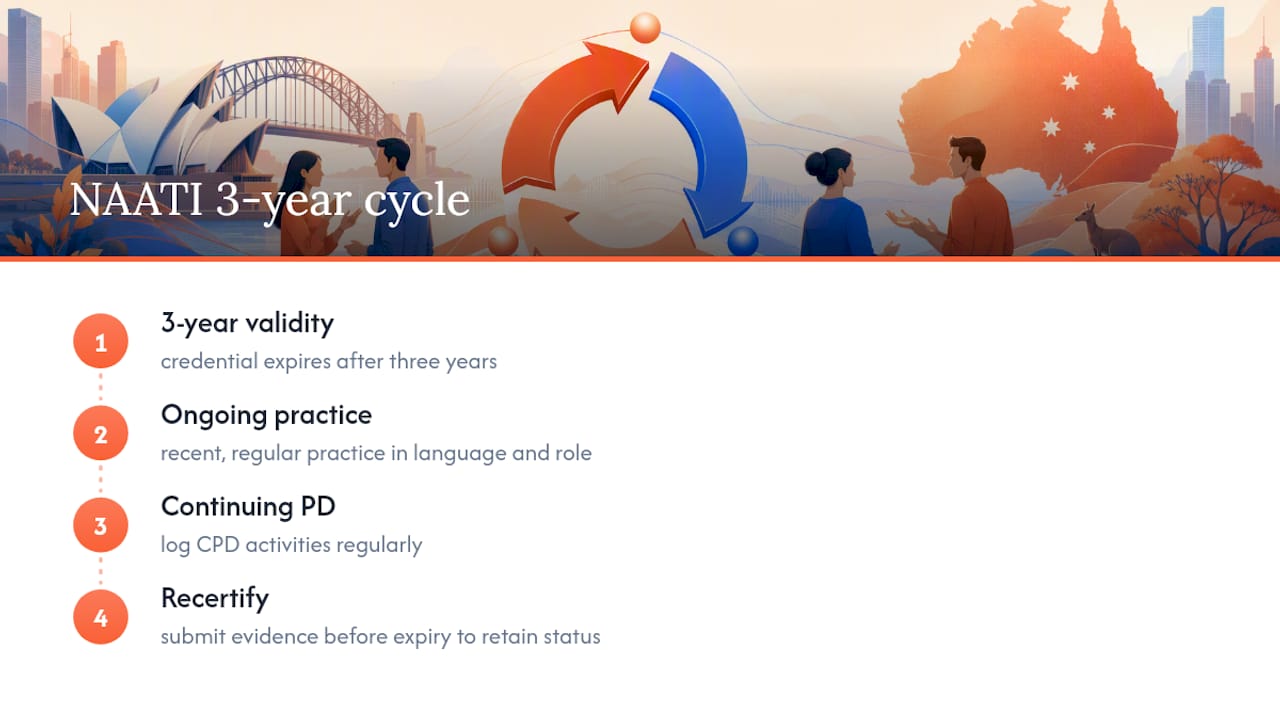
NAATI credentials issued under the current system carry a three-year validity period, after which certification lapses unless the holder recertifies. Recertification requires evidence of recent, regular practice in the credentialed language and role, plus continuing professional development.
Letting a credential expire means losing the right to describe yourself as NAATI certified until you requalify, so it pays to track renewal dates well ahead and log your practice hours and CPD activities as you go rather than scrambling in month thirty five.
What does NAATI certification cost?
Fees vary by credential and test format, and NAATI updates them periodically, so the official fees page is the only place to confirm current figures before applying. As a guide, published fee examples include Certified Translator testing, Certified Provisional Interpreter, Certified Interpreter, and recertification fees, with exact amounts detailed on NAATI’s official website.
Budget for extras too. Endorsed preparation courses, practice test packs, and any prerequisite qualification assessments add to the total cost of getting certified, on top of the test fee itself.
How do you find and verify a NAATI-certified translator or interpreter?
NAATI maintains a public directory where anyone can search by language, location, and credential type, and it’s worth checking before you hire rather than after. Immigration applications, court proceedings, medical consultations, and most legal contracts specifically require NAATI-certified translation or interpreting, not just a bilingual staff member.
- Search the NAATI directory and confirm the credential matches the task (Certified Translator versus Certified Interpreter, for instance).
- Ask for the practitioner’s NAATI number and credential expiry date.
- Confirm the language pair and specialisation match your document, especially for legal or medical content.
Where does AI fit into certified translation work?
NAATI’s own position is clear: AI is a useful tool, not a substitute for certified practitioners in high-risk contexts like legal, medical, or court settings, where a mistranslation carries real consequences. Machine tools can assist with drafting or first-pass work, similar to how mobile translation apps handle casual, low-stakes exchanges, but a certified practitioner remains responsible for accuracy, ethics, and the final result on anything official.

A practitioner’s view on what certification actually delivers
NAATI certification is often talked about as a compliance checkbox, something you need to tick before a visa office or a court will accept a document. That undersells what the credential is actually testing for.
The rubric-based assessment behind Certified Translator and Certified Interpreter credentials specifically probes ethical judgement and specialised terminology handling, not just bilingual fluency. That’s the gap between someone who speaks two languages well and someone qualified to render a birth certificate, a medical report, or a legal contract with the terminology precision an official body will accept without question.
At CertiTranslate, every certified translator on our team holds current NAATI credentials matched to the document type they’re working on, whether that’s an immigration file, a legal agreement, or a technical business contract. Documents go through terminology checks and quality assurance before delivery, which is why turnaround stays fast without cutting corners on accuracy. Readers researching what sets NAATI-certified quality control apart will find the same rigour NAATI itself demands built into every step of that process.
— David
Get your document translated by a NAATI-certified translator
If you’ve read this far because you need a document accepted by Home Affairs, a court, a university, or a business partner, the practical next step is straightforward: work with translators who hold the exact NAATI credential your situation requires. CertiTranslate is the option for readers who want that certainty without agency overheads or guesswork over which credential applies, we handle immigration, legal, business, and technical documents across more than 120 languages, matched to translators certified for that specific document type.
Every translation comes with the NAATI-certified stamp of authenticity institutions expect, backed by terminology checks and rapid turnaround so you’re not left waiting on a visa deadline. Read our complete guide to certified translation to see exactly what’s involved, then request a quote for your document and get it moving today.