


A NAATI-certified translation of a scientific research document is an English version of your original text that carries a signed certification statement, the translator’s NAATI Practitioner ID, and a NAATI stamp (digital or physical) on every translated page. That combination is what Australian authorities accept as proof the translation is accurate and complete.
Before you do anything else:
- Identify your recipient: the Department of Home Affairs, AHPRA, a university, or an ethics/regulatory body.
- Gather your original document or a notarised copy.
- Appoint a NAATI-certified translator with experience in your scientific domain.
- Confirm the translator’s listing in the NAATI public directory and record their Practitioner ID.
- Check whether your recipient accepts a digital NAATI stamp with QR code or requires a physical stamp.
Key takeaways
Validating research document authenticity in Australia requires a NAATI-certified translation with a signed statement, Practitioner ID, and stamp on every page, submitted to the correct recipient with originals or notarised copies.
| Point | Details |
|---|---|
| Certification statement essentials | Every page needs the translator’s name, NAATI Practitioner ID, credential direction, date, and signature or digital stamp. |
| Verify before you submit | Confirm the translator’s listing in the NAATI public directory and check the digital stamp QR code scans correctly. |
| Originals matter | Provide the original document or a notarised copy; AHPRA and Home Affairs do not accept extracts or partial translations. |
| Domain expertise reduces rejections | Translators with scientific background make accurate terminology choices that prevent reviewer queries and resubmissions. |
| Certitranslate | Provides NAATI-certified translators with scientific domain expertise across 120+ languages, with digital stamps and direct submission support. |
Table of Contents
- What must a NAATI-certified translation include?
- Who may certify translations in Australia?
- Step-by-step process for certifying a research document
- Why scientific content needs specialist translators
- What do key Australian recipients expect?
- What if no NAATI-certified translator exists for your language?
- How to spot a translation that will be rejected
- Why domain expertise changes the outcome
- Certitranslate: NAATI-certified translations for research documents
- Sources
What must a NAATI-certified translation include?
The certification process for research papers requires every translated document to carry a signed certification statement from a translator holding current NAATI credentials. That statement must include:
- Translator’s full printed name
- NAATI Practitioner ID (the unique number that lets recipients verify credentials)
- Credential direction (e.g. Spanish to English — Certified Translator)
- Date of certification
- Signature or NAATI digital stamp (digital stamps include a QR code; DFAT requirements specify the QR code and web address must remain legible and not be resized)
A typical certification statement reads: “I, [Full Name], NAATI Practitioner ID [XXXXXXX], Certified Translator [Language] to English, certify that this is a true and accurate translation of the original document. Date: [DD Month YYYY]. Signature: ___________”
This statement appears on every translated page, not just the cover sheet.
Pro Tip: Preserve the original document’s page numbering, headers, footers, and all figure/table labels in the translation. Recipients cross-reference these against the original; a mismatch in figure numbering is one of the most common reasons a submission is queried.
Who may certify translations in Australia?
NAATI does not provide translation services itself. It certifies individual translators and maintains an online directory where anyone can verify a practitioner’s credentials. Two credential types are relevant for document translation:
- Certified Translator: the standard credential for most submissions to Home Affairs, AHPRA, and universities.
- Recognised Practising Translator: accepted in some contexts where a full Certified Translator is unavailable for a language pair.
To verify a translator before engaging them:
- Search the NAATI directory by name or Practitioner ID.
- Confirm the credential direction matches your language pair.
- Request a sample of their digital or physical stamp.
- Ask for evidence of subject-matter experience in your scientific field (publications translated, relevant qualifications, or a domain glossary they have developed).
Some bodies, including AHPRA, may request the translator’s contact details and ask them to submit directly to the receiving body. Supply the translator’s full name, Practitioner ID, and contact email when briefing them so they are prepared for that request. For a detailed breakdown of NAATI certification benefits, that resource covers the credential types and what each unlocks for applicants.
Step-by-step process for certifying a research document
The steps for certifying academic research follow a consistent workflow regardless of whether the document is a thesis, lab report, dataset, or ethics application.
- Identify your recipient and their exact requirements. Home Affairs, AHPRA, and universities each have slightly different submission rules. Check their websites before briefing a translator.
- Prepare your originals. Provide the original document or a notarised copy. For online submissions, supply a high-resolution scan (300 dpi minimum). See the original document requirements guide for when notarisation is needed.
- Brief the translator thoroughly. Share a domain glossary, any bilingual reference materials, and the specific figures, tables, and methodology sections that carry specialised terminology. State your confidentiality requirements in writing.
- Receive the translation with signed certification on every page. Confirm the Practitioner ID, credential direction, date, and stamp are present before accepting the document.
- Verify the translator listing in the NAATI directory one final time, then submit per your recipient’s instructions.
A short briefing request you can send to a translator:
Typical turnaround for a research document of moderate length is several business days with a specialist translator. Complex technical documents with dense data tables or equations may take longer.
Pro Tip: Ask the translator to log any terminology queries alongside the translation as a separate notes document. This record is useful if a reviewer later questions a term choice, and it demonstrates due diligence to ethics committees.
Why scientific content needs specialist translators
Translating a research paper is not the same as translating a contract. NAATI’s certification system sets domain competencies that include handling scientific and technical texts, using specialist research tools, and managing complex terminology. A translator without that background will struggle with:
- Domain-specific terminology: gene nomenclature, chemical compound names, statistical methods, and clinical trial terminology do not have simple word-for-word equivalents.
- Equations and variables: symbols, subscripts, and Greek letters must be reproduced exactly; a misplaced subscript changes a result.
- Figure and table labels: axis labels, column headers, and footnotes carry scientific meaning and must match the original precisely.
- Methodology sections: passive constructions and hedged language in methods sections have specific conventions that differ between languages.
Practical steps to protect accuracy:
- Supply a bilingual glossary of key terms before translation begins.
- Provide editable source files (Word or LaTeX) rather than scanned PDFs where possible; this reduces transcription errors in equations.
- Ask the translator to flag any term where the target-language equivalent is contested or ambiguous.
Pro Tip: For academic translation best practices, including file-format recommendations and glossary templates, that resource is worth reviewing before you brief a translator on a complex manuscript.
What do key Australian recipients expect?
Each major recipient has procedural expectations that go beyond simply requiring a NAATI stamp.
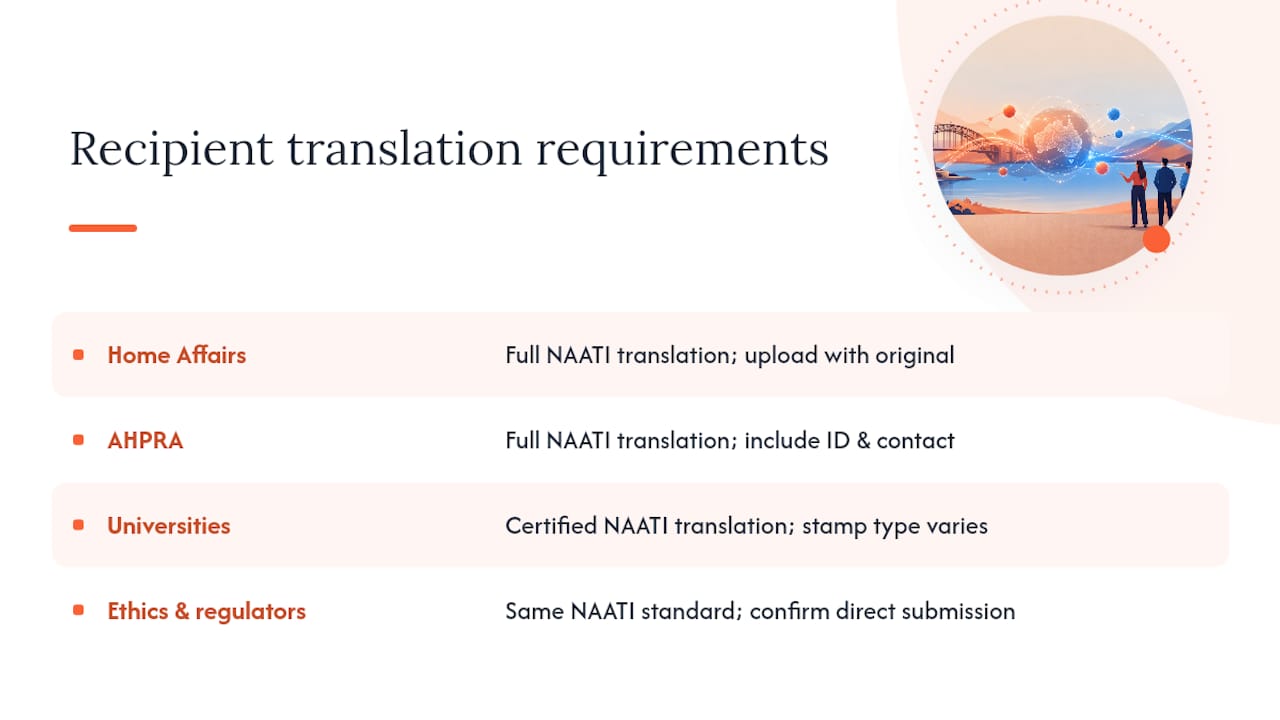
Department of Home Affairs advises agencies to engage NAATI-credentialed translators for immigration-related documents. For visa applications involving research credentials or publications, the translation must be complete, not an extract. Upload the certified translation alongside the original in the online portal.
AHPRA requires that non-English supporting documents be accompanied by a full English translation completed by a NAATI-accredited translator. Partial translations are not accepted. AHPRA may contact the translator directly to verify credentials, so supply their Practitioner ID and contact details with your application. If an initial submission is incomplete, AHPRA will request a compliant NAATI-accredited translation before processing continues.
Universities commonly require certified translations for enrolment, publication submissions, and ethics applications. Policies vary; check whether your institution accepts digital NAATI stamps or requires a physical stamp on a hardcopy.
Ethics committees and regulators generally follow the same NAATI certification standard. Ask the committee coordinator early whether they require the translator to submit directly or whether you may include the certified translation in your application package.
Ask every recipient upfront: “Do you accept a digital NAATI stamp with QR code, or do you require a physical stamp?” Getting that answer before submission saves a round trip.
What if no NAATI-certified translator exists for your language?
For less common language pairs, a Certified Translator may not be available. Acceptable fallback routes include:
- Recognised Practising Translator: a NAATI credential accepted by some bodies when a Certified Translator is unavailable.
- Translator approved by local authorities overseas: some recipients accept translations certified by an authority in the source country, provided you obtain prior approval.
- Embassy or consulate guidance: the relevant embassy may maintain a list of approved translators for their language.
- Recipient pre-approval: contact the receiving body before submitting and ask for written confirmation of an acceptable alternative route.
A short pre-approval request:
Keep the written response on file. If the submission is later queried, that correspondence demonstrates you followed an approved process.
How to spot a translation that will be rejected
Before you submit, run through this checklist:
- NAATI Practitioner ID is present and matches the NAATI directory listing.
- Digital stamp QR code scans correctly and the web address is legible (not resized to the point of being unscannable).
- Signed certification statement appears on every translated page, not just the first.
- Abstract, methods, and results sections have been compared against the original for completeness.
- All figures, tables, and footnotes are present and labelled consistently.
Red flags that almost always cause rejection:
- Translation done by a family member, friend, or unverified bilingual.
- Machine translation with no human review or NAATI certification statement.
- Missing or incomplete translator statement.
- Truncated tables or figures omitted from the translation.
- Inconsistent terminology across sections or missing units in data tables.
If a submission is rejected, request written feedback from the recipient, obtain a remedial retranslation from a NAATI-certified translator, and include your original correspondence showing you followed accepted procedures. For guidance on choosing the right certified translator to avoid these issues from the outset, that resource covers the key selection criteria.
Why domain expertise changes the outcome
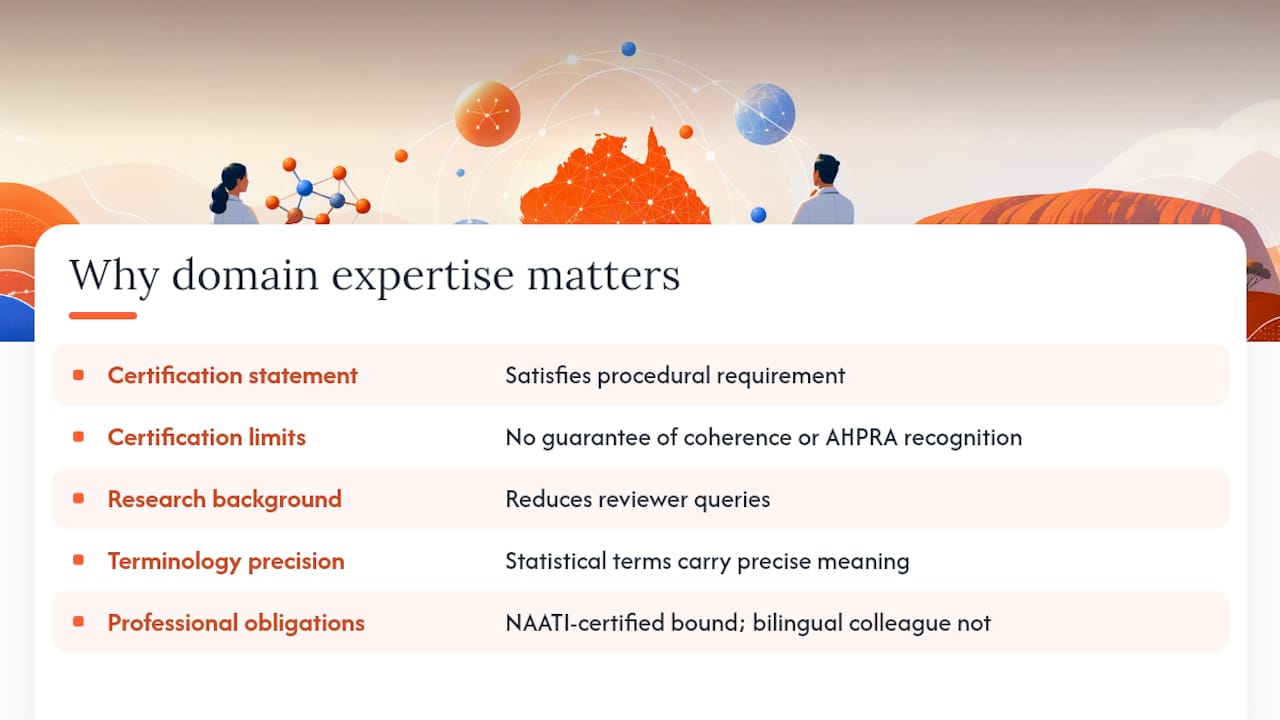
The gap between a technically compliant translation and one that actually sails through review comes down to one thing: whether the translator understands the science. A certification statement with the right Practitioner ID and stamp satisfies the procedural requirement. What it cannot guarantee, on its own, is that a reviewer reading the translated methods section will find it coherent, or that an AHPRA assessor will recognise the translated qualification as equivalent to what the original says.
Translators with a research background or specialist domain experience reduce reviewer queries because they make the right terminology choices the first time. They know that a statistical term carries a precise meaning that cannot be approximated, and that a methodology section written in the passive voice in one language does not become an active-voice summary in another. That specificity is what keeps a submission moving rather than bouncing back for clarification.
Confidentiality matters too. Research documents often contain unpublished findings, patient data, or commercially sensitive methods. A professional NAATI-certified translator operates under professional obligations; a bilingual colleague does not.
Certitranslate: NAATI-certified translations for research documents
Certitranslate connects researchers, postgraduate students, and institutions with NAATI-certified translators who hold genuine scientific domain expertise, covering over 120 languages with digital NAATI stamps accepted by Home Affairs, AHPRA, and Australian universities.
Documents covered include theses, manuscripts, datasets, ethics applications, regulatory submissions, and visa-related research credentials. Every translation includes a signed certification statement, Practitioner ID, and NAATI stamp on every page, with direct submission support available for AHPRA and Home Affairs applications. Confidentiality agreements are standard.
Turnaround is typically 3–5 business days for most research documents. To get a quote or place an order, visit the NAATI-certified translation service page or review what certified translation covers before you start.
Sources
These are the primary authoritative sources to consult before submitting a certified translation of a scientific research document in Australia:
- Frequently asked questions – NAATI
- Translating documents – AHPRA
- Language services guidelines – Department of Home Affairs (immigration)
Recommended
- Academic language translation best practices for Australia – CertiTranslate – Translations by NAATI Certified Translators
- Why original documents accompany translations: 2026 guide – CertiTranslate – Translations by NAATI Certified Translators
- What Is Certification and Why It Matters for Your Australian Visa or Citizenship Application – CertiTranslate – Translations by NAATI Certified Translators
- Notarized vs certified translation: legal guide for Australia – CertiTranslate – Translations by NAATI Certified Translators