


NAATI-certified translators are the accepted standard for almost every official purpose in Australia, from visa applications to court proceedings. Some government agencies also recognise their own approved services or translators authorised directly by the receiving authority. TIS National runs a free translating service, but it excludes visa and citizenship documents entirely. Before you pay for anything, verify the translator’s Certified Practitioner Number (CPN) and check the exact requirements of whichever agency will receive your document.
TL;DR:
- Confirm the translator’s NAATI Certified Practitioner Number and verify it using NAATI’s online credential verification tool.
- Ensure the translation includes a signed statement, the translator’s full name, date, source document, and certification stamp or digital authentication for acceptance.
- Be aware that free services like TIS National exclude visa and citizenship applications and have limited document types.
- Expect to pay based on flat fees for simple documents or per-word rates for complex or lengthy materials, with higher costs for rare languages or urgent turnaround.
- Always check the specific requirements of the receiving authority before ordering a certified translation to avoid rejection and resubmission delays.
Table of Contents
- Who can translate documents in Australia officially?
- What about TIS National, Multicultural NSW and other free services?
- What does an accepted certified translation actually need?
- Which documents usually need certified translation?
- How do you find and verify a qualified translator?
- What do certified translations typically cost and how long do they take?
- What should you check before ordering a certified translation?
- Why does Certitranslate insist on NAATI-certified translators only?
- Get a certified translation that’s accepted the first time
- Sources
Who can translate documents in Australia officially?
The National Accreditation Authority for Translators and Interpreters, known as NAATI, is Australia’s national standards and certifying body. It sets the training, ethics, and testing requirements that determine whether a translator’s work will be accepted by government departments, courts, universities, and professional registration bodies. NAATI covers a very large number of languages through a substantial network of practitioners, which means almost any language pair you need has a certified option somewhere in the country.
Certification comes in a few relevant forms:
- Certified translator — the standard credential for most official document translation.
- Recognised practitioner — a status NAATI applies to certain languages where formal certification testing isn’t yet available.
- Certified provisional translator — a newer entry pathway for translators building experience toward full certification.
Government bodies rely on these credentials because they represent a tested, auditable standard rather than a translator’s own claim of fluency. NAATI’s online directory lets you search by language and location, which is usually the fastest way to confirm someone actually holds the credential they claim.
What about TIS National, Multicultural NSW and other free services?
Not every translation needs to be paid for, but the free options are narrower than most people expect. The TIS National Free Translating Service is available to eligible visa holders and some permanent residents, and it covers personal documents that support things like employment, education, or community participation.
It explicitly excludes visa and citizenship application documents, which is exactly where most people assume it will help.
- TIS National — free, but limited to specific eligibility groups and document types.
- Multicultural NSW — a state government service covering 100+ languages, delivered through NAATI-certified translators.
- Overseas translations — sometimes accepted conditionally, but many Australian authorities will insist on a fresh NAATI-certified version regardless of what was already done abroad.
Always check the receiving authority’s own eligibility rules rather than assuming a free service applies to your situation.
What does an accepted certified translation actually need?
Authorities aren’t looking for a good translation alone. They’re checking for a specific set of formal elements that prove the document is authentic and traceable. The DFAT translation requirements guide, along with AHPRA’s own instructions, point to a consistent checklist across agencies:
- A signed statement from the translator confirming the translation is a true and accurate rendering of the original.
- The translator’s full name and their NAATI Certified Practitioner Number or official stamp.
- The date the translation was completed.
- A copy of the original source document attached to the translation.
- For legalisation purposes, a clear stamp showing the practitioner ID, certification type and language, and either a signature or the words “Digitally Authenticated by NAATI” for digital stamps.
DFAT has only accepted translations from translators credentialed under NAATI’s current certification system since 1 July 2018, so an older or unrecognised credential can cause a rejection even if the translation itself is fine.
Pro Tip: Ask for a PDF copy of the stamp page before you accept delivery. A blurry scan or a stamp missing the practitioner’s certification language can get an otherwise perfect translation bounced by DFAT or an immigration officer.
Which documents usually need certified translation?
Most people underestimate how many document types fall into this category until they’re actually preparing a submission. The usual suspects include:
- Identity documents — passports, national ID cards, driver’s licences.
- Civil records — birth certificates, marriage certificates, divorce decrees.
- Police and character checks — often required for visas and professional registration.
- Academic records — transcripts, degree certificates, professional qualifications.
- Medical records — for AHPRA registration, insurance claims, or hospital admissions.
- Legal agreements and licences — contracts, guardianship orders, business registrations.
Requirements shift between agencies even within the same category, so it pays to check the receiving agency’s own guidance before you order anything.
How do you find and verify a qualified translator?
Finding someone who claims NAATI certification is easy. Confirming it’s real takes one extra step most people skip.
- Search the NAATI online directory and filter by your language pair and location.
- Ask the translator directly for their CPN and a copy of their signed statement of accuracy.
- Run that CPN through NAATI’s Verify a Credential tool to confirm the credential is current and matches the name on the document.
- Check whether the translator is also a member of AUSIT, the Australian Institute of Interpreters and Translators, as an additional professional signpost.
Pro Tip: Save a screenshot of the NAATI verification result the same day you order. If an authority queries the translation months later, that screenshot plus the invoice and signed statement settles the question in seconds.
What do certified translations typically cost and how long do they take?
Pricing usually runs on one of two models: a flat fee for short, standard documents like birth certificates, or a per-word rate for longer material such as contracts or academic transcripts. Treat any quote as a starting estimate rather than a guarantee until the translator has actually seen the document.
Several factors push the price and turnaround up or down:
- Language rarity — less common language pairs generally cost more and take longer to source.
- Subject complexity — legal, medical, and technical terminology requires translators with matching expertise, not just a general NAATI credential.
- Certification and legalisation needs — DFAT legalisation adds extra steps and time.
- Turnaround speed — rush jobs typically carry a premium.
Get more than one quote, and treat an unusually cheap price as a warning sign rather than a bargain.
What should you check before ordering a certified translation?
Run through this before you hand over any documents or payment:
- Confirm the receiving agency’s exact translation rules, including whether NAATI certification specifically is required.
- Request the translator’s CPN and their signed statement of accuracy in writing.
- Check the stamp includes the practitioner ID, name, and certification details DFAT and other agencies expect.
- Confirm turnaround time and accepted file formats before you pay.
- Keep the invoice and any correspondence as a paper trail.
Watch for red flags: no CPN offered, an unsigned translation, vague or shifting turnaround promises, and quotes that sit well below everyone else’s.
Pro Tip: Keep the NAATI verification screenshot, the signed statement, and the invoice together in one folder. That single folder is what you’ll want if an authority ever asks you to prove the translation was legitimate.
Why does Certitranslate insist on NAATI-certified translators only?
David here. After years of watching applications stall over avoidable translation errors, my position is simple: a NAATI credential isn’t a box to tick, it’s the difference between a document an authority accepts on sight and one that bounces back weeks later with a request for resubmission.
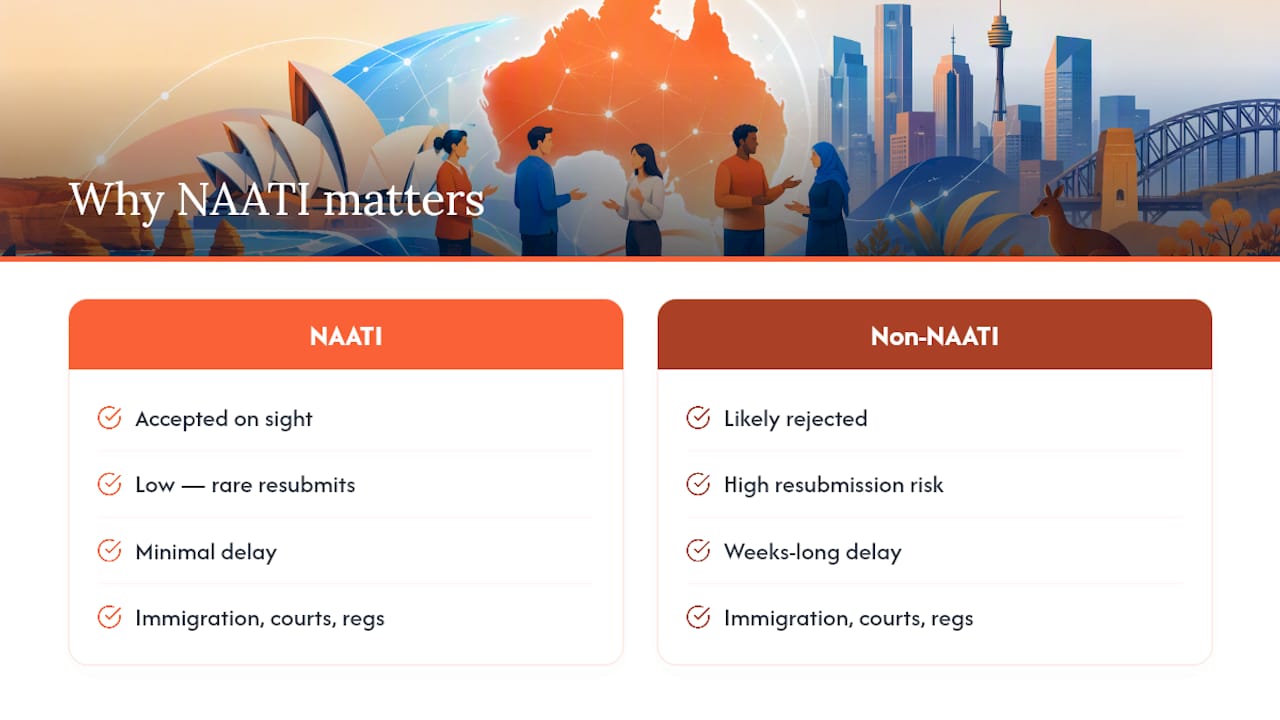
The pattern is consistent across immigration files, court documents, and professional registrations. If you’re unsure whether your document qualifies or what an agency will actually accept, get advice before you order rather than after a rejection.
— David
Get a certified translation that’s accepted the first time
Certitranslate’s advantage over piecing this together yourself is simple: every translator on the team is NAATI-certified, so you’re not left guessing whether your CPN checks out or your stamp meets DFAT’s formatting rules. Certitranslate covers immigration, legal, business, and technical documents across more than 120 languages, with translators who know the terminology specific to each field, not just the language.
Every order comes with the translator’s signed statement, verifiable credentials, and formatting built to match what Australian authorities expect, plus turnaround times that don’t leave you waiting until your deadline passes. If you’re preparing documents for a visa application, start with the immigration document translation guide to see exactly what’s required, or head straight to the NAATI certified translation service page to get a quote on your specific document today.
Sources
- NAATI – A connected community without language barriers
- TIS National Free Translating Service
- Translating documents – AHPRA
- Document Translation Services – Multicultural NSW