


A translated legal notice is a certified translation of a formal legal document, produced so the document carries the same legal effect when it’s presented to an authority that requires English. It’s not a rough conversion of meaning. It’s a matched version of the original, backed by a certification statement that tells the receiving body exactly who translated it and how.
Two names matter here. ASIC sets the practical benchmark for what Australian regulators expect from a translation. NAATI is the credentialing body whose certified translators produce work that courts, government departments, and financial institutions actually accept.
Before you submit anything, check the document for:
- The translator’s full name
- Their NAATI practitioner number
- A signed and dated certification statement
- The original document, or a certified copy, attached to the translation
Key Takeaways
A translated legal notice only carries legal weight when it pairs accurate translation with explicit NAATI certification details that the receiving authority can verify.
| Point | Details |
|---|---|
| Definition matters | A translated legal notice is a certified translation that preserves legal effect for official submission. |
| Certification beats polish | Authorities reject documents missing a NAATI practitioner number more often than for translation errors. |
| Attach the original | Keep the source document or a certified copy paired with the translation for cross-checking. |
| Translation and apostille differ | An apostille verifies signatures and seals; it does not translate language, so both may be needed. |
| Certitranslate covers the full process | NAATI-certified translators handle certification wording, originals, and turnaround across 120+ languages. |
Table of Contents
- What makes a legal notice translation different from a regular translation
- Why accuracy and certification decide legal outcomes
- How authorities verify translations and where apostilles fit in
- When do you actually need a translated legal notice?
- Do you need a certified translation, or just a translation?
- How to order a translation that actually gets accepted
- What to look for in a credible translation provider
- Where the conventional advice on this topic gets it wrong
- How Certitranslate handles your legal notice translation
- Where to check the rules yourself
- Frequently asked questions
- Sources
What makes a legal notice translation different from a regular translation
Ordinary translation aims for readable, natural-sounding text. A legal notice translation aims for something narrower: exact correspondence to the source, with no stylistic smoothing that could shift meaning. A translator working on a court summons or a regulatory notice can’t paraphrase an ambiguous clause into something clearer. They have to translate what’s actually there, including the ambiguity.
That’s why certified legal translations carry specific markers most everyday translations skip. According to industry guidance on legal translation requirements, a properly certified version includes:
- The translator’s name and NAATI practitioner number
- A signature and date
- A formal certification statement confirming accuracy and completeness
- The source document, or a certified copy of it, physically attached
Attaching the original isn’t a formality. It lets the receiving authority cross-check every line against the translation, which is exactly what a regulator or court clerk will do if anything looks off.
Pro Tip: Ask your translator to number and reference each page against the original before they send the final document. It saves a scramble later if a court registry wants to match pages one to one.
Why accuracy and certification decide legal outcomes
A single mistranslated term in a contract clause or a court notice can change what a document legally means. That’s not an exaggeration. Courts can, and do, weigh inaccurate translations against the party that submitted them, and a mistranslated deadline or condition can alter a case’s outcome entirely.

Certification is what gives a translation evidentiary weight. Without a NAATI practitioner’s credentials attached, a court or regulator has no way to verify who produced the document or whether they’re qualified to attest to its accuracy. That’s the difference between a document a judge will accept and one that gets challenged by opposing counsel.
The practical fallout from getting this wrong shows up in predictable ways: rejected ASIC lodgements, delayed visa processing, and disputes over whether a legal notice was properly served at all. None of these are edge cases. They’re the routine consequence of submitting a translation that looks fine but lacks the paperwork an authority needs to trust it.
How authorities verify translations and where apostilles fit in
ASIC’s guidance on translation of documents is explicit: if you’re lodging a non-English document with ASIC, or giving one to someone in Australia, you need a certified English translation. Crucially, ASIC draws a line between translations completed inside Australia, which must be NAATI-certified, and translations certified overseas through different verification routes.
NAATI certification isn’t a badge you take on faith. Every certified translator holds a unique practitioner number, and that number is what a regulator or court registry checks when they want to confirm the translation is legitimate.
Authorities frequently reject translations not because of a linguistic error, but because the certification is missing an explicit credential marker, most commonly the NAATI practitioner number.
Where this gets confused is apostilles. An apostille authenticates a signature, stamp, or seal on a public document for use overseas. It says nothing about language. As explained in guidance on notarisation, apostille, and certified translation, translation and legalisation are two separate processes, and depending on the receiving country or authority, you may need both.
- If the problem is “this authority can’t read the document,” you need a translation
- If the problem is “this authority needs to verify the document is genuine,” you need an apostille or notarisation
- Some cases need both, in sequence
When do you actually need a translated legal notice?
Certified translations show up across a narrower set of situations than people expect, but they’re consequential ones:
- Court proceedings — summonses, affidavits, and evidence submitted in a language other than English
- Regulatory lodgements — filings with ASIC, the ABR, or the ATO involving foreign-language corporate documents
- Immigration applications — birth certificates, marriage certificates, and identity documents for visa processing
- Bank identity checks — KYC documentation for opening accounts or verifying identity as an overseas resident or business
- Cross-border disputes — contract termination notices, debt recovery correspondence, and service of process across jurisdictions
Each of these carries its own consequence for getting the translation wrong, from a bounced ASIC filing to a stalled visa. Lexigo’s overview of common certified translation scenarios confirms this pattern holds across court, immigration, and financial contexts alike.
Do you need a certified translation, or just a translation?
The fastest way to answer this is to ask the receiving authority directly whether a certified translation is mandatory. Don’t assume a plain translation will do.
If you’re dealing with a court, a regulator, or any government body, default to “yes, get it certified” unless someone in writing tells you otherwise. The cost of over-preparing is small. The cost of a rejected filing, with a deadline attached, is not.
Watch for these signals that certification is non-negotiable:
- A fixed submission deadline is involved
- The document uses formal legal or contractual language
- It’s an identity document (birth certificate, passport, marriage certificate)
- Missing the deadline affects service of process or a legal right
Pro Tip: If you’re unsure, call the registry or department first. A five-minute phone call is cheaper than resubmitting a rejected translation two weeks before a hearing.
How to order a translation that actually gets accepted
Getting this right is mostly about sequencing. Skip a step, and you risk a rejection that costs you both time and money.
- Choose a NAATI-certified translator or service. Confirm their practitioner number before work starts, not after delivery.
- Supply the original document, or a certified copy. Attaching originals to translations is standard practice, and most authorities expect to see both together.
- Request the full certification statement. It should appear on every translated page, or as a clearly referenced cover statement, and include the translator’s name, signature, date, and practitioner number.
- Confirm whether the receiving authority also needs an apostille or notarisation. These are separate services from translation, and mixing them up costs time you may not have.
- Build in turnaround time. Rushed jobs increase the risk of a missing certification element, which is one of the most common reasons authorities send documents back.
Pro Tip: A surprising number of rejected translations are otherwise perfectly accurate. They just left off the NAATI practitioner number on the certification page. Check for that number specifically before you submit anything.
What to look for in a credible translation provider
Not every translation service is set up to handle legal notices properly. A provider worth using should have NAATI-certified translators on staff, not just access to freelancers, and experience with the specific terminology that shows up in immigration, legal, and business documents.
Before committing, ask for:
- Sample certification wording, so you know exactly what you’ll receive
- Confirmation of the assigned translator’s NAATI practitioner number
- A clear turnaround estimate for your document type
- Evidence of experience with your specific document category (visa paperwork, contracts, court filings)
A provider with NAATI-certified translators across a wide range of languages is generally better placed to handle both the terminology and the certification requirements that regulators check.
Where the conventional advice on this topic gets it wrong
Most guides on this subject focus almost entirely on language quality: find a fluent translator, get accurate wording, done. That’s necessary, but it’s not what actually causes translations to get rejected.
In practice, authorities reject far more translations for missing paperwork than for translation errors. A perfectly accurate rendering of a court summons still bounces if it’s missing the NAATI practitioner number, or if the original wasn’t attached, or if the certification statement uses vague wording instead of the specific attestation an authority expects. The linguistic work is often the easy part. The compliance scaffolding around it is where people trip up.
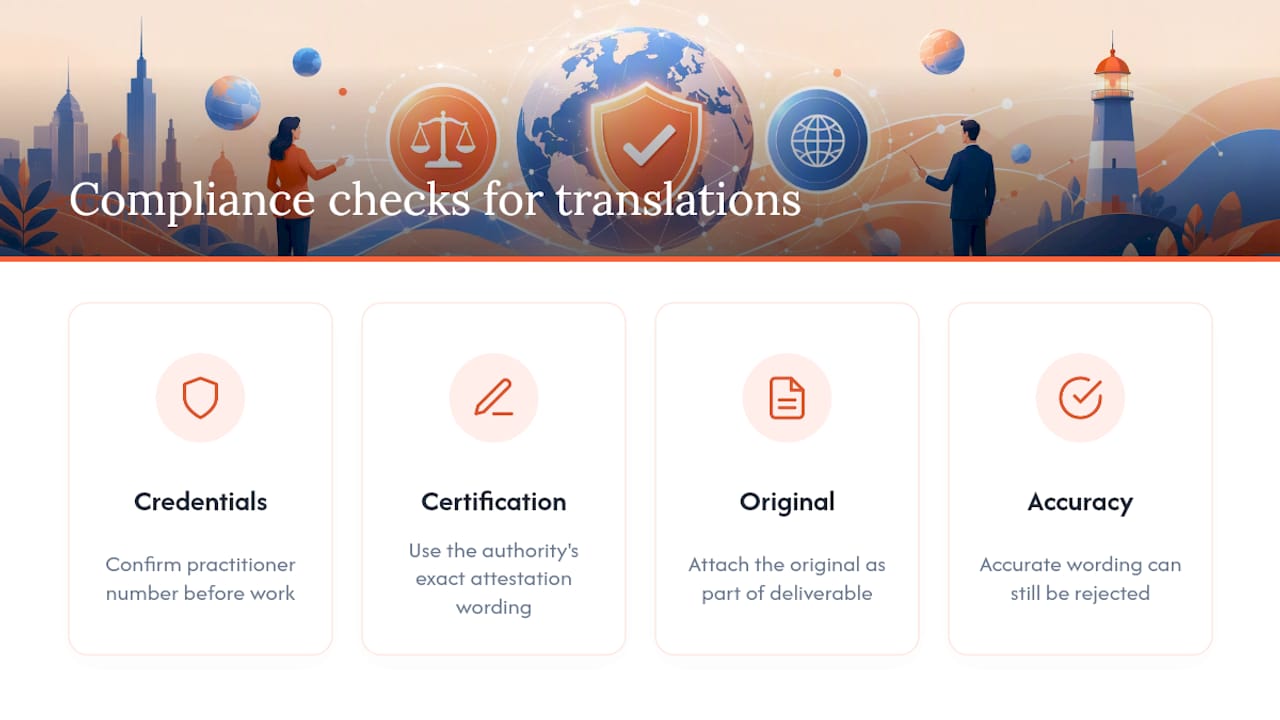
If you’re preparing a document for lodgement, I’d prioritise verification over polish. Confirm the translator’s credentials before they start work, not after you’ve paid. Ask the receiving body exactly what they need to see on the certification page. Treat the original document as part of the deliverable, not an afterthought you attach at the end.
The conventional wisdom isn’t wrong, it’s just incomplete. Accuracy matters, but it’s the paperwork around the accuracy that decides whether a court or regulator actually accepts what you’ve submitted.
How Certitranslate handles your legal notice translation
If you’ve read this far, you already know the two things that decide whether your translation gets accepted: a genuine NAATI credential, and certification wording that matches what the authority expects. Certitranslate builds its entire process around exactly those two requirements, with translators who hold current NAATI credentials and handle the specific terminology found in immigration, legal, and business documents.
Turnaround varies by document complexity, but most legal notices, court documents, and immigration paperwork move through the process quickly, with the original attached and a certification statement that names the translator, their practitioner number, and the date of completion. Certitranslate covers document types from court summonses to visa paperwork to corporate filings, across more than 120 languages.
If you need to check what certified translation actually includes before you order, this complete guide to certified translation walks through the process in full. If you’re ready to move, start by choosing your document type and requesting a quote directly through Certitranslate’s service pages.
Where to check the rules yourself
- ASIC’s guidance on translation of documents sets out certification requirements for lodgements.
- Certitranslate’s comparison of notarised and certified translation explains when apostille or notarisation applies alongside translation.
- Certitranslate’s guide to NAATI-certified translator benefits covers what the credential means in practice.
Frequently asked questions
What is a translated legal notice, in simple terms?
It’s a certified translation of a formal legal document, produced so it holds the same legal meaning and effect as the original when submitted to a court, regulator, or government body.
Does every legal document need a certified translation?
Not always, but if you’re lodging with a court, regulator, or official body, default to assuming certification is required unless the authority confirms otherwise.
Is an apostille the same as a translated legal notice?
No. An apostille authenticates a signature or seal for international use. It doesn’t translate the document, and you may need both a certified translation and an apostille for the same paperwork.
Who can certify a legal translation in Australia?
A NAATI-certified translator, whose practitioner number appears on the certification statement alongside their signature and the date of completion.
What happens if a translation is submitted without proper certification?
It’s commonly rejected or delayed, even if the language itself is accurate, because the receiving authority can’t verify who produced it or confirm their qualification to do so.
Sources
Recommended
- Why legal terminology requires a specialist translator – CertiTranslate – Translations by NAATI Certified Translators
- Notarized vs certified translation: legal guide for Australia – CertiTranslate – Translations by NAATI Certified Translators
- Types of business documents requiring translation – CertiTranslate – Translations by NAATI Certified Translators
- Role of translation in civil legal cases in Australia – CertiTranslate – Translations by NAATI Certified Translators