

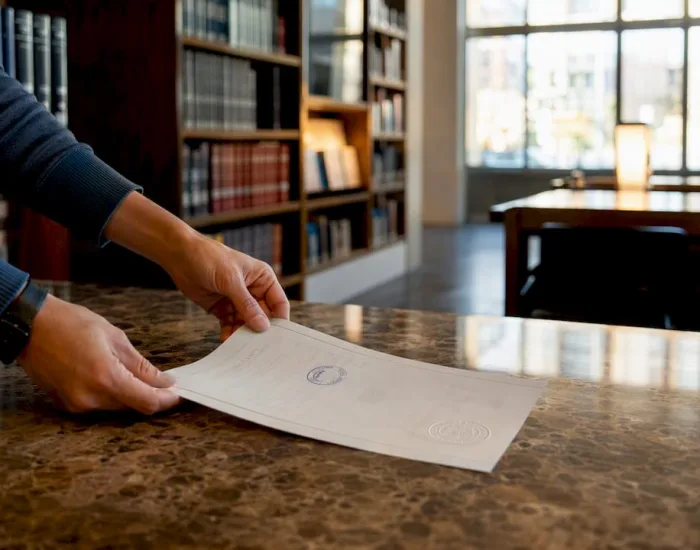
A certified translation of an academic document is a complete English version of your transcript, diploma or testamur, produced and signed off by an accredited translator, usually NAATI-certified in Australia. It is not a photocopy stamped by a JP. It carries a signed statement of accuracy, the translator’s name and accreditation number, a date, and an official stamp or seal. That’s what gets it through the door at a university, a visa office or a regulator.
Before you order anything:
- Check the recipient’s own “accepted translators” page. ANU, UNSW, AHPRA, SATAC and VTAC each publish one.
- If none is listed, default to a NAATI-certified translation.
- Never submit a partial translation or one done by a friend or relative.
Key Takeaways
A certified translation of an academic document must include a full English translation, a signed accuracy statement, translator accreditation details, and a stamp or seal to be accepted by universities, visa authorities and regulators.
| Point | Details |
|---|---|
| Definition matters | A certified translation is a full English version with a signed accuracy statement, not a stamped photocopy. |
| Translate the whole document | Extracts, summaries and partial transcripts are routinely rejected by universities and regulators. |
| Use an accepted translator | NAATI-accredited translators, the awarding institution or diplomatic missions are the main accepted sources. |
| Check the certification statement | Every translation needs the translator’s name, accreditation number, date, signature and stamp. |
| Certitranslate delivers compliant translations | NAATI-certified translators produce academic translations with the signed statement and stamp institutions expect. |
This article is general information, not a substitute for advice from a qualified lawyer. Consult a qualified legal professional about your own circumstances before acting on anything here.
Table of Contents
- Which academic documents need a certified translation?
- Who is allowed to produce the translation?
- What must the translator’s certification statement include?
- How do you prepare and submit the files?
- Why translations get rejected, and how to dodge it
- How long does it take, and what does it cost?
- When do institutional or diplomatic translations apply?
- How Certitranslate handles compliant academic translations
- Certified copy vs certified translation: what’s the actual difference?
- How do you verify a certified translation once you’ve got it?
- What if your document is in a rare language?
- What does an acceptable certification statement actually look like?
- A note from the team
- How to order a compliant translation and skip the guesswork
- Sources
Which academic documents need a certified translation?
Universities and regulators want the whole document translated, not the highlights. That covers full academic transcripts (every subject and every result, not just the pass list), diplomas and degree certificates, testamurs, parchments, and course completion letters when a recipient specifically asks for one.
Extract translations, partial transcripts, or a summary someone typed up in English are usually knocked back outright. SATAC requires results for every subject studied, not a condensed version, and university registrars apply the same logic even when it isn’t written in bold on their checklist.
- Full transcripts (all subjects, all results)
- Diplomas, degree certificates, testamurs
- Parchments and, where requested, completion letters
Pro Tip: If you’re unsure whether a page counts, translate it. Include any page carrying an official seal, stamp or signature, even if it looks like an administrative afterthought.
Who is allowed to produce the translation?
In Australia, the safest and most widely accepted option is a NAATI-accredited translator, working at Certified Translator level or above, with their accreditation number quoted on the document. That single detail settles most disputes about whether a translation counts.
Beyond that, UNSW also lists interstate multicultural language services, the awarding institution itself (issuing an official bilingual version), and Australian diplomatic missions as acceptable sources. ANU follows a near-identical list and reserves the right to reject anything that falls outside it or arrives incomplete.
Translations done overseas raise a separate question. A stamp from a “government-approved” translator in another country doesn’t automatically satisfy an Australian recipient. Some universities and regulators will still ask for NAATI verification or a notarised version once the document lands here, particularly for regulator applications through bodies like AHPRA.
- NAATI-accredited translators (Australia’s default standard)
- The awarding institution, issuing its own bilingual record
- Diplomatic missions and recognised multicultural language services
- Overseas translators, with a caveat: confirm before you pay
Always check the recipient’s current accepted-translator list before you order. Rules shift between institutions and even between faculties.
What must the translator’s certification statement include?
This is where most rejected translations fall over. The paperwork looks fine at a glance, but a line item is missing, and the whole thing bounces.
Every accepted certified translation needs a signed statement declaring the translation is complete and accurate, the translator’s printed name, their accreditation body and accreditation number or level (NAATI details, specifically, for Australian submissions), and the date the translation was completed. UNSW’s guidance spells out exactly this list, and ANU adds that the translator’s signature and date should appear on the translation itself, not just a cover letter.
Per page, expect a stamp or official imprint where the recipient requires it, plus the translator’s identifying details repeated on the cover page. On file format: submit the original-language document alongside the full English translation, as high-quality colour scans, in sequential order. A scan that cuts off a seal or blurs a signature is a common, avoidable reason for delay.
- Signed statement of accuracy (complete and accurate translation)
- Translator’s name, accreditation number/level, and date
- Stamp or seal on relevant pages
- Original document + translation submitted together, in colour
Pro Tip: Add a one-page cover note listing every file in the submission and the translator’s accreditation details. It costs you five minutes and saves a verification officer twenty.
How do you prepare and submit the files?
Work through it in order, and you’ll avoid most of the back-and-forth that eats weeks off a deadline.
- Get hold of the original document, or a certified copy of it if the original can’t leave your possession.
- Order a full certified translation from an accepted translator, not a summary or an extract.
- Confirm the translation carries the signed statement, translator details, and stamp before you accept delivery.
- Scan everything as a high-quality colour PDF, at a resolution that keeps stamps and signatures legible.
- Name files clearly, for example
SURNAME_FIRSTNAME_transcript_2026.pdf, so the recipient can match documents fast. - Where the recipient’s portal allows it, combine the original and the translation into one PDF, in the order they ask for.
On submission itself: most university and visa portals want translated documents uploaded directly, declared as translations at the point of upload. Some regulators, AHPRA among them, prefer translations sent directly by the translator or agency rather than forwarded by the applicant, specifically so they can verify accreditation independently. Keep your certified originals and the translator’s signed statement on hand regardless. Institutions frequently request a second look months into an application.
Why translations get rejected, and how to dodge it
Most rejections trace back to five repeat offenders: extract or partial translations, an unsigned translator statement, missing or unverifiable accreditation details, scans too poor to read a stamp, and translations from someone outside the recipient’s approved list, including well-meaning bilingual relatives.
Official guidance is blunt about it. AHPRA’s fact sheet states plainly that extract translations and self-translations are not acceptable, and both ANU and UNSW apply the same standard in practice even when their checklists phrase it more gently.
- Full translation ordered, not a summary
- Every page signed and stamped, not just the last one
- Accreditation number checked against the recipient’s list
- Scans rechecked in colour, at full resolution
The fix is almost always the same: reorder the full translation, have the translator correct and re-sign anything incomplete, rescan in colour, and attach proof of the translator’s accreditation alongside the document.
How long does it take, and what does it cost?
Standard turnaround for a NAATI-certified academic translation typically runs a few business days; rush options exist with most providers for tighter deadlines. Turnaround stretches for less common languages, dense technical transcripts, or scans that need cleaning up before translation can even start.
Cost bands vary by document length and language pair, generally priced per page or per document, with specialist terminology (medical, legal, engineering subjects on a transcript) pushing the fee up. Rare-language pairs tend to sit at the higher end, since fewer accredited translators cover them.
- Standard turnaround: a few business days for most common languages
- Rush turnaround: available for an extra fee, where language and volume allow
- Costs: priced per page or document, higher for rare languages or technical content
Pro Tip: Build in buffer time beyond the stated turnaround. Recipients sometimes come back asking to sight the original or query a detail, and that adds days you don’t want eating into a visa or enrolment deadline.
When do institutional or diplomatic translations apply?
Sometimes the best translation isn’t from an independent translator at all. Universities and tertiary admissions bodies including VTAC accept translations issued directly by the awarding institution, a government agency, or a recognised notary office, provided both the original-language document and the full English translation are submitted together.
Before you go this route, confirm three things with the recipient: that the translation carries an official stamp or seal, that it’s presented as a genuine bilingual document rather than a loose retype, and whether notarisation is needed on top of the institutional translation.
Recipient discretion decides this every time. A translation that satisfies one university’s admissions office might not satisfy a visa caseworker reviewing the same document a month later. Confirm before you pay for a specialised institutional translation, not after.
How Certitranslate handles compliant academic translations
Certitranslate works exclusively with NAATI-certified translators, which means every academic translation arrives with the accreditation number, signed accuracy statement and stamp that ANU, UNSW, AHPRA and SATAC all expect to see. Translators are matched to your document’s subject area, so a science transcript full of technical terminology doesn’t end up with a generic literal translation that a registrar has to query.
The process runs in a straightforward line: you submit your original documents and tell us the recipient and deadline, a suitably accredited translator is assigned, the translation goes through a quality check, and you receive the finished document with its signed certification and stamp attached, formatted the way institutions expect.
- NAATI-certified translators matched by subject expertise
- File preparation support, including cover documentation
- Fast turnaround with verification support if a recipient queries the document
- Direct delivery options where a regulator prefers translator-to-recipient submission
Certified copy vs certified translation: what’s the actual difference?
These two terms get used almost interchangeably by applicants, and that mix-up causes real delays. A certified copy is a photocopy of your original document that someone authorised, a Justice of the Peace, a solicitor, a police officer, has endorsed as a true and accurate copy of the original. It’s still in the original language. Nothing about the content has changed; only its authenticity as a copy has been verified.
A certified translation is a different animal entirely. It’s a full English version of the document, produced by an accredited translator, who then signs a statement vouching for the accuracy of the translation itself, not the authenticity of the copy underneath it. The two processes solve different problems: one proves your photocopy matches your original, the other proves your English text matches your foreign-language original.
Here’s where it gets confusing for applicants: most universities and visa authorities want both. They want a certified copy (or the original) of your foreign-language transcript, and a certified translation of that same document into English. Submit only a certified copy of a non-English transcript, and a registrar has no way to read it. Submit only a translation with no verified original or copy behind it, and there’s nothing to confirm the translation was made from a genuine document.
TIS National makes the distinction explicit in its own service rules: its Free Translating Service will translate original documents but will not accept certified copies as source material at all. That single rule trips up more applicants than almost any other requirement on this list, because it seems like a minor technicality until your submission gets bounced back for it.
How do you verify a certified translation once you’ve got it?
Before you submit anything, run your own check. It takes ten minutes and catches most of the problems recipients would otherwise flag weeks later.
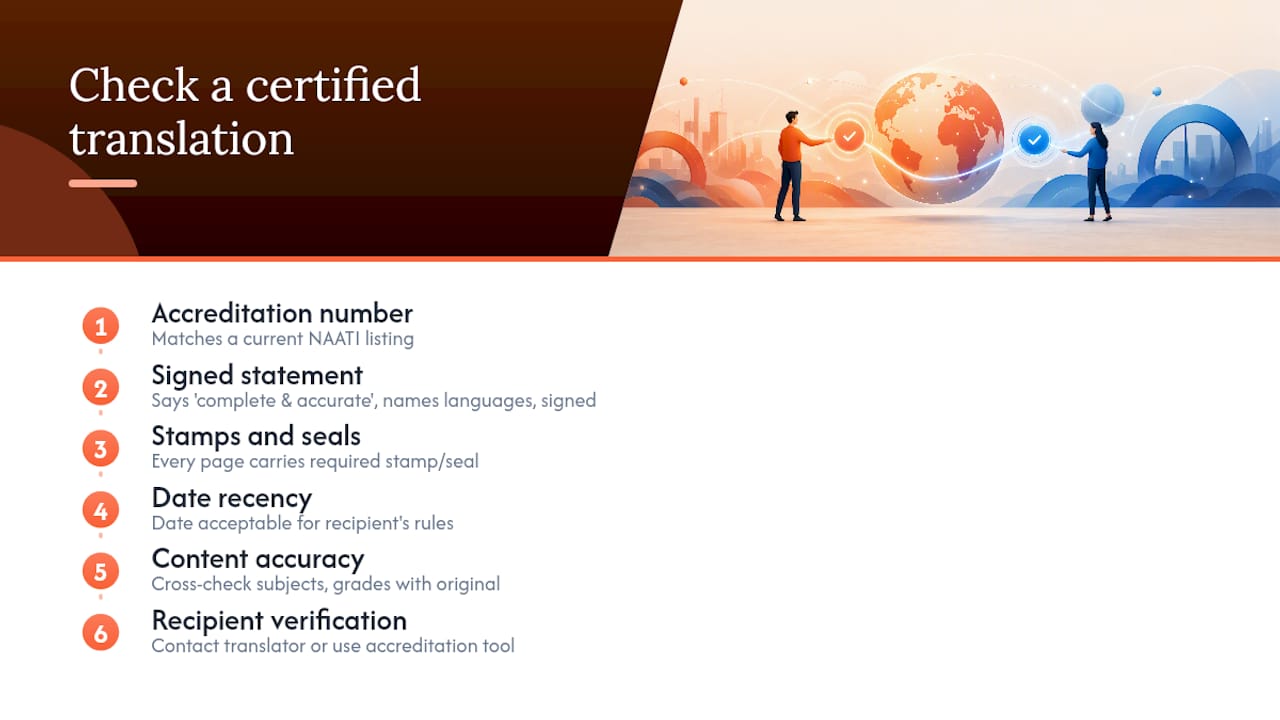
Start with the accreditation number. NAATI maintains a public register, and if a translator’s certification number doesn’t match a real, current listing, that’s a serious red flag before you go any further. Next, check the signed statement itself: does it explicitly say the translation is “complete and accurate”, does it name the source and target languages, and is it actually signed, not just typed with a name underneath?
Check every page carries the stamp or seal where the translator’s certification requires it. A single unstamped page in an otherwise correct bundle is a common reason institutions send documents back for reprocessing rather than rejecting them outright.
Confirm the date on the translation is recent enough for the recipient’s rules. Some visa categories and university intakes specify how old a translation can be before they’ll no longer accept it. Cross-check subject names and results against your original, particularly for transcripts with dozens of subject lines. A transposed grade or a misspelt subject name is a translator error worth catching before a registrar does.
Finally, if a recipient offers a verification pathway, direct contact with the translator, a reference number, an accreditation lookup tool, use it. Regulators like AHPRA specifically build in these checks so they can confirm a translation’s legitimacy independent of what the applicant hands over.
What if your document is in a rare language?
Common language pairs, Mandarin, Arabic, Hindi, Spanish, have deep pools of NAATI-accredited translators and rarely cause delays. Documents in less common languages, certain regional dialects, older Eastern European languages, some African and Pacific languages, are a different story. Fewer accredited translators cover them, which stretches turnaround time and can push costs higher.
Start by checking NAATI’s own directory for accredited practitioners in that specific language pair rather than assuming none exist. The pool is often smaller than for major languages but not empty. Where no NAATI-accredited translator is available for a genuinely rare language, recipients including ANU and UNSW will generally still accept a translation from a recognised overseas authority, an accredited translator body in the country of origin, a diplomatic mission, or the awarding institution itself, provided it meets the same certification standard: signed statement, translator credentials, date and stamp.
This is exactly the situation where checking with the recipient before ordering matters most. A translation that satisfies one university’s rare-language policy might not satisfy a different registrar or a visa caseworker reviewing the same document. Ask the specific question: for this language, given no NAATI translator is available, which alternative authorities do you accept? Get the answer in writing if you can, because verbal guidance from a call centre doesn’t help you if the document gets queried six weeks later.
What does an acceptable certification statement actually look like?
Institutions rarely publish a literal template, but the required content is consistent enough across ANU, UNSW, AHPRA and SATAC to describe precisely.
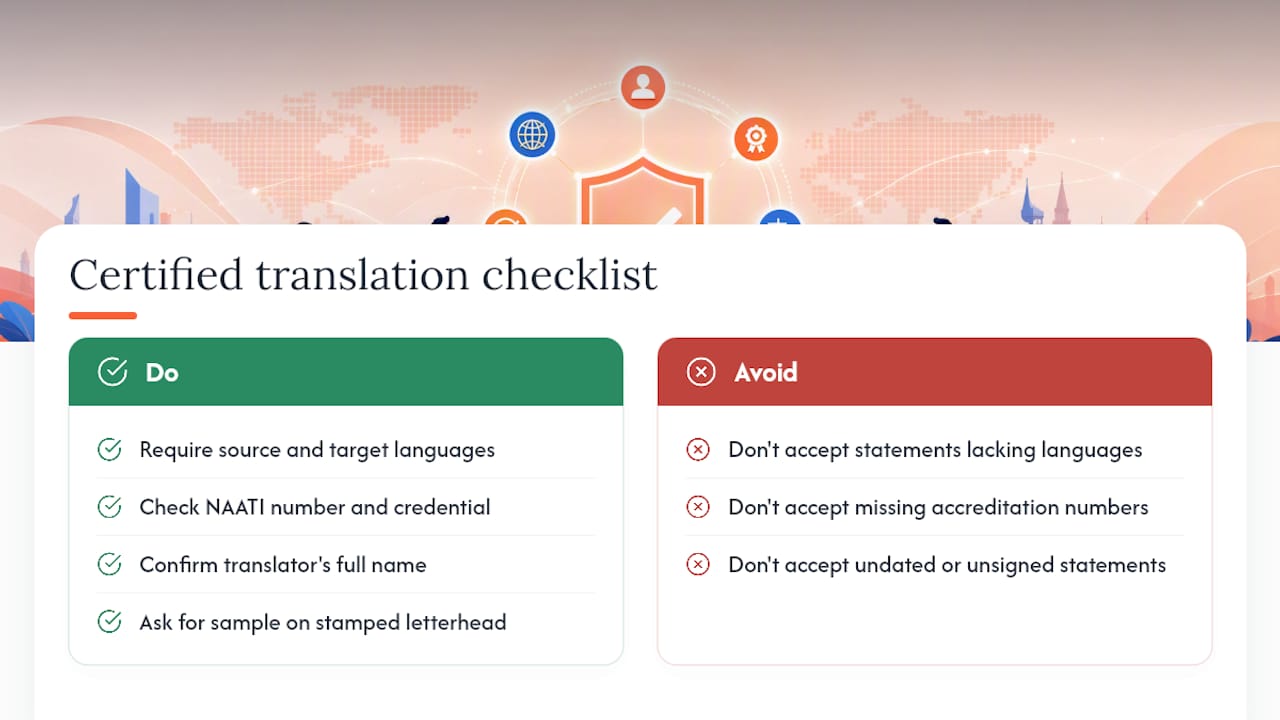
A compliant statement typically reads along these lines: “I certify that this is a true and accurate translation of the attached document from [source language] to English, to the best of my knowledge and ability.” Below that, expect the translator’s full printed name, their NAATI accreditation number and credential level (for example, Certified Translator), the language pair they’re accredited in, the date of translation, and their signature. Many translators also affix a physical or digital stamp bearing similar details: name, accreditation number, and sometimes the NAATI logo or a translation agency’s letterhead.
What separates an acceptable statement from a shaky one is specificity. “Accurate translation” with no source and target language named, no accreditation number, and no date is exactly the kind of vague certification that gets bounced by university registrars, because there’s nothing in it a verification officer can check. A statement that names the languages, cites a real accreditation number, carries a legible signature, and sits on letterhead or a stamped page gives a registrar everything they need to confirm it in minutes rather than querying it for weeks.
If you’re ordering from a translation service, ask to see a sample statement before you commit. A provider that can’t show you what the finished certification looks like is one worth being cautious about.
A note from the team
Working through university and regulator document requirements day in, day out shows you a pattern fast: the applications that sail through are the ones where the translation checklist was followed to the letter the first time, not fixed after a rejection.
How to order a compliant translation and skip the guesswork
Certitranslate is built specifically around the checklist above, not a generic translation workflow bolted on afterwards. Where a standalone freelancer might hand you a translation and leave the certification wording up to guesswork, Certitranslate builds the signed statement, accreditation number and stamp into every academic document translation as standard, matched to the exact language pair and subject terminology on your transcript.
Ordering takes three steps: request a quote through the document translation service, upload your original transcript, diploma or testamur along with the recipient’s name and your deadline, and confirm you need NAATI certification for university, visa or regulator submission. You’ll get back a full English translation carrying the signed accuracy statement, translator accreditation details and stamp, formatted the way ANU, UNSW, AHPRA and SATAC expect to see it. If you’re not sure which service level your recipient requires, the NAATI-certified translator guide walks through how to check before you order. Get a quote today and have your compliant translation in hand well ahead of your submission deadline.
Sources
- Document certification & translation — UNSW Sydney
- Documentation requirements — Australian National University
- Translating documents — AHPRA
- Free Translating Service eligibility — TIS National
- Supplying documents to SATAC — SATAC
Recommended
- Types of academic documents requiring translation – CertiTranslate – Translations by NAATI Certified Translators
- Academic language translation best practices for Australia – CertiTranslate – Translations by NAATI Certified Translators
- Why universities require certified translations: 2026 guide – CertiTranslate – Translations by NAATI Certified Translators
- Australian universities accepting certified translations: 2026 guide – CertiTranslate – Translations by NAATI Certified Translators