


Why translation is the backbone of civil justice in Australia
Translation in civil legal cases does one non-negotiable thing: it puts a non-English speaker in the same position as an English speaker before the court. Without it, a party cannot meaningfully participate in proceedings that may determine their property, family, or financial future. That is not a procedural nicety. It is the foundation of a fair hearing.
Justice Melissa Perry made this point with precision at the launch of the Recommended National Standards for Working with Interpreters in Courts and Tribunals:
The standard is deliberately low. An error does not need to have changed the result. The mere possibility is enough to invalidate a proceeding. That framing places enormous weight on translation quality in every civil matter where a party or witness has limited English proficiency.
In Australian civil proceedings, the party requiring an interpreter bears the cost of that service. Unlike most criminal matters, where the court arranges and funds interpretation, civil litigants must engage and pay for their own qualified interpreter. Courts in New South Wales, for instance, require interpreters to hold at least a Level 3 accreditation from the National Accreditation Authority for Translators and Interpreters (NAATI).
Key translation roles in Australian civil proceedings:
- Providing accurate oral interpretation of testimony and court exchanges
- Performing sight translation of written documents for non-English-speaking parties
- Certifying written translations of documentary evidence for court submission
- Maintaining impartiality regardless of which party engaged or paid for the service
- Alerting the court immediately to any conflict of interest or comprehension difficulty
- Adhering to the Court Interpreters’ Code of Conduct and NAATI ethical standards
Table of Contents
- What duties do translators actually owe in civil proceedings?
- What makes legal translation so hard to get right?
- How does translation accuracy affect procedural fairness?
- How does sight translation work in family law cases?
- How Certitranslate approaches certified translation for civil cases
- How do you become a certified legal translator in Australia?
- What technology helps translators working on civil cases?
- Certitranslate: certified legal translation ready for court
- Key takeaways
What duties do translators actually owe in civil proceedings?
Translators and interpreters working in Australian courts are officers of the court. That status carries a paramount duty of accuracy and impartiality that overrides any obligation to the party who engaged them. A solicitor who pays for an interpreter does not thereby acquire a compliant witness assistant. The interpreter’s loyalty runs to the court.
Queensland Courts and Tribunals have adopted the Recommended National Standards published by the Judicial Council on Diversity and Inclusion (JCDI), which set out the specific conduct expected of interpreters in civil and criminal matters. Under those standards, interpreters must take an oath or affirmation before commencing their role, and must immediately disclose any conflict of interest to the judicial officer rather than to counsel.
Confidentiality is equally non-negotiable. Interpreter neutrality and confidentiality are mandatory obligations under the JCCD standards, protecting the integrity of civil proceedings from the moment an interpreter is briefed through to the conclusion of the matter.
Professional duties and legal requirements for translators in civil cases:
- Take an oath or affirmation before commencing interpretation
- Interpret communications accurately, completely, and impartially
- Disclose conflicts of interest immediately to the judicial officer
- Seek clarification from the judicial officer, not from counsel or witnesses
- Correct mistakes by addressing the judicial officer directly
- Maintain strict confidentiality about all case-related information
- Hold at least NAATI Level 3 accreditation for court and tribunal work
Pro Tip: If you are a legal practitioner engaging an interpreter, brief them on the nature of the case and provide all relevant materials before the hearing. The JCDI standards require this, and an unprepared interpreter is a procedural risk.

What makes legal translation so hard to get right?
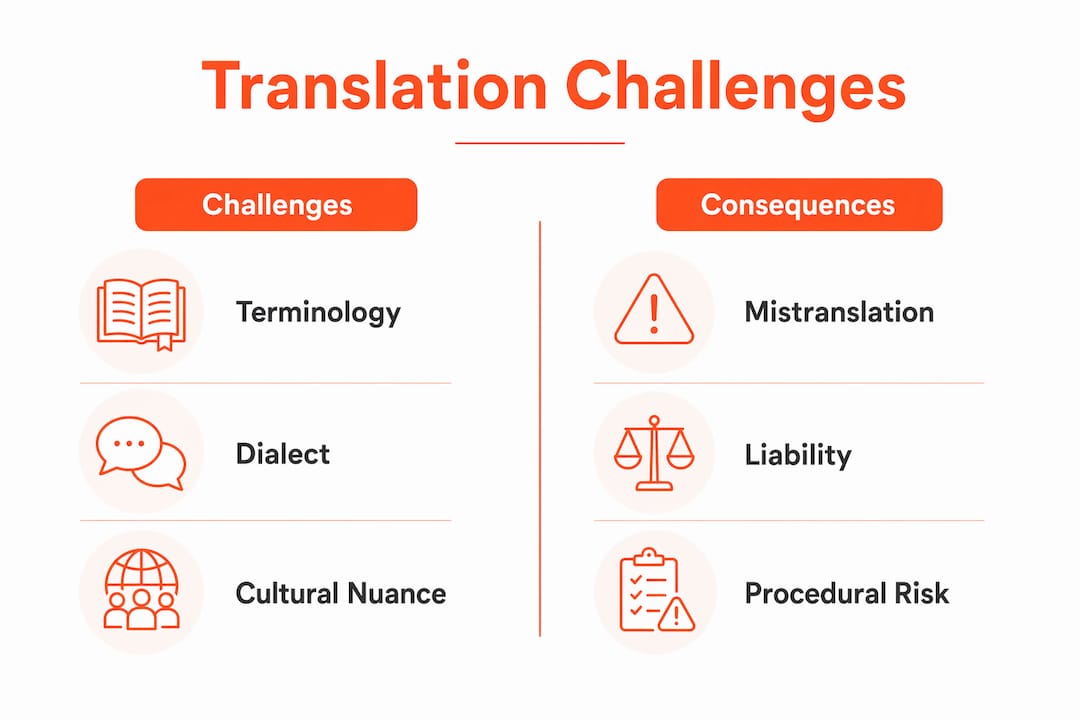
Legal translation is not simply a matter of finding equivalent words. The difficulty lies in the fact that legal systems themselves are not equivalent. A concept that exists in one jurisdiction’s civil code may have no direct counterpart in Australian law, leaving the translator to choose between a literal rendering that confuses, and a functional equivalent that may not be precise enough for evidentiary purposes.
Terminology mismatches are common. A contractual term translated without understanding its legal effect in the source jurisdiction can produce a document that reads fluently in English but carries a different legal meaning. Inaccurate translation of a contractual term has led to adverse outcomes in Australian courts, including case dismissal and significant costs for the affected party.
Dialect and cultural nuance add another layer of risk. The NSW Judicial Commission has documented a case in the Northern Territory where an Aboriginal witness used the expression “half-moon” to describe what standard English speakers call a crescent moon. Cross-examining counsel attempted to discredit the witness by pointing out there was no half-moon that night. An interpreter present intervened and clarified the dialectal meaning, preventing a serious miscarriage of justice. Without that intervention, the witness’s credibility would have been destroyed by a linguistic misunderstanding.
Using in-house staff for translation compounds these risks. Solicitors who translate evidence themselves risk creating a conflict of interest that can render that evidence inadmissible or cause proceedings to be stayed. The perception of bias alone is enough to trigger adverse procedural rulings.
Major challenges in legal translation for civil cases:
- Absence of direct legal equivalents between source and target legal systems
- Dialect and idiomatic expressions that carry different meanings across communities
- Cultural communication norms affecting how testimony is given and received
- Conflicts of interest when non-independent parties perform translations
- Variable quality among translators without specialist legal training
- Complexity of technical documents requiring simultaneous legal and linguistic expertise
| Challenge | Civil law consequence |
|---|---|
| Terminology mismatch | Mistranslated clause changes contractual liability |
| Dialect error | Witness credibility damaged by misunderstood expression |
| In-house translation | Evidence ruled inadmissible; proceedings stayed |
| Lack of NAATI accreditation | Translation rejected by court or tribunal |
| Cultural communication norms | Demeanour misread; credibility findings distorted |
How does translation accuracy affect procedural fairness?
The connection between translation quality and procedural fairness in civil cases is direct and well-established under Australian law. A party who cannot understand what is being said, or whose evidence is conveyed inaccurately, is not genuinely present in the proceeding regardless of their physical attendance.
Justice Perry’s address at the launch of the JCCD’s national standards identified the broader social cost of poor interpretation. When a non-English speaker leaves court with a negative experience, they often tell others in their community that the legal system cannot help them. That chilling effect extends well beyond the individual case.
The consequences of flawed interpretation range from adverse credibility findings against witnesses whose incoherence was caused by poor translation, through to retrials at significant public expense. A witness whose answers appear inconsistent or unresponsive may simply be the victim of incompetent interpretation. Courts have recognised this risk explicitly, noting that resting credit findings on poorly interpreted answers fails to take advantage of the opportunity to actually assess the witness.
Certified translation with proper NAATI accreditation is the primary safeguard against these outcomes. Accreditation signals adherence to recognised national standards and ethical codes, giving courts a basis for confidence in the accuracy of the translated material.
How does sight translation work in family law cases?
Sight translation is a specific technique where a translator reads a written document and renders it orally in another language in real time. In family law proceedings, it is used routinely to convey the content of affidavits, parenting plans, property settlement documents, and court orders to clients who cannot read English.
The use of sight translation in family law is particularly demanding because the documents are often lengthy, emotionally charged, and legally technical. A translator performing sight translation of a parenting affidavit must simultaneously process written English, produce accurate oral output in the target language, and remain alert to terms that require explanation rather than literal translation.
Client vulnerability is a constant consideration. Family law clients are frequently in acute distress, and a translation error that misrepresents the terms of a parenting order or a property settlement can have lasting consequences for the client’s understanding of their rights and obligations.
| Document type | Sight translation considerations |
|---|---|
| Affidavits | Length and emotional content require preparation time |
| Parenting orders | Legal terms must be rendered functionally, not literally |
| Property settlement agreements | Financial and legal terminology requires specialist knowledge |
| Court orders | Precision is critical; ambiguity can affect compliance |
Best practices for sight translation in family law:
- Provide the interpreter with documents in advance wherever possible
- Avoid requiring sight translation of long or complex documents without notice
- Allow the interpreter adequate preparation time before the hearing
- Use plain English in court to reduce the interpreter’s cognitive load
- Ensure the interpreter is briefed on the cultural background of the client
- Confirm the client’s comprehension after each translated segment
How Certitranslate approaches certified translation for civil cases
NAATI certification is the standard Australian courts and tribunals rely on to assess whether a translated document is trustworthy. Certified translations submitted to courts must be accompanied by an affidavit and a certification of accuracy by the translator, including their NAATI credentials. Without those elements, a translation is unlikely to be accepted as evidence.
Certitranslate’s team of NAATI-certified translators works specifically with legal terminology, which means the translators understand not just the words but the legal effect of the documents they handle. That distinction matters in civil cases where a single mistranslated clause can alter the meaning of a contract or an affidavit.
The service covers the full range of documents that appear in civil proceedings: contracts, affidavits, corporate records, property documents, and correspondence. Each translation is accompanied by a signed certification of accuracy and the translator’s NAATI credentials, meeting the requirements for court and tribunal submission across Australian jurisdictions.
Key advantages Certitranslate offers for civil legal matters:
- NAATI-certified translators with specialist legal terminology knowledge
- Affidavit and certification of accuracy provided with every translation
- Fast turnaround suited to court deadlines and filing requirements
- Strict impartiality and confidentiality protocols aligned with court standards
- Coverage of all document types commonly encountered in civil proceedings
- Translations accepted by Australian courts, tribunals, and government bodies
Pro Tip: When briefing a translator for a civil matter, provide the full document set and any relevant background on the legal system of the source country. A translator who understands the source jurisdiction’s legal framework will produce a more accurate and court-ready translation.
How do you become a certified legal translator in Australia?
NAATI is the national body responsible for accrediting translators and interpreters in Australia. Accreditation is not automatic for bilingual speakers. Candidates must pass a rigorous assessment that tests their ability to translate accurately between languages at a professional standard, with specific attention to the conventions and terminology of the relevant domain.
For court work, the minimum requirement is NAATI Certified Translator status, which corresponds to what was previously called Level 3 accreditation. Translators working in legal settings are expected to maintain their skills through continuing professional development, and NAATI requires credential holders to demonstrate ongoing competency to retain their certification.
Specialist legal translation training is available through university programmes in Australia, including postgraduate courses in translation and interpreting offered by institutions such as Macquarie University and Monash University. These programmes cover legal terminology, court procedure, and the ethical obligations that apply when translating for legal purposes. Graduates who then pass the NAATI assessment are equipped to work across civil, criminal, and administrative proceedings.
The bilingual support services available to legal professionals extend beyond court interpreting to include document translation, certified translation for evidentiary purposes, and consultation on cross-cultural communication. Understanding the full range of these services helps legal practitioners match the right type of support to each stage of a civil matter.
What technology helps translators working on civil cases?
Technology has changed the workflow of legal translation without replacing the judgement that makes it reliable. Computer-assisted translation (CAT) tools such as SDL Trados and memoQ allow translators to build and maintain glossaries of legal terminology, ensuring consistency across long documents and across multiple matters for the same client. A contract translated today draws on the same term choices as the affidavit translated last month, reducing the risk of inconsistency that courts notice.
Machine translation has improved substantially, but it remains unsuitable as a standalone tool for legal documents. The risk of a plausible-sounding but legally incorrect output is too high in a context where a single word can change the meaning of a liability clause. Experienced legal translators use machine translation as a drafting aid, not as a finished product, and always review output against the source document.
Back-translation is a quality assurance technique worth knowing. A second independent translator translates the document back into the source language, and the result is compared with the original to identify discrepancies. In contested civil cases where the accuracy of a translated document is itself in dispute, back-translation provides an objective check that courts find persuasive.
Plain language drafting tools also play a role. The NSW Judicial Commission has noted that plain English combined with professional interpreting reduces communication failures in court. When source documents are drafted clearly, the translator’s task is simpler and the risk of error falls.
Certitranslate: certified legal translation ready for court
Civil proceedings move on tight deadlines. A translation that arrives late, lacks the required certification, or contains a terminology error can derail a filing, delay a hearing, or compromise a party’s position entirely.
Certitranslate provides NAATI-certified translation for civil legal matters across Australia, with every document accompanied by a signed affidavit and certification of accuracy that meets court and tribunal requirements. The focus is on legal documents: contracts, affidavits, corporate records, property agreements, and correspondence. Turnaround is fast enough to meet court filing windows without sacrificing the accuracy that legal proceedings demand.
For legal practitioners who need certified translation services that are court-ready from the moment they arrive, Certitranslate is the practical choice. Get a quote today at certitranslate.com and have your documents translated by a NAATI-certified specialist who understands what Australian courts actually require.
Key takeaways
Accurate, certified translation is the single most important safeguard against procedural unfairness for non-English speakers in Australian civil proceedings.
| Point | Details |
|---|---|
| Procedural fairness threshold | An error need only have the potential to affect an outcome to constitute a denial of procedural fairness. |
| Payment responsibility | In civil proceedings, the party requiring an interpreter bears the cost of that service. |
| NAATI accreditation | Court interpreters must hold at least NAATI Level 3 accreditation; translated documents require NAATI-certified translator credentials and an affidavit. |
| Conflict of interest risk | In-house or solicitor-conducted translations risk inadmissibility and adverse procedural rulings. |
| Certitranslate | Provides NAATI-certified legal translation with affidavit and certification of accuracy, accepted by Australian courts and tribunals. |
Recommended
- Notarized vs certified translation: legal guide for Australia – CertiTranslate – Translations by NAATI Certified Translators
- Why original documents accompany translations: 2026 guide – CertiTranslate – Translations by NAATI Certified Translators
- How legal contract translation works: a complete guide – CertiTranslate – Translations by NAATI Certified Translators
- Why legal terminology requires a specialist translator – CertiTranslate – Translations by NAATI Certified Translators