


Why certified translation is essential in Australian inheritance proceedings
When a foreign will or death certificate lands in an Australian probate registry, the court cannot simply take it at face value. Every document written in a language other than English must be translated by a NAATI-accredited translator before it carries any legal weight. That is not a formality. It is a hard requirement, and missing it can bring an entire estate administration to a halt.
The role of certified translation in inheritance matters comes down to one thing: legal recognition. Australian courts need to know that what they are reading is an accurate, complete rendering of the original document, not a rough summary or a well-meaning attempt by a bilingual family member. A certified translation carries a formal declaration from a qualified translator attesting to its accuracy, and that declaration is what gives the document standing as evidence.
NAATI, the National Accreditation Authority for Translators and Interpreters, sets the professional standard that Australian courts and government agencies rely on. A translation produced by a NAATI-certified translator meets the evidentiary threshold required by probate registries across every state and territory. Without that accreditation, informal translations are rejected outright, regardless of how accurate they might actually be.
Certified translation in inheritance proceedings serves several distinct functions:
- Legal validity: Gives foreign documents the standing required for court acceptance in probate applications.
- Dispute prevention: A precise, certified translation reduces the risk of beneficiaries or creditors challenging the meaning of key terms.
- Asset recognition: Courts and financial institutions can only act on assets they can clearly identify; ambiguous translations create gaps.
- Compliance with evidence law: Foreign death certificates must meet the standards of the Foreign Evidence Act 1994 (Cth) or Hague Convention requirements depending on where the document originated.
- Probate registry requirements: The Supreme Court in each state requires certified translations to accompany original foreign documents in every probate filing.
Which inheritance documents need certified translation in Australia?
Not every piece of paper in an estate file needs to go through a certified translator, but the documents that carry legal or financial weight almost always do. The distinction matters because unnecessary translations add cost, while missing a required one can invalidate a filing.

Foreign-issued death certificates are the most common document requiring certified translation in Australian probate proceedings. Without an accurate English version, the court cannot confirm the deceased’s identity, date of death, or place of death, all of which are foundational to granting probate.
The following documents typically require certified translation when they originate from a non-English-speaking country:
- Foreign wills and codicils: The original document remains the authoritative legal instrument; the certified translation of a will serves as an interpretive aid for the court.
- Death certificates: Mandatory for probate applications where the deceased died outside Australia.
- Property deeds and title documents: Required when the estate includes real property held overseas or registered in another language.
- Probate grants from foreign jurisdictions: If probate was granted in another country, that grant may need translation before Australian courts will recognise it.
- Marriage and birth certificates: Relevant when establishing the identity of beneficiaries or the validity of a spousal claim.
- Powers of attorney: Where an executor or administrator was appointed under a foreign instrument.
- Financial account statements or asset registers: Needed when overseas financial institutions require proof of entitlement in English.
Translation is mandatory wherever the document forms part of the formal probate application. It becomes optional only for supporting correspondence or background materials that the court does not need to rely on as evidence. When in doubt, translate. Submitting an uncertified document and having it rejected costs far more time than getting the translation done correctly from the start.
Pro Tip: If you are working with a wills and estates lawyer, ask them to review the full document list before you commission any translations. A specialist firm like Elamine Lawyers can identify exactly which documents the registry will require, saving you from translating materials that are not needed.
Why accuracy and certification standards matter in inheritance cases
A mistranslated word in a will can redirect an entire estate. That is not an exaggeration. In the 2015 New South Wales Supreme Court case Gordon Salier v Robert Angius, the court found that the translation annexed to the grant of letters of administration was “somewhat misleading,” and the court had to go behind it to determine the correct meaning of the original Italian document. The case turned on the interpretation of specific property gifts, and the quality of the translation was central to the dispute.

Inaccurate translation of inheritance documents risks estate disputes or outright rejection by Australian courts. Misinterpretation of terms like beneficiary categories or asset definitions can create legal complications that take months and significant legal fees to resolve. The original foreign will remains the authoritative document; the translation is what allows the court to understand it. If that translation is wrong, the court’s understanding is wrong.
Australian courts hold translations to a formal standard. The translator must be NAATI-certified, the translation must be complete (not summarised), and it must be accompanied by a signed declaration confirming accuracy. Court registries may reject documents with ambiguous phrasing or lacking formal certification, regardless of how well-intentioned the translator was.
Pro Tip: Before submitting any translated document to a probate registry, verify that the translator’s NAATI credentials are current and that their declaration includes their full name, accreditation number, language pair, and a statement that the translation is true and accurate to the best of their knowledge. Missing any of these elements can trigger a rejection.
How to obtain certified translation services for inheritance documents
The process is straightforward when you know what to prepare. Getting it wrong, or starting too late, is where most delays occur.
Processing overseas assets and foreign wills can take weeks or months due to document scrutiny and compliance checks. Executors who leave translation to the last minute often find themselves holding up the entire probate application while waiting for certified translations to come through.
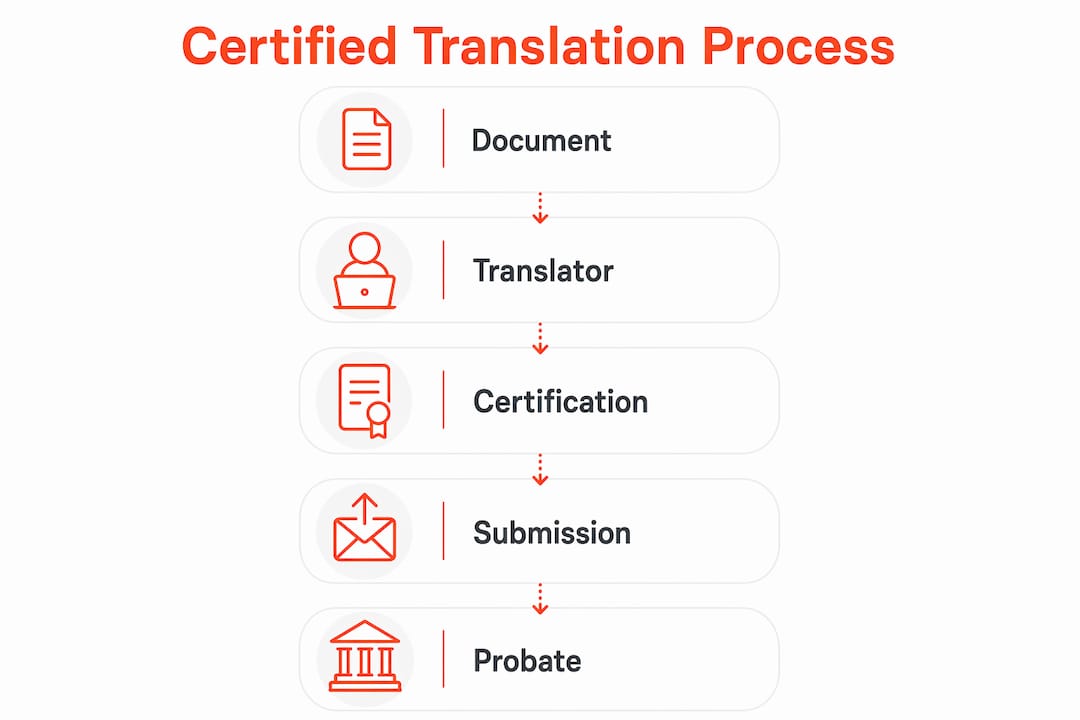
Follow these steps to get certified translations right:
- Identify all documents requiring translation before engaging a translator. Work through the full probate checklist for your state’s Supreme Court.
- Engage a NAATI-certified translator with demonstrated experience in legal and inheritance documents. General translators may not be familiar with probate-specific terminology.
- Provide the original documents, not photocopies, wherever possible. Where originals are unavailable, confirm with the translator and the court registry what copies are acceptable.
- Request a full translation, not a summary. Courts require the complete document to be translated, including headings, signatures, and any stamps or official notations.
- Confirm the certification format your state’s probate registry requires. Some registries want a separate affidavit; others accept a declaration on the translated document itself.
- Allow adequate lead time. Legal experts advise starting early with certified translations to allow time for verification, notarisation, and meeting court deadlines.
Certified translations of foreign wills typically include the full document translation, a certification by a NAATI-accredited translator, and a declaration confirming translation accuracy. Executors or heirs should submit certified translations alongside original wills, death certificates, and affidavits to the Supreme Court Probate Registry.
Pro Tip: Commission translations as soon as you have confirmed which documents the estate requires. If the original documents are held overseas, request certified copies from the issuing authority at the same time you begin the translation process. Running both in parallel cuts weeks off the timeline.
How Certitranslate supports inheritance matters in Australia
Certitranslate’s team of NAATI-certified translators handles the full range of inheritance-related documents, from foreign wills and death certificates to property deeds and powers of attorney. Every translation meets the evidentiary standards required by Australian probate registries, with the formal declaration and certification that courts expect.
Certified translations for wills and legal documents from Certitranslate include industry-specific legal terminology accuracy, which matters enormously when a single word can determine who inherits what. The service is built for executors, heirs, and legal professionals who need documents processed correctly and without unnecessary back-and-forth with the registry.
Specific advantages Certitranslate provides for inheritance matters:
- NAATI accreditation: Every translator holds current NAATI credentials, satisfying the evidentiary standard required by all Australian state and territory courts.
- Legal terminology accuracy: Translators with experience in inheritance and probate documents understand the difference between terms that look similar but carry distinct legal meanings.
- Acceptance guarantee: Translations are prepared to meet court and government agency requirements, reducing the risk of rejection.
- Fast turnaround: Inheritance proceedings are time-sensitive; Certitranslate’s process is designed to meet tight deadlines without sacrificing accuracy.
- Complete certification package: Each translation includes the signed declaration and certification details that probate registries require.
Certitranslate: certified translations for Australian inheritance proceedings
Dealing with a foreign will or estate documents in another language is stressful enough without having to worry about whether your translation will hold up in court. Certitranslate removes that uncertainty. Every translation is handled by a NAATI-certified translator with legal document experience, and every document comes with the formal certification that Australian probate registries require.
Where a general translation service hands you a document and wishes you luck, Certitranslate delivers a court-ready package. That means the full translation, the signed declaration, and the accreditation details, all formatted to meet the requirements of your state’s Supreme Court Probate Registry. For executors managing complex estates with overseas assets, that difference in preparation can save weeks of back-and-forth. Get a quote for your certified inheritance document translation and have your documents court-ready without the guesswork.
Key takeaways
Certified translation by a NAATI-accredited translator is a legal requirement for foreign inheritance documents in Australian probate proceedings, and missing it risks rejection, delays, and estate disputes.
| Point | Details |
|---|---|
| NAATI accreditation is mandatory | Australian courts require translations by NAATI-certified translators to meet evidentiary standards in probate applications. |
| Original document stays authoritative | The foreign will remains the legal instrument; the certified translation serves as the court’s interpretive aid, not a replacement. |
| Start translations early | Processing overseas assets can take weeks or months; commissioning translations at the outset avoids holding up the entire probate application. |
| Accuracy prevents disputes | Mistranslated terms like beneficiary categories or asset definitions can trigger estate disputes or outright rejection by the probate registry. |
| Certitranslate for inheritance documents | Certitranslate provides NAATI-certified, court-ready translations of wills, death certificates, and property deeds for Australian inheritance proceedings. |
Recommended
- Translate a will or testament: certified guide – CertiTranslate – Translations by NAATI Certified Translators
- Notarized vs certified translation: legal guide for Australia – CertiTranslate – Translations by NAATI Certified Translators
- Certified guardianship document translation: a complete guide – CertiTranslate – Translations by NAATI Certified Translators
- What is certified translation: a complete guide – CertiTranslate – Translations by NAATI Certified Translators