


In Australia, a government-accepted immigration translation is one completed by a NAATI-certified translator, full stop. The Department of Home Affairs, DFAT, and most other federal agencies will not accept translations from uncredentialled providers, regardless of how accurate the work appears.
Here is what every accepted translation must include:
- The translator’s full name and NAATI credential number
- The translator’s signature and NAATI stamp (physical or digital, depending on the agency)
- A declaration that the translation is accurate and complete
- The date the translation was completed
- The original foreign-language document submitted alongside the translation
A certified translation is not the same as a notarised one. Notarisation involves a Notary Public witnessing and authenticating a document’s legitimacy, whereas certification confirms the translation itself is accurate. For Australian immigration purposes, you need certification by a NAATI-accredited translator, not notarisation, unless DFAT legalisation is also required for use overseas.
Who qualifies for the free TIS National translating service?
TIS National provides a free translating service to permanent residents and eligible visa holders for up to 10 personal documents. This is a genuine government-funded service, not a commercial offering, and it covers a defined set of circumstances.
Eligible groups include:
- Permanent residents of Australia
- Holders of certain temporary humanitarian visas
- Applicants sponsored by eligible community organisations in some cases
To apply, follow these steps:
- Confirm your visa or residency status meets TIS National’s eligibility criteria.
- Gather the original documents you need translated (originals or certified copies).
- Contact TIS National directly to request the service and specify your language pair.
- Submit your documents through the process TIS National outlines, either by post or through an approved service centre.
- Await confirmation and collection or delivery of the completed translation.
The free service covers personal documents related to settlement, not commercial or business records. Documents beyond the 10-document limit, or those outside the eligible categories, will require a paid certified translation from a NAATI-accredited provider.
Which documents qualify for official immigration translation?
Not every document you own needs a certified translation for immigration purposes. The Department of Home Affairs focuses on documents that establish identity, status, and eligibility.
- Birth certificates: Required for identity verification in visa and citizenship applications.
- Marriage and divorce certificates: Needed to establish family relationships or change of name.
- Police clearance certificates: Mandatory for character assessments in most visa categories.
- Passports and national identity cards: Translated when pages contain non-English information relevant to the application.
- Academic transcripts and qualifications: Required for skilled migration and student visa applications.
- Medical records: Relevant to health requirement assessments.
- Court documents and legal records: Necessary for character and background checks.
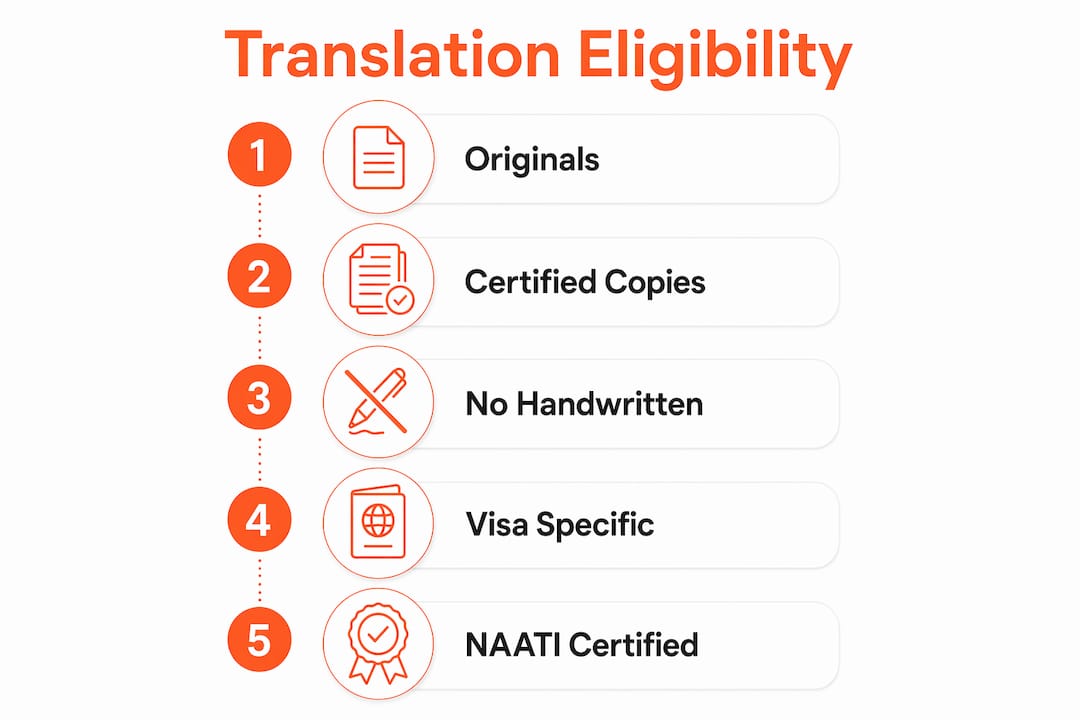
Documents must be originals or certified copies. Handwritten documents and those in non-Latin scripts (Arabic, Chinese, Cyrillic, and others) are accepted, provided the NAATI translator is credentialled in that specific language pair. Translations must never alter or obscure official seals or stamps on source documents; any clarification should appear in brackets within the translated text, leaving the original marks intact.
Pro Tip: Check the visa documents list for your specific visa subclass before ordering translations. Some categories require documents others do not, and ordering unnecessary translations wastes both time and money.
How to apply for certified document translation in Australia
The process differs slightly depending on whether you use TIS National, a private NAATI-certified provider, or a state-based service such as Service NSW.
- Identify the documents required for your specific visa or immigration application by checking the Department of Home Affairs checklist for your visa subclass.
- Confirm the translator’s NAATI credentials before engaging anyone. Search the NAATI online register using the translator’s credential number to verify their current certification status.
- Prepare originals or certified copies of every document. Most agencies require the original to accompany the translation when submitted.
- Provide proof of identity if the service provider or agency requires it, particularly for in-person submissions at service centres.
- Submit documents either by post, in person at an approved centre (such as a Service NSW location), or via a certified online translation service.
- Retain copies of both the original documents and the completed translations before submitting anything to a government agency.
For DFAT legalisation specifically, the translator must include their NAATI seal and signature on every page, alongside certified copies of the original documents.
Fees, turnaround times, and when translations are free

Certified translation fees in Australia vary by provider, language pair, document length, and urgency. TIS National’s free service covers eligible residents up to the 10-document limit. Beyond that, paid services apply.
| Service type | Typical turnaround | Cost indication |
|---|---|---|
| Standard certified translation | 2–5 business days | Varies by page count and language |
| Express certified translation | 24–48 hours | Higher than standard rate |
| TIS National free service | Varies | Free for eligible residents (up to 10 documents) |
| DFAT legalisation (apostille) | Varies by office | Government fee applies; check Smartraveller |
Tips to avoid delays and cost surprises:
- Order translations well before your visa application deadline. Express fees add up quickly.
- Confirm whether your receiving agency requires a physical NAATI stamp or accepts a digital one. Getting this wrong means reordering.
- Ask for a quote based on word count or page count upfront, not a flat rate, so there are no surprises for longer documents.
Why NAATI certification is the gold standard for government-approved translations
NAATI is Australia’s national authority for translator and interpreter credentialling, and its endorsement by government agencies is not incidental. The Certified Translator credential is the primary standard for immigration document translation, requiring candidates to pass rigorous testing and undertake periodic recertification to maintain their standing.
From 1 july 2018, DFAT only accepts translations completed under current NAATI certification standards. Older accreditations, including those granted under previous systems, are no longer valid for government submissions. This means a translator who was credentialled years ago but has not recertified may produce a translation that gets rejected outright.
Pro Tip: Before submitting to DFAT or the Department of Home Affairs, ask your translator for their current NAATI credential number and verify it on the NAATI register. A few minutes of checking can prevent weeks of delays.
Common mistakes to avoid with immigration translations
The most frequent reason a certified immigration document gets rejected is a missing or incorrect translator credential. Submitting a translation without the NAATI stamp, credential number, or signed declaration is the single fastest way to have your application delayed.
Other mistakes worth knowing: submitting a photocopy of the translation rather than the original certified copy; using a translator credentialled in a different language pair than the one your document requires; and failing to include the original foreign-language document alongside the translation. Some applicants also assume that a translation done overseas by a qualified translator in another country will be accepted in Australia. It generally will not. Australian government agencies require NAATI-certified translators specifically.
What to do if your translation is rejected
A rejected translation does not mean your application is over. The Department of Home Affairs or the relevant agency will typically advise the reason for rejection in writing.
Start by identifying the specific problem: was it the translator’s credentials, a missing stamp, an incomplete declaration, or an error in the translated content itself? Once you know the cause, contact your original translator. If the error is theirs, a reputable NAATI-certified provider will correct and reissue the translation. If the translator is no longer available or was not properly credentialled, you will need to commission a fresh translation from a verified provider.
Resubmit the corrected translation with a cover note referencing your original application. Keep records of all correspondence with the agency, including the rejection notice, as these may be needed if the matter escalates.
How to find government-accepted translators and agencies in Australia
The NAATI online register is the definitive starting point. Search by language pair and location at naati.com.au to find translators currently holding the Certified Translator credential. Every result includes the translator’s credential number, which you can use to confirm their status is active.
For document-specific guidance on choosing a certified translator, look for providers who specialise in immigration documents rather than general translation. Specialisation matters because immigration terminology is precise, and errors in legal or identity documents carry real consequences.
How to verify that your translation will be accepted
Check three things before submitting any certified translation to an immigration authority. First, confirm the translator holds a current NAATI Certified Translator credential by searching the NAATI register. Second, verify that the translation includes all required elements: the translator’s name, credential number, signature, NAATI stamp, declaration of accuracy, and date. Third, check with the specific agency whether they require a physical stamp or accept a digital one, since requirements differ between departments.
The immigration document translation process from a reputable NAATI-certified provider will include all of these elements as standard. If a provider cannot confirm their credential number or refuses to include a signed declaration, that is a clear signal to look elsewhere.
Certitranslate works with NAATI-certified translators across a wide range of languages to produce certified translations accepted by the Department of Home Affairs, DFAT, and other Australian government bodies. Whether you need a certified translation for a visa application, a police clearance, or a birth certificate, Certitranslate delivers translations that meet every government requirement.
Key takeaways
Government-accepted immigration translations in Australia must be completed by a NAATI-certified translator and include the translator’s credential number, signature, stamp, and a signed declaration of accuracy.
| Point | Details |
|---|---|
| NAATI certification is mandatory | Australian government agencies require NAATI-certified translators for all immigration document translations. |
| Free service has a document cap | TIS National provides free translations to eligible residents and visa holders for up to 10 personal documents. |
| Original documents must accompany translations | Most agencies require the original foreign-language document submitted alongside the certified translation. |
| DFAT standards changed in 2018 | From 1 july 2018, DFAT only accepts translations completed under current NAATI certification standards. |
| Verify before you submit | Check the translator’s credential number on the NAATI register and confirm stamp type requirements with the receiving agency. |
Recommended
- Immigration document translation process: a complete guide – CertiTranslate – Translations by NAATI Certified Translators
- Certified Translations for Australia
- Why original documents accompany translations: 2026 guide – CertiTranslate – Translations by NAATI Certified Translators
- Translate birth certificate for immigration: 2026 guide – CertiTranslate – Translations by NAATI Certified Translators