


A certified translation is defined as a translated document accompanied by a signed statement from a NAATI-certified translator attesting to its accuracy and completeness. A notarized translation goes one step further: a notary public or Justice of the Peace witnesses the translator’s signature, confirming identity rather than translation quality. For anyone dealing with notarized vs certified translation legal requirements in Australia, the distinction matters enormously. Submitting the wrong type to a government agency, court, or university can cause rejection, delays, and added costs. Australian authorities primarily recognise NAATI certification, while notarisation is typically reserved for international legal contexts or specific embassy requirements.
What is a certified translation and when is it legally required in Australia?
A certified translation is the standard accepted format for official document submissions across Australia. NAATI certification confirms a translator’s competence and is the accepted benchmark for legal document translations in Australia. Most government departments, courts, universities, and regulatory bodies will not accept anything less.
The certificate itself must include specific elements to be valid. A certified translation includes the translator’s NAATI number, their signature, the date of certification, and a written declaration attesting to the accuracy of the translation. Without all four elements, the document may be rejected outright.

The range of documents requiring certified translation is broad. Affidavits, powers of attorney, court orders, and contracts all fall under this requirement, as do birth certificates, marriage certificates, academic transcripts, and police clearances. Almost every Australian government agency and professional body mandates NAATI certification for foreign language documents. That scope means certified translation is not a niche requirement. It is the default for anyone dealing with official paperwork in a language other than English.
Beyond individual translator credentials, organisational certifications add another layer of quality assurance. ISO 17100 and NAATI LSP Endorsement verify that a translation provider maintains consistent processes and quality controls across their entire operation. These certifications complement individual NAATI credentials and signal that a provider meets internationally recognised standards for legal translation services.
The consequences of submitting non-certified translations are serious. Non-compliance causes additional costs and can derail visa applications, legal proceedings, and university enrolments. A rejected document does not just waste money. It can set back an immigration timeline by weeks or months.
- Certified translations must include the translator’s NAATI number, signature, date, and accuracy declaration.
- Accepted document types include birth certificates, court orders, contracts, academic transcripts, and police clearances.
- Australian government agencies, courts, and universities require NAATI certification as the standard.
- ISO 17100 and NAATI LSP Endorsement indicate a provider meets organisational quality standards.
- Non-certified translations submitted to Australian authorities result in rejection or significant delays.
Pro Tip: Always ask your translation provider to confirm their NAATI number before you pay. You can verify any NAATI credential directly on the NAATI website at naati.com.au.
What is a notarized translation and what legal purpose does it serve?
A notarized translation is a certified translation that has been signed in front of a notary public or Justice of the Peace. The notary does not review the translation for accuracy. Their role is to witness the translator’s signature and confirm the translator’s identity. That distinction is the most misunderstood aspect of notarisation in the context of legal documents.
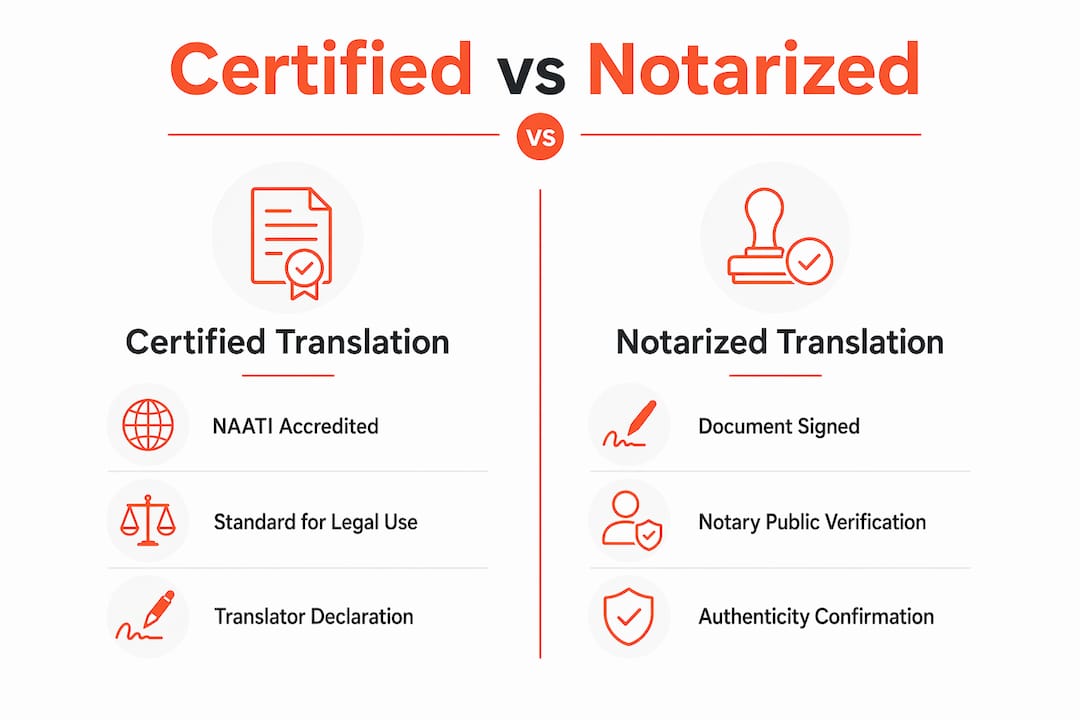
Notarisation confirms the authenticity of the translator’s involvement, not the quality of the translation itself. This means a notarized document can still contain errors if the underlying translation was poor. Notarisation adds a layer of procedural credibility, not linguistic accuracy. For that reason, the translation must already be certified by a NAATI-accredited translator before notarisation takes place.
The situations that call for notarised translations are specific. International legal filings and embassy submissions are the most common scenarios where a foreign authority requests a notary’s verification. A notary public or Justice of the Peace typically witnesses signatures or certifies declarations on translations in these cases. If you are submitting documents to a court in the United States, a European embassy, or a foreign government agency, notarisation may be a firm requirement.
Australian institutions do not generally require notarisation for official translations. They rely on NAATI certification alone. Some foreign jurisdictions or institutions may require notarised translations in addition to certification, which is where confusion most often arises.
- Obtain a certified translation from a NAATI-accredited translator, including all required certification elements.
- Contact a notary public or Justice of the Peace and book an appointment.
- Bring the certified translation and your identification to the appointment.
- The notary witnesses your signature or the translator’s signature and applies their seal.
- Confirm with the receiving authority that the notarised document meets their specific format requirements.
Pro Tip: Before booking a notary appointment, contact the receiving institution directly and ask exactly what format they require. Some foreign embassies accept a Justice of the Peace, while others insist on a notary public. The difference can affect acceptance.
How do you decide between a notarized or certified translation?
The decision depends on three factors: the document type, the jurisdiction of the receiving authority, and the specific requirements of the institution or court receiving the document. Getting this wrong is the most common and costly mistake applicants make.
The table below outlines the most common scenarios and which type of translation each requires.
| Situation | Translation type required |
|---|---|
| Australian visa application | NAATI certified translation only |
| Australian court submission | NAATI certified translation only |
| University enrolment in Australia | NAATI certified translation only |
| Embassy submission overseas | Certified plus notarised translation |
| International court filing | Certified plus notarised translation |
| Foreign government agency submission | Certified plus notarised (confirm with authority) |
For Australian visa applications, NAATI certification is sufficient and notarisation is not required. For immigration document submissions, the Department of Home Affairs accepts NAATI-certified translations without any notary involvement. Attempting to substitute notarisation for certification in this context will result in rejection.
For international submissions, the requirements vary significantly by country and institution. A document submitted to a United States court may require notarisation. A document submitted to a German embassy may require an apostille in addition to notarisation. Always verify requirements directly with the receiving authority before commissioning any translation.
- Confirm the receiving authority’s exact requirements in writing before ordering a translation.
- For Australian submissions, NAATI certification alone is the standard.
- For international submissions, ask whether notarisation, an apostille, or both are required.
- Specialist translators with subject matter expertise improve accuracy beyond language skills alone, particularly for legal documents.
- Working with a provider holding ISO 17100 and NAATI LSP Endorsement reduces the risk of non-compliant translations.
Pro Tip: Matching specialist legal expertise with language proficiency produces more accurate translations for court and immigration documents. Always ask whether your translator has experience with your specific document type.
Step-by-step process to get a certified or notarized translation
The process for obtaining a legally valid translation follows a clear sequence. Skipping any step risks rejection by the receiving authority.
- Identify your requirements. Confirm with the receiving authority whether you need a certified translation, a notarised translation, or both. Get this confirmation in writing where possible.
- Locate a NAATI-certified translator. Search the NAATI directory at naati.com.au to find a credentialled translator in your language pair. Verify their NAATI number before engaging them. Providers like Certitranslate employ NAATI-certified translators across a wide range of language pairs and document types.
- Submit your documents. Provide clear, legible copies of the original documents. Include any context the translator needs, such as the purpose of the translation and the receiving authority’s name.
- Receive the certified translation. The completed translation must include the translator’s NAATI number, signature, date, and accuracy declaration. Check all four elements before accepting the document.
- Arrange notarisation if required. If the receiving authority requires notarisation, book an appointment with a notary public or Justice of the Peace. Bring the certified translation and your photo identification.
- Review before submission. Check that the translation matches the original document in structure and content. Confirm that all certification and notarisation elements are present and legible.
Timeframes vary by provider and language pair. Standard certified translations are typically completed within one to three business days. Notarisation appointments depend on notary availability and may add one to two business days. Fees vary based on document length, language pair, and urgency.
Common mistakes with certified and notarized legal translations
The most frequent error is submitting a notarised translation to an Australian authority that requires NAATI certification. Notarisation does not substitute for certification in the Australian legal context. The two serve different purposes and are not interchangeable.
Using a translator without NAATI credentials for Australian legal submissions is the second most common mistake. A translation produced by an uncredentialled translator, regardless of their language ability, will be rejected by Australian government agencies and courts. The NAATI credential is the minimum threshold, not an optional quality marker.
- Submitting a notarised translation instead of a NAATI-certified one to Australian authorities causes rejection.
- Using non-NAATI translators for Australian legal documents risks the entire application.
- Confusing notarisation with certification leads to improper document use and wasted costs.
- Missing notary signatures or witness details invalidates a notarised document.
- Failing to confirm requirements with the receiving authority before ordering a translation is the root cause of most errors.
Pro Tip: Ask your translation provider whether they hold ISO 17100 certification or NAATI LSP Endorsement. These organisational quality standards signal that the provider has consistent internal processes, not just individual translator credentials.
Key takeaways
Certified translations verified by a NAATI-accredited translator are the accepted legal standard in Australia, while notarised translations serve a separate function for international filings and embassy submissions.
| Point | Details |
|---|---|
| Certified translation is the Australian standard | NAATI certification is required by Australian courts, government agencies, and universities. |
| Notarisation confirms identity, not accuracy | A notary public witnesses the translator’s signature but does not verify the translation’s quality. |
| Know your jurisdiction before ordering | Australian submissions need NAATI certification; international filings may also require notarisation. |
| Organisational certifications matter | ISO 17100 and NAATI LSP Endorsement indicate a provider maintains consistent quality standards. |
| Errors cause serious consequences | Submitting the wrong translation type causes rejection, delays, and additional costs in legal and visa processes. |
Why the certified vs notarized distinction matters more than most people realise
The confusion between these two document types is not just a technicality. I have seen applicants spend weeks waiting on a visa decision, only to receive a rejection because they submitted a notarised translation to the Department of Home Affairs instead of a NAATI-certified one. The notary’s seal looked official. The document looked complete. But it was the wrong type for the context.
My view is that NAATI certification should always be the starting point for anyone dealing with Australian legal or government documents. It is not one option among many. It is the accepted standard, and there is no workaround. For international submissions, the picture is more complex, and that is where I recommend spending extra time confirming requirements directly with the receiving authority, in writing, before commissioning any translation.
The providers I trust most are those holding both individual NAATI credentials and organisational certifications like ISO 17100 and NAATI LSP Endorsement. Individual credentials tell you the translator is qualified. Organisational certifications tell you the provider has quality controls that go beyond any single person. For high-stakes legal documents, that combination is the safest choice.
One more thing worth saying plainly: do not attempt to use an uncertified or DIY translation for any legal document. The short-term saving is not worth the risk of rejection, reapplication fees, or a delayed immigration outcome.
— David
Certitranslate: NAATI-certified translations for legal documents
Certitranslate provides NAATI-certified translations for immigration, legal, and business documents across Australia. Every translation is completed by a credentialled NAATI translator and includes the required certification statement, translator number, signature, and date.
For documents requiring notarisation, Certitranslate can advise on the process and ensure the certified translation is prepared correctly before any notary appointment. The team works with a wide range of document types, from birth certificates and court orders to contracts and academic transcripts. If you want a clear explanation of what certified translation involves and what to expect, the complete certified translation guide on the Certitranslate website covers the full process in plain language.
Preguntas frecuentes
What is the main difference between a certified and notarized translation?
A certified translation includes a NAATI-accredited translator’s signed declaration of accuracy, while a notarized translation involves a notary public witnessing the translator’s signature to confirm identity. Notarisation does not verify the quality or accuracy of the translation itself.
Does Australia require notarized translations for visa applications?
No. The Department of Home Affairs requires NAATI-certified translations for visa applications. Notarisation is not required for Australian immigration submissions and does not substitute for NAATI certification.
When would I need both a certified and notarized translation?
Both are typically required for international legal filings, embassy submissions, or foreign government agencies that request a notary’s verification in addition to a certified translation. Always confirm the exact requirements with the receiving authority before ordering.
What documents must be NAATI certified in Australia?
Affidavits, powers of attorney, court orders, contracts, birth certificates, marriage certificates, academic transcripts, and police clearances all require NAATI-certified translations when submitted to Australian authorities.
How do I verify a translator’s NAATI credentials?
Search the NAATI directory at naati.com.au using the translator’s name or NAATI number. Reputable providers like Certitranslate include the translator’s NAATI number on every certified translation document.
Recommended
- What is certified translation: a complete guide – CertiTranslate – Translations by NAATI Certified Translators
- Australian universities accepting certified translations: 2026 guide – CertiTranslate – Translations by NAATI Certified Translators
- Translate a will or testament: certified guide – CertiTranslate – Translations by NAATI Certified Translators
- What is a sworn translation? your complete guide – CertiTranslate – Translations by NAATI Certified Translators