


Legal contract translation is the process of converting a legally binding agreement from one language to another while preserving its original legal effect, not just its words. This is distinct from general translation. The industry term is “legal translation,” and it sits at the intersection of linguistics and law. How legal contract translation works matters deeply to any business or individual signing cross-border agreements, submitting documents to regulators, or navigating immigration processes. A mistranslated clause can void a contract, trigger a dispute, or cause a submission to be rejected outright. Getting it right requires a structured workflow, specialist expertise, and in many cases, formal certification.
How does the legal contract translation workflow operate?
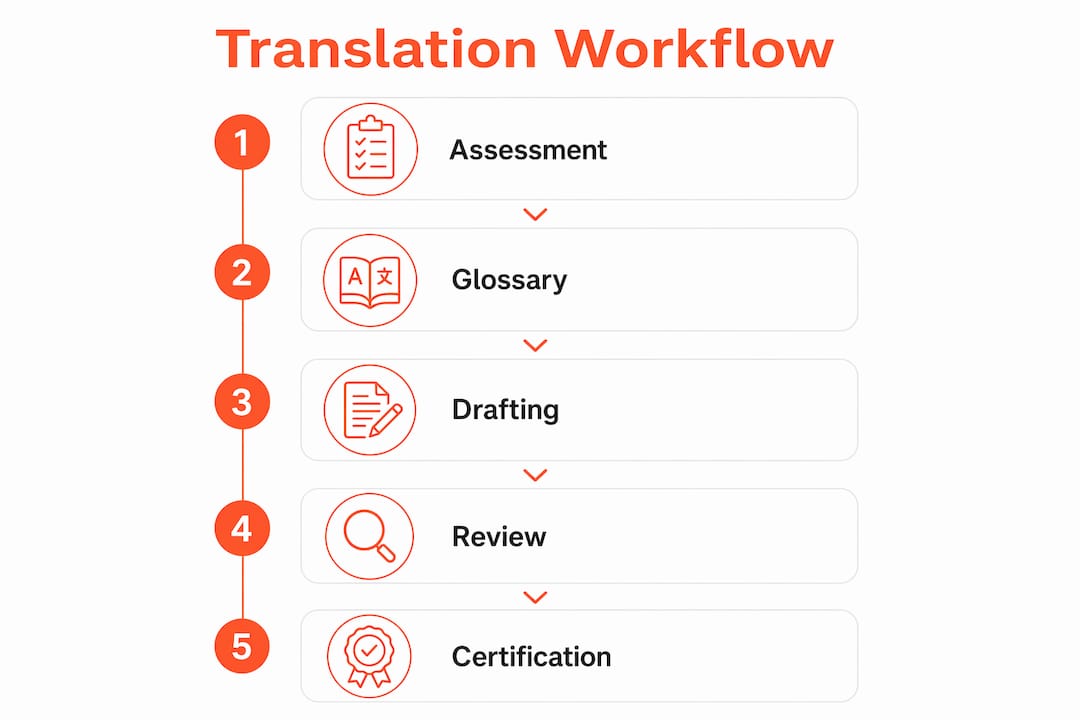
The legal translation process follows six defined steps, each building on the last to protect the document’s legal integrity.
-
Document assessment and preparation. The translator reviews the contract’s type, jurisdiction, subject matter, and target audience before any translation begins. This step identifies ambiguities in the source text that could cause problems downstream.
-
Legal research and glossary development. The translator builds a project-specific glossary of defined terms, technical phrases, and jurisdiction-specific concepts. Legal teams maintain centralised glossaries to ensure terminology consistency across related documents and amendments, reducing future interpretation disputes.
-
Draft translation with cultural and jurisdictional adaptation. The translator produces a working draft. This is not a word-for-word substitution. Legal concepts that exist in one legal system may have no direct equivalent in another, requiring careful adaptation rather than literal rendering.
-
Translation-Editing-Proofreading (TEP) quality assurance. A second qualified translator edits the draft, then a proofreader checks for consistency, grammar, and formatting. TEP is the industry-standard quality assurance model for professional translation.
-
Expert legal review. A qualified legal practitioner in the target jurisdiction reviews the translated contract. Expert legal review by a local practitioner is non-negotiable to confirm enforceability in the target jurisdiction. This step catches issues that a linguist alone would miss.
-
Certification or notarisation. Where required, the translator or translation provider attaches a signed statement of accuracy. Some jurisdictions require notarisation on top of certification.
Pro Tip: Request a glossary from your translation provider at the outset. A documented glossary becomes a reference asset for every future amendment or related agreement.
Why does specialised legal expertise matter so much?

The biggest misconception in contract translation is that fluency in two languages is sufficient. Legal translation requires a “double-qualified” professional who is fluent in both the source and target languages and knowledgeable about both legal systems. Linguistic skill alone does not protect you.
The risks of using a non-specialist are specific and serious:
- Defined terms. Legal contracts assign precise meanings to ordinary words. “Party,” “material,” and “notice” all carry technical definitions. A general translator may render these as their everyday equivalents, shifting the contract’s meaning entirely.
- Modal verbs. The difference between “shall” and “may” determines whether an obligation is mandatory or discretionary. Misuse of modality can reshape a contract’s risk profile or invalidate a clause.
- Internal cross-references. Contracts reference other clauses internally. A translation error in one clause can corrupt the meaning of every clause that references it.
- Common law versus civil law systems. Australian and English contracts operate under common law. Many European, Latin American, and Asian jurisdictions use civil law. Concepts like “consideration,” “estoppel,” and “implied terms” do not translate directly into civil law frameworks.
The enforceability of a contract in a foreign jurisdiction depends on whether its translated version reflects the legal intent of the original. A legal review by a practitioner admitted in the target jurisdiction is the only reliable check on this. For businesses managing specialist legal documents, this step is not optional.
Pro Tip: Always ask your translation provider whether their legal translators hold formal legal qualifications or have practised law, not just studied it.
How do technology and quality assurance support accuracy?
Technology plays a supporting role in legal contract translation, but it does not replace human judgement. The current best-practice model is the human-in-the-loop (HITL) approach, which combines AI-assisted drafting with rigorous expert review.
The HITL model in practice
An AI tool can generate a first draft quickly, reducing turnaround time on long contracts. However, AI tools lack accountability and legal intent comprehension, making AI-only output legally risky for binding agreements. The HITL model treats the AI draft as a starting point, not a finished product. A qualified legal translator then reviews, edits, and takes professional responsibility for the final text.
Back-translation and logic review
Back-translation is a quality check where a separate translator converts the translated document back into the source language. The two versions are then compared. A HITL model with back-translation identifies discrepancies before finalisation, catching meaning shifts such as “shall” becoming “should.” This is a safety net that AI alone cannot provide.
Centralised glossaries and translation memory
Translation memory software stores previously approved translations of phrases and sentences. When the same phrase appears in a new document or amendment, the system flags it for consistent rendering. Combined with a centralised glossary, this creates an audit trail across all related documents. Treating translations as auditable business assets with version control makes future amendments faster and reduces the risk of inconsistency creeping in over time.
Pro Tip: Ask whether your provider uses translation memory software. If you have an ongoing commercial relationship with a foreign counterpart, consistent terminology across all contracts protects you in any future dispute.
What do certification and legal formalities mean for contracts?
Certification and sworn translation are not interchangeable terms, and confusing them causes real problems.
| Formality | What it involves | When it is required |
|---|---|---|
| Certified translation | Signed statement of accuracy from the translator or provider | Commercial contracts, immigration submissions, university enrolments |
| Sworn translation | Completed by a translator officially sworn before a court or authority | Court filings, judicial proceedings, some governmental submissions |
| Notarised translation | Certified translation verified by a notary public | Property transactions, powers of attorney, some regulatory filings |
| Bilingual version | Both language versions exist as part of the contract | International commercial agreements, cross-border joint ventures |
Certified translation is accepted by bodies like USCIS and most courts for commercial and immigration submissions. Sworn translation is mandatory for judicial and governmental proceedings in many jurisdictions. In Australia, NAATI certification is the recognised standard for official document translation. A NAATI-certified translator’s signed declaration satisfies most Australian government and court requirements.
Version control matters as much as the formality itself. When a contract exists in two languages, the parties must agree on which version governs in the event of a conflict. Failing to include a language precedence clause can lead to unenforceable or contested provisions. This clause should be drafted by a lawyer, not added as an afterthought. For businesses managing import and export agreements, a language precedence clause is a standard protective measure.
The statement of accuracy attached to a certified translation must include the translator’s full name, qualifications, contact details, and a declaration that the translation is complete and accurate to the best of their knowledge. Any omission from this statement can cause a submission to be rejected.
Key takeaways
Legal contract translation requires specialist legal and linguistic expertise at every stage, from glossary development through to certification, to produce a document that is enforceable across jurisdictions.
| Point | Details |
|---|---|
| Six-step workflow | Every professional legal translation follows assessment, research, drafting, TEP, legal review, and certification. |
| Double-qualified translators | Effective contract translators hold both linguistic and legal expertise across the relevant jurisdictions. |
| HITL over AI-only | AI drafts must be reviewed by a qualified legal translator; AI alone cannot produce defensible legal translations. |
| Certification versus sworn | Certified translation suits most commercial and immigration needs; sworn translation is mandatory for court and government filings. |
| Language precedence clause | Contracts in two languages must specify which version governs to avoid enforceability disputes. |
What I have learned from watching contracts go wrong
The contracts that end up in dispute are rarely the ones with obvious translation errors. They are the ones where a subtly wrong modal verb, a missing cross-reference, or an undefined term slipped through because the translator was fluent but not legally trained.
I have seen businesses hand a commercial contract to a bilingual employee to save money. The employee was genuinely skilled in both languages. But they had no training in contract law, no awareness of how civil law jurisdictions treat implied terms differently, and no understanding of why “reasonable endeavours” and “best endeavours” are not synonyms. The resulting translation looked fine. It was not fine.
The other pattern I see repeatedly is skipping the legal review step. Businesses treat it as an optional add-on rather than the core quality check it actually is. A qualified practitioner in the target jurisdiction is the only person who can confirm that the translated contract will be read the way you intend it to be read by a local court or regulator.
My practical advice: verify your translator’s credentials before you engage them. Ask specifically whether they hold a law degree or have practised in the relevant jurisdiction, not just whether they are “experienced in legal translation.” Check whether they use a documented glossary and whether they can provide a certified statement of accuracy. And always include a language precedence clause in any bilingual contract. It is a one-sentence addition that can prevent years of litigation.
Treat your translated contracts as business assets, not administrative tasks. The right NAATI certified translator brings both the linguistic and legal knowledge to make that possible.
— David
Certitranslate: accurate legal contract translation for Australian businesses
Certitranslate provides certified legal translation services delivered by NAATI-certified translators with specialist legal knowledge. Every contract translation follows the full six-step workflow, including TEP quality assurance and expert legal review, so the final document is accurate and ready for official submission.
Whether you need a certified translation for a commercial agreement, a regulatory submission, or an immigration document, Certitranslate’s translators hold the credentials and legal expertise to produce a translation that meets Australian and international standards. Fast turnaround, documented accuracy, and a signed statement of accuracy are included as standard. Visit certitranslate.com to get started with your legal document translation today.
Preguntas frecuentes
What is legal contract translation?
Legal contract translation is the process of converting a legally binding agreement from one language to another while preserving its original legal meaning, defined terms, and enforceability across jurisdictions.
How is certified translation different from sworn translation?
Certified translation involves a signed statement of accuracy from a qualified translator and is accepted for most commercial and immigration submissions. Sworn translation is completed by a translator officially sworn before a court or authority and is mandatory for judicial and governmental proceedings.
Can AI translate a legal contract accurately?
AI tools can assist with drafting but cannot produce a legally defensible translation on their own. AI lacks accountability and legal intent comprehension, so all AI-assisted output requires rigorous review by a qualified legal translator before use in a binding agreement.
What does NAATI certification mean for legal translation in Australia?
NAATI certification is the recognised Australian standard for professional translators. A NAATI-certified translator’s signed declaration of accuracy satisfies most Australian government, court, and regulatory submission requirements.
Why does a bilingual contract need a language precedence clause?
A language precedence clause specifies which language version of a contract governs in the event of a conflict between the two versions. Without it, disputed provisions may be unenforceable or subject to competing interpretations in different jurisdictions.
Recommended
- Why legal terminology requires a specialist translator – CertiTranslate – Translations by NAATI Certified Translators
- Certified translation for import/export agreements: 2026 guide – CertiTranslate – Translations by NAATI Certified Translators
- Types of business documents requiring translation – CertiTranslate – Translations by NAATI Certified Translators
- Certified guardianship document translation: a complete guide – CertiTranslate – Translations by NAATI Certified Translators