

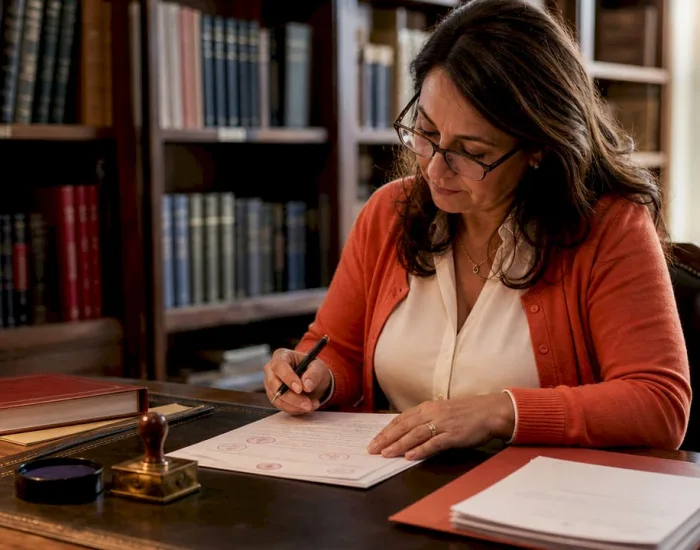
A sworn translation is an official document translated by a translator who has been formally authorised by a government or court authority, carrying a legal oath that confirms the accuracy and authenticity of the translation. Unlike a standard translation, a sworn translation carries legal weight allowing it to act as an equivalent to the original document in specific court or government settings. This distinction matters enormously if you are submitting documents for immigration, legal proceedings, or academic enrolment. Knowing exactly what type of translation you need saves time, money, and the risk of having documents rejected outright.
What is a sworn translation and how does it differ from certified and notarised translations?
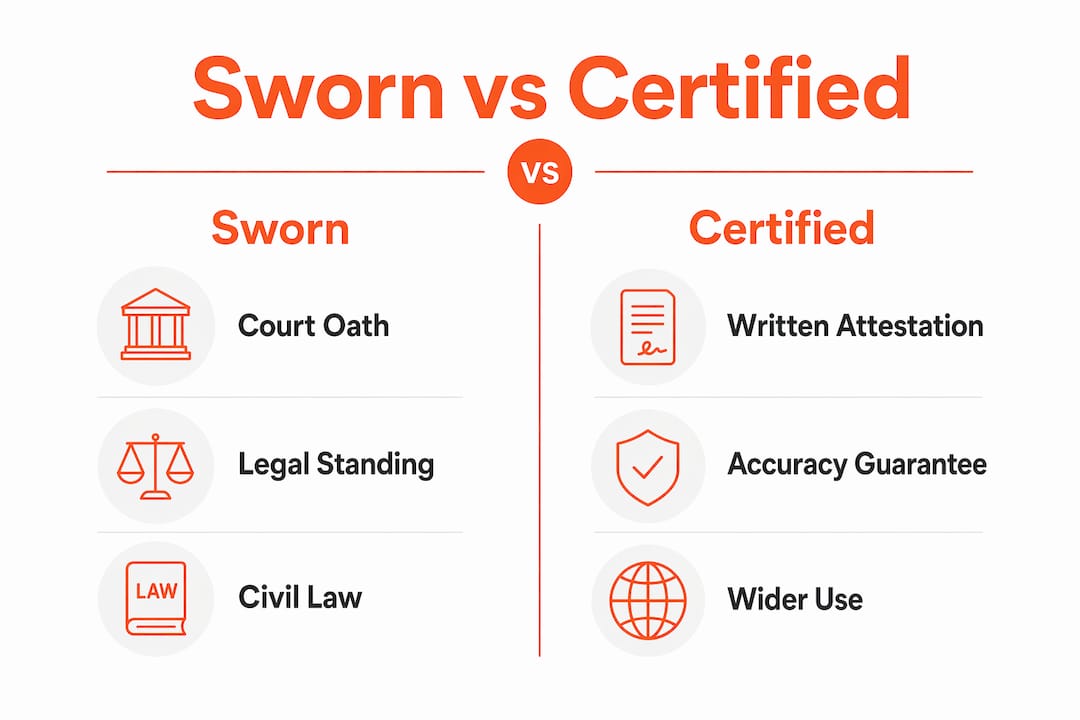
A sworn translation is defined as a translation produced by a translator who has taken a formal oath before a court or government body, with their signature and official stamp applied to every page. That oath is the critical element. It grants the translated document direct legal standing, meaning authorities treat it as legally equivalent to the original.

A certified translation works differently. The translator or agency attests in writing that the translation is accurate and complete, backed by their professional accreditation rather than a court oath. In Australia, that accreditation comes from NAATI, the National Accreditation Authority for Translators and Interpreters. NAATI certification confirms professional competence, but it does not confer the same court-appointed authority as a sworn translator in a civil-law country.
A notarised translation adds another layer again. A notary public witnesses and verifies the translator’s signature, confirming the translator’s identity rather than the quality of the translation itself. Notarisation is common for documents used in cross-border legal matters where a receiving authority wants an additional layer of authentication.
The table below summarises the key differences.
| Type | Authority basis | Legal standing | Common use |
|---|---|---|---|
| Sworn | Court or government oath | Acts as legal equivalent to original | Civil-law countries: courts, government registries |
| Certified | Professional body accreditation (e.g., NAATI) | Attests accuracy professionally | Australia, UK, Canada: immigration, academic, legal |
| Notarised | Notary witnesses translator’s signature | Confirms identity, not translation quality | Cross-border legal matters, foreign embassies |
The primary difference lies in legal framework, not translator skill. A sworn translator in Germany or Spain holds a court registration number and a legal seal. A NAATI-certified translator in Australia holds professional accreditation. Both can produce accurate translations. Only one carries an oath-based legal authority recognised by courts.
What documents typically require sworn or certified translation?
The list of documents that require formal translation is broader than most people expect. For immigration purposes, you will typically need translations of birth certificates, marriage certificates, police clearances, and passports. For legal proceedings, court judgments, powers of attorney, and contracts all require a qualified translator. Academic applications commonly require diplomas, transcripts, and professional licences.
Corporate and business documents form a significant category of their own. When you translate company registration documents such as certificates of incorporation, shareholder agreements, or director identification records, the receiving authority needs to verify legal names, registration numbers, and corporate structure with precision. Inconsistent translations of corporate documents may be rejected by foreign commercial registries outright.
The consequences of using an unqualified translation are real. A visa application submitted with a translation that does not meet the Department of Home Affairs’ standards will be refused. A university that requires NAATI-certified translations of academic documents will not accept a bilingual friend’s version, regardless of how accurate it may be.
Turnaround times for formal translations typically range from 3–10 business days depending on volume and document complexity. Urgent requests can often be accommodated at a premium, but planning ahead avoids that cost entirely.
Pro Tip: Always confirm with the receiving authority, whether a court, university, or government department, exactly which type of translation they require before commissioning the work. Requirements vary by institution and jurisdiction.
How does the sworn translation process work?
The process for obtaining a sworn translation follows a clear sequence, though the specific steps vary by country. Understanding each stage helps you avoid delays and rejected submissions.
-
Locate a qualified translator. In civil-law countries, this means finding a translator registered with the relevant court or government body. In Australia, you need a NAATI-certified translator whose credentials match the language pair and document type.
-
Submit the original document. The translator works from the original or a certified copy. Submitting a low-quality scan or an uncertified photocopy can invalidate the final translation in some jurisdictions.
-
Translation and quality review. The translator produces the full translation. For complex legal or corporate documents, quality assurance often includes a second independent linguist and, in some cases, a legal professional to verify enforceable terminology.
-
Signing and stamping. The translator signs and stamps every page of the completed translation. In sworn translation systems, this stamp carries the translator’s court registration number and official seal.
-
Physical attachments. Sworn translations often require the original document or a certified copy to be physically attached to the translation. Some authorities also require an apostille or notarisation of the translator’s signature for foreign use.
-
Delivery and submission. You receive the completed package and submit it to the relevant authority. Keep copies of everything, including the original documents and the certified translation.
Regional systems differ in notable ways. Germany requires sworn translators, known as vereidigter Übersetzer, who take an oath at a Landgericht and hold a registration number on their legal seal. France and Spain operate similar models. In Australia, the equivalent authority comes from NAATI accreditation rather than a court oath.
Pro Tip: When selecting a translator or agency for legal documents, ask specifically whether they have experience with the receiving authority’s requirements. A translator familiar with the Department of Home Affairs or a specific foreign commercial registry will know exactly what format and attachments are needed.
Are sworn translations recognised worldwide?
Sworn translations are not a universal standard. The concept is concentrated in civil-law countries, primarily across Europe and Latin America, where court-appointed translators hold independent legal authority. Common-law countries including Australia, the United Kingdom, and Canada do not operate sworn translator systems in the same sense.
This creates a practical problem for people navigating the cross-border business document translation process. If you are an Australian company submitting documents to a Spanish commercial registry, you need a Spanish sworn translator, not an Australian NAATI-certified one. Conversely, if a Spanish company is submitting documents to an Australian authority, a NAATI-certified translation will satisfy the requirement.
The table below outlines how major countries approach formal translation authority.
| Country / Region | System used | Governing body |
|---|---|---|
| Australia | NAATI-certified translation | NAATI |
| United Kingdom | Certified translation | Chartered Institute of Linguists |
| Canada | Certified translation | Provincial translator associations |
| Germany | Sworn translation (vereidigter Übersetzer) | Landgericht (regional court) |
| France | Sworn translation (traducteur assermenté) | Court of Appeal |
| Spain | Sworn translation (traductor jurado) | Ministry of Foreign Affairs |
| Most of Latin America | Sworn translation | National or regional government bodies |
For documents crossing between these two systems, additional authentication is often required. An apostille, issued under the Hague Convention, authenticates the origin of a public document so it is accepted in another member country. Some countries outside the Hague Convention require full legalisation through an embassy instead.
Corporate documents present particular challenges in this context. Registration numbers, director names, and legal form descriptions must be translated with absolute consistency. A single discrepancy between a translated document and the original can trigger rejection by a foreign registry, causing significant delays in the cross-border business document translation process.
Key takeaways
A sworn translation carries court-authorised legal standing in civil-law countries, while Australia and other common-law nations rely on NAATI-certified translations to meet the same official requirements.
| Point | Details |
|---|---|
| Sworn vs certified | Sworn translations carry a court oath; certified translations rely on professional accreditation like NAATI. |
| Legal standing | A sworn translation acts as a legal equivalent to the original document in civil-law jurisdictions. |
| Document types | Birth certificates, court judgments, diplomas, and corporate registration documents commonly require formal translation. |
| Australia’s system | Australia uses NAATI-certified translators, not court-sworn translators. Requesting a “sworn translator” here causes confusion. |
| International use | Cross-border submissions may require apostilles or embassy legalisation in addition to the translation itself. |
Why the “sworn” label trips people up more than it should
The terminology around sworn translations causes genuine confusion, and I have seen it waste weeks of effort for people who were otherwise well-prepared. The most common mistake is requesting a “sworn translation” from an Australian provider when the receiving authority, whether a local court, university, or government department, actually requires a NAATI-certified translation. These are not the same thing, but they serve the same function in Australia’s legal framework.
What I find more concerning is when people go the other direction. They assume that because Australia does not use sworn translators, any translation will do. That thinking leads to visa refusals and rejected academic applications. The standard in Australia is NAATI certification, and it is non-negotiable for most official submissions.
The other mistake I see regularly involves corporate documents. People translate company registration documents accurately but forget that consistency across every document in a submission is just as important as accuracy within a single document. A director’s name rendered two different ways across a set of translated corporate records will raise red flags with a foreign registry, even if both versions are technically correct translations.
My practical advice is simple. Before you commission any translation, contact the receiving authority and ask for their exact requirements in writing. That one step eliminates most of the confusion around sworn, certified, and notarised translations. It also gives you a clear brief to hand to your translator or agency, which speeds up the entire process.
— David
Certitranslate: NAATI-certified translations for official submissions
Certitranslate provides certified translation services backed by NAATI-accredited translators, covering legal, immigration, academic, and corporate document needs across Australia.
Whether you need to translate immigration documents, business registration records, or academic transcripts, Certitranslate’s translators understand the specific requirements of Australian government bodies, universities, and legal institutions. Every translation includes the certification statement and translator credentials required for official acceptance. For a full overview of what certified translation involves and how it meets Australian standards, the certified translation guide covers the process in detail. Certitranslate also offers guidance on choosing the right translator for your specific document type and jurisdiction.
Preguntas frecuentes
What is a sworn translation in simple terms?
A sworn translation is a translation produced by a translator who has taken a formal oath before a court or government authority, with their signature and stamp on every page confirming its accuracy and legal standing.
Does Australia use sworn translators?
Australia does not use court-sworn translators. The equivalent standard is a NAATI-certified translation, which is accepted by Australian government bodies, courts, and universities as the authoritative form of official translation.
What documents need a sworn or certified translation?
Birth certificates, marriage certificates, court judgments, academic diplomas, and corporate registration documents commonly require formal translation for immigration, legal, or academic submissions.
How long does a certified translation take?
Turnaround times typically range from 3–10 business days depending on document volume and complexity, with urgent options available at additional cost.
Do I need an apostille as well as a translation?
An apostille may be required when submitting translated documents to a foreign authority, particularly in civil-law countries. The apostille authenticates the origin of the document independently of the translation itself.
Recommended
- Immigration document translation process: a complete guide – CertiTranslate – Translations by NAATI Certified Translators
- Certified guardianship document translation: a complete guide – CertiTranslate – Translations by NAATI Certified Translators
- What is certified translation: a complete guide – CertiTranslate – Translations by NAATI Certified Translators
- Certified translation of a power of attorney: 2026 guide – CertiTranslate – Translations by NAATI Certified Translators