


Certified translation of ISO standards documents is defined as a translation deliverable that attests to the accuracy and completeness of the target text, produced under the quality requirements of ISO 17100:2015. This standard, published in may 2015, replaced older regional benchmarks to create a unified international benchmark covering human resources, operational processes, project management, and quality assurance. For individuals and organisations submitting ISO compliance certificates, audit reports, or technical manuals to regulatory bodies, this distinction matters enormously. A translation that merely looks professional is not the same as one that is audit-proof and legally defensible. Bodies such as TÜV SÜD and BSI conduct third-party audits to verify that providers genuinely meet ISO 17100 requirements, not just claim they do.
What are ISO 17100 requirements for certified translation services?
ISO 17100:2015 sets specific, enforceable obligations on translation service providers. Meeting these requirements is what separates a genuinely certified translation from a self-declared one.
The standard mandates a minimum two-step process: translation followed by independent revision from a separately qualified reviser. Waiving the revision step is not permitted under any circumstances. That single rule eliminates a large portion of providers who rely on one person to both translate and check their own work.

Translator qualifications under ISO 17100 are equally strict. Providers must document that each translator holds a recognised graduate degree in translation or a related field, or can demonstrate equivalent full-time professional experience. This is not a self-reported checkbox. Auditors verify competence records during certification assessments.
The standard also requires detailed documentation across every project. Providers must retain records of:
- Project initiation and client-specific instructions
- Translator and reviser competence evidence
- Revision step completion and bilingual checks
- Quality assurance controls applied throughout
Pro Tip: Ask any provider to show you their ISO 17100 certificate number and the name of the accredited body that issued it. A genuine certificate is traceable. A self-declared one is not.
One distinction that trips up many clients: ISO 17100 certification belongs to the translation service provider, not to an individual translation deliverable. The certified translation document you receive is the output of a certified process. Both concepts matter, but they are not the same thing.
Which types of ISO standard documents require certified translation?
Certified translation is critical for any ISO-related document submitted to a legal, commercial, or regulatory authority. The document types span several sectors, and the consequences of inaccurate translation in each are severe.
| ISO document type | Why certified translation is required |
|---|---|
| ISO compliance certificates | Submitted to regulators and auditors; errors invalidate certification claims |
| Technical manuals and specifications | Safety-critical content; mistranslation creates liability and compliance failure |
| Audit reports | Legal records; inaccuracies can constitute misrepresentation |
| Regulatory filings and submissions | Government bodies require verifiable accuracy and translator attestation |
| Quality management system documentation | Operational standards must be reproduced exactly across languages |
The risk of using an uncertified translation in these contexts is not theoretical. A mistranslated clause in a quality management system document can cause a facility to fail an international audit. An error in a regulatory filing can delay market entry by months. For business documents requiring translation, the standard of accuracy demanded is the same as for the source document itself.
The documents most commonly requiring certified translation in the ISO context include:
- ISO 9001 quality management certificates and supporting records
- ISO 14001 environmental management system documentation
- ISO 45001 occupational health and safety manuals
- Medical device technical files submitted under ISO 13485
- Food safety management records under ISO 22000
Each of these document types carries regulatory weight. A translation produced without a documented revision step or qualified translator is not fit for submission, regardless of how accurate it appears on the surface.
How to ensure your translation provider complies with ISO 17100 standards
The single most important step is verifying that the provider holds a current, third-party-issued ISO 17100 certificate. Self-declaration is invalid under the standard. Certification requires an external audit by an accredited body, and that audit must be renewed through ongoing surveillance assessments.
When evaluating a provider, ask these questions directly:
- Which accredited body issued your ISO 17100 certificate, and when was it last renewed?
- Can you provide documented evidence of translator and reviser qualifications for this project?
- How do you record and retain project-specific instructions and revision completion?
- What happens if the revision step identifies significant errors?
Documented workflows are the backbone of ISO 17100 compliance. A provider that cannot produce records of translator competence, revision steps, and project controls has not met the standard, regardless of what their website claims. These records also protect you legally. If a translated document is ever challenged, the provider’s archived evidence of due diligence is what stands up in court.
Avoid providers who offer only a letter of attestation without any reference to an external audit. In 2026, clients increasingly require verifiable ISO 17100 documentation rather than self-declared compliance. That shift reflects a maturing market where regulatory bodies and legal teams know the difference.
Pro Tip: Check the certification body’s own public register. TÜV SÜD, BSI, and similar accredited bodies maintain searchable databases of certified organisations. If the provider’s name does not appear, their certificate is not genuine.
Step-by-step process for obtaining certified translation of ISO standards documents
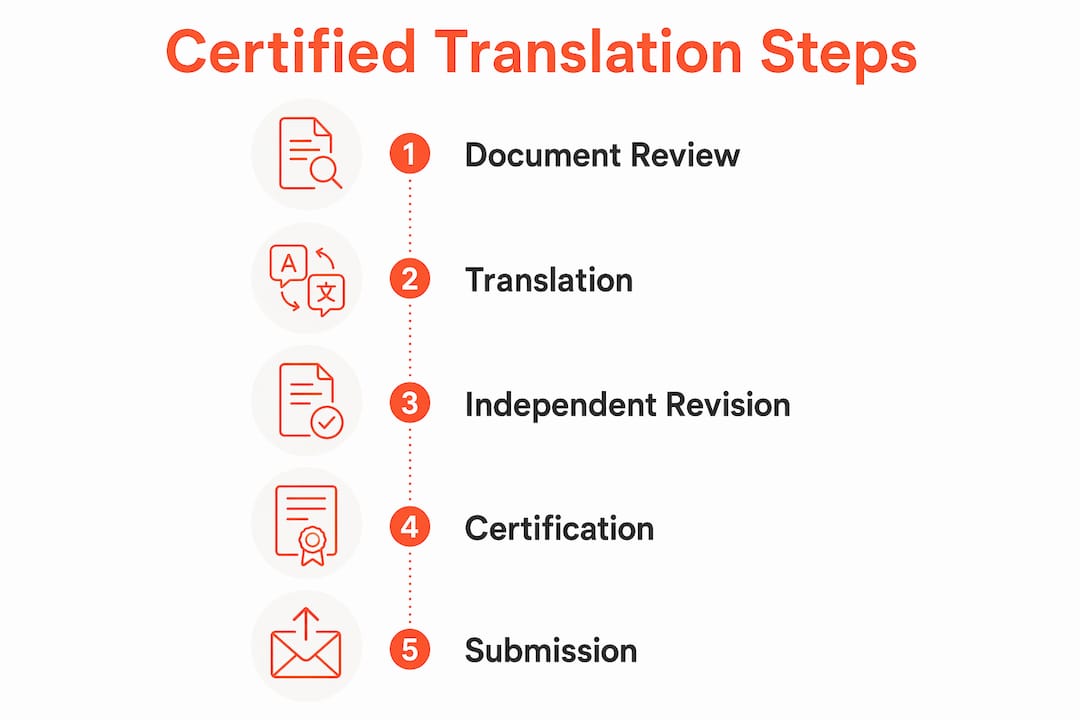
A properly executed certified translation under ISO 17100 follows a defined sequence. Skipping or compressing any step disqualifies the output from meeting the standard.
-
Submit project specifications and source documents. Provide the original ISO document in its native format, along with any client-specific terminology glossaries, style guides, or regulatory context the translator needs. Clear instructions at this stage prevent costly corrections later.
-
Translator assignment and qualifications assessment. The provider assigns a translator whose documented qualifications match the subject matter. For ISO technical documents, this typically means a translator with a background in quality management, engineering, or the relevant regulated industry.
-
Translation of the source document. The assigned translator produces the target-language text, working to preserve both meaning and technical precision. No shortcuts are taken with terminology, even when the source document uses dense ISO-specific language.
-
Independent revision by a separately qualified reviser. A second qualified professional reviews the translation against the source. Auditors verify revision step completion as part of the ISO 17100 audit process. This step is mandatory and cannot be performed by the original translator.
-
Quality assurance controls and project management review. The project manager checks that all client instructions were followed, that the revision is documented, and that the final file meets formatting and completeness requirements.
-
Final certification attestation and delivery. The provider issues a signed statement attesting that the translation is accurate and complete, produced under ISO 17100-compliant processes. This attestation, along with the translated document, forms the certified translation deliverable.
Insufficient documentation of translator and reviser competence is the leading cause of ISO 17100 certification failure during audits, irrespective of how accurate the final translation actually is. Process evidence is not optional. It is the certification.
Common pitfalls at each stage include submitting poor-quality scans of source documents, failing to provide terminology guidance for highly specialised content, and selecting providers who cannot demonstrate the revision step was completed by a separate qualified person. Each of these issues can delay delivery or result in a translation that fails regulatory acceptance.
Key takeaways
Certified translation of ISO standards documents requires a provider with genuine, third-party-audited ISO 17100 certification, a mandatory two-step translation and revision process, and documented evidence of translator qualifications retained for legal due diligence.
| Point | Details |
|---|---|
| ISO 17100 mandates two steps | Every translation must include independent revision; waiving it is not permitted. |
| Self-declaration is not certification | Only third-party-audited certificates from bodies like TÜV SÜD or BSI are valid. |
| Documentation protects you legally | Providers must retain competence records and project files to defend translations if challenged. |
| Document type determines risk | ISO audit reports, compliance certificates, and technical manuals carry the highest accuracy stakes. |
| Verify before you commission | Check the certifying body’s public register before engaging any translation provider. |
Why ISO 17100 certification is no longer optional
The translation industry has spent years debating whether ISO 17100 certification is a genuine quality signal or just a marketing badge. Having worked closely with organisations submitting documents to international regulators, I can tell you the answer is clear: it is a genuine quality signal, and the gap between certified and uncertified providers is wider than most clients realise.
What I find most telling is where certification failures actually occur. Auditors focus on process documentation rather than on reading the translated text for accuracy. A provider can produce a beautifully accurate translation and still fail certification because they cannot prove the revision step happened. That tells you something important: the standard is designed to protect clients from systemic risk, not just individual errors.
The rise of ISO 18587 for machine translation post-editing adds another layer of complexity. Providers using machine translation in their workflows need to demonstrate human oversight that meets ISO 17100 requirements. Clients who do not ask about this are taking on risk they may not even know exists.
My advice: treat ISO 17100 certification the same way you treat a professional licence. You would not hire an unlicensed engineer to certify a building. Do not commission a translation for a regulatory submission from a provider who cannot show you a current, externally audited certificate.
— David
Certitranslate: certified translation that meets the standard
Regulatory submissions and legal filings leave no room for translation errors. Certitranslate’s team of traductores certificados por NAATI works to ISO 17100-aligned quality processes, covering the mandatory translation and revision steps, documented translator qualifications, and full project records retained for your protection.
Whether you need a complete certified translation guide for a first-time submission or ongoing support for complex ISO documentation across multiple languages, Certitranslate delivers translations accepted by government bodies, courts, and international regulators. Every project includes a signed attestation of accuracy and completeness. Get in touch with Certitranslate to discuss your ISO document translation requirements.
Preguntas frecuentes
What is ISO 17100 and why does it matter for translation?
ISO 17100:2015 is the international standard that defines quality requirements for translation service providers, including mandatory translator qualifications, a two-step translation and revision process, and documented project controls. It matters because it gives clients a verifiable benchmark for assessing whether a provider’s processes are genuinely reliable.
What documents require certified translation under ISO standards?
ISO compliance certificates, audit reports, technical manuals, regulatory filings, and quality management system documentation all require certified translation when submitted to legal, commercial, or regulatory authorities. Errors in these documents can invalidate certifications or delay regulatory approvals.
How do I verify that a translation provider is genuinely ISO 17100 certified?
Request the certificate number and the name of the accredited body that issued it, then check that body’s public register directly. Third-party-audited certification from bodies such as TÜV SÜD or BSI is the only valid form; self-declared compliance does not meet the standard.
Can machine translation be used for ISO standards documents?
Machine translation output requires human post-editing that meets ISO 17100 requirements to be used in certified translation workflows. ISO 18587 provides the complementary standard for machine translation post-editing, but human oversight and the mandatory revision step remain non-negotiable for certified deliverables.
What is the difference between a certified translation and a certified translator?
A certified translation is a specific deliverable that includes a signed attestation of accuracy and completeness, produced under a certified process. A certified translator holds a recognised credential, such as NAATI certification in Australia, attesting to their individual qualifications. Both are required for compliant translation of ISO standards documents.
Recommended
- Certified translation for import/export agreements: 2026 guide – CertiTranslate – Translations by NAATI Certified Translators
- How import export documents are translated: 2026 guide – CertiTranslate – Translations by NAATI Certified Translators
- Certified guardianship document translation: a complete guide – CertiTranslate – Translations by NAATI Certified Translators
- What is certified translation: a complete guide – CertiTranslate – Translations by NAATI Certified Translators