


Yes, professional translation confidentiality is enforceable. It rests on three pillars: professional ethics and privacy law, contractual protections like NDAs and DPAs, and technical safeguards such as encrypted transfer and access controls. If you’re sending sensitive documents anywhere, skip public machine translation and demand contractual and technical guarantees in writing before you hand over a single file.
TL;DR:
- Verifiable operational safeguards like signed NDAs, documented data handling policies, and role-based access controls are critical to maintaining translation confidentiality.
- Public machine translation tools pose a significant risk because they can retain or reuse submitted text without obligation, often sharing sensitive information.
- Licensing standards such as NAATI accreditation and ISO 27001 certification demonstrate a provider’s commitment to confidentiality, but verifying their controls is essential.
- Confidential translation requires layered protections, including encrypted file transfer, access logs, and contractual guarantees that data will not be used for training public models.
- Before outsourcing, clients should demand clear contractual terms, including authorized personnel, data storage location, subcontractor standards, and explicit deletion policies to ensure confidentiality.
Table of Contents
- What confidentiality in translation actually means and why it matters
- Legal and professional obligations that bind translators and interpreters
- Technical and operational safeguards used by secure translation providers
- What to ask and demand from a translation provider
- Why do consumer tools and casual workflows leak sensitive data?
- How Certitranslate applies these safeguards in practice
- Where to check the rules yourself
- The gap between what providers promise and what they actually prove
- Certitranslate: certified translation built around confidentiality, not bolted onto it
- Sources
What confidentiality in translation actually means and why it matters
Confidentiality in translation means your document, and everything in it, stays out of hands that shouldn’t have it. That covers unauthorised access while a file sits on a server, disclosure to anyone outside the agreed project team, and downstream reuse, like a translator feeding your contract into a public AI tool that stores the text for training data.
The risk isn’t theoretical. Some document types carry more exposure than others:
- Legal filings and affidavits, where a leak can undermine a case or breach a court order
- Medical records, protected under health privacy obligations and often deeply personal
- Immigration documents, which contain identity, financial and family details in one bundle
- Intellectual property filings, including patents and technical specifications worth protecting
- Financial models and contracts, where competitors or markets could exploit early access
A breach isn’t just embarrassing. It can trigger regulatory penalties, get an official submission rejected outright because the chain of custody looks compromised, or cost a business a client relationship it spent years building.
Legal and professional obligations that bind translators and interpreters
Two professional bodies shape how confidentiality works in Australia’s translation industry, and understanding both helps you know what you’re entitled to demand. NAATI sets the credentialing standard, and its ethical guidance states that confidentiality is a core professional obligation extending across an entire project team, not just the lead translator. Subcontractors and reviewers are bound too.
AUSIT’s code of ethics and code of conduct goes further, requiring translators and interpreters to keep confidential anything acquired during their work. Disclosure is only permitted with the client’s explicit agreement or when the law compels it.
The legal backbone: Australia’s Privacy Act 1988 and the Australian Privacy Principles require organisations handling personal information to do so openly, securely, and with limits on how it’s collected and stored. Any translation provider processing personal data, names, addresses, medical history, financial details, sits inside that framework whether they acknowledge it or not.
So when can disclosure legally happen? Only in narrow circumstances:
- A court order or subpoena requiring specific documents
- Statutory reporting obligations, such as suspected fraud in certain regulated sectors
- Explicit written client consent for a specific, named purpose
A competent provider will tell you upfront how they’d respond if faced with a legal demand for your files, rather than leaving it as an unspoken assumption.
Technical and operational safeguards used by secure translation providers
Ethics and law set the boundaries. Technical controls are what actually stop a leak in practice. A provider that takes confidentiality seriously builds a layered system rather than relying on a single measure.
Here’s what that layering typically looks like:
- Encrypted transfer and storage — files move through SFTP or an authenticated client portal, never plain email attachments
- Access logging — every person who opens a file leaves a record, so there’s an audit trail if something goes wrong
- Role-based access controls — only the linguists actually assigned to your job can see it, not the whole team
- Signed NDAs for every individual — including freelance subcontractors, not just the agency’s core staff
- Documented retention and deletion policies — your files don’t sit on a server indefinitely after the job’s done
- Private machine translation, if any MT is used at all — with a contractual guarantee that your data won’t train a public model
That last point matters more than most clients realise; for more details on why contractual, procedural and technical safeguards should combine, see Confidential Cross‑Language Messaging: What You Need to Know. A secure confidential document translation workflow needs role-based access and documented deletion schedules built in, not bolted on after a client asks.
Pro Tip: Ask any provider whether they hold ISO 27001 or an equivalent audited information security certification. It’s not a guarantee of perfection, but it means an independent auditor has actually checked their controls rather than taking their word for it.
What to ask and demand from a translation provider
Before you send a single sensitive file, get answers to these questions in writing. A provider that hesitates or gives vague answers has already told you something important.
Contractual essentials:
- A signed NDA covering the specific individuals working on your file
- A data processing agreement (DPA) that explicitly names how personal data is handled
- A clause stating whether machine translation is used and, if so, that your data is isolated from any public model
- Clear retention and deletion terms, not “we keep it as needed”
Operational questions to ask directly:
- Which named individuals will access my files, and can you confirm they’ve signed confidentiality agreements?
- Where are files physically stored, and in which jurisdiction?
- Do you subcontract, and if so, does the same confidentiality standard apply to subcontractors?
- Can you produce access logs if I ask for them later?
- Can you confirm NAATI accreditation for the translator assigned to my document?
Finally, ask about delivery: how the final file gets to you, whether it comes with a certification or attestation statement confirming who translated it, and what happens to the working file afterwards.
Why do consumer tools and casual workflows leak sensitive data?
Most confidentiality failures aren’t dramatic hacks. They’re mundane process gaps that nobody thought through.
The biggest one right now is public machine translation. Free tools and consumer AI engines can retain or reuse the text you submit, sometimes to train future versions of the model. Pasting a client contract into a free translator isn’t just unprofessional, it can hand your confidential text to a system with no obligation to forget it.
Other common failure points show up constantly in ordinary business workflows:
- Sending documents as unencrypted email attachments
- Storing files on shared drives with no permission controls, where anyone in the organisation can browse in
- Using subcontractors nobody vetted or asked to sign anything
When you’re vetting a provider, treat these as hard red flags: no DPA on offer, a vague or evasive answer about machine translation, or an inability to name where your files are stored or produce an access log on request.
How Certitranslate applies these safeguards in practice
Certitranslate builds every project around the same standards this article describes, because they’re the baseline for any provider handling sensitive documents. Translators are NAATI-certified, which means they operate under NAATI’s ethical framework and produce documents formatted for acceptance by Australian authorities without a second round of corrections.
On the operational side, projects typically involve:
- Signed confidentiality agreements covering the individuals working on your file
- Secure portal delivery rather than unprotected email
- A documented, NAATI-accredited certified translation process with rapid turnaround
- Clear terms on how your source files are handled once the job is complete
Pro Tip: If you’re translating documents for a visa, court filing, or business agreement, ask specifically whether the certification statement will be accepted by the receiving body. A translation can be accurate and still get rejected if the certification format doesn’t match what the authority expects.
Where to check the rules yourself
The claims in this article aren’t proprietary; they’re drawn from public professional and legal standards you can verify directly. Start with AUSIT’s code of ethics and code of conduct for the profession’s confidentiality rules, NAATI’s ethics guidance for accreditation standards, and the Privacy Act 1988 and Australian Privacy Principles for the legal framework governing personal data. For a deeper look at why casual use of translation tools is risky, the EU’s explainer on data storage in translation tools is worth a read.
The gap between what providers promise and what they actually prove
Most translation providers say they take confidentiality seriously. Almost none show you how. That gap is the whole problem, and it’s why an NDA on its own means so little: a signature promises intent, not capability. It doesn’t tell you where your file physically sits, who else can open it, or whether a subcontractor three steps removed from the client relationship has agreed to anything at all.
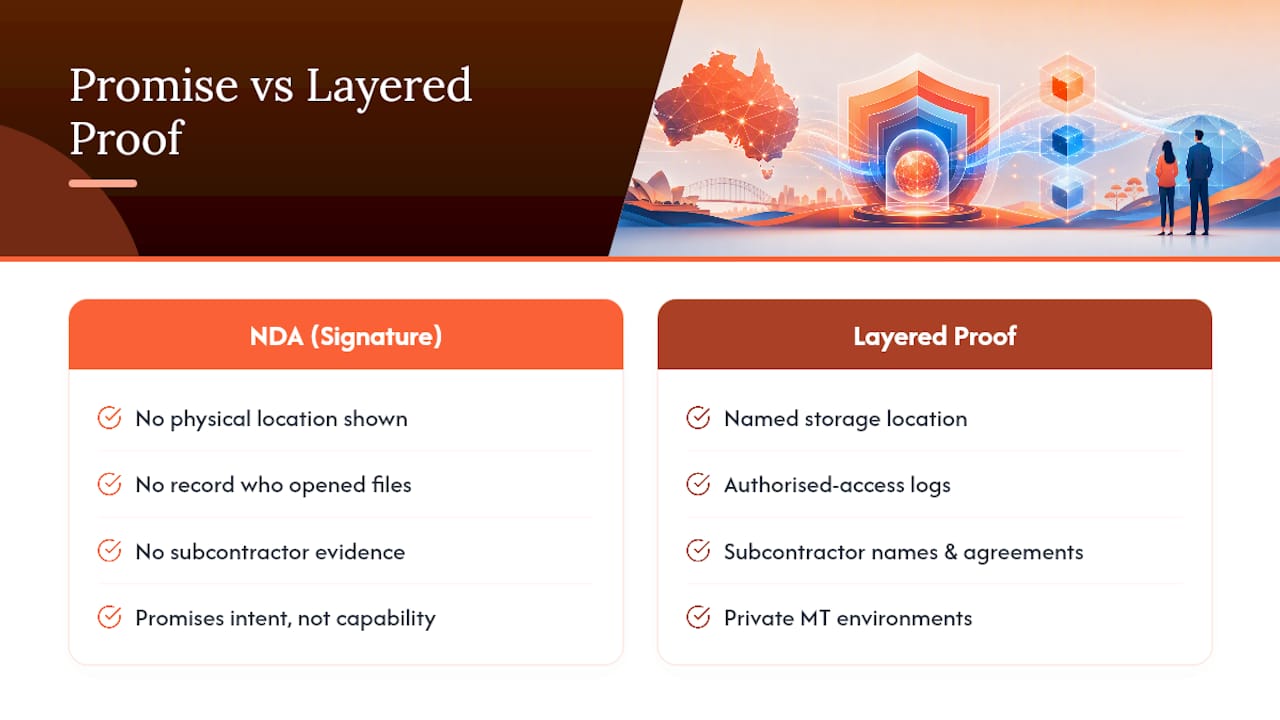
What the evidence actually supports is layered proof, not a single document. Ethics codes from NAATI and AUSIT set the professional floor. Privacy law sets the legal floor. Neither one, alone, stops a careless staff member from pasting your contract into a free AI tool at 11pm to save time. That’s an operational failure, not an ethics failure, and it needs an operational fix: private MT environments, access logs, and a provider willing to name its subcontractors rather than gesture vaguely at “our trusted network.”
If you take one thing from this, prioritise verifiability over reassurance. Ask for the DPA. Ask who touches the file. A provider that answers plainly is telling you more than one that simply promises to “take confidentiality seriously.”
— David
Certitranslate: certified translation built around confidentiality, not bolted onto it
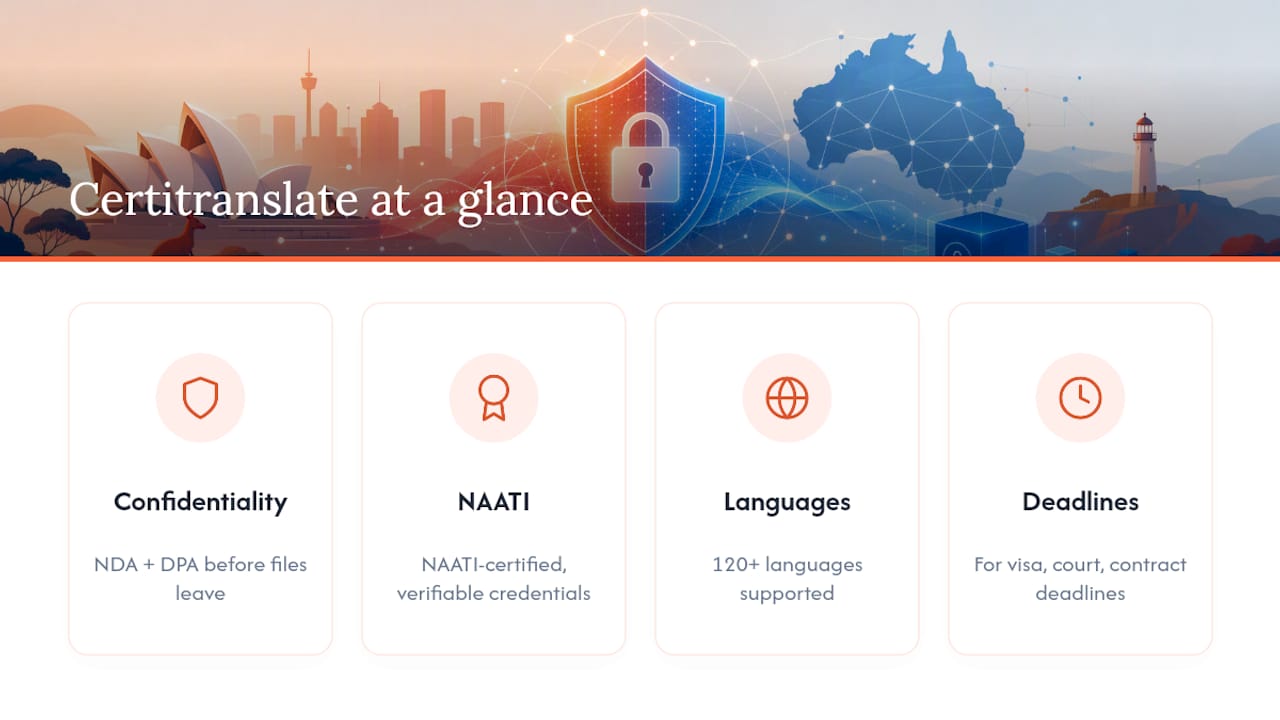
If you’ve read this far, you already know what to ask for: NDAs that cover every individual on a file, a DPA that names how your data is handled, and a translator whose credentials you can actually verify. Certitranslate is built around exactly that standard rather than treating it as an add-on for clients who ask.
Every document goes through NAATI-certified translators who work under the professional ethics obligations this article describes, across more than 120 languages, with the industry-specific terminology that legal, medical and immigration documents demand. That matters most for anyone facing a strict deadline: a visa application, a court filing, a business contract awaiting signature, where a rejected translation costs you weeks you don’t have.
If you need a certified translation for an official submission, get a quote through Certitranslate and ask directly about NDA and DPA terms before your files leave your hands.
This article is general information, not a substitute for advice from a qualified lawyer. Consult a qualified legal professional about your own circumstances before acting on anything here.
Sources
- AUSIT code of ethics and code of conduct
- NAATI code of ethics explainer (NAATI directory)
- Legislation
- Confidential? Not at all! — why translation tools may store your data (EU knowledge centre)