


If your certificate of incorporation isn’t in English, ASIC expects a certified English translation before it will accept your lodgement. In Australia, that translation should come from a NAATI-certified practitioner, not a general translation service, and it must be lodged alongside a certified copy of the original document.
Three things need to land on the desk together, and missing any one of them is the most common reason foreign company registrations get bounced back for rework.
- A certified copy of the certificate of incorporation, dated recently enough for acceptance by ASIC
- A complete certified English translation, with the practitioner’s NAATI ID, name, and signature or digital stamp on every page
- Confirmation that the company name on the translation matches the original exactly, with no anglicised spelling changes.
The three-month window is the detail most applicants miss. ASIC’s foreign company registration guidance requires the certified copy to be dated no more than three months before you lodge it, and if translation takes longer than expected, that certified copy can expire while you’re still waiting on the translated version.
Key Takeaways
Compliant ASIC lodgement of a certificate of incorporation requires a certified copy dated within three months, a complete NAATI-certified English translation, and an unbroken link between the two.
| Point | Details |
|---|---|
| Certified copy timing | Keep the certified copy dated within three months of lodgement, and order the translation immediately after. |
| Complete translation only | Translate every page, seal, and stamp; a partial translation is a common rejection reason. |
| Translator details on every page | Confirm the NAATI practitioner ID, name, date, and signature or QR code appear on each page, not just the cover. |
| Don’t anglicise the company name | Enter the registered name exactly as it appears on the original certificate. |
| Certitranslate for compliant lodgement | Certitranslate’s NAATI-certified translators format each page to ASIC and DFAT standards and keep the translation clearly linked to its certified original. |
Where to check the official rules yourself
ASIC’s own translation of documents guidance and its foreign company registration page are the first stops for confirming current lodgement requirements, since these pages are updated directly by the regulator.
- NAATI’s DFAT translation requirements resource sets out exactly what a compliant translation must show on each page.
- DFAT’s apostilles and authentication services page explains when legalisation of the original is needed before translation.
- The Corporations Act 2001, section 601CE sets out the statutory attachments required for foreign company registration.
If your translation will also be used overseas for notarised certification purposes, MyNotary’s overseas certification guidance is a useful reference for how notary-based pathways work outside Australia.
Table of Contents
- What does ASIC require for translating a certificate of incorporation?
- How long is a certified copy valid before you translate it?
- Who is qualified to translate a certificate of incorporation?
- Do you need an apostille as well as a translation?
- What’s the checklist for a compliant ASIC lodgement packet?
- How does a NAATI provider protect your document chain?
- Ready to lodge? How to order a compliant translation
- Sources
What does ASIC require for translating a certificate of incorporation?
ASIC’s own guidance is unambiguous: any document lodged with the regulator that isn’t in English must be accompanied by a certified English translation, and where that translation is produced in Australia, it should be done by a NAATI-certified practitioner. This isn’t a suggestion buried in fine print. It sits at the front of ASIC’s translation guidance because unclear or uncertified translations are a recurring cause of processing delays for foreign companies trying to register here.
The legal backbone for this sits in the Corporations Act itself. Section 601CE and related provisions set out exactly what a foreign company must attach when registering in Australia, and a certified copy of a current certificate of incorporation, or an equivalent document from the home jurisdiction, is on that list. This is a statutory requirement, not just administrative preference.
The certified copy and its translation form a single document chain. Break that chain, whether through a stale certification date or a translation that doesn’t reference the original clearly, and ASIC has no reliable way to confirm what it’s actually looking at.
One detail trips up more applicants than it should: your company name goes onto the translation exactly as it appears on the original certificate.
- Do not anglicise, translate, or “clean up” the registered name, even if it reads awkwardly in English
- Transliterate characters only where standard practice requires it, and note the transliteration method used
- Keep punctuation, capitalisation, and legal suffixes (Pty Ltd equivalents, GmbH, SA, and so on) exactly as issued
Get the name wrong and you risk a mismatch between your ASIC record and your original incorporation document, which creates problems well beyond the initial lodgement.
How long is a certified copy valid before you translate it?
A certified copy is a reproduction of your original certificate of incorporation that’s been verified as a true copy by an authorised certifier, typically a notary, solicitor, or equivalent authority in the issuing country, complete with their stamp, signature, and the date of certification. ASIC treats that certification date as the clock that starts ticking toward the three-month validity window.
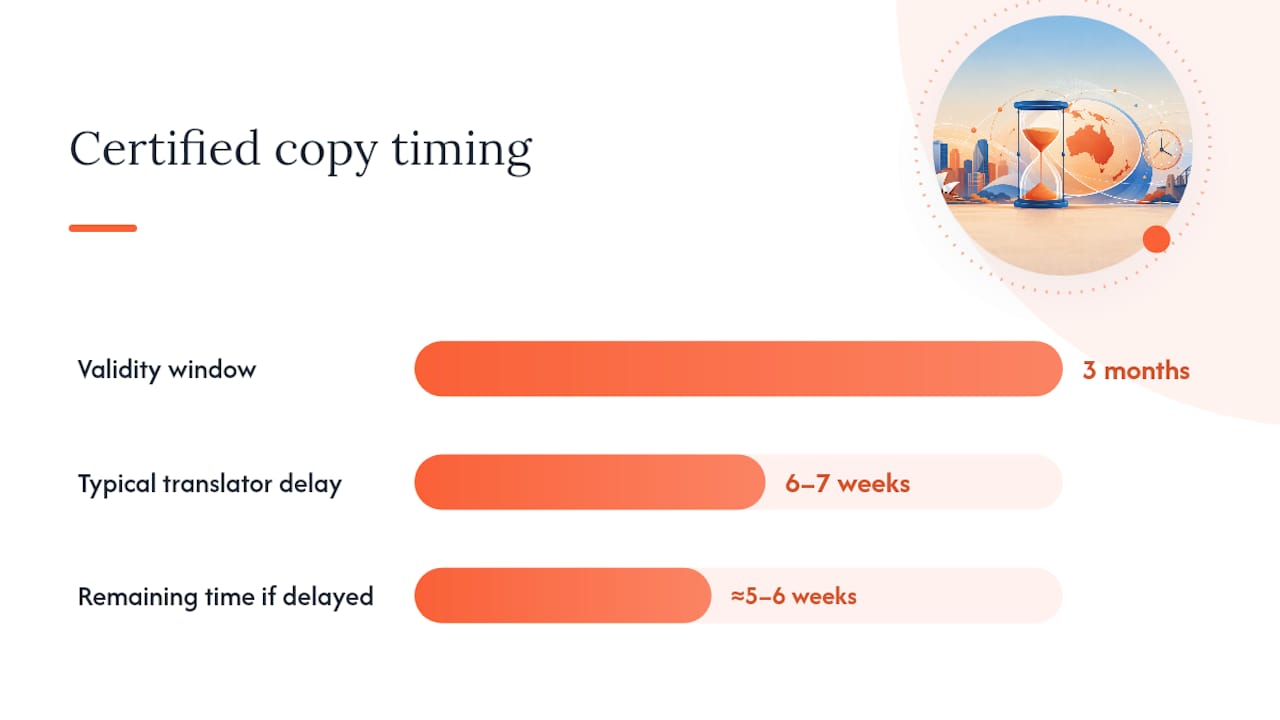
Here’s where timing catches people out. If you get your certified copy done first, then spend six or seven weeks sourcing a translator, negotiating turnaround, and waiting on delivery, you can easily burn through half your validity window before the translation even exists. Delays on the translation side don’t pause the three-month clock on the certified copy, and applicants who treat these as sequential rather than parallel tasks often end up re-certifying a document they’d already paid to have certified once.
The sequence that avoids this:
- Obtain your certified copy of the certificate of incorporation from an authorised certifier in the issuing jurisdiction.
- Order the certified English translation immediately, ideally the same week, rather than treating it as a later step.
- Before submission, check that the translator’s details, ID, name, date, and signature or stamp, appear on every single translated page, not just the final one.
Pro Tip: Book your translation order the same day you collect the certified copy. Treating the two as parallel tasks rather than sequential ones is the single easiest way to avoid a rejected lodgement.
Who is qualified to translate a certificate of incorporation?
For documents produced or lodged in Australia, a NAATI-certified practitioner is the safest option, and in most cases the only one ASIC and DFAT will accept without extra scrutiny. NAATI is Australia’s national accreditation body for translators and interpreters, and its certification is recognised uniformly across ASIC, DFAT, and the ATO. That consistency matters: an overseas credential might be perfectly legitimate in its home country and still trigger a manual verification request here, simply because the reviewing officer has no fast way to check it.
DFAT’s requirements, which ASIC lodgements should also follow where legalisation might later be needed, spell out exactly what must appear on a compliant translation:
- The translator’s NAATI practitioner ID number
- The language pair and certification type
- The translator’s full name
- The date the translation was completed
- Either a physical signature and stamp, or a “Digitally Authenticated by NAATI” QR code
All five details need to appear on every page of the translation, not just a cover sheet. A translation missing the practitioner ID on page two because it was only printed on page one is technically incomplete, even if the wording itself is accurate.
Overseas alternatives exist. A foreign sworn translator, a notary attached to the issuing country’s regulatory body, or a certification issued by the foreign regulator itself can sometimes be accepted, but expect ASIC to ask follow-up questions or request additional verification before it’s satisfied. If you have any choice in the matter, sourcing the translation locally through a NAATI practitioner avoids that back-and-forth entirely.

Do you need an apostille as well as a translation?
An apostille or consular legalisation authenticates the original document itself, confirming that the certificate of incorporation is a genuine record issued by a real authority in that country. A certified translation, by contrast, only confirms that the English text is an accurate rendering of that original. These are two separate jobs, and one doesn’t substitute for the other.
Whether you need both depends on the issuing country and what the document will ultimately be used for.
- If the issuing country is a member of the Hague Apostille Convention, an apostille on the original is usually sufficient authentication before translation
- If it isn’t a member, you may need full consular legalisation through DFAT’s authentication services before the translation is produced
- If the translation will later be used for a second purpose, such as a visa or migration application, plan for DFAT’s stricter NAATI documentation requirements from the outset rather than redoing the translation later
The practical rule is to sort out apostille or legalisation on the original before you commission the translation, wherever the issuing country requires it. Doing it in the wrong order means paying for a translation of a document that then needs to be re-authenticated, and possibly re-translated once the authentication is stamped onto it.
What’s the checklist for a compliant ASIC lodgement packet?
Most rejected lodgements fail for the same handful of avoidable reasons, and nearly all of them show up before the paperwork ever reaches an ASIC reviewer’s desk.
- Confirm your certified copy is dated within three months of your intended lodgement date.
- Commission a complete translation covering every page, seal, stamp, and annotation, not just the main body text.
- Check that the translator’s NAATI ID, name, date, and signature or digital stamp appear on each translated page.
- Leave all original seals, stamps, and letterheads untouched and visible, don’t crop, resize, or “tidy up” scanned images.
- Attach the certified copy and its translation together, clearly labelled so the reviewer can see which translation belongs to which original.
The errors that cause the most rework are depressingly simple: a partial translation that skips an appendix or a registration seal, a missing practitioner ID on one page out of six, a certified copy that’s technically expired by the time everything else is ready, or a company name that’s been quietly anglicised somewhere along the way.
Pro Tip: Build in five to ten business days of buffer beyond your translator’s quoted turnaround, especially if an apostille or legalisation step is involved. Authentication offices and translation providers rarely miss their own estimates by much, but the two processes stacking up back to back is where most timelines blow out.
How does a NAATI provider protect your document chain?
A NAATI-certified translator’s job doesn’t end at producing accurate English text. It includes making sure practitioner ID, date, and a legible NAATI stamp or QR code appear on every page, that scanned files aren’t compressed to the point the QR code becomes unreadable, and that the translation clearly references which certified copy it belongs to.
A translation that can’t be traced back to a specific certified original is a liability, no matter how accurate the language is. Clear file labelling and consistent formatting across every page are what actually get a lodgement through on the first attempt.
That’s the standard Certitranslate applies to every certificate of incorporation it handles: page-by-page verification, secure handling of original documents, and formatting that keeps the translation and certified copy unmistakably linked.
Ready to lodge? How to order a compliant translation
Certitranslate handles certificates of incorporation and related corporate documents through NAATI-certified translators who work specifically with ASIC and DFAT formatting requirements in mind, which means every page carries the practitioner ID, date, and stamp or QR code a reviewer expects to see, not just the summary page.
Ordering maps directly onto the checklist above. You upload your certified copy, specify that the translation is for ASIC or foreign company registration, and Certitranslate handles the page-by-page formatting, verification details, and document labelling that keep your certified copy and translation clearly linked. Turnaround is fast enough that most applicants can order the translation the same week they receive their certified copy, closing the timing gap that causes most re-certification headaches. For documents that also need DFAT legalisation, the team works from the stricter DFAT NAATI checklist from the start, so you’re not paying for a second pass later.
Start with the certified translation guide if you want the full picture of how certification works, or go straight to the NAATI translators page to upload your certificate of incorporation and get a turnaround estimate today.
A quick word on getting this right the first time
Most of the pain in this process isn’t the translation itself, it’s the sequencing. Businesses treat the certified copy and the translation as two separate errands, done whenever convenient, and that’s exactly how a perfectly valid certified copy expires while a translation is still sitting in someone’s inbox.
My honest recommendation, having looked closely at how ASIC and DFAT actually process these lodgements: use a NAATI-certified translator based in Australia wherever you have the choice, and order the translation the same week you receive your certified copy, not after. Overseas certification schemes aren’t invalid, but they invite scrutiny that a NAATI practitioner ID simply doesn’t. Certitranslate’s process is built around that exact sequencing problem, verifying practitioner details, document links, and formatting before anything goes anywhere near ASIC’s inbox.
— David
Sources
- Translation of documents — ASIC
- Register a foreign company in Australia — ASIC
- DFAT translation requirements — NAATI
- Corporations Act 2001 — AustLII (s 601CE)
- Apostilles, authentications and related services — DFAT
Recommended
- Statutory declaration translation requirements in Australia – CertiTranslate – Translations by NAATI Certified Translators
- Certified translation in inheritance matters: an Australian guide – CertiTranslate – Translations by NAATI Certified Translators
- Why original documents accompany translations: 2026 guide – CertiTranslate – Translations by NAATI Certified Translators
- Academic language translation best practices for Australia – CertiTranslate – Translations by NAATI Certified Translators