


Invoice translation for import is the process of converting a foreign-language commercial invoice into English so that the Australian Border Force (ABF) and the Department of Agriculture, Fisheries and Forestry (DAFF) can assess customs value, calculate GST, and conduct biosecurity checks against each declared line item. If your supplier’s invoice arrives in Mandarin, Arabic, Spanish, or any language other than English, you need a translated version before lodging your import declaration. For most government submissions, that means a NAATI-certified translation, not a Google Translate printout.
Two things to do right now: check every field on your invoice for non-English characters, and if the goods are subject to a DAFF biosecurity assessment or an import permit, order a NAATI-certified translation before the shipment arrives. Skipping that step risks manual inspection, detention, demurrage charges, and an incorrect duty or GST calculation that can trigger an audit.
Table of Contents
- What fields on a commercial invoice must you translate for customs?
- When is translation required for Australian imports?
- What types of translation and certification does Australia recognise?
- How do you prepare an invoice translation that customs will accept?
- When does machine translation work, and when does it put your shipment at risk?
- How do you order a certified invoice translation in Australia?
- What should you expect to pay, and how long does it take?
- Why accurate translations protect you during audits
- Common invoice terms and how they translate for Australian customs
- Key takeaways
- The mistake most importers make before the shipment arrives
- Certitranslate: certified invoice translations for Australian importers
- Authoritative Australian sources to save
What fields on a commercial invoice must you translate for customs?
Australian customs officers and biosecurity inspectors work line by line. A translated invoice that omits or mistranslates even one field can stall clearance. The commercial invoice is the document ABF uses to determine duties and taxes; a proforma invoice is preliminary and is not accepted for final valuation.
Fields that must appear in English on every translated invoice:
- Seller and buyer names and addresses
- Invoice number and invoice date
- Currency of transaction
- Unit price and quantity per line item
- Total invoice value
- Incoterms (e.g., FOB Shanghai, CIF Sydney)
- Tariff description or HS code reference
- Country of origin
- Net weight and gross weight per line
- Line numbers (critical for mapping to the import declaration)
Each of these fields feeds a specific part of the clearance process. ABF uses unit price, quantity, and currency to calculate customs value and GST. DAFF uses the tariff description, country of origin, and net weight to assess biosecurity risk. Incoterms determine which costs are included in the customs value calculation, so a mistranslated Incoterm can shift hundreds of dollars in duty.
Recommended bilingual layout for a translated invoice:
| Field | Original (e.g., French) | English translation |
|---|---|---|
| Line 1 description | Roulements à billes en acier | Steel ball bearings |
| Valeur unitaire | — | — (unit price) |
| Valeur totale | — | — (total value) |
| Pays d’origine | Allemagne | Germany |
| Incoterms | FOB Hambourg | FOB Hamburg |
Present the original text alongside the English translation on the same page. Keep the original line numbers intact. When you lodge your import declaration, the line numbers on the translated invoice must match the line numbers in your declaration exactly.
Pro Tip: Before sending the invoice to a translator, confirm it is the final commercial invoice, not a proforma. Exporters sometimes send proformas by default. A proforma translated and submitted to ABF can trigger a valuation query and delay clearance.
When is translation required for Australian imports?
The short answer: whenever a document lodged with ABF or DAFF contains non-English text. DAFF’s minimum documentary requirements policy states that documents submitted for biosecurity assessment must use English characters and must reference each line of the import declaration to the corresponding goods on the invoice.
Scenarios that trigger mandatory or strongly recommended translation:
- Goods subject to a BICON case or import permit where the invoice contains commodity-specific declarations
- Invoices accompanying biosecurity-sensitive goods (timber, food, plant material, animal products)
- Any import where the invoice, packing list, or lot code list contains non-English text
- Goods cleared through IFIS (Import Food Inspection Scheme) where label and ingredient declarations must be verified
- High-value goods where ABF requires documentary evidence of customs value
When a BICON case requires statements such as mosquito declarations or lot code endorsements, the invoice may also need to be endorsed by a company employee with explicit declaration language. DAFF enforces these rules strictly, and an unendorsed or untranslated document will not satisfy the requirement.
Poor translations flag consignments for manual inspection. That means detention, demurrage, and in serious cases, penalties under the Customs Act 1901 for incorrect declarations.
For internal use, such as checking a supplier’s price list or reviewing a draft invoice before the shipment leaves the origin country, a simple machine translation is generally acceptable. The moment a document is lodged with a government agency, a certified human translation is the standard you need.
What types of translation and certification does Australia recognise?
Not all translations carry the same weight with Australian authorities. Understanding the difference saves you from submitting a document that gets rejected.
Simple (lay) translation is an informal translation produced by a bilingual person or a machine translation tool. It is useful for internal review, buyer-seller communication, and pre-clearance checks. ABF and DAFF will not accept a simple translation as the sole basis for a biosecurity assessment or a formal import declaration where the original is in a foreign language.
Certified translation (NAATI-certified) is produced by a translator accredited by the National Accreditation Authority for Translators and Interpreters (NAATI). The translation is accompanied by a translator statement that confirms the translator’s credentials, declares the translation is accurate and complete, and provides a date and contact. This is the standard ABF and DAFF expect for formal submissions. You can read more about what certified translation involves and why the NAATI credential matters for government acceptance.
Notarisation, attestation, and apostille are rarely required for commercial invoices in routine import clearance. They become relevant when a translated invoice is used in legal proceedings, a court-ordered valuation dispute, or a formal permit application that specifically requests a notarised document. If your import permit or BICON case does not mention notarisation, you do not need it.
A compliant translator statement for customs and DAFF purposes should include:
- Full name of the translator
- NAATI credential number and language pair
- A declaration that the translation is accurate and complete to the best of the translator’s knowledge
- Date of translation
- Translator’s signature and contact details
This block should appear on the same page as the translation or as a signed cover page attached to it.
How do you prepare an invoice translation that customs will accept?
Follow these steps in order. Skipping any one of them is where most clearance problems start.
- Identify any BICON or permit requirements. Log into BICON and confirm whether your commodity requires specific declarations or endorsements on the invoice.
- Request a NAATI-certified translation — Provide the translator with the original invoice, the language pair, any relevant HS codes or commodity descriptions, and the import permit or BICON case number if applicable.
- Attach the original. Australian authorities prefer originals alongside certified translations. Lodge both the original and the translation together.
- Lodge via the correct channel. For DAFF email lodgement, follow the DAFF email lodgement requirements, which specify the email coversheet details, the import permit number, and which documents to attach.
When emailing documents to DAFF, your coversheet must include the import permit number, the consignment reference, and a list of every attached document. A translated invoice without a coversheet referencing the permit number is treated as incomplete.
Pro Tip: When uploading to an ICS portal or emailing DAFF, merge the translated invoice, the translator statement, and the original into a single PDF in that order. One file is faster to process than three separate attachments, and it reduces the chance of a document being separated from its statement.
When does machine translation work, and when does it put your shipment at risk?
Machine translation tools such as Google Translate and DeepL have improved significantly, but they have a consistent failure mode on import documentation: technical and regulatory terminology.
Where machine translation is acceptable:
- Internal review of a supplier’s draft invoice before the shipment is confirmed
- Pre-clearance checks to identify which fields need attention
- Buyer-seller communication where no government submission is involved
- Rough verification that a translated invoice covers all expected line items
Where machine translation creates real risk:
- Any document lodged with ABF or DAFF
- Incoterms: machine tools frequently translate “FOB” as a generic term rather than the specific trade term, or mistranslate the named port
- HS tariff descriptions: commodity-specific language such as “unroasted, not decaffeinated Arabica coffee beans” requires precise wording that affects both the tariff classification and biosecurity risk category
- Biosecurity declarations: a mistranslated lot code statement or mosquito-status declaration can result in the goods being detained for manual inspection
- Country-of-origin statements: errors here affect preferential tariff eligibility
Professional translation is essential for documents containing biosecurity or regulatory declarations, and accurate documentation speeds clearance. When the terminology is technical and the consequences of error include detention or penalties, a NAATI-certified human translator is the only safe choice. The cost of a certified translation is a fraction of one day’s demurrage on a detained container.
How do you order a certified invoice translation in Australia?
The process is straightforward when you know what to prepare before you contact a translation service.
- Collect the originals. Gather the final commercial invoice, packing list, and any permit or BICON case reference documents.
- Identify the language pair and technical context. Note the source language and flag any commodity-specific terminology, HS codes, or biosecurity declarations the translator needs to handle accurately.
- Choose a NAATI-certified provider. Verify that the translator or service holds current NAATI accreditation for the relevant language pair. You can check credentials through the NAATI online register.
- Brief the translator on the import context. Provide the import permit number or BICON case number, the relevant HS codes, and any specific declaration language DAFF requires.
- Request a bilingual layout and a signed translator statement. Specify that line numbers must be preserved and that the statement must include the translator’s NAATI credential number.
- Request a native-language verifier for complex technical terms. For highly specialised commodities such as pharmaceutical ingredients or industrial chemicals, a second reviewer with subject-matter expertise reduces the risk of terminology errors.
- Receive, review, and file. Check that every field from the original appears in the translation, that line numbers match, and that the translator statement is signed and dated.
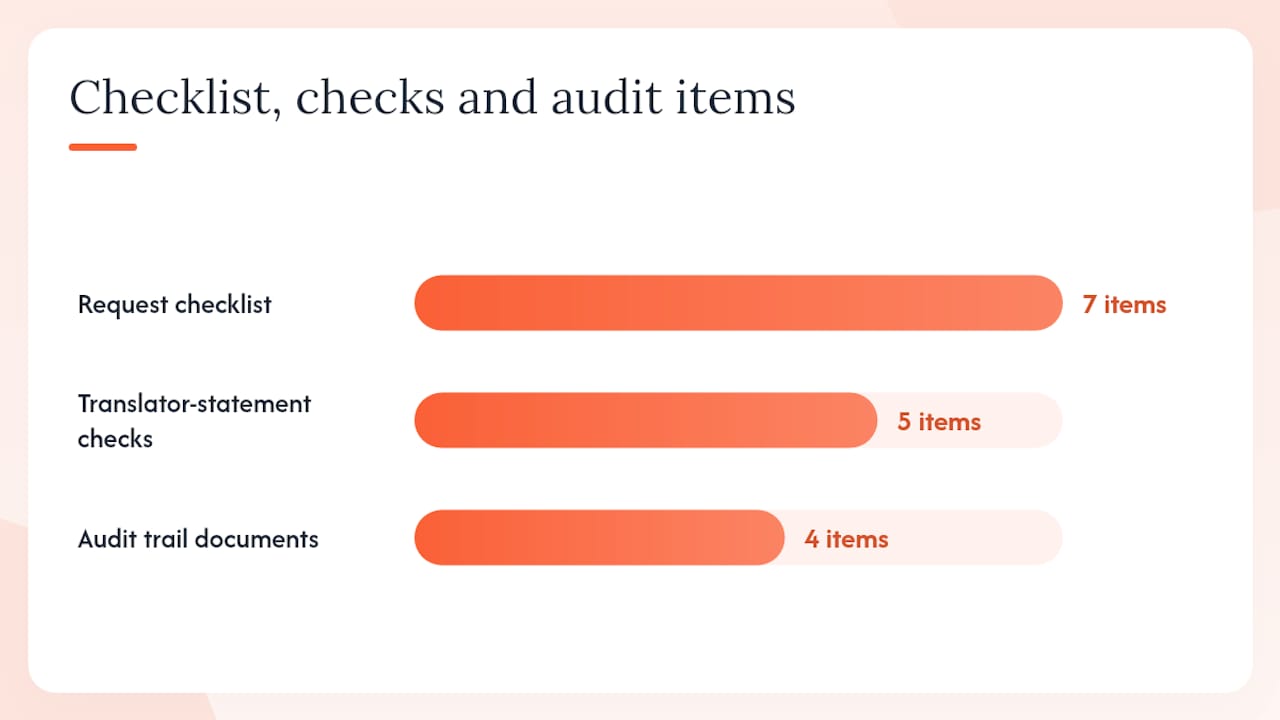
Checklist for requesting a translation from a service provider:
- Original invoice in highest-quality scan or native PDF
- Preferred file format for delivery (PDF, DOCX, or both)
- Import permit number or BICON case number (if applicable)
- Instruction to preserve original line numbers
- Request for bilingual layout
- Request for signed translator statement with NAATI credential number
- Turnaround requirement (standard or expedited)
What to check on the translator statement before submitting to ABF or DAFF:
- Translator’s full name matches the NAATI register
- NAATI credential number is present and current
- Language pair is stated explicitly
- Declaration of accuracy is signed and dated
- Contact details are included
DAFF provides documentary requirements templates, including translated factsheets in several languages, which give useful guidance on the format and content expected for translated submissions.
Under the Customs Act 1901, importers must retain commercial documents for five years. Store the original invoice, the certified translation, and the translator statement together with the import declaration reference number. That combination is your audit trail.
What should you expect to pay, and how long does it take?
Pricing for certified invoice translation in Australia varies based on several factors. There is no single flat rate, but the cost is almost always less than the demurrage or penalty exposure it prevents.
Factors that drive the cost:
- Language rarity: Common language pairs (Mandarin, Spanish, French) are priced lower than rare pairs (Tigrinya, Khmer, Pashto).
- Word count and document complexity: A single-page invoice with ten line items costs less than a multi-page invoice with technical commodity descriptions.
- Technical terminology: Invoices with HS code descriptions, biosecurity declarations, or chemical nomenclature require a specialist translator and attract a higher rate.
- Certification requirement: A NAATI-certified translation with a signed translator statement costs more than a simple translation, but it is the only version accepted for government submission.
- Notarisation: Rarely required for invoices, but if needed, adds cost and time.
- Rush fees: Same-day or next-business-day certified translations attract a premium, typically a percentage surcharge on the standard rate.
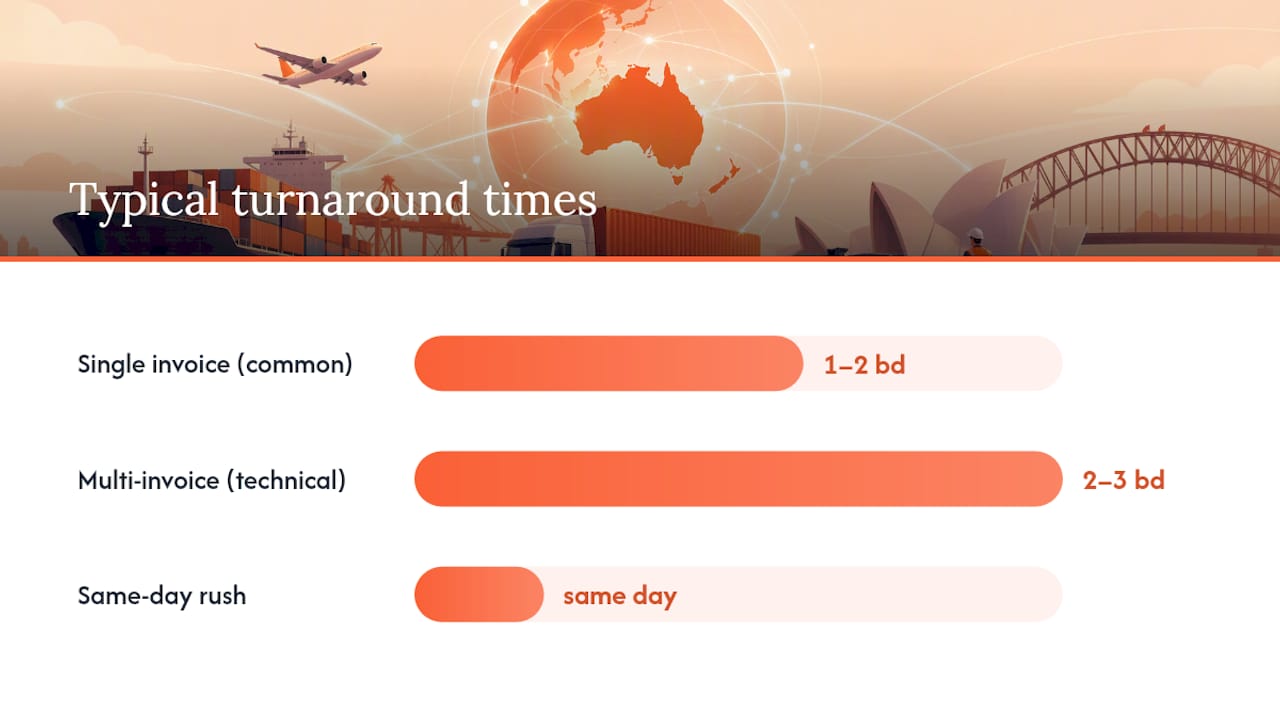
Typical turnaround scenarios:
- Single commercial invoice, common language pair: 1–2 business days for certified translation
- Multi-invoice consignment with technical descriptions: 2–3 business days
- Rush same-day certified translation: available from specialist providers for an additional fee
When structuring a purchase order for translation services, specify the document type, language pair, word count estimate, required format, certification level, and deadline. That scope prevents surprise costs and ensures the translator delivers exactly what customs needs. For importers who regularly receive invoices in the same language, a standing arrangement with a NAATI-certified provider is more cost-effective than ordering ad hoc. The benefits of professional certified translation extend beyond compliance to faster clearance and fewer broker queries.
If you are a small business importer, translated invoice values also feed directly into your BAS reporting. Accurate translation of the invoice currency and total value matters for GST credit calculations and reconciling your import costs against your BAS.
Why accurate translations protect you during audits
ABF import declarations create a paper trail that can be audited years after clearance. The Customs Act 1901 requires importers to retain commercial documents, including invoices, for five years. Translated invoices and their accompanying translator statements are part of that obligation.
What to store for a five-year audit trail:
- Original foreign-language invoice (highest-quality scan or native file)
- Certified English translation
- Signed translator statement with NAATI credential number
- Import declaration reference number
- Import permit or BICON case number (if applicable)
- Email lodgement confirmation from DAFF (if applicable)
During an audit, ABF or DAFF may request the original invoice alongside the translation to verify that the translated values match the declared customs value. A missing or unsigned translator statement is treated as an incomplete record, which can extend the audit and attract penalties.
Assign a single internal custodian for import documentation, whether that is your customs broker, your compliance officer, or your accounts team. Inconsistent filing is the most common reason translated documents cannot be located during an audit.
Pro Tip: Store the signed translator statement, the original invoice, and the import declaration reference number in a single folder named by consignment. When an auditor asks for documentation, you can produce the complete set in under a minute.
Common invoice terms and how they translate for Australian customs
When checking a translated invoice, these are the terms most likely to appear in a foreign-language original and the English equivalents customs expects.
| Foreign term | Idioma | Correct English translation |
|---|---|---|
| Quantité | Francés | Quantity |
| Valeur unitaire | Francés | Unit price |
| Valeur totale | Francés | Total value |
| Pays d’origine | Francés | Country of origin |
| Poids net / Poids brut | Francés | Net weight / Gross weight |
| Menge | Alemán | Quantity |
| Einzelpreis | Alemán | Unit price |
| Gesamtbetrag | Alemán | Total amount |
| Ursprungsland | Alemán | Country of origin |
| 数量 (shùliàng) | Mandarin | Quantity |
| 单价 (dānjià) | Mandarin | Unit price |
| 总价 (zǒngjià) | Mandarin | Total price |
| 原产地 (yuánchǎndì) | Mandarin | Country of origin |
| Cantidad | Español | Quantity |
| Precio unitario | Español | Unit price |
| Valor total | Español | Total value |
| País de origen | Español | Country of origin |
Points to watch when translating for customs:
- Incoterms must be translated as the standard three-letter code plus the named place: “FOB Shanghai”, not “free on board Shanghai port.”
- HS tariff descriptions should use the most specific standard wording available. “Steel ball bearings, not tapered” is more useful to a customs officer than “metal round parts.”
- Country-of-origin statements affect preferential tariff eligibility under Australia’s free trade agreements. A vague translation such as “made abroad” is not acceptable.
- Ambiguous commodity descriptions should default to the more specific HS wording rather than a generic term.
Sample bilingual invoice line with correct line-number mapping:
Line 3 | Roulements à billes en acier inoxydable, non effilés | Line 3 | Stainless steel ball bearings, not tapered | Qty: 200 | Unit price: EUR 6.50 | Total: EUR 1,300.00 | Origin: Germany
The line number appears in both the original and the translation, and it matches the line number in the import declaration. That is the mapping ABF and DAFF need.
Key takeaways
Invoice translation for import in Australia requires English-character documents that map line by line to the import declaration, with NAATI-certified translations mandatory for any submission to ABF or DAFF.
| Point | Details |
|---|---|
| NAATI certification is required for government submission | Simple or machine translations are not accepted by ABF or DAFF for formal import declarations or biosecurity assessments. |
| Line-number mapping is non-negotiable | Every translated invoice line must match the corresponding line in your import declaration to satisfy DAFF’s minimum documentary requirements. |
| Retain documents for five years | The Customs Act 1901 requires importers to keep commercial documents, including certified translations and translator statements, for five years. |
| Machine translation is for internal use only | Use machine translation for pre-clearance checks; commission a NAATI-certified human translator for any document lodged with a government agency. |
| Certitranslate delivers NAATI-certified invoice translations | Certitranslate provides NAATI-certified translations accepted by ABF and DAFF, with bilingual formatting, signed translator statements, and expedited options for time-sensitive shipments. |
The mistake most importers make before the shipment arrives
The conventional wisdom is that translation problems get caught at the border. In practice, they get caught much earlier, or much later, and both are worse than people expect.
Earlier: a customs broker reviews the invoice the night before the vessel berths and realises the entire document is in Mandarin with no English translation. The broker cannot lodge the import declaration. The shipment sits on the wharf. Demurrage starts accumulating at a rate that quickly exceeds the cost of a certified translation by a factor of ten or more.
Later: the goods clear because the broker used a rough machine translation to get through. Two years later, ABF conducts a post-clearance audit and requests the original invoice and the translation used at the time of entry. The machine translation is retrieved, and it contains a mistranslated Incoterm that shifted the customs value calculation. The importer faces a duty shortfall assessment plus interest.
Neither scenario is rare. The first is the most common complaint customs brokers raise about importer-prepared documentation. The second is less visible because audits happen quietly, but the financial exposure is significant.
The part people underestimate is how specific the requirements are. It is not enough to have a translated invoice. The translation must preserve line numbers, use the correct English equivalents for Incoterms and tariff descriptions, include a signed NAATI translator statement, and be lodged alongside the original. A translation that ticks four of those five boxes can still fail.
The practical fix is simple: treat the certified translation as part of the import cost, not an optional extra. Order it when you confirm the purchase order, not when the container is on the water.
Certitranslate: certified invoice translations for Australian importers
Australian importers who need a NAATI-certified translation that ABF and DAFF will accept without a query have one clear option: a specialist provider whose translators hold current NAATI accreditation and understand import documentation requirements.
Certitranslate delivers NAATI-certified translations for commercial invoices, packing lists, and biosecurity declarations across more than 120 languages. Every translation includes a bilingual layout with original line numbers preserved, a signed translator statement with the translator’s NAATI credential number, and delivery in PDF format ready for DAFF email lodgement or ICS portal upload. Expedited same-day and next-business-day options are available for time-sensitive shipments. When you order, include your import permit number or BICON case number so the translator can reference the correct declaration language.
Order a certified invoice translation through Certitranslate, or read the complete guide to certified translation for import and export agreements to understand exactly what your shipment requires before it arrives.
Authoritative Australian sources to save
Every importer handling foreign-language documentation should have these references bookmarked.
Primary government sources:
- Minimum documentary and import declaration requirements policy – DAFF
- Lodgement of import documentation via email – DAFF
- How to import – Australian Border Force
- Customs Act 1901 importer obligations: declarations, tariff classification and valuation | Rules Mate
- Australia import requirements and documentation – trade.gov
- Commercial invoice requirements for Australian customs: Template & tips – Phoenix SCM
- Documentary requirements templates – DAFF
- Import declarations – Australian Border Force
Supporting references:
| Source | Why it matters |
|---|---|
| Customs Act 1901 importer obligations (Rules Mate) | Explains the five-year document retention obligation and the risks of incorrect declarations. |
| Commercial invoice requirements (Phoenix SCM) | Clarifies the difference between commercial and proforma invoices and what customs needs for correct valuation. |
| Australia import requirements (trade.gov) | US government trade guide covering Australian import documentation, including the role of professional translation for biosecurity declarations. |
| Certitranslate NAATI translators | Landing page for ordering certified invoice translations and verifying NAATI credentials. |
This article provides general information about invoice translation requirements for Australian imports. It is not legal or customs advice. Confirm current requirements with ABF, DAFF, or a licensed customs broker before lodging import documentation.
Recommended
- Translation requirements for Australian tenders: 2026 guide – CertiTranslate – Translations by NAATI Certified Translators
- How import export documents are translated: 2026 guide – CertiTranslate – Translations by NAATI Certified Translators
- Certified translation for import/export agreements: 2026 guide – CertiTranslate – Translations by NAATI Certified Translators
- How QA documents are translated for Australian compliance – CertiTranslate – Translations by NAATI Certified Translators