


Certified translation for Australian immigration is defined as a translation of a non-English document produced by a NAATI-accredited translator and accepted by the Department of Home Affairs as legally valid. Every non-English document you lodge with a visa application must meet this standard. The Department of Home Affairs requires the translator’s name, NAATI number, signature, certification statement, and date to appear on the translation itself. Getting this wrong is one of the fastest ways to receive a Request for Further Information notice and push your application timeline back by weeks or months. This guide covers exactly what you need to translate documents for Australian immigration in 2026 without delays.
Which documents need certified NAATI translation for Australian immigration in 2026?
The Department of Home Affairs requires a certified English translation for every non-English document in your application. That rule applies regardless of visa subclass. The documents that come up most often fall into four clear categories.
Identity documents are the most common. These include birth certificates, passports, national identity cards, and adoption papers. Even if a passport contains some English text, any non-English sections require translation. For birth certificate requirements, the 2026 translation guide from Certitranslate covers the specific fields officers check.
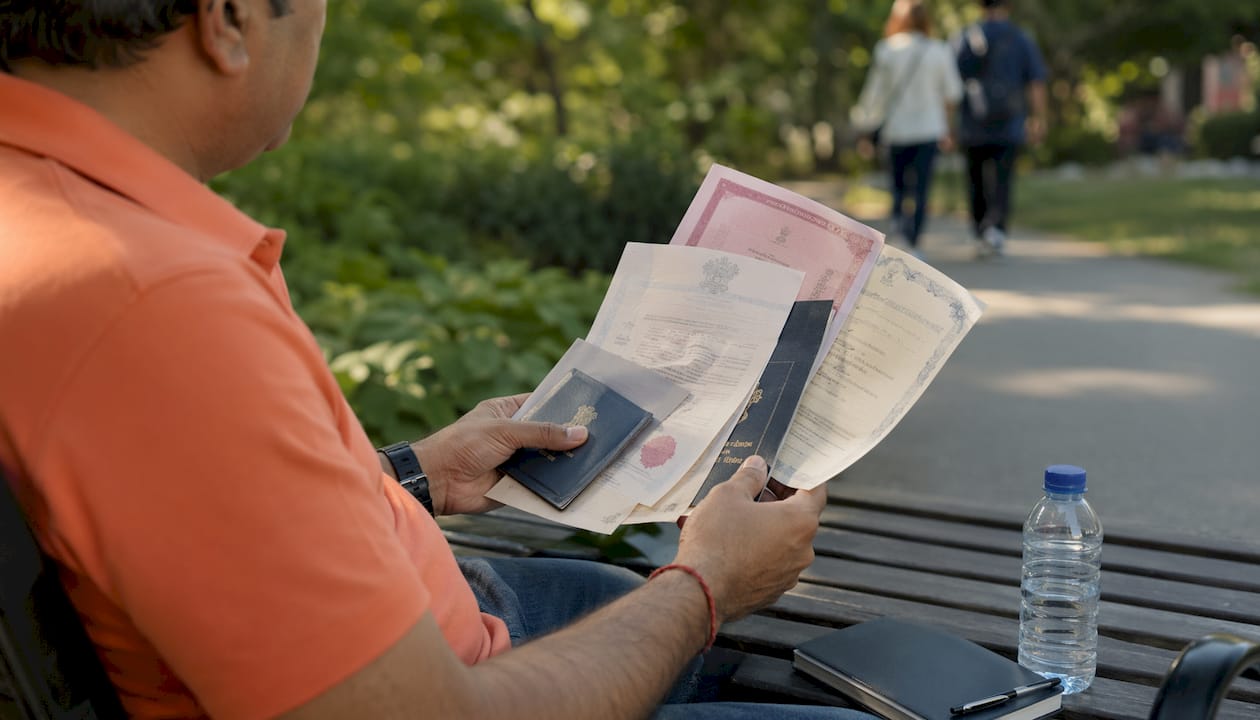
Relationship documents are the second major category. Marriage certificates, divorce decrees, de facto statutory declarations, and death certificates all require full certified translation. Missing certified translations of relationship evidence is a top cause of Request for Further Information notices in partner visa applications. A single untranslated foreign marriage certificate can stall a subclass 820 or 309 application for months.
Character documents include police clearances from every country you have lived in for 12 months or more since turning 16. These must be translated in full, not summarised. Partial translations of police clearances are not accepted.
Education and employment documents matter for skilled and student visa applicants. Academic transcripts, degree certificates, professional licences, and employment references written in a language other than English all require certified translation. Student visa applicants translating academic records should also check the university acceptance requirements for certified translations, as some institutions have their own formatting expectations.
One nuance worth knowing: extract translations that capture key data fields are often acceptable for standard civil documents, but full translations are required for legal proceedings and tribunal documents. If your document is headed to the Administrative Appeals Tribunal, do not rely on an extract.
| Document type | Translation requirement |
|---|---|
| Birth certificate | Full certified translation |
| Marriage or divorce certificate | Full certified translation |
| Police clearance | Full certified translation |
| Academic transcripts | Full certified translation |
| Passports (non-English sections) | Certified translation of all non-English text |
| Civil documents for visa lodgement | Extract translation acceptable if key fields are complete |
How do you verify a NAATI-certified translator?
The NAATI Online Directory is the only reliable way to confirm a translator’s credentials. You search by name or practitioner number and confirm the translator holds a current certification in the relevant language pair. Caseworkers verify credentials by doing exactly this lookup. If the number does not appear or the certification has lapsed, the translation will not be accepted.
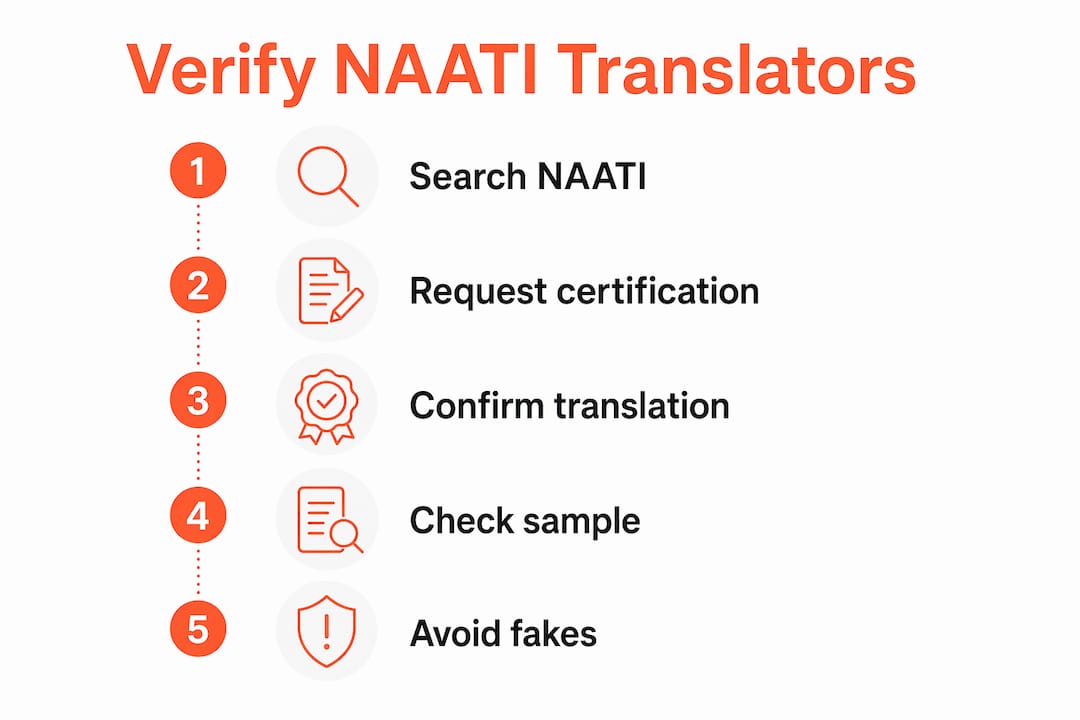
Fake translator stamps are a real problem in the Australian market. Some providers use stamps that look official but carry no valid NAATI number. You can verify NAATI accreditation online in minutes, and doing so before you pay protects you from fraudulent certifications and application rejections.
The rules differ slightly for documents translated overseas. Notarised translations from overseas are often questioned by Home Affairs and can require resubmission. NAATI-certified local translations remain the gold standard for visa applications lodged inside Australia. If you have a translation done abroad, check with a migration agent before submitting it.
Here is a clear process for selecting a qualified translator:
- Go to the NAATI Online Directory at naati.com.au and search for a practitioner certified in your required language pair.
- Confirm the certification status shows as current, not lapsed or suspended.
- Ask the translator to provide their NAATI practitioner number in writing before you engage them.
- Check that the final translation carries the translator’s name, NAATI number, signature, certification statement, and date.
- Cross-reference the number on the delivered translation against the directory one final time before lodging.
Pro Tip: Ask your translator for a sample certification statement before they begin work. A legitimate NAATI-certified translator will produce one immediately. Hesitation or a vague response is a warning sign.
For more guidance on selecting the right professional, Certitranslate’s translator selection guide walks through the key questions to ask.
How do you submit translated documents in your Australian immigration application?
Every translated document must be submitted alongside a copy of the original. This is not optional. Original documents must accompany translations so that officers can compare the two side by side. Submitting a translation without the original is a common reason applications receive a Request for Further Information.
Layout fidelity is one of the most overlooked requirements. Officers visually compare pages, headings, tables, and signature blocks between the original and the translation. If the translated document restructures the layout or omits a section heading, it can trigger a delay even when the text itself is accurate. The translation should mirror the original’s structure as closely as possible.
Key steps for preparing and uploading your documents through ImmiAccount:
- Scan originals at a minimum of 300 DPI so that stamps, seals, and handwritten text are clearly legible.
- Name your files descriptively, for example “birth-certificate-original.pdf” and “birth-certificate-translation.pdf,” rather than using default scanner filenames like “scan001.pdf.”
- Upload the original and its translation as a paired set, not as separate unrelated files.
- Check that the PDF file size falls within ImmiAccount’s upload limits before submitting.
- Review each uploaded file in the ImmiAccount preview to confirm the scan is not cut off at the edges.
Pro Tip: Merge the original and its translation into a single PDF in the correct order: original first, translation second. Officers find paired documents far easier to assess, and it reduces the chance of a mismatch query.
The immigration document translation process guide from Certitranslate covers the full submission workflow in detail, including file format requirements for different visa subclasses.
What mistakes cause delays when submitting translated immigration documents?
Inconsistent name spellings across documents are the single most common cause of avoidable delays. If your birth certificate transliterates your name one way and your police clearance transliterates it another way, a visa officer will flag the discrepancy. Consistent name spelling across all translations and original documents is not a minor detail. It is the difference between a smooth assessment and a formal request for explanation.
Other frequent errors include:
- Untranslated stamps and seals. Stamps, seals, and handwritten annotations in foreign languages must be translated and described in English. Marking them as “illegible” is not acceptable and often causes rejection.
- Self-translations or family member translations. Home Affairs does not accept translations produced by the applicant or a family member, regardless of their language skills. Only a NAATI-certified translator qualifies.
- Incomplete translations. Leaving out a section because it seems irrelevant is a mistake. Officers expect the translation to account for every element of the original document.
- Missing certification details. A translation without the translator’s NAATI number, signature, or certification statement is treated as unverified. Incorrect or unverifiable translations are a leading cause of Request for Further Information notices and visa delays.
Translations must include an explicit certification statement by the translator confirming truth and accuracy, alongside a verifiable NAATI practitioner number and signature. A translation that omits any of these elements is not a certified translation under Australian immigration standards, regardless of how accurate the language itself may be.
Key takeaways
Certified NAATI translation is the non-negotiable standard for every non-English document in an Australian immigration application, and errors in credentials, formatting, or name consistency are the leading causes of avoidable delays.
| Point | Details |
|---|---|
| NAATI certification is mandatory | Every non-English document must be translated by a NAATI-certified practitioner. |
| Verify credentials before engaging | Check the NAATI Online Directory to confirm the translator’s number is current before paying. |
| Layout must mirror the original | Officers compare structure side by side; restructured formatting can trigger a delay even with accurate text. |
| Translate all stamps and seals | Handwritten notes, official seals, and stamps must be described in English, not left blank. |
| Consistent name spelling matters | Name transliterations must match across every document in the application to avoid identity queries. |
What I’ve learned from watching immigration applications succeed and fail
The applications that sail through assessment share one quality: the applicant treated translation as a compliance task, not an afterthought. The ones that stall almost always involve a translation sourced from an unverified provider, a name spelled differently across two documents, or a stamp left blank because someone assumed it was decorative.
The credential verification step is where most people cut corners. Checking the NAATI Online Directory takes about three minutes. Recovering from a rejected translation takes weeks, sometimes months, and often costs more than the original translation did. The maths are straightforward.
What surprises people is how seriously officers treat layout. I have seen applications delayed because a translated birth certificate used a two-column layout when the original was a single column. The text was perfect. The structure was not. Caseworkers use side-by-side comparison as a standard check, and a document that looks structurally different raises an immediate question about completeness.
My strongest recommendation is to use a NAATI-certified specialist who has direct experience with immigration documents, not just general translation work. Immigration documents carry specific formatting conventions, certification language, and field-by-field expectations that general translators sometimes miss. The difference in outcome is real.
— David
Certitranslate: certified immigration translation, done right
Certitranslate works with NAATI-certified translators who specialise in Australian immigration documents. Every translation covers the full document, including stamps, seals, handwritten annotations, and certification statements, so your application meets Department of Home Affairs standards from the first submission.
Turnaround times are built around immigration deadlines, not general business schedules. Whether you need a birth certificate, police clearance, marriage certificate, or a full set of documents for a skilled visa, Certitranslate’s team handles the detail. Read the certified translation guide to understand exactly what the standard requires, or go straight to the NAATI translation service to get started.
Preguntas frecuentes
What is a certified translation for Australian immigration?
A certified translation is a translation of a non-English document produced by a NAATI-accredited translator, accompanied by the translator’s name, NAATI number, signature, certification statement, and date. The Department of Home Affairs requires this standard for all non-English documents lodged with a visa application.
Can I translate my own documents for an Australian visa?
No. Home Affairs does not accept self-translations or translations produced by family members. Only a NAATI-certified translator qualifies to produce an accepted certified translation for immigration purposes.
Do I need to submit the original document with the translation?
Yes. Every translation must be submitted alongside a copy of the original document. Officers compare the two side by side, and submitting a translation without the original is a common cause of Request for Further Information notices.
Are overseas notarised translations accepted by Home Affairs?
Notarised translations from overseas are frequently questioned and can require resubmission. For visa applications lodged inside Australia, NAATI-certified local translations are the accepted standard and carry the least risk of challenge.
What happens if my translation has an error or missing details?
Incorrect or unverifiable translations are a leading cause of Request for Further Information notices and visa processing delays. Home Affairs may request a new certified translation, which adds time and cost to your application.
Recommended
- Why original documents accompany translations: 2026 guide – CertiTranslate – Translations by NAATI Certified Translators
- Immigration document translation process: a complete guide – CertiTranslate – Translations by NAATI Certified Translators
- Translate birth certificate for immigration: 2026 guide – CertiTranslate – Translations by NAATI Certified Translators
- Certified Translations for Australia