


A translated professional membership certificate is a certified document that converts your professional body credentials into another language, verified by an accredited translator for official use. In Australia, this type of document plays a direct role in licence approvals, skills assessments, and employer recognition. Understanding what is a translated professional membership certificate, and how to obtain one correctly, can determine whether your application succeeds or stalls at the first review. The standard for these translations in Australia is set by NAATI, the national accreditation authority for translators and interpreters.
What does a translated professional membership certificate include?
A translated membership certificate is more than a word-for-word conversion of your original document. It is a complete package that carries specific certification elements required by Australian authorities. NAATI-certified translations must include the translator’s full name, their Certified Practitioner Number (CPN), the language direction of the translation, an expiry date, and either a physical signature or a digital stamp.

The CPN is the single most important identifier on the document. It links the translation directly to a verified professional in the NAATI online directory, allowing any receiving body to confirm legitimacy within minutes.
A properly prepared translated certificate typically contains:
- The full translated text of the original membership certificate
- A signed statement affirming the translation’s accuracy and the translator’s qualifications
- The translator’s name and CPN
- The credential direction (for example, Spanish to English)
- The translation’s expiry date
- A physical signature or NAATI digital stamp with an encrypted QR code
Pro Tip: Before accepting a translated document from any service, search the translator’s CPN in the NAATI online directory. If the number does not appear, the translation is invalid for official submission.
The verification process is straightforward when the CPN is present. You enter the number into the NAATI directory, confirm the translator’s active status, and check that the language pair matches your document. The most common pitfall is receiving a translation without a CPN at all. If a translator refuses to provide their CPN, or it does not appear in the directory, Australian authorities will reject the translation outright.
Why does NAATI certification matter for professional certificate translation?
NAATI certification is the legal threshold for translation acceptance in Australia. Any document not in English submitted to an Australian authority must be accompanied by a NAATI-certified translation that includes a statement affirming accuracy and the translator’s credentials. This is not a preference. It is a requirement.
The risks of using uncertified translations are significant. Submitting a translation done by a bilingual friend, a general online service, or an uncredentialled freelancer will result in automatic rejection. Uncertified translations are not accepted by the Department of Home Affairs, CPA Australia, Engineers Australia, or any other recognised assessing body.
The consequences extend beyond a delayed application. A rejected submission can reset processing timelines by weeks or months. In visa contexts, it can affect your legal status in Australia.
NAATI operates several certification levels, and the level required depends on the document type and the receiving body. For professional membership certificates, a Certified Translator credential is the standard requirement. Here is why NAATI certification matters at each stage:
- Legal recognition. NAATI-certified translations carry legal weight in Australian courts, government agencies, and professional bodies.
- Employer confidence. Employers reviewing foreign credentials rely on NAATI certification as proof that the translation is accurate and unaltered.
- Skills assessment compliance. Bodies like CPA Australia and Engineers Australia require NAATI-certified translations as part of their formal assessment process.
- Visa application integrity. The Department of Home Affairs will not process applications containing uncertified translations of professional documents.
- Fraud prevention. NAATI’s digital stamp system uses multi-factor authentication and unique 32-bit encrypted QR codes, making fraudulent translations detectable immediately.
Pro Tip: Always ask your translator for their NAATI credential level before engaging them. A Certified Translator credential is the minimum standard for professional membership certificates submitted to Australian assessing bodies.
The benefits of certified translation go beyond compliance. A properly certified document signals to employers and licensing boards that you take your professional standing seriously.
What are the submission standards for translated membership certificates?
Australian assessing bodies follow consistent submission protocols, and understanding them prevents the most common causes of delay. Assessing bodies require the original certificate, a certified copy, and the NAATI-certified translation as a complete package. Submitting the translation alone causes automatic rejection because the receiving body cannot verify the source document.
The table below outlines what each component must contain and why it is required.
| Submission component | What it must include | Why it matters |
|---|---|---|
| Original certificate | Issued by the professional body in the original language | Provides the source document for verification |
| Certified copy | Notarised or officially certified copy of the original | Required when the original cannot be submitted permanently |
| NAATI-certified translation | Full translation with CPN, signature or digital stamp, and accuracy statement | Confirms the document’s content for English-speaking authorities |
| Translator’s statement | Signed declaration of accuracy and translator credentials | Legally required for acceptance by Australian bodies |
CPA Australia, for example, specifies that translations must accompany the original or certified copy at all times. The Department of Home Affairs applies the same rule for visa-related submissions. Sending the translation without the source document is the single most common reason applications are returned.
Digital verification is now standard practice across many Australian agencies. NAATI’s digital stamp uses multi-factor authentication and encrypted QR codes, replacing the need for wet ink signatures in many contexts. Agencies that accept digital submissions can scan the QR code and confirm the translator’s credentials in real time. This reduces processing time and eliminates the risk of a forged physical stamp.
How do you obtain and use a translated professional membership certificate?
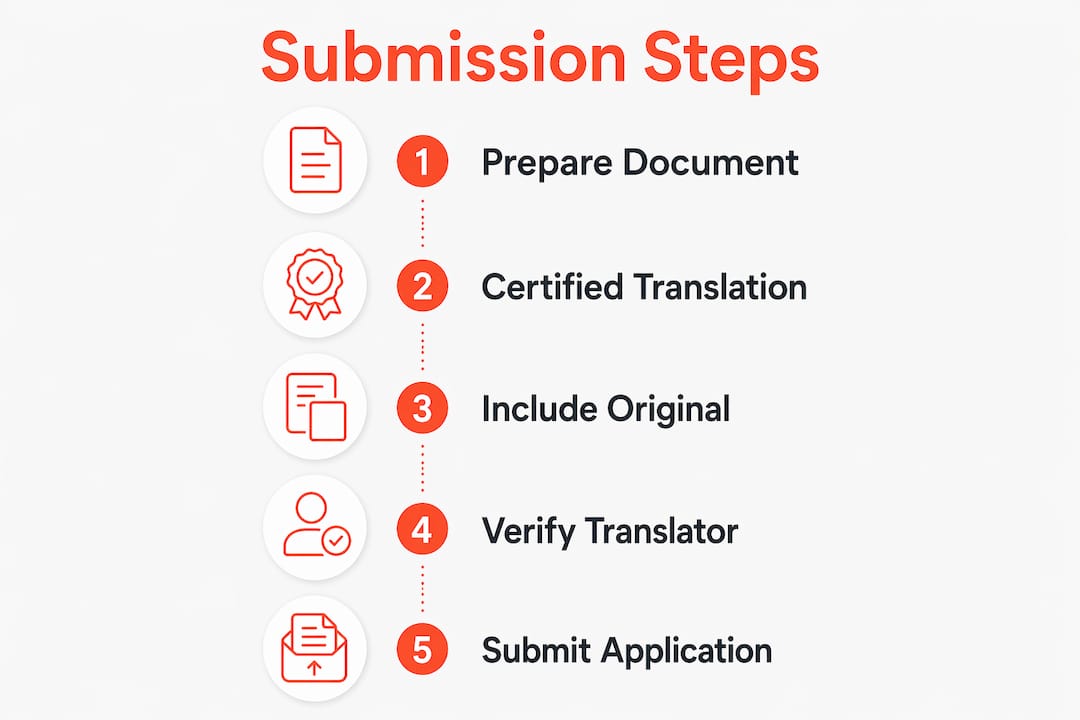
The process of obtaining a valid translated membership certificate follows a clear sequence. Skipping any step risks rejection.
- Request your original certificate. Contact your professional body directly. Ask for an official copy on letterhead, with the body’s seal or stamp. Some bodies issue digital certificates; confirm whether the receiving Australian agency accepts these.
- Confirm what the receiving body requires. Check the specific submission guidelines for the agency you are applying to, whether that is the Department of Home Affairs, CPA Australia, or a state licensing board. Requirements vary slightly between bodies.
- Select a NAATI-certified translator. Use the NAATI online directory to find a translator certified in your language pair. Review their credential level and confirm they have experience with professional membership documents. Guidance on choosing the right translator can save you significant time at this stage.
- Provide the translator with the original document. Do not send a low-resolution scan. A clear, complete copy of the original is required for an accurate translation.
- Review the completed translation before submission. Check that the CPN appears on the document, that the language direction is correct, and that the accuracy statement is signed or digitally stamped.
- Submit the full package. Include the original or certified copy alongside the translation. Keep copies of everything you submit.
The importance of professional memberships in this process cannot be overstated. Membership in a recognised body, such as the Chartered Institute of Management Accountants or the Australian Medical Association, signals a verified level of professional standing. A translated certificate carries that signal across language barriers. Agencies and employers treat it as direct evidence of your qualifications.
Key takeaways
A translated professional membership certificate is only valid in Australia when produced by a NAATI-certified translator and submitted alongside the original document or a certified copy.
| Point | Details |
|---|---|
| Definition of the document | A certified translation of your professional body credentials, verified by a NAATI-accredited translator for official use. |
| NAATI certification is mandatory | Australian authorities reject translations without a valid CPN, accuracy statement, and NAATI credential. |
| Submit a complete package | Always include the original certificate or certified copy with the translation; the translation alone causes rejection. |
| Verify the translator’s CPN | Search the NAATI online directory before accepting any translation to confirm the translator’s active status. |
| Digital stamps are now standard | NAATI’s encrypted QR code system allows real-time verification and is accepted by most Australian agencies. |
What I have learned from watching applications fail
Working with professional credential applications over many years, the pattern I see most often is not fraud or incompetence. It is overconfidence. Applicants assume that any bilingual person can produce a valid translation, or that a translation produced overseas for one purpose will be accepted in Australia for another. Both assumptions are wrong.
The shift to NAATI digital stamps is the most significant change in this space in recent years. Digital verification reduces fraud risk and speeds up processing, but only when both the translator and the receiving agency use it correctly. I have seen applications delayed because a translator provided a physical stamp on a document submitted to an agency that expected a QR code. The fix was simple, but the delay was not.
The other mistake I see constantly is submitting the translation without the original. Applicants read the requirement for a “certified translation” and assume that is the whole requirement. It is not. The translation is one part of a three-part package. Miss any part, and the application goes back to the start.
My advice is straightforward. Treat your professional membership certificate translation the same way you would treat a legal contract. Verify every credential, keep every copy, and confirm the submission requirements in writing before you send anything.
— David
Certitranslate: professional membership certificate translations done right
Certitranslate works with a network of NAATI-certified translators who specialise in professional credential documents, including membership certificates, licence confirmations, and skills assessment materials.
Every translation produced through Certitranslate includes the required CPN, accuracy statement, and NAATI digital stamp, meeting the submission standards of the Department of Home Affairs, CPA Australia, and state licensing boards. If you want to understand the full scope of what certified translation covers, the complete guide to certified translation is a practical starting point. For professional licence applications specifically, the certified translation for licences page outlines exactly what Australian bodies require and how Certitranslate meets those standards.
Preguntas frecuentes
¿Qué es un certificado de afiliación profesional traducido?
A translated professional membership certificate is a certified document that converts your professional body credentials into another language, verified by a NAATI-accredited translator for acceptance by Australian authorities and employers.
Does the translation need to come from a NAATI-certified translator?
Yes. Australian authorities require that all translations of non-English documents be produced by a NAATI-certified translator, including a signed accuracy statement and a valid Certified Practitioner Number.
What happens if I submit a translation without the original certificate?
Submitting the translation alone causes automatic rejection by assessing bodies such as CPA Australia and the Department of Home Affairs, because they cannot verify the source document.
How do I verify that my translator is NAATI-certified?
Search the translator’s Certified Practitioner Number in the NAATI online directory. If the number does not appear or the translator refuses to provide it, the translation is invalid for official use.
Are digital stamps accepted by Australian agencies?
Yes. NAATI’s digital stamp system uses encrypted QR codes and multi-factor authentication, and is accepted by most Australian government agencies and professional assessing bodies as a secure alternative to physical signatures.