


Certified translation of import/export agreements is the process of producing a legally recognised, accurate translation of trade documents, accompanied by a signed statement from a qualified translator attesting to its completeness and accuracy. Businesses that skip this step risk customs delays, rejected contracts, and unenforceable clauses across borders. Standards like ISO 17100 and NAATI accreditation set the benchmark for quality in this field. Providers such as Certitranslate, Globibo, and LingvoHouse operate within these frameworks to deliver translations that hold up under regulatory scrutiny. Getting this right from the start protects your trade relationships and your legal position.
What documents require certified translation in import/export agreements?
The range of documents that need certified translation in import/export processes is broader than most businesses expect. Customs authorities, courts, and regulatory bodies each have their own requirements, and a missing or poorly translated document can halt a shipment or void a contract.
The most commonly required documents include:
- Commercial contracts and supplier agreements: These form the legal backbone of any trade relationship. Certified legal translators preserve the enforceability of contract clauses by ensuring functional equivalence, including jurisdiction-specific terms like “force majeure.”
- Customs declarations and import/export permits: Authorities require these to be translated with full accuracy. Any discrepancy between the original and the translation can trigger a compliance review.
- Certificates of origin: These confirm where goods were manufactured and directly affect tariff classifications.
- Commercial invoices: Customs officers use these to assess duties. An inaccurate translation can result in incorrect duty calculations.
- Phytosanitary and health certificates: Required for food, agricultural, and pharmaceutical goods crossing borders.
Regulatory demands vary significantly by country. HMRC in the UK requires a true and accurate translation that includes the translator’s full credentials, the date, and a signed accuracy statement on official letterhead. Germany goes further, mandating sworn translations (“vereidigter Übersetzer”) for documents used in legal disputes. Australia’s Department of Home Affairs and the Australian Border Force expect NAATI-certified translations for official submissions.
The consequences of getting this wrong are serious. Improperly translated documents can result in customs clearance failures, contract disputes, and financial penalties. A translation without the required certification statement is treated as no translation at all by most authorities.

How to choose a qualified vendor for certified trade document translation
Choosing the right translation vendor for import/export documentation is a compliance decision, not just a procurement one. The wrong choice can invalidate legal documents and expose your business to data breaches and regulatory penalties.
Follow these steps when evaluating vendors:
- Verify ISO 17100 and ISO 9001 certifications. Vendors should be audited annually to confirm active certifications, including the issuing registrar, scope, and expiry date. Collect these certificates within 30 days of contract start to maintain audit readiness.
- Check translator credentials and domain expertise. Legal translation professionals should be assigned based on the document type and the jurisdiction involved. A translator experienced in pharmaceutical imports is not automatically qualified to handle financial trade agreements.
- Assess data protection compliance. Trade documents often contain commercially sensitive information. Confirm the vendor operates under a documented data security policy and complies with applicable privacy laws.
- Review quality assurance processes. Ask specifically whether the vendor’s QA workflow aligns with ISO 18587 for post-editing quality assurance. This standard applies when machine translation is used as a first pass, which is increasingly common.
- Evaluate terminology management. The best vendors maintain client-approved terminology databases. This matters when you have ongoing trade relationships with consistent product names, legal terms, and regulatory language.
Pro Tip: Consolidating your translation work with a single ISO-certified vendor builds reusable translation memory assets, reduces audit complexity, and lowers costs over time. Fragmented vendor lists in regulated sectors multiply your security risk.
Choosing the right certified translator for your specific document type and jurisdiction is the single most important decision in this process. Do not treat it as an afterthought.
Step-by-step process to get certified translations for trade agreements
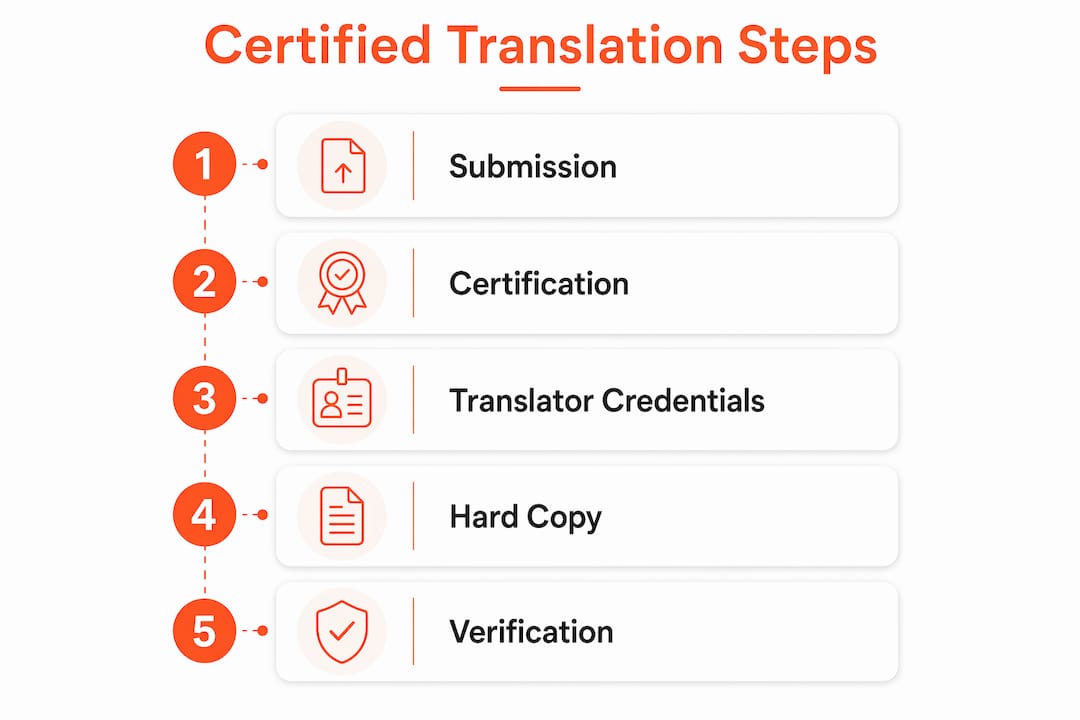
Getting a certified translation for an import/export agreement follows a defined workflow. Each step matters for the final document to be accepted by customs, courts, or regulatory bodies.
- Prepare your source documents. Gather clean, complete copies of all documents requiring translation. Blurry scans or incomplete pages cause delays and errors. Include any reference glossaries or previously approved translations if available.
- Submit to a qualified translator. Send documents to a translator with verified credentials in the relevant language pair and subject area. For Australian businesses, this means a NAATI-certified translator with experience in trade or legal documentation.
- Translation and review. The translator produces the target-language version. A second qualified linguist reviews it for accuracy, terminology consistency, and formatting. This two-step process is required under ISO 17100.
- Certification statement issuance. The translator attaches a signed statement confirming the translation is complete and accurate to the best of their knowledge. This statement must include the translator’s name, qualifications, contact details, and the date.
- Formatting and packaging. The final document must mirror the layout of the original where required. Some authorities, including customs bodies, expect the translation to be bound with a copy of the source document.
- Delivery. Most reputable providers offer both digital and hard copy delivery. Digital copies with electronic signatures are accepted by many authorities, but some jurisdictions still require wet signatures on physical documents. Confirm requirements with the receiving authority before ordering.
The table below compares certification requirements across three common submission contexts:
| Submission context | Certification statement required | Translator credentials needed | Hard copy required |
|---|---|---|---|
| Australian customs (ABF) | Yes | NAATI-certified | Often accepted digitally |
| UK customs (HMRC) | Yes, on letterhead | Qualified translator with full details | Depends on document type |
| German legal proceedings | Yes, sworn translation | Vereidigter Übersetzer | Yes, in most cases |
Pro Tip: Always confirm the specific formatting requirements with the receiving authority before submitting. ISO 17100 certifies workflow quality but does not guarantee acceptance by bodies like USCIS or customs without the correct certification statement and formatting.
Common pitfalls in certified translation of import/export agreements
Errors in certified translation for trade agreements are more common than businesses realise, and the consequences range from shipment delays to voided contracts. Knowing where things go wrong helps you avoid them.
The most frequent mistakes include:
- Using uncertified or underqualified translators. A bilingual employee or a general translation tool does not produce a certified translation. The document will be rejected by any authority that checks credentials.
- Missing certification elements. A translation without the translator’s signed statement, credentials, or date is not a certified translation. Customs authorities treat it as an uncertified document regardless of translation quality.
- Inconsistent terminology across documents. When multiple vendors handle different documents in the same shipment, terminology inconsistencies appear. “Force majeure” in one document and “act of God” in another can create ambiguity in a dispute.
- Ignoring jurisdiction-specific requirements. A translation that meets Australian standards may not meet German or US requirements. Multi-jurisdictional trade requires jurisdiction-specific review for each destination.
- No audit trail or record retention. Regulatory bodies can request documentation years after a transaction. Without records of who translated what and when, you cannot demonstrate compliance.
Procurement insiders require collection of ISO certificates and linguist credentials within 30 days of contract start to ensure compliance audit readiness.
Ongoing vendor audits and compliance checks are not optional in regulated trade sectors. Annual verification of vendor certifications, scope, and expiry dates protects you from inheriting a compliance gap when a vendor’s accreditation lapses.
Pro Tip: Maintain a client-owned terminology database and request audit trail documentation from your vendor after every project. This gives you a defensible record if a translation is ever challenged.
Key takeaways
Certified translation for import/export agreements requires qualified translators, jurisdiction-specific certification statements, and documented quality assurance processes to be legally valid and accepted by authorities.
| Point | Details |
|---|---|
| Certification statements are mandatory | Every certified translation must include the translator’s signed statement, credentials, and date to be accepted. |
| Vendor credentials must be verified annually | Confirm ISO 17100 and ISO 9001 certifications, scope, and expiry dates before onboarding or renewing a vendor. |
| Jurisdiction requirements differ | Australian, UK, and German authorities each have distinct formatting and credential requirements for certified translations. |
| Consolidate vendors where possible | A single ISO-certified vendor builds terminology consistency, reduces audit complexity, and lowers long-term costs. |
| Audit trails protect your business | Retain records of translator credentials, certification statements, and QA sign-offs for every trade document translated. |
Why certified translation is worth treating as a core compliance function
I have reviewed enough failed trade transactions to say this plainly: the businesses that treat certified translation as a box-ticking exercise are the ones that end up in disputes. A contract clause that reads clearly in English can mean something entirely different when translated without legal domain knowledge. I have seen “best efforts” obligations rendered in ways that created binding performance standards the exporting party never intended to accept.
The standard advice is to find an ISO 17100 certified provider and move on. That is necessary but not sufficient. ISO 17100 certifies a workflow, not a legal outcome. The translator still needs jurisdiction-specific knowledge, and the document still needs the right certification statement for the receiving authority. These are separate requirements that a quality standard alone cannot satisfy.
What I recommend to any business with regular import/export activity is to treat certified translation as part of your compliance function, not your procurement function. That means assigning accountability, setting document standards, and auditing your vendor the same way you would audit any other compliance-critical supplier. The cost of getting it right is modest. The cost of getting it wrong, in delayed shipments, voided contracts, or regulatory penalties, is not.
— David
How Certitranslate supports your import/export translation needs
Certitranslate provides certified translation services for businesses handling import/export documentation across Australia and internationally. Every translation is completed by a NAATI-certified translator with subject-matter expertise in legal and trade documents, including commercial contracts, customs declarations, certificates of origin, and supplier agreements.
Certitranslate’s quality management process meets the standards required for submission to Australian customs, courts, and regulatory bodies. Turnaround is fast, and each translation includes the signed certification statement and translator credentials needed for official acceptance. If your business needs document translation for trade agreements or import/export permits, Certitranslate is ready to help. Contact the team today to discuss your requirements.
Preguntas frecuentes
What is a certified translation for import/export agreements?
A certified translation is a translated document accompanied by a signed statement from a qualified translator confirming its accuracy and completeness. For import/export agreements, it is required by customs authorities, courts, and regulatory bodies to accept the document as legally valid.
Which documents need certified translation for international trade?
Commercial contracts, customs declarations, certificates of origin, commercial invoices, and import/export permits commonly require certified translation. Requirements vary by country and the authority receiving the document.
Does ISO 17100 certification guarantee my translation will be accepted?
No. ISO 17100 certifies translation workflow quality but does not guarantee acceptance by specific authorities. Each jurisdiction requires its own certification statement format and translator credentials.
How much does certified translation of trade documents cost?
Pricing for certified translation of routine import/export documents starts at around $39.00 per page in 2026, varying by language pair and document complexity.
How do I verify a translation vendor’s credentials?
Request copies of the vendor’s ISO 17100 and ISO 9001 certificates, confirm the issuing registrar and expiry date, and collect individual translator credentials. Annual vendor audits are the standard practice for maintaining compliance in regulated industries.
Recommended
- Certified translation of a power of attorney: 2026 guide – CertiTranslate – Translations by NAATI Certified Translators
- United States – CertiTranslate – Translations by NAATI Certified Translators
- How to Choose the Right Certified Translator for Your Needs – CertiTranslate – Translations by NAATI Certified Translators
- Certified Translations – CertiTranslate – Translations by NAATI Certified Translators