


The immigration document translation process is the submission of a certified, accurate English translation alongside a signed statement of translator competence for every foreign-language document required by immigration authorities. Whether you are applying for a visa, permanent residency, or citizenship, this requirement is non-negotiable. Authorities like USCIS (United States Citizenship and Immigration Services) and EOIR (Executive Office for Immigration Review) each specify exactly what a compliant translation package must contain. Getting this wrong does not just slow your application. It can get it rejected outright.
What are the official requirements for translating immigration documents?
The rules governing legal document translation for immigration are more specific than most applicants expect. Under 8 CFR 103.2(b)(3), USCIS requires that every non-English document submitted with an immigration application be accompanied by a complete English translation and a signed certification. That certification must state that the translation is complete and accurate, and that the translator is competent to translate between the relevant languages.
EOIR takes a slightly different approach. It requires a typed, signed certificate physically attached to the foreign-language document. This certificate must specify the translator’s competence, confirm accuracy, and include the translator’s contact details. EOIR even provides a sample certificate format in Appendix F of its Policy Manual.

The critical difference between the two authorities comes down to format and attachment. USCIS focuses on the content of the certification statement. EOIR is more prescriptive about how the certificate is presented and attached. Knowing which authority you are filing with before you order translations is not optional. It determines the format your translator must follow.
Key certification requirements at a glance:
- USCIS: signed statement confirming completeness, accuracy, and translator competency
- EOIR: typed, signed certificate attached to the original document, including contact details
- Neither authority accepts notarisation or a government stamp as a substitute for a proper translator certification
- The certification content is what matters legally, not a seal or signature alone
Pro Tip: Identify your filing forum before ordering any translation. A USCIS-format certificate will not satisfy EOIR requirements, and vice versa. Ask your translator to confirm which format they are providing.
How to prepare your immigration documents for translation
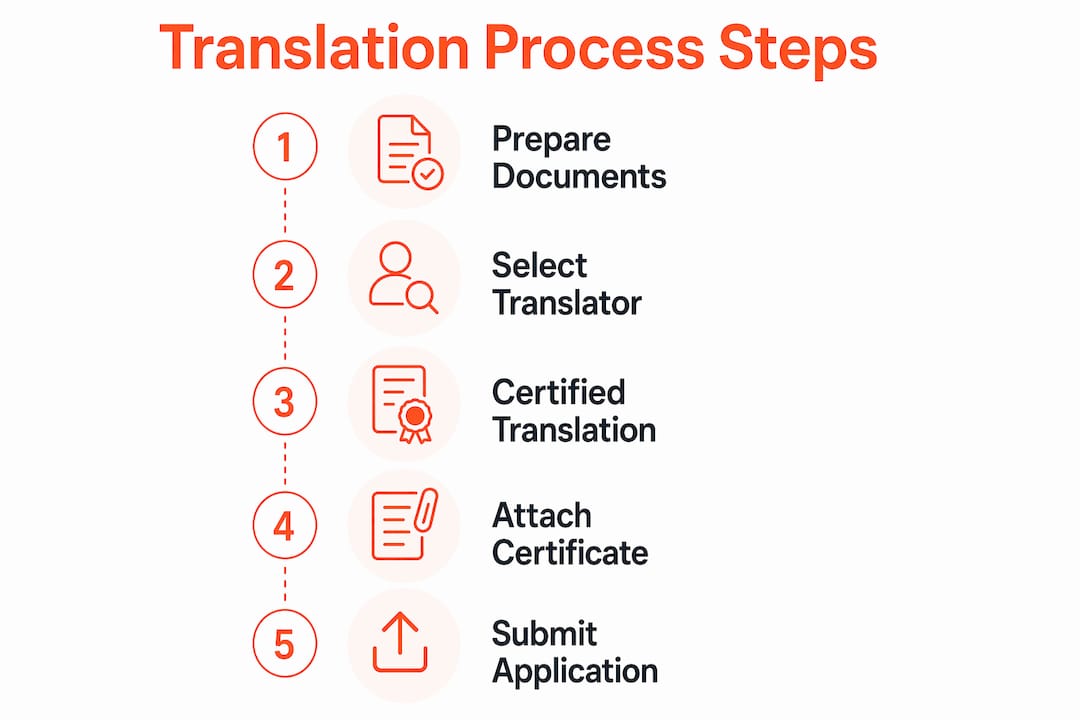
Preparation is where most applicants lose time. Handing a translator a blurry scan of a single page when the original document has stamps, marginal notes, and a back page is one of the most common reasons translations get rejected or returned for revision.
Follow these steps to prepare your documents properly:
-
Gather every page of every document. This includes the back of pages, cover sheets, and any attached annexures. A birth certificate with a stamp on the reverse must be scanned front and back.
-
Scan at high resolution. Aim for at least 300 DPI. Blurry scans produce ambiguous translations. If a translator cannot read a stamp clearly, they cannot translate it accurately.
-
Flag all non-English elements. Stamps, seals, marginal notes, and handwritten annotations all count as foreign-language content. Every visible element must be translated to meet completeness requirements. Omitting a single stamp can make an otherwise perfect translation non-compliant.
-
Provide clear written instructions. Tell your translator the purpose of the translation, the authority it is being submitted to, and the certification format required. Do not assume they will guess.
-
Request a draft review before final delivery. Ask to see the translation before the certificate is signed and attached. Catching errors at draft stage costs nothing. Catching them after submission costs weeks.
Pro Tip: Keep a master folder with three items for each document: the original, the certified translation, and the signed certificate. Immigration officers review these as a set. Having them organised together speeds up the review process significantly.
Certified vs non-certified translators: why does it matter?
Certified translation means a signed statement from the translator confirming completeness, accuracy, and competence. It is not a government licence, and it is not notarisation. Any translator can technically sign such a statement, which is exactly why choosing the right one matters so much.
In Australia, the recognised standard for immigration translation is NAATI certification. NAATI (National Accreditation Authority for Translators and Interpreters) tests and accredits translators to a defined professional standard. When you use a NAATI certified translator, you are using someone who has demonstrated competence through a formal assessment process, not just someone who is bilingual.
Certified vs non-certified: a direct comparison
| Factor | NAATI certified translator | Non-certified translator |
|---|---|---|
| Accepted by Australian authorities | Yes | Not guaranteed |
| Meets USCIS/EOIR competency standard | Yes, with correct certificate | Risky without verified credentials |
| Provides compliant certification statement | Yes | May not know the required format |
| Accountability if errors occur | Professional and regulatory | Limited |
| Recommended for visa applications | Always | Never |
Why this matters in practice: immigration authorities do not verify translator credentials at the time of submission. They verify compliance when reviewing the file. If a non-certified translator’s statement is later found to be deficient, your application can be delayed or rejected at a critical stage.
Pro Tip: Ask any translator you are considering to show you a sample certification statement before you engage them. If they cannot produce one that matches USCIS or EOIR requirements, move on.
What are the most common mistakes in immigration translation?
The most frequent cause of translation-related delays is not poor language quality. It is non-compliance with certification and completeness requirements. These are the errors that appear most often:
-
Using an uncertified translator. A bilingual friend or a generic online translation service cannot provide the signed competency certification that USCIS and EOIR require. The translation may be linguistically perfect and still be rejected.
-
Omitting stamps, seals, or marginal notes. Completeness typically fails when translators treat stamps and annotations as decorative rather than evidentiary. Every mark on a document is part of the record.
-
Failing to attach the certificate correctly. EOIR requires the certificate to be physically attached to the foreign-language document. A certificate submitted as a separate loose page does not meet this requirement.
-
Reusing a single certificate for multiple documents without listing them. EOIR rules require that a certificate used to cover multiple documents must explicitly list every document it covers. A generic certificate creates evidentiary confusion at hearings and can result in non-compliance findings.
-
Rushing translation close to filing deadlines. Translation is part of evidence assembly and should not be treated as a last-minute task. Turnaround delays on obtaining signed certificates are common. Build at least two weeks into your timeline for each document set.
-
Confusing notarisation with certification. A notary confirms identity. A translator’s certification confirms accuracy and competence. These are different things. Submitting a notarised translation without a proper translator certification does not satisfy USCIS or EOIR requirements.
Key takeaways
The immigration document translation process requires a complete, accurate English translation paired with a signed translator certification that explicitly confirms competence, accuracy, and completeness for every non-English document submitted.
| Point | Details |
|---|---|
| Certification content is what counts | The signed statement must confirm completeness, accuracy, and translator competency. |
| USCIS and EOIR have different formats | Identify your filing authority before ordering translations to get the right certificate format. |
| Every document element must be translated | Stamps, seals, and marginal notes are part of the translation, not optional extras. |
| NAATI certification is the Australian standard | Use a NAATI certified translator to meet competency requirements for visa applications. |
| Plan translation early | Build at least two weeks into your timeline to avoid last-minute certificate delays. |
What I have learned from watching applications go wrong
I have reviewed enough immigration translation packages to know where things fall apart. It is almost never the translation itself. It is the certificate.
Applicants spend weeks gathering documents and months preparing their case, then hand the translation job to whoever is cheapest or fastest. The translator delivers a linguistically accurate document with a certificate that is missing a contact detail, or that covers three documents without naming any of them. The application stalls. The family waits longer.
The insight that changed how I think about this process is treating translation as evidence assembly, not a clerical task. Every page, every stamp, every annotation is part of the evidentiary record. When you approach it that way, you stop looking for shortcuts.
The other thing I would tell anyone going through this: do not assume your translator knows which authority you are filing with. USCIS and EOIR have genuinely different requirements, and a translator who works primarily with Australian immigration authorities may not default to the right format for a US filing. You need to tell them. Spell it out in writing. Ask for confirmation before they finalise anything.
The applicants who get through this process without delays are the ones who choose their translator carefully, communicate clearly, and start early. That is not complicated advice. But it is the advice that actually works.
— David
How Certitranslate can handle your immigration translation
Certitranslate works with NAATI certified translators who specialise in immigration documents, from birth certificates and marriage records to police clearances and academic transcripts. Every translation comes with a signed certification statement that meets the requirements of Australian immigration authorities and, where needed, USCIS and EOIR standards.
If you are preparing a visa application, citizenship filing, or any legal immigration submission, Certitranslate’s certified translation services cover the full document set, including stamps, seals, and annotations. Fast turnaround is standard, not an upgrade. You can also explore Certitranslate’s document translation services for a full breakdown of what is included with each package. Submit your documents with confidence, knowing the certification is correct the first time.
Preguntas frecuentes
What does certified translation mean for immigration?
Certified translation means a signed statement from the translator confirming the translation is complete, accurate, and produced by someone competent in both languages. It is not notarisation and does not require a government licence.
Does USCIS accept translations from any translator?
USCIS accepts translations from any competent translator, but the translator must sign a certification confirming their competence, the accuracy of the translation, and its completeness. Using an uncertified or unqualified translator creates compliance risk if the certification is later found deficient.
What is NAATI certification and why does it matter?
NAATI (National Accreditation Authority for Translators and Interpreters) is the Australian standard for professional translator accreditation. NAATI certified translators have passed formal competency assessments, making them the most reliable choice for immigration document translation in Australia.
Do I need to translate stamps and seals on my documents?
Yes. Every visible foreign-language element on a document must be translated, including stamps, seals, marginal notes, and handwritten annotations. Omitting these elements makes a translation incomplete and non-compliant with USCIS and EOIR requirements.
Can one certificate cover multiple immigration documents?
A single certificate can cover multiple documents, but EOIR rules require that the certificate explicitly list every document it covers. A generic certificate that does not name the specific documents it applies to can cause non-compliance findings during review.